






The world is full of little details, surprising connections, and interesting pieces of information that somehow rarely make it into everyday conversation. And so, it can be satisfying to learn a fact you never knew you needed to know, and the next thing, you just want to immediately tell someone else about it.
That’s exactly what makes pages dedicated to interesting facts so easy to get lost in. The Instagram page interestingasfacts, which has around 1.4 million followers, has built an audience around sharing the kind of bite-sized information that makes people pause mid-scroll. From surprising discoveries and unusual details to facts about history, science, animals, and everyday life, its posts offer plenty of reasons to keep scrolling.
Here are some of the most fascinating examples, so prepare to leave this list knowing a little more than you did before.
#41
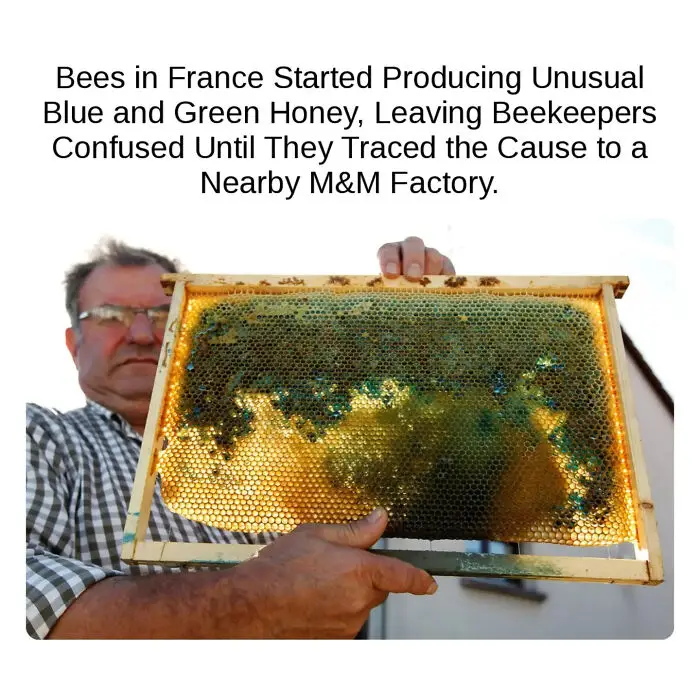
In 2012, beekeepers in northeastern France were shocked to discover that their bees were producing honey in unusual shades of blue and green instead of the familiar golden color. The strange discovery puzzled local honey producers, who initially struggled to understand why their hives were suddenly yielding such unusually colored honey.
After investigating the mystery, they traced the unusual colors to a nearby biogas plant that processed waste from an M&M’s candy factory. Bees had apparently found their way to sugary residue from the candy production process and were collecting it as an alternative food source to flower nectar.
The blue and green colors came from the artificial food dyes used in the colorful candy shells. As the bees collected the sugary material and brought it back to their hives, the pigments affected the appearance of the honey. The incident demonstrated how bees can sometimes exploit unexpected food sources when they are available nearby.
The discovery raised concerns among beekeepers because honey contaminated by industrial food waste could be difficult to sell as a natural product. In response, the facilities involved took steps to prevent bees from accessing the sugary waste. The unusual honey became a memorable example of how human activities can unexpectedly influence wildlife and the products that nature provides.
Report
3points





#47

Blue stripes appear when water freezes with very few air bubbles, allowing light to penetrate the dense ice and creating a deep blue color. These layers can form when liquid water fills cracks or spaces in existing ice and then freezes.
Green stripes can develop when seawater containing organic material becomes trapped and freezes into the iceberg. Brown or yellowish bands may form when sediment, rock particles, and minerals become incorporated into the ice.
Green stripes can develop when seawater containing organic material becomes trapped and freezes into the iceberg. Brown or yellowish bands may form when sediment, rock particles, and minerals become incorporated into the ice.
Report
3points
#49
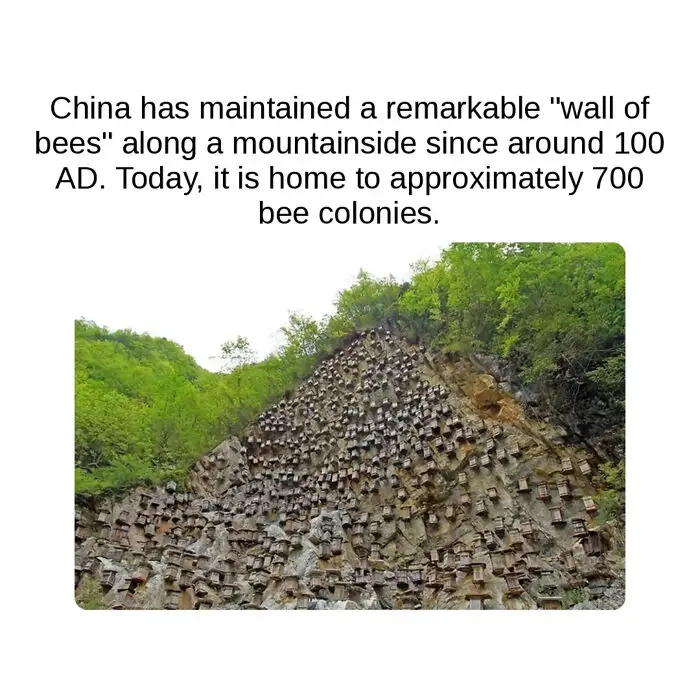
High in the mountains of China's Shennongjia Nature Reserve, hundreds of wooden beehives cling to an almost vertical cliff face. Known as the "Wall of Hives," this extraordinary arrangement is designed to protect native honey bees while creating one of the most unusual beekeeping sites in the world.
China has a long history of beekeeping, but native bee populations face growing threats from habitat loss, disease, and competition from introduced species. One of the most important native species is the Chinese honey bee, Apis cerana cerana, which plays a vital role in pollinating wild plants and crops. However, claims that more than 80 percent of China's native bees have disappeared, or that European honey bees alone caused the decline, should be treated with caution.
Maintaining the cliffside hives requires remarkable skill and courage. Beekeepers climb using lower hives as footholds, while the highest boxes may require ropes to reach. The steep location also helps keep the colonies and their honey out of reach of bears and other hungry animals.
The surrounding Shennongjia region is renowned for its rich biodiversity, with a wide variety of plant species growing across different elevations and climate zones. The unusual hives have also attracted visitors fascinated by this remarkable combination of traditional beekeeping, human ingenuity, and wildlife conservation.
Report
3points



#54
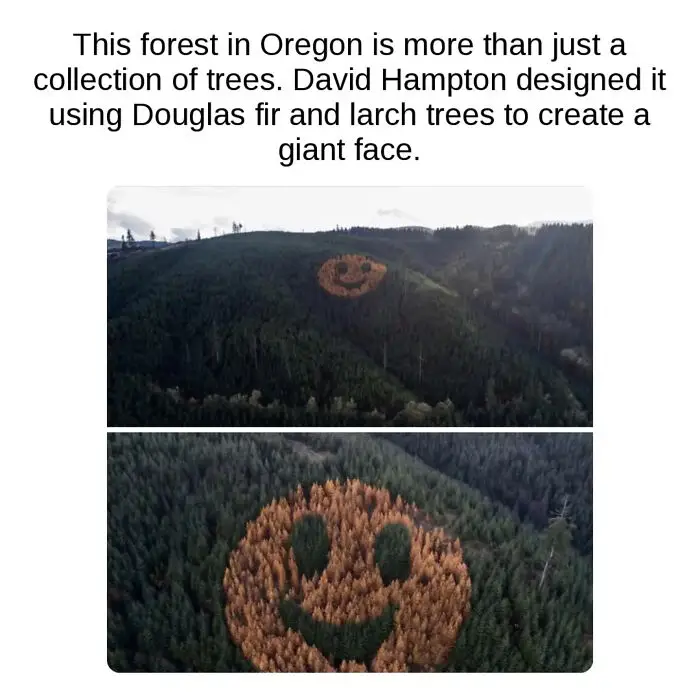
Every autumn, a giant smiley face appears in a forest as the larch trees turn a brilliant shade of orange. Measuring approximately 300 feet in diameter, this remarkable woodland design becomes especially visible when the surrounding trees change color.
The face was carefully created using two different tree species. Rope was used to measure the circle, while Douglas fir trees were planted to form the eyes and mouth. Larch trees filled in the rest of the face, creating a striking contrast between the different shades of green and orange.
The design relies on the natural growth and seasonal changes of the trees rather than paint or artificial decorations. As autumn arrives, the larch trees change color, making the cheerful expression stand out against the surrounding forest.
Although both species are eventually intended to be harvested, the forest smiley face is expected to remain visible for at least another 30 to 50 years. It is a wonderful example of how thoughtful forestry can combine nature, creativity, and a little happiness into one unforgettable landscape.
Report
2points





#60

The Cashew of Pirangi, located in Rio Grande do Norte, Brazil, is famous for being the largest cashew tree in the world. This extraordinary tree covers an area estimated at between 7,300 and 8,400 square meters, making it comparable in size to around 70 ordinary cashew trees. With a circumference of approximately 500 meters, it is a remarkable natural attraction that draws visitors from around the world.
Unlike most trees that grow upward from a single trunk, the Cashew of Pirangi spreads outward across the ground. Its branches bend downward under their own weight, and when they touch the soil, they can develop new roots. Over time, this unusual growth pattern allows the tree to expand across a vast area, creating the appearance of an entire forest formed by one tree.
The tree is believed to have been planted in the 1880s, although its extraordinary size and growth pattern have inspired claims that it could be much older. Some estimates suggest it may be more than a thousand years old, but this age has not been conclusively established. Its exact age therefore remains a subject of debate.
Today, the Cashew of Pirangi is one of Brazil’s most fascinating botanical landmarks. Its enormous canopy provides shade for visitors, while its unusual network of branches demonstrates how plants can adapt and grow in unexpected ways. The tree is a striking example of nature’s ability to create something that seems almost impossible, turning a single plant into a sprawling living wonder.
Report
2points
