



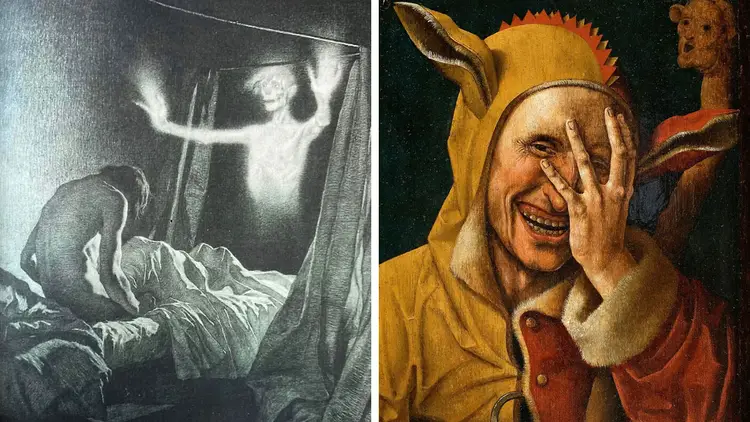


If you love art that’s atmospheric, emotional, and a little mysterious, 'Dark & Gloomy' is a page you’ll want to explore. Their Instagram feed is full of hauntingly beautiful pieces – from moody portraits to dramatic, almost dreamlike scenes – that grab your attention and linger in your mind long after you scroll.
The page celebrates art created across centuries that embraces the darker side of expression, showing how shadows, contrast, and emotion can tell stories just as powerful as any bright, colorful painting.
In this post, we’ve gathered some of the most striking pieces shared by this community, so scroll down to explore them and get lost in the beauty of the shadows.
#41 Human Frailty, Circa 1656, By Salvator Rosa
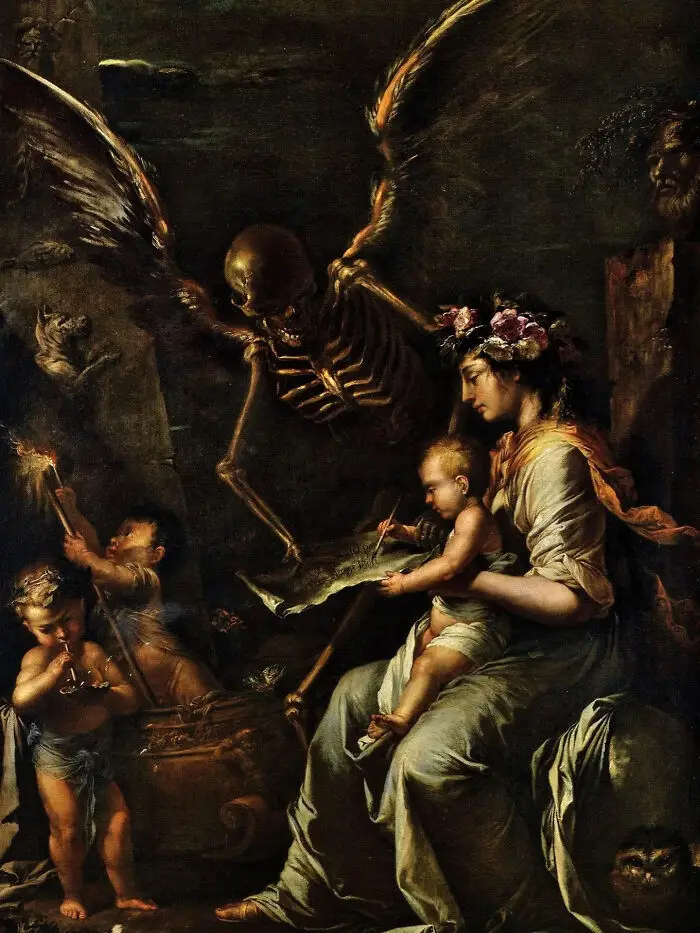
A dark meditation on mortality and fate, Human Frailty shows a mother guiding a child as he writes, while a looming winged skeleton — a symbol of Death — oversees the scene. The contrast between tender human life and the ominous figure behind them creates a powerful tension, reminding the viewer of life’s fragility and the inevitability of time.
Rosa fills the composition with symbolic details — extinguished light, skulls, and shadowed surroundings — reinforcing the Baroque fascination with vanitas themes and the transience of earthly existence. The work blends drama, philosophy, and allegory, making it one of his most haunting reflections on the human condition.
Report
2points
#42 The Sorrows Of Ossian, Circa 1822, By Károly Kisfaludy
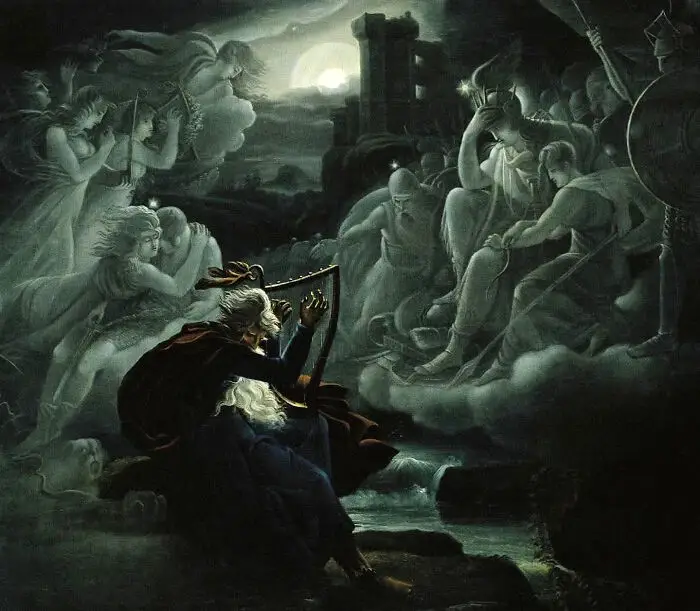
This work presents the legendary bard seated by a moonlit river, summoning spirits from the shadowed past. Draped in dark robes, Ossian bends over his harp as ghostly warriors and ethereal maidens emerge from mist and ruin around him. Bathed in a cold, silvery glow, the scene blends melancholy, memory, and myth, capturing the Romantic fascination with lost heroes and the haunting power of song.
Report
2points
#43 Mouse Town. Illustration By Theodor Kittelsen (1857 - 1914)
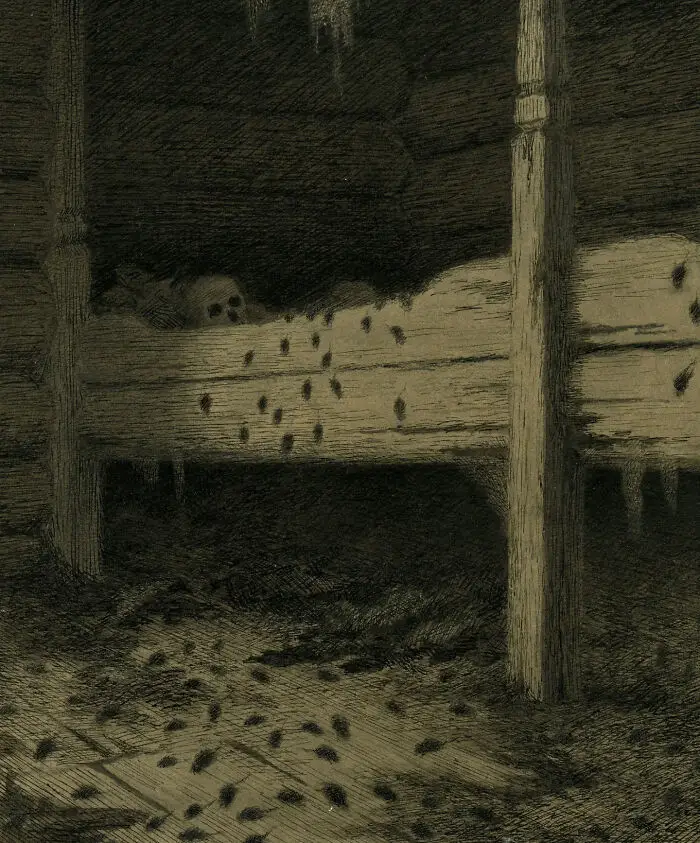
This illustration depicts a dark, oppressive room where a bed holds the skull of a deceased person. The scattered mice around the bed suggest they have been feeding on the remains, quietly inhabiting the space left behind by death. Drawn in muted tones and deep shadow, the scene feels claustrophobic and unsettling, transforming a simple interior into a grim vision of decay and silent horror.
Report
2points
#44 The Palace Of The Spirits By Romolo Tessari (1868–1925)
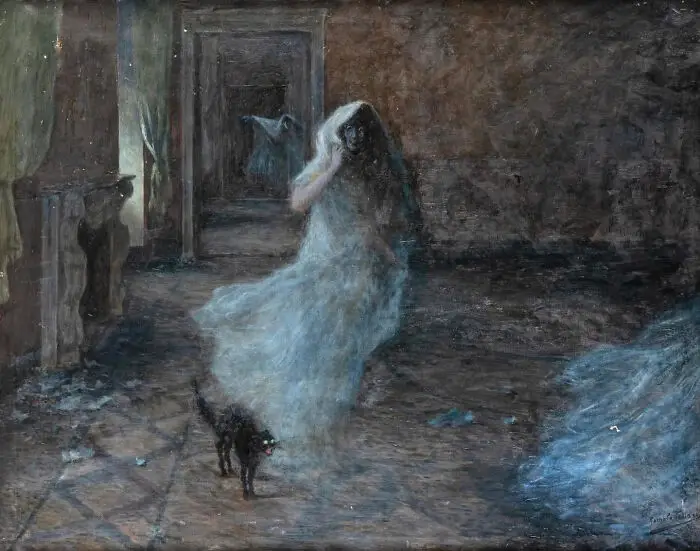
In this haunting meditation on decay and the supernatural, Tessari evokes the spectral poetry of an abandoned interior. A phantom like woman, draped in gauzy, diaphanous folds, glides soundlessly through the desolate hall, her form mirrored by distant apparitions dissolving into shadowed thresholds. A black cat, its eyes glinting with eerie luminescence, punctuates the scene with a note of living menace. Through his restrained palette and ethereal brushwork, Tessari transforms the derelict palace into a liminal realm where memory, melancholy, and the unseen converge.
Report
2points
#45 Paradise Lost, But His Fate, Circa 1940. Illustration By Charles Goeller
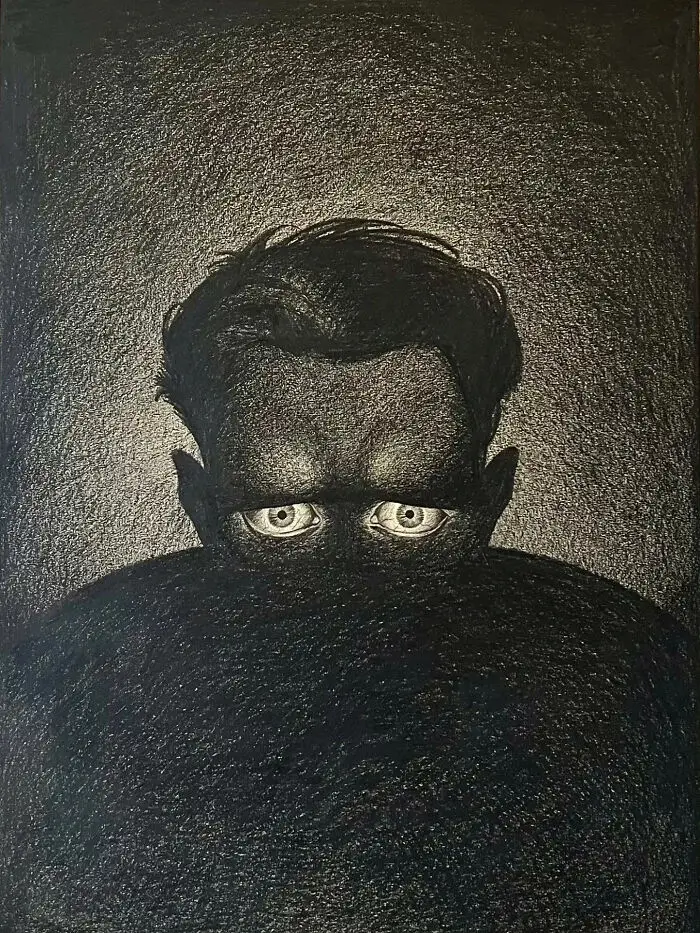
This striking drawing presents a solitary figure engulfed in shadow, his pale, unblinking eyes emerging from a void like darkness. Through intense chiaroscuro and refined tonal control, Goeller evokes a powerful sense of psychological unease and existential isolation, distilling mid-century anxieties into a stark, haunting vision.
Report
2points
#46 Contemplation, Circa 1912 By Maria Peter-Reininghaus
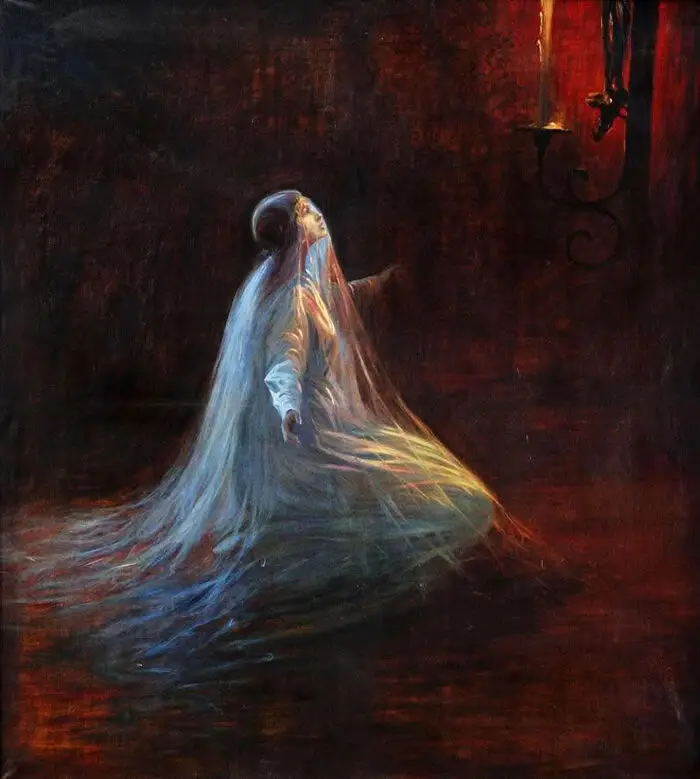
In this quietly luminous Symbolist work, a veiled female figure appears to crouch beneath a statue of Christ, her body turned upward in silent devotion. Soft, flowing brushwork and prismatic light dissolve her form into the surrounding darkness, heightening a sense of humility and inward reflection. The deep reds and cool blues create an atmosphere of spiritual stillness, suggesting a private moment of prayer and surrender before the sacred.
Report
2points
#47 Illustration For Mikhail Lermontov’s Poem "The Demon", Circa 1910. Illustrated By Alfred Eberling
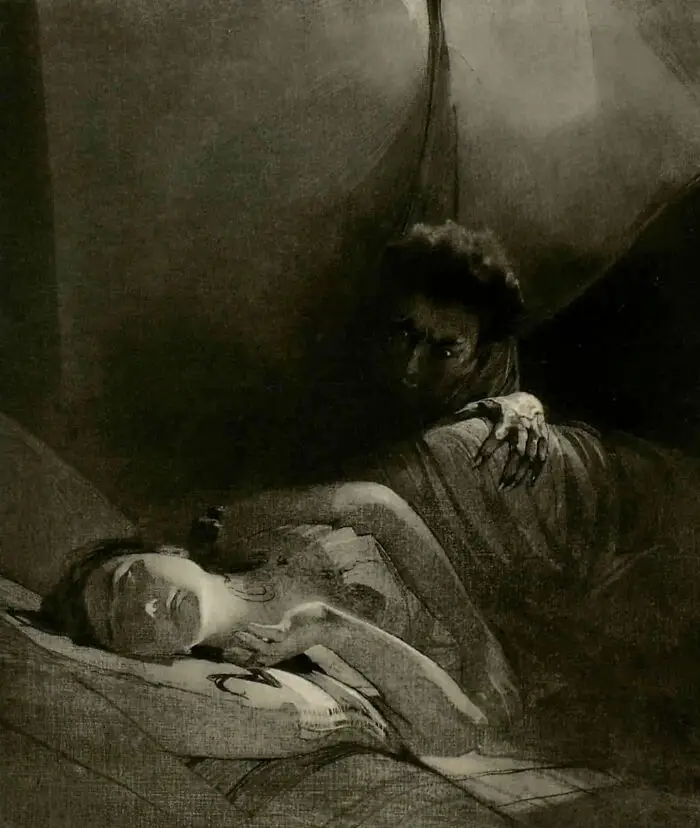
This haunting illustration shows the shadowy, winged figure of the "Demon" watching over a sleeping woman. The scene is rendered in muted tones and deep shadow, creating a mood of quiet menace and melancholy. Through his careful use of light and darkness, Eberling expresses the poem’s central themes of forbidden desire, spiritual conflict, and tragic temptation, giving the image an intimate yet deeply unsettling, dreamlike atmosphere.
Report
2points
#48 The Fool And Death, Circa 1924. Illustration By Fritz Silberbauer
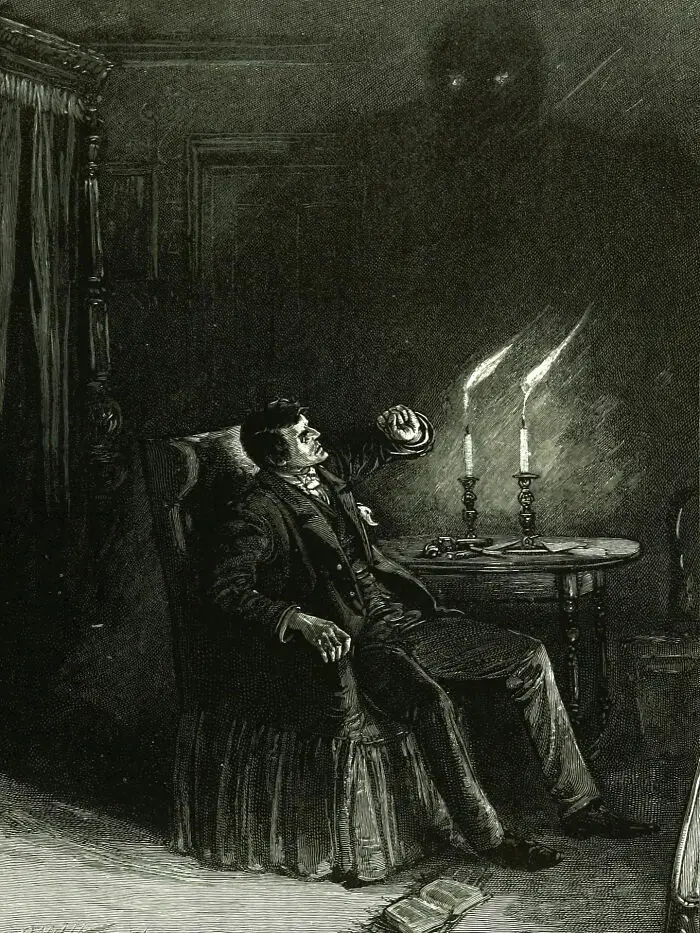
This work was made for Hugo von Hofmannsthal’s Der Tor und der Tod (The Fool and Death). It delicts a man confronted by the overwhelming presence of Death while seated inside a dark, enclosed room. Behind him, a gigantic shadow figure rises and fills the wall, its glowing eyes emerging from the darkness like a silent, inescapable force. Through dramatic light and shadow, Silberbauer turns Death into a vast, impersonal presence rather than a simple figure, transforming the interior into a scene of psychological reckoning. The flickering candles and scattered objects heighten the sense of a final awakening, when comfort and illusion give way to the unavoidable reality of mortality.
Report
2points
#49 Vale (Farewell) By Arthur Hacker (English, 1858–1919)
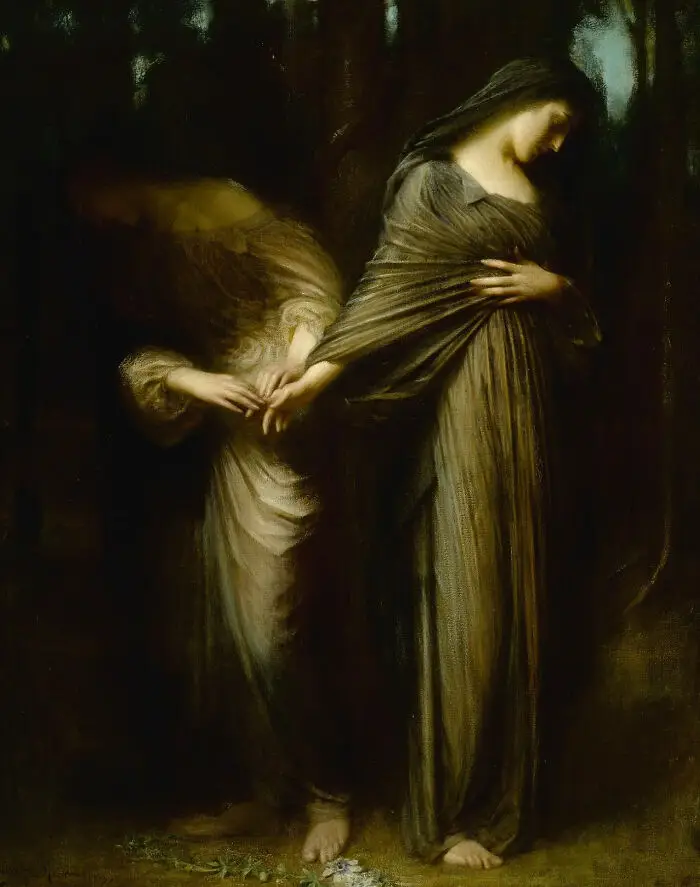
This painting presents a haunting, symbolist vision of parting and inner fracture. A solitary female figure appears doubled, her form dissolving into a ghostly echo that gently withdraws, suggesting the painful separation of self, memory, or love. Rendered in muted, shadowed tones and softened contours, the painting conveys an atmosphere of quiet sorrow and emotional suspension. Hacker’s subtle use of motion and blurred edges transforms the farewell into a psychological moment—intimate, dreamlike, and steeped in melancholy introspection.
Report
2points
#50 Destruction Of The Turkish Fleet In The Bay Of Chesme, Circa 1771 By Jacob Philipp Hackert (German, 1737–1807)
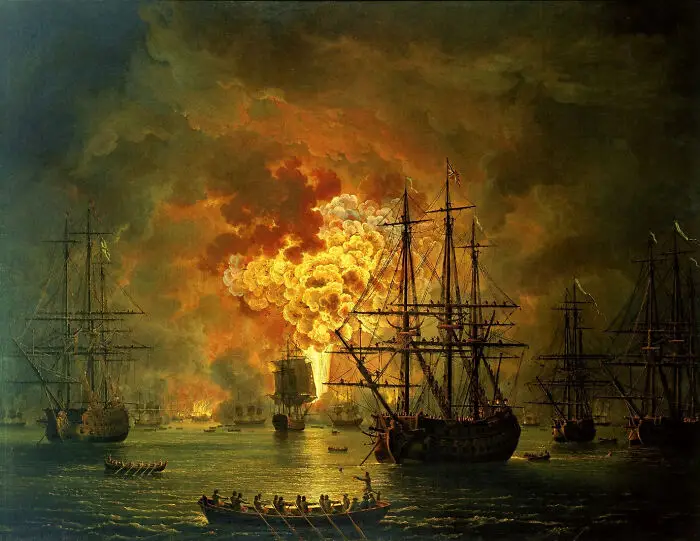
This dramatic painting depicts the catastrophic destruction of the Ottoman fleet during the Battle of Chesme in July 1770, a decisive naval victory for the Russian Empire in the Russo-Turkish War (1768–1774). Hackert captures the moment of chaos and annihilation as fire and explosions tear through the anchored Turkish ships, turning the night sky into a blazing inferno reflected on the water below. The towering plumes of smoke and flame, set against the dark silhouettes of warships and fleeing boats, convey both the scale of the disaster and the terrifying power of naval warfare in the age of sail. The scene stands as a vivid monument to one of the 18th century’s most decisive and destructive naval engagements.
Report
2points
#51 Birds Of Prey, Circa 1876 By Alexandre Struys
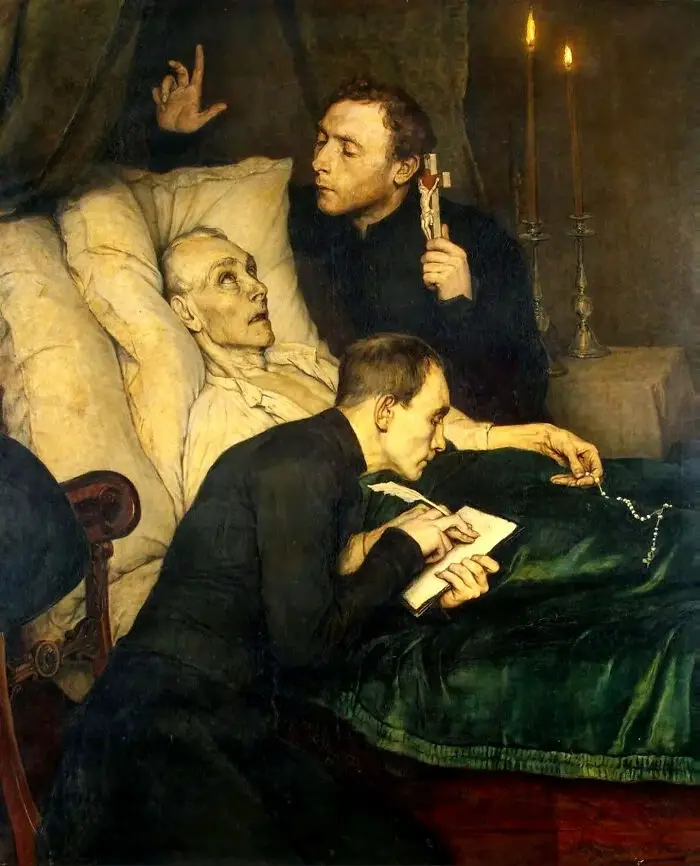
Alexandre Struys shows a quiet but deeply sad scene at a man’s death bed. A priest leans in closely in an attempt to keep the dying man’s attention fixed on salvation. The dying man looks upward with a desperate, almost pleading expression while holding a rosary in his left hand. Below, another man guides his weakened hand across a set of papers, likely a will, suggesting that worldly concerns are taking advantage of the moment. The tension between spiritual comfort and quiet greed gives real weight to the title "Birds of Prey", hinting at those who gather around the vulnerable when they have little power left.
Report
2points
#52 Oh, What’s That In The Hollow?, Circa 1895 By Edward Robert Hughes
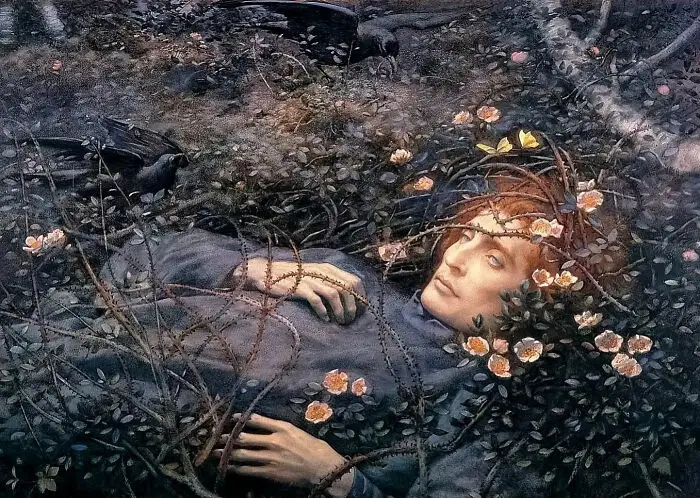
In this hauntingly poetic vision of decay and beauty entwined. A pale figure lies amidst withered brambles and blooming roses, their lifeless serenity contrasting with the vitality of nature reclaiming them. Rendered with exquisite Pre-Raphaelite detail and melancholic atmosphere, the painting evokes themes of death, transience, and the fragile boundary between life and dream.
Report
2points
#53 Crypt Of The Capuchin Friars By Oscar Parviainen (1880–1938)
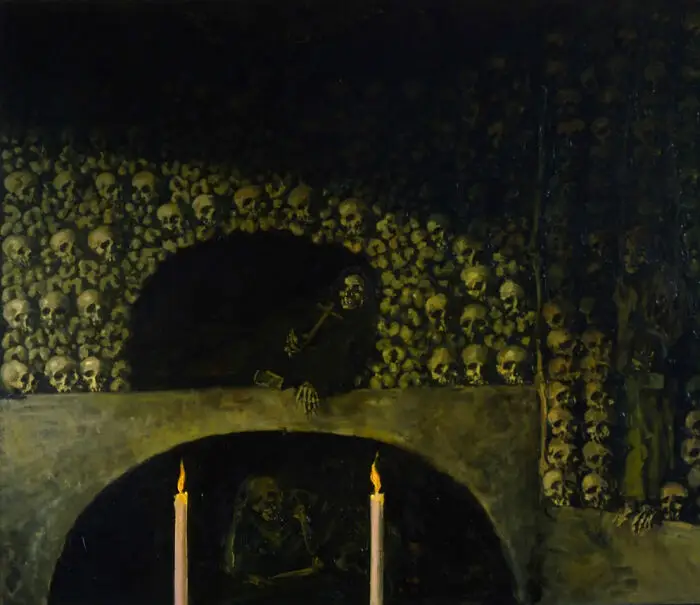
In this haunting and unsettling scene, Parviainen depicts the dim interior of the Capuchin crypt, its walls densely lined with human skulls and bones that fade into shadow. Two flickering candles illuminate the eerie chamber, revealing a skeletal figure below that appears to smile directly at the viewer, creating an unnerving sense of awareness. Above, another skeleton leans over the stone arch, clasping a crucifix as if in silent vigil over the dead. The oppressive darkness and the endless ranks of skulls transform the crypt into a macabre meditation on mortality, where the boundary between devotion and decay feels disturbingly thin.
Report
2points
#54 Pandemonium, Circa 1841, By John Martin
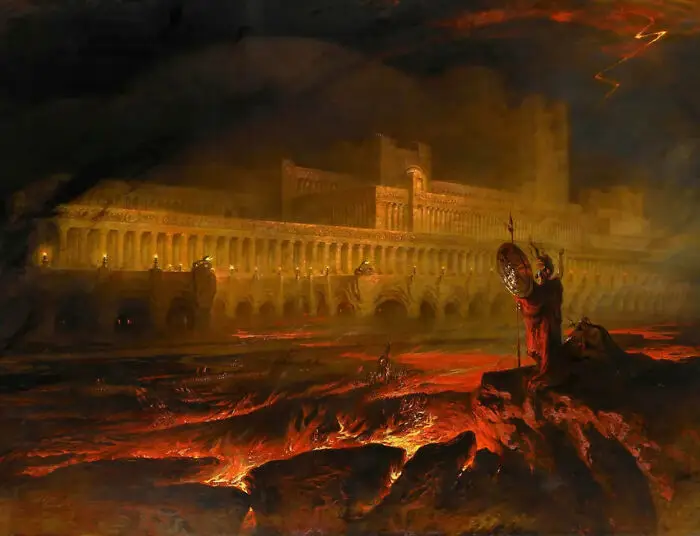
This painting presents a monumental vision of Hell’s capital as described in John Milton’s Paradise Lost. At the centre of the composition stands Satan, positioned on a dark, rocky promontory in the foreground. Clad in a red robe and helmet and holding a spear, he is portrayed with the bearing of a Roman general or master architect, commanding and defiant as he gestures toward his newly constructed dominion. Behind him rises the colossal city of Pandemonium—an immense, ordered architectural complex glowing with fire and sulphurous light. Its classical grandeur, partly inspired by the architecture of the Palace of Westminster, contrasts starkly with the barren darkness surrounding Satan, underscoring themes of rebellion, ambition, and fallen majesty. Now housed in the Louvre Museum, the painting captures the moment after the fallen angels’ expulsion from Heaven, transforming Milton’s epic narrative into a powerful expression of the Romantic sublime - at once awe-inspiring, theatrical, and deeply ominous.
Report
1point
#55 It Rains, It Shines, The Devil Whipping His Wife By William Holbrook Beard (1824–1900)
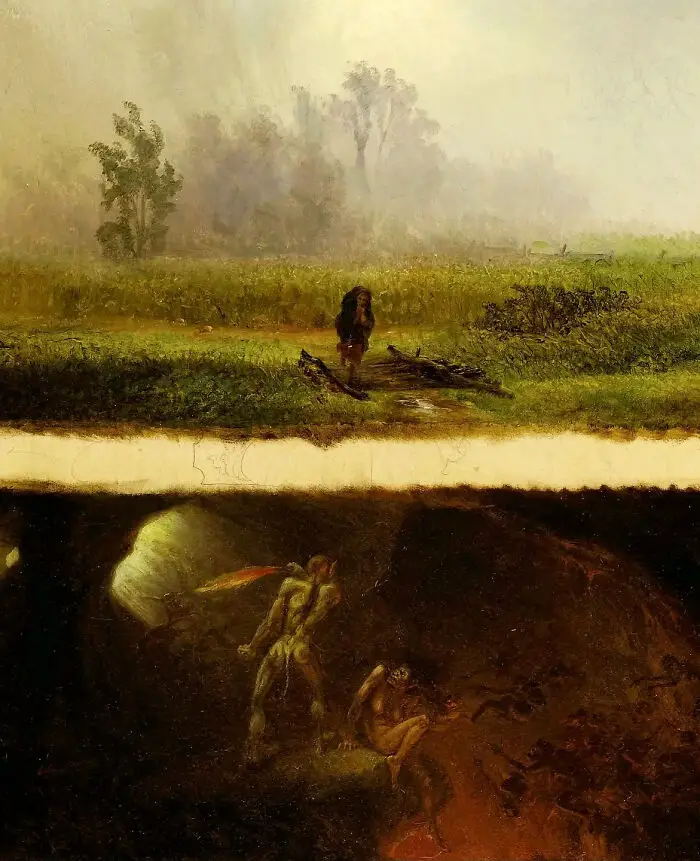
This imaginative painting by William Holbrook Beard shows a misty countryside landscape split between two worlds. Above ground, a lone figure walks calmly through a quiet field; below, a hidden hell is revealed, the devil whipping his wife. The contrasting calm rural life with chaos beneath the surface, William Beard uses dark humour and satire to suggest that violence and moral corruption often lie hidden beneath everyday appearances.
Report
1point
#56 Kiss From The Trenches, Circa 1920. Illustration By John E. Sutcliffe
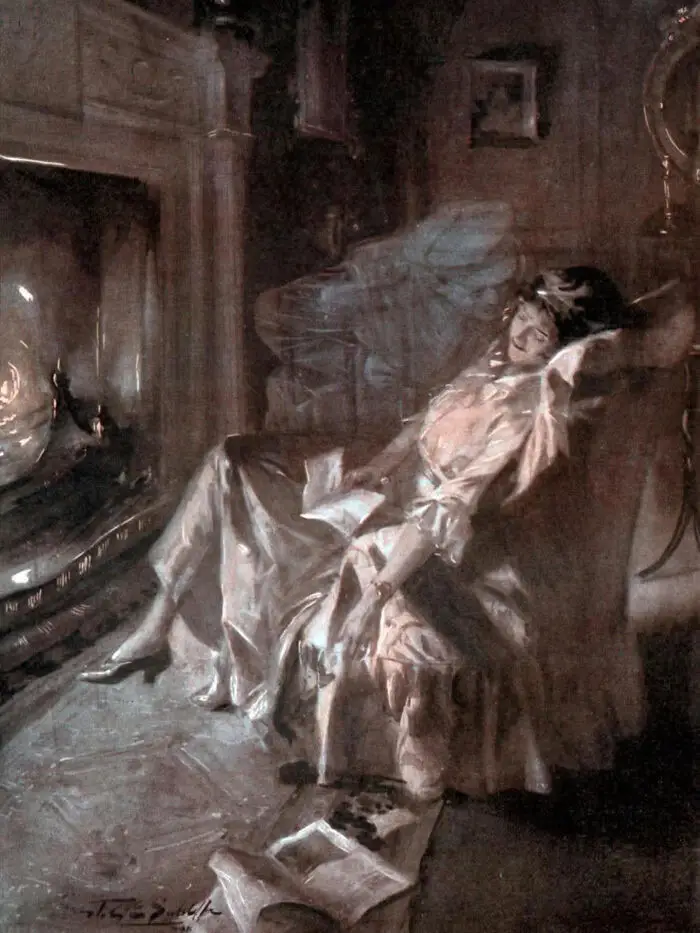
This is a quiet and deeply emotional scene shaped by the grief of the First World War. A woman sleeps peacefully beside a glowing fireplace, unaware as the ghostly figure of her husband — lost in the trenches — leans toward her to give a final, tender kiss. Rendered in soft tones and gentle light, the painting blends reality and memory, capturing the lingering presence of love beyond death and the haunting sorrow carried by those left behind.
Report
1point
#57 Apparition Above Trees, Circa 1928 By Franz Sedlacek
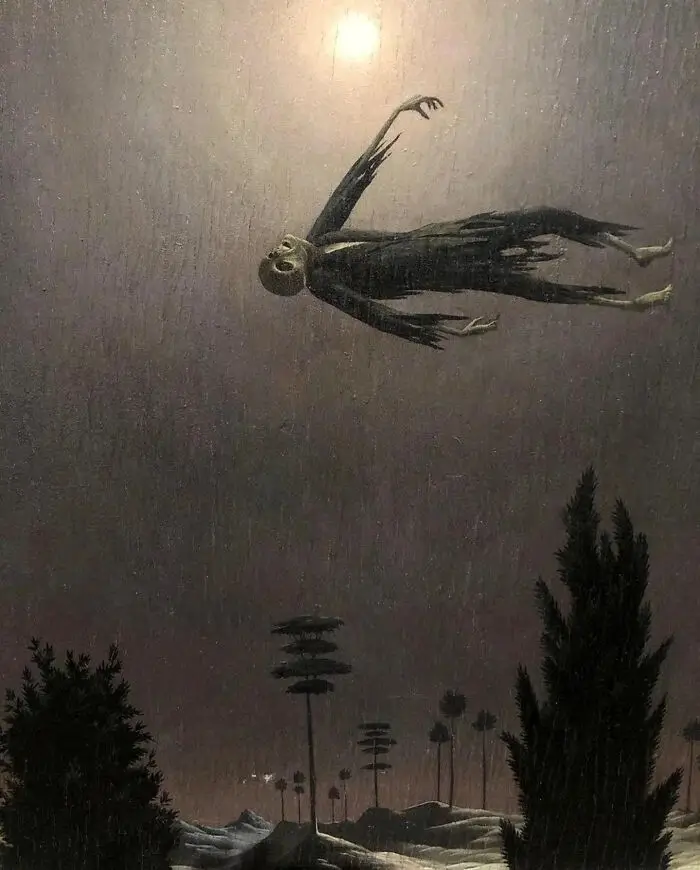
This painting presents a haunting, dreamlike vision of a spectral figure suspended in the night sky above a desolate landscape. Rendered in muted, atmospheric tones, the elongated form appears weightless and uncanny, its rigid posture and skull like face heightening a sense of unease. Below, sparse trees and a barren terrain recede into darkness, reinforcing the painting’s quiet isolation. Blending elements of New Objectivity and Surrealism, Sedlacek evokes a disturbing yet poetic meditation on the unknown, mortality, and the fragility of human presence.
Report
1point
#58 Into The Unknown, Circa 1901 By Alfred Kubin
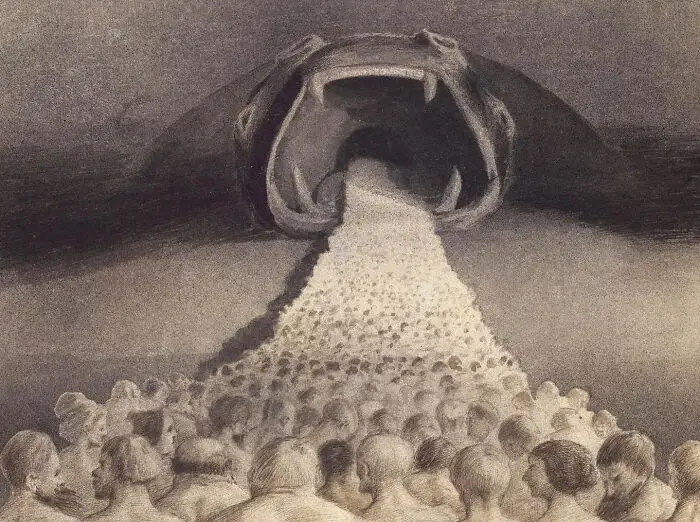
This work presents a nightmarish procession of faceless figures drawn toward a vast, gaping mouth that dominates the composition. Rendered in muted, shadowy tones, the scene evokes a sense of collective surrender to an ominous and inescapable force. The dense crowd, moving in silent unison, suggests themes of existential anxiety, loss of individuality, and the terrifying pull of the unknown—hallmarks of Kubin’s early, symbolist-influenced vision of the human psyche.
Report
1point
#59 Old House In Wind, Circa 1906 By Charles Frederick William Mielatz (1864–1919)
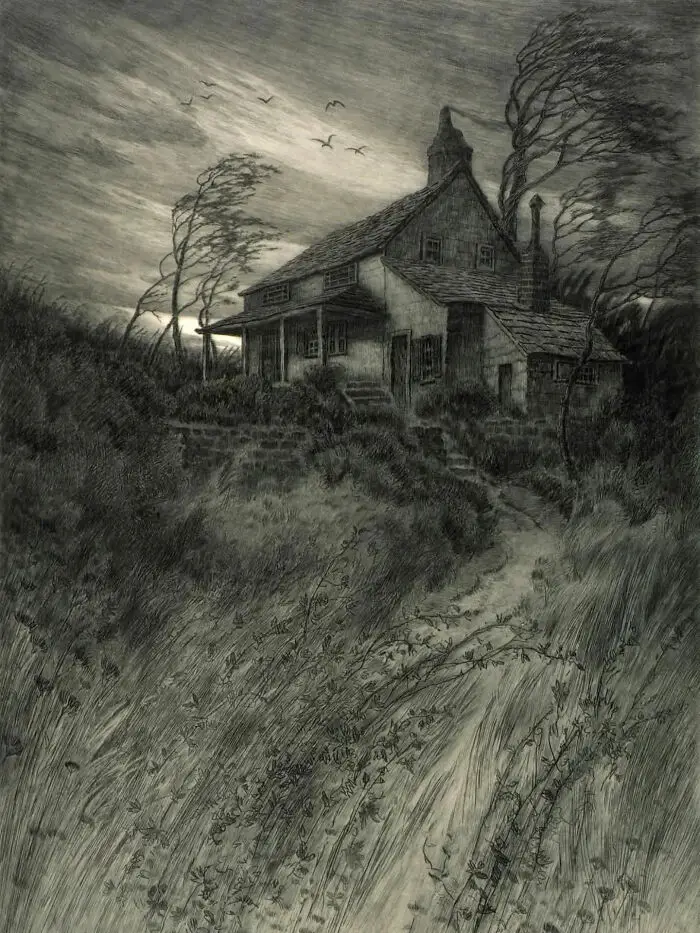
Mielatz’s etching presents a remote house caught in the grip of an unforgiving wind, its fragile silhouette barely holding its ground against the restless landscape. The sweeping movement of the grasses and the contorted trees fills the scene with a sense of tension and unease, as if the air itself were charged with quiet violence. Rendered in dark, searching lines, the house appears isolated and vulnerable, suspended between habitation and abandonment. The narrow path leading toward it invites the viewer forward, yet only deepens the feeling of solitude, turning this rural scene into a haunting reflection on exposure, persistence, and nature’s quiet dominance.
Report
1point
#60 Vision In The Coliseum, Circa 1885 By José Benlliure Y Gil
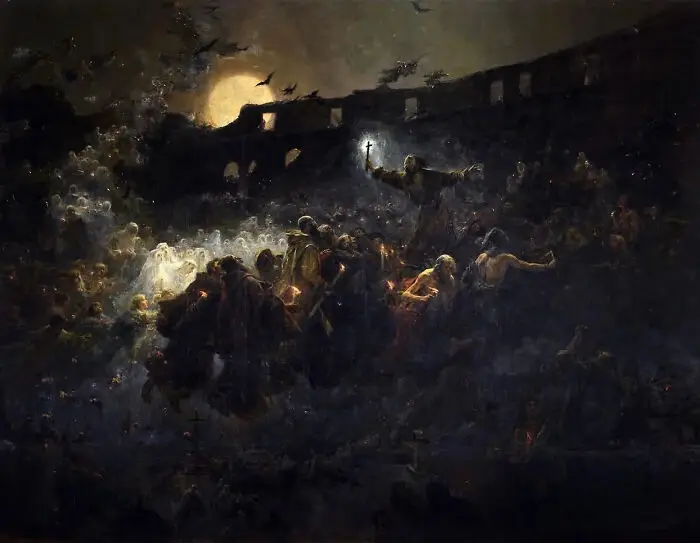
This painting is a dramatic night scene set within the ruins of the Roman Colosseum. Beneath a pale moon, a Christian figure raises a glowing cross before a vast crowd of shadowy, suffering figures, while ghostly apparitions seem to rise from the darkness around them. Benlliure contrasts deep gloom with supernatural light to evoke a powerful vision of faith, martyrdom, and the lingering presence of the past, transforming the ancient arena into a stage for spiritual revelation and historical memory.
Report
1point