



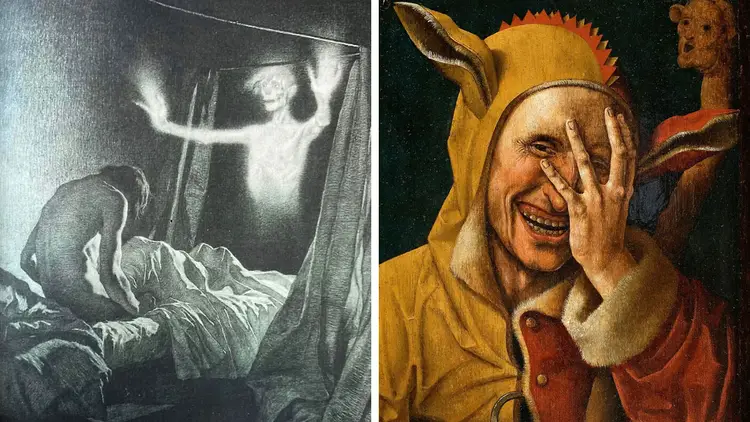


If you love art that’s atmospheric, emotional, and a little mysterious, 'Dark & Gloomy' is a page you’ll want to explore. Their Instagram feed is full of hauntingly beautiful pieces – from moody portraits to dramatic, almost dreamlike scenes – that grab your attention and linger in your mind long after you scroll.
The page celebrates art created across centuries that embraces the darker side of expression, showing how shadows, contrast, and emotion can tell stories just as powerful as any bright, colorful painting.
In this post, we’ve gathered some of the most striking pieces shared by this community, so scroll down to explore them and get lost in the beauty of the shadows.
#21 Sunset Of Life, Circa 1907 By The Adolf Hengeler (1863–1927)
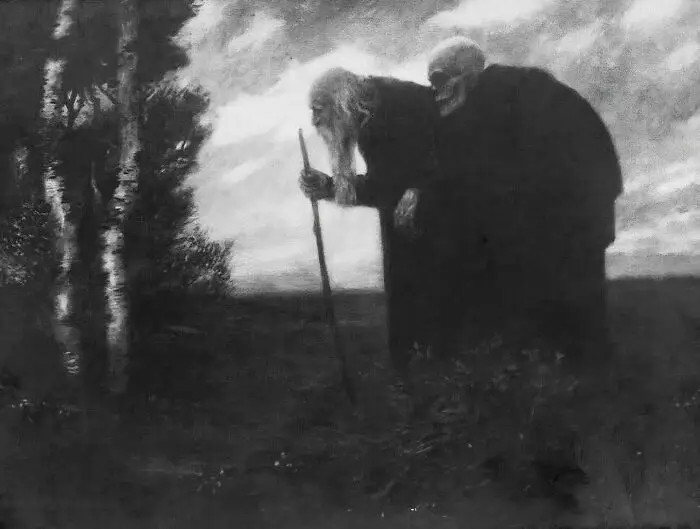
This work is a profoundly somber allegory of aging and mortality. The mist laden composition depicts a frail old man leaning on his staff while a shadowy personification of Death walks beside him, gently guiding him toward the dark forest ahead. Hengeler’s subdued palette and softened forms cause the figures to merge almost imperceptibly with the surrounding landscape, transforming an ordinary moment into a quiet yet deeply moving meditation on the final passage of human life.
Report
4points
#22 Macabre Cemetery Scene Of A Winter Night By Ferdinand Staeger (Swiss, 1880–1976)
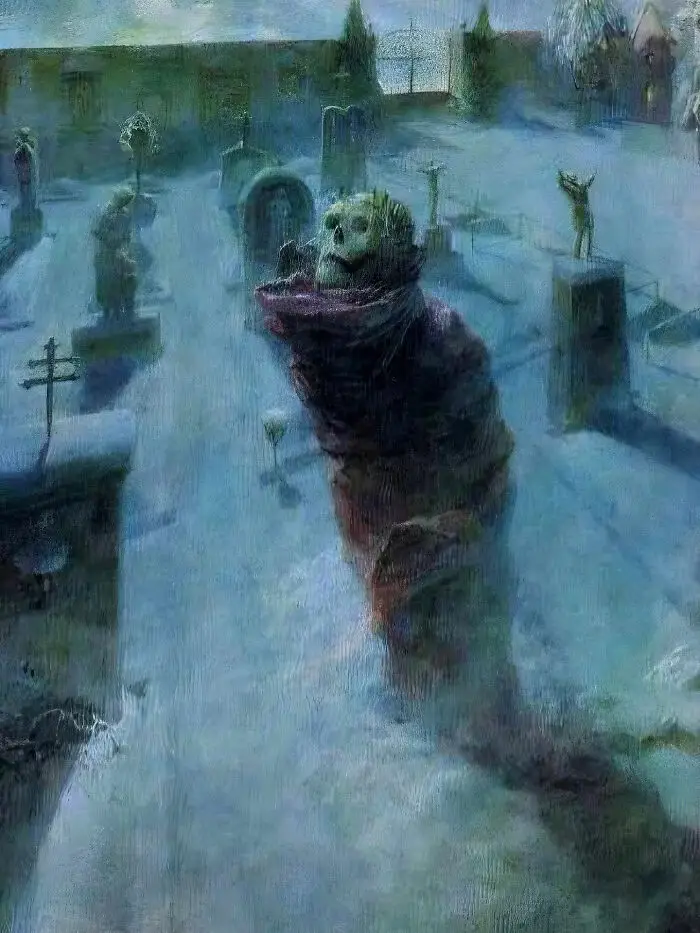
This haunting painting shows a skeletal, ghost like figure moving through a snow covered cemetery, where crooked gravestones and crosses fade into cold mist and darkness. Painted in muted blues and greys, the scene feels quiet, frozen, and deeply melancholic, as if time itself has slowed to a standstill. Staeger’s soft, blurred handling of paint gives the image a dreamlike, uneasy atmosphere, turning the winter graveyard into a powerful and poetic reflection on loneliness, death, and the stillness that follows life.
Report
4points
#23 Eye, Circa 1946. Illustration By M.c. Escher (1898 - 1972)
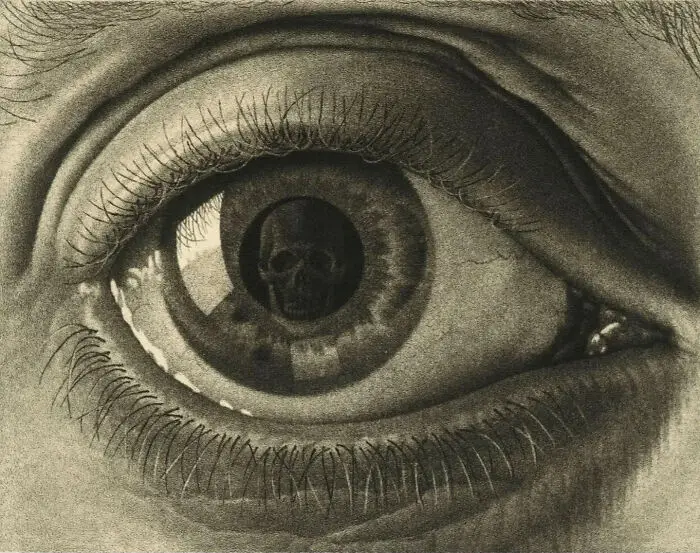
This striking illustration shows a hyper detailed human eye staring directly at the viewer, its glossy surface rendered with almost clinical precision. At the centre of the pupil, a skull is reflected, turning the act of seeing into a confrontation with mortality. Escher transforms a familiar organ into a quiet memento mori, suggesting that awareness itself is inseparable from the presence of death.
Report
4points
#24 The Pilgrim Pulpit. Illustration By Ludwig Rösch (1865–1936)
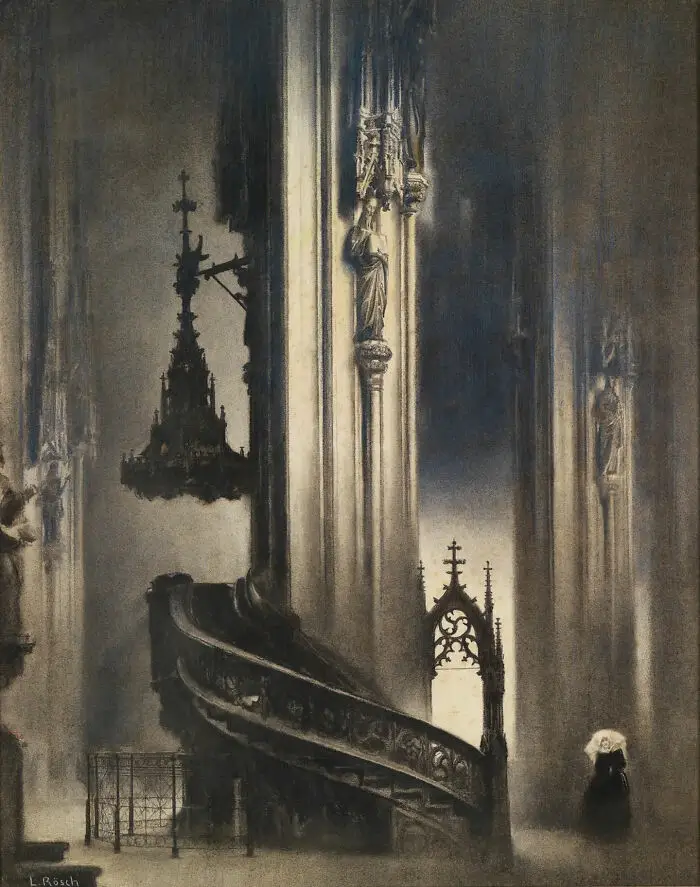
This atmospheric illustration shows the vast interior of a Gothic cathedral. Tall columns rise into shadow while a curved stone staircase leads up to the ornate Pilgrim Pulpit. Soft light filters through the arches, revealing carved statues and delicate Gothic details. Near the base of the pillars stands a solitary nun, her white headdress faintly catching the light. Her small figure emphasizes the immense scale of the cathedral, adding a quiet sense of devotion and stillness. Rösch’s muted tones and soft shading create a mysterious, almost dreamlike mood within the silent sacred space.
3points
#25 The Fear, Circa 1919. Illustration By Edwin Henel
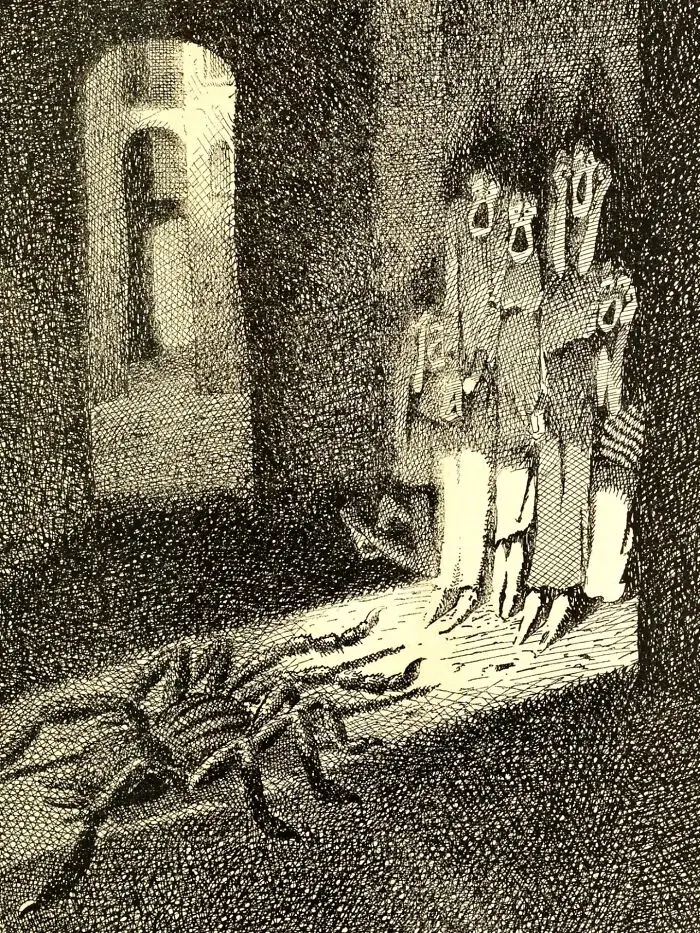
This stark, claustrophobic illustration presents a narrow interior crowded with mask like figures, their rigid postures and empty expressions creating an atmosphere of quiet dread. In the foreground, a skeletal body lies exposed, intensifying the sense of fear and unease. The compressed space and strong contrasts heighten the psychological tension, transforming the scene into a haunting image of anxiety and moral disturbance.
Report
3points
#26 Palm Of Peace By Josef Mandl (Czech, 1874–1933)
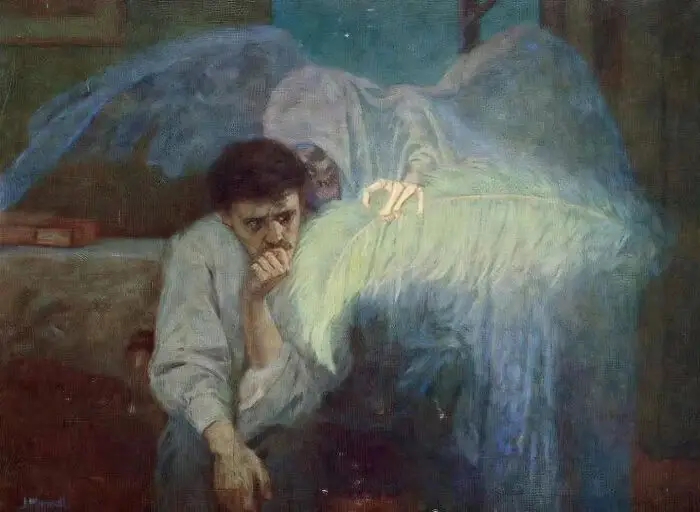
This haunting, dream like composition portrays a sorrowful, inward looking man whose drawn, shadowed face bears the marks of profound fatigue and despair. Next to him a spectral figure—often interpreted as an "angel of death"—inclines toward him, murmuring something into his ear. The luminous, flowing presence both envelops and oppresses him, heightening the tension between fragile human vulnerability and an inescapable spiritual force. Executed in subdued tones of blue and green with softly dissolving contours, the painting becomes a restrained yet deeply affecting meditation on grief, resignation, and the threshold between consolation and surrender.
Report
3points
#27 Laughing Fool, Circa 1500. Attributed To Jacob Cornelisz Van Oostsanen
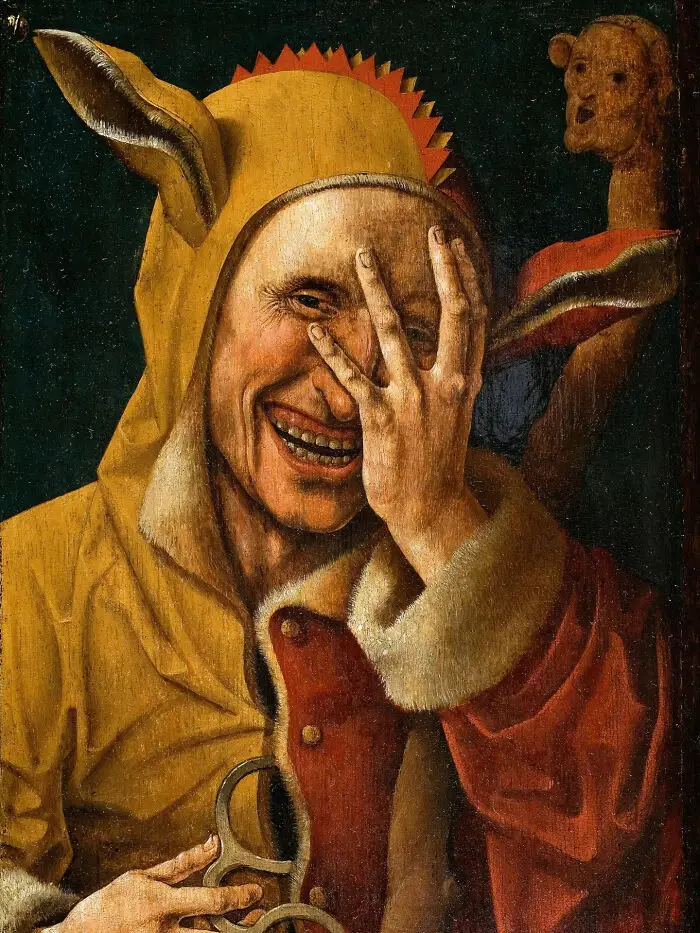
This unsettling early sixteenth century painting presents a grinning fool whose laughter feels more grotesque than joyful. Clad in a jester’s costume and partially shielding his face, he exposes a toothy, almost manic smile, while a faint, ghostly figure lurks behind him in the darkness. The sharp realism of the features and the claustrophobic closeness of the composition transform comedy into something deeply ambiguous, suggesting folly, madness, and moral corruption. The work stands as a haunting meditation on human vanity and the thin line between humor and unease.
Report
3points
#28 Famine, Circa 1904, By John Charles Dollman
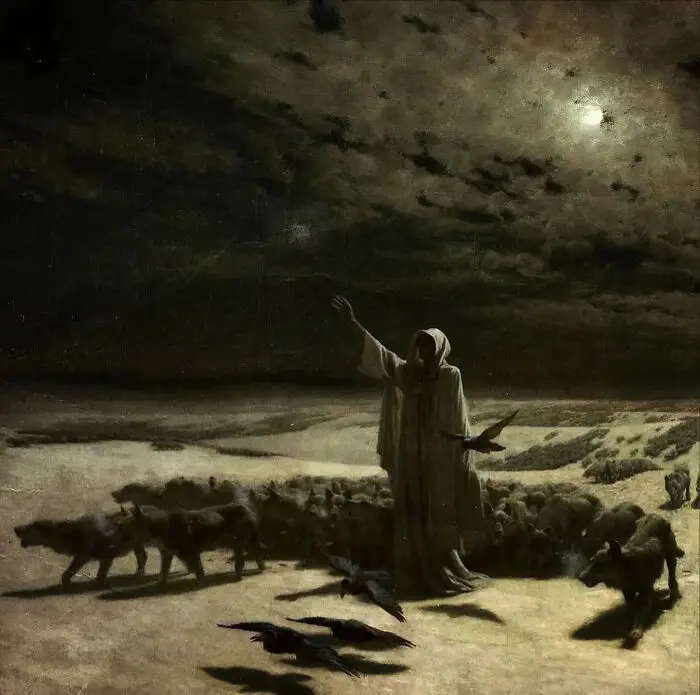
In "Famine", John Charles Dollman shows a dark, haunting night scene filled with silence and fear. Under a cold moon, a ghost like figure resembling "Death" leads a pack of wolves across a barren landscape, symbolising hunger and the approach of suffering. Deep shadows, empty space, and muted colours create a chilling atmosphere, turning the painting into a powerful image of survival, mortality, and nature at its most unforgiving.
Report
3points
#29 The Fall Of The Rebel Angels, Circa 1826. Mezzotint By John Martin
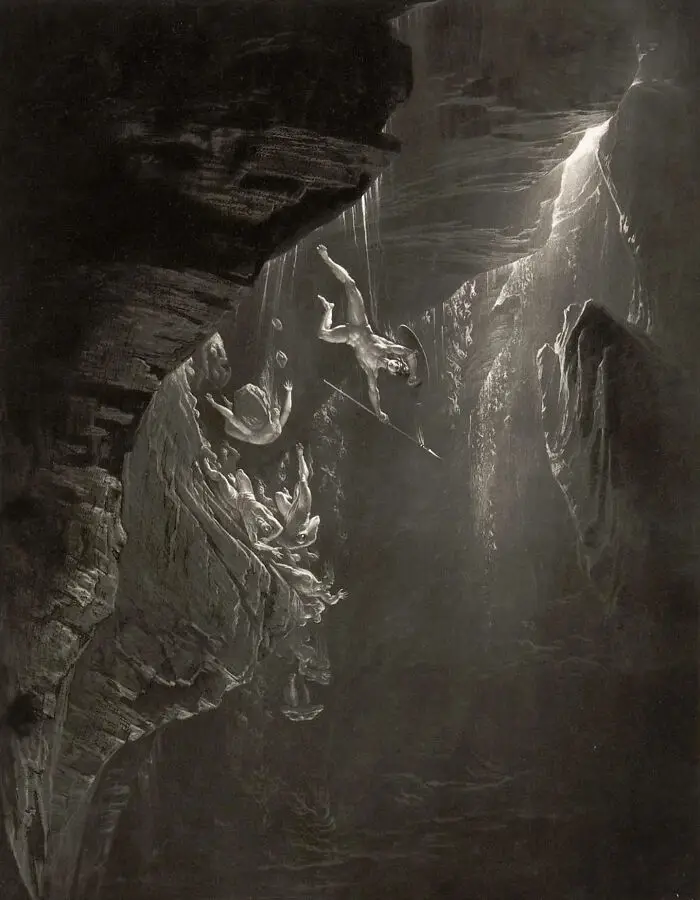
Lucifer and his fellow angels are cast out of Heaven, plunging into a vast chasm whose towering rock walls appear tangled with root-like forms. Light pours in from the opening above, briefly illuminating the falling figures before they vanish into deep shadow. Clutching spears and shields, the angels tumble alongside crashing stones toward a seemingly endless abyss. The strong contrast of light and darkness in the mezzotint heightens the drama, suggesting the divide between the radiance of Heaven and the darkness of Hell below. Though neither realm is fully shown, the image evokes the sublime — a lost paradise above and a terrifying unknown beneath.
Report
3points
#30 Scherzo In Gold, Circa 1948. Illustration By Victor Delhez
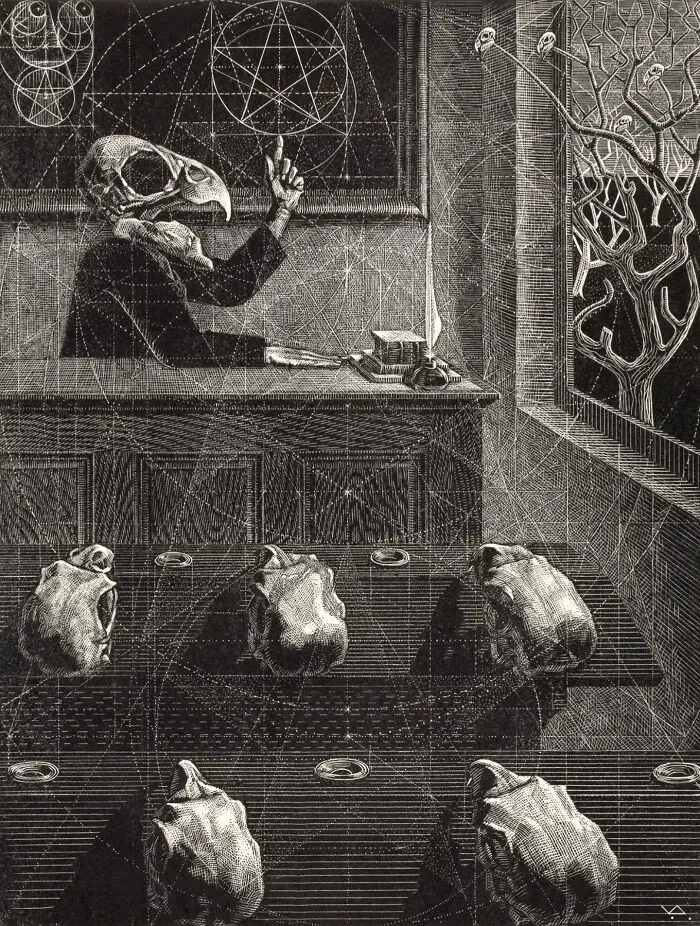
This work presents a surreal and unsettling classroom where human order has been replaced by something ritualistic and otherworldly. Rows of silent "students", reduced to bird-like skulls, sit facing a "teacher" who gestures toward a geometric, star-shaped diagram resembling an occult or satanic symbol drawn upon the board. The precise etched lines and cold, scientific setting contrast with the eerie figures, creating a disturbing fusion of reason and mysticism. Delhez transforms an ordinary place of learning into a dreamlike vision of forbidden knowledge, where education feels less like instruction and more like initiation into a dark, symbolic doctrine.
Report
3points
#31 Samwise Gamgee Saves Frodo From Shelob, Circa 1987. Colored Illustration By Ted Nasmith
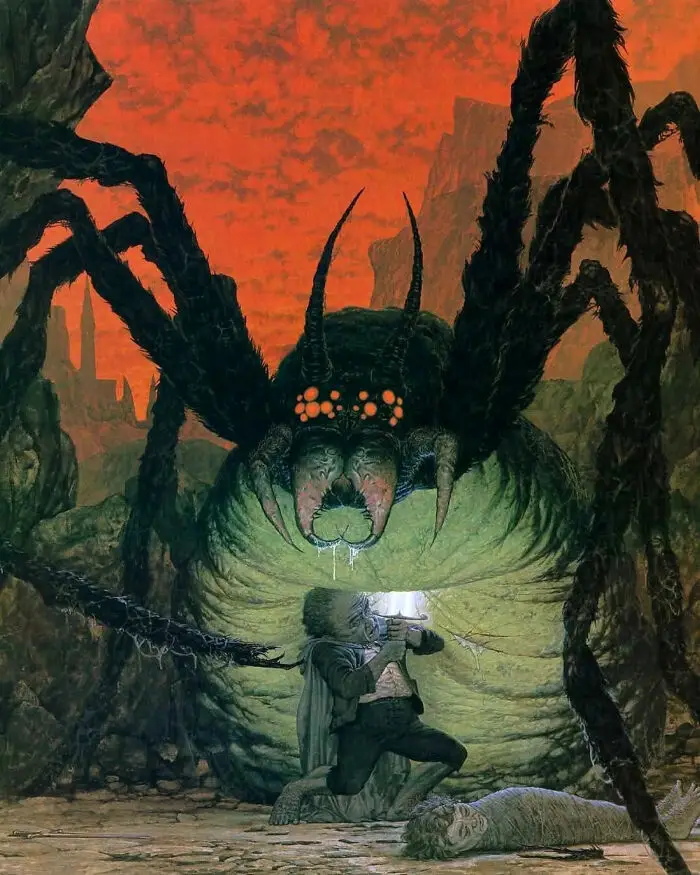
This illustration depicts a scene from the novel "The Lord of the Rings" showing "Samwise Gamgee" making a final and desperate stand to save "Frodo Baggins" from "Shelob", the monstrous spider that looms in the darkness. Frodo lies helpless, poisoned and paralysed by her sting, while Sam wounds Shelob with Frodo's sword and drives her back into the darkness. The scene captures a moment of raw courage amid overwhelming dread—an act of loyalty and sacrifice at the heart of Tolkien's fantasy novel.
Report
3points
#32 Thunder God, Circa 1840, By Katsushika Hokusai
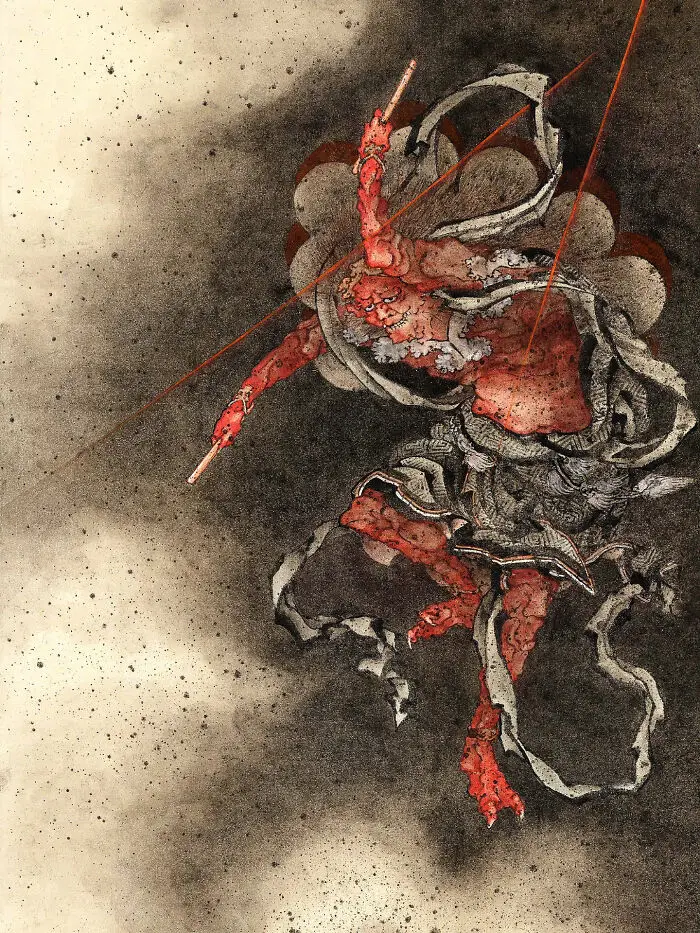
This painting presents a ferocious vision of the "Shinto deity Raijin", suspended amid swirling clouds and charged atmosphere. Rendered with explosive energy, the contorted figure beats his drums of thunder, streaked with jagged lines of lightning and violent motion. Hokusai’s bold use of ink, texture, and dynamic composition transforms the divine into something elemental and terrifying, capturing nature as a force of chaos, power, and awe rather than harmony.
Report
3points
#33 Interior Of An Abbey In Ruins, Circa 1848 By Hippolyte Victor Valentin Sebron
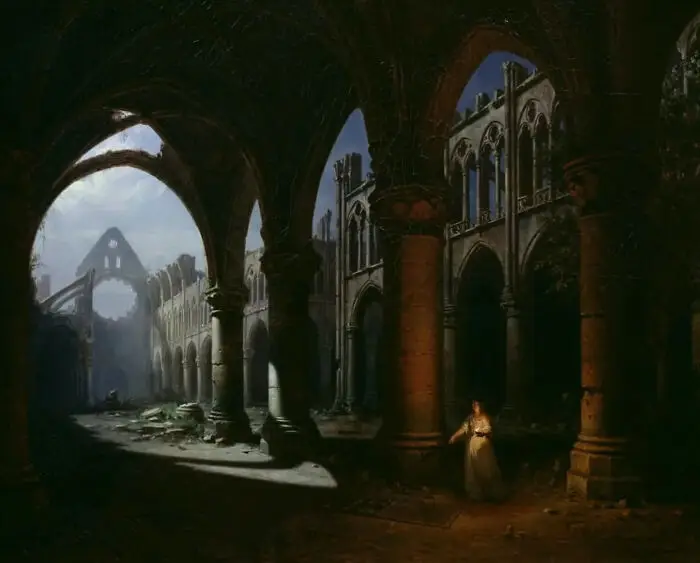
This atmospheric painting shows the shattered interior of a Gothic abbey, its towering arches and broken vaults opened to a pale, distant sky. Amid the vast ruin, a solitary woman holding a small light stands in the shadows, her fragile presence contrasting with the cold stone and silence around her. Sebron uses light and scale to evoke loss, time’s passage, and the quiet melancholy of faith and human life lingering within decay.
Report
3points
#34 The Nightmare, Circa 1781, By Johann Heinrich Füssli
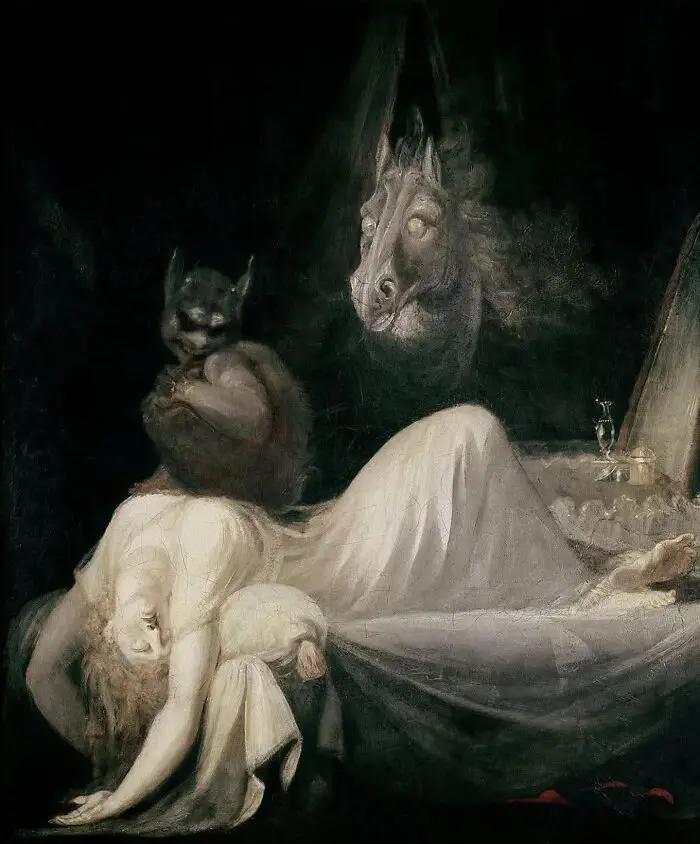
This is a haunting vision of sleep disturbed by terror. A woman lies sprawled across her bed in unnatural repose as a grotesque incubus crouches on her chest, embodying the crushing weight of nightmares. From the darkness behind her, a ghostly horse thrusts its head forward, eyes wide and unblinking, heightening the sense of dread. The painting explores the fragile boundary between dreams, fear, and the unconscious mind.
Report
3points
#35 Woman At A Fountain With Rising Moon, Circa 1866 By Ferdinand Knab
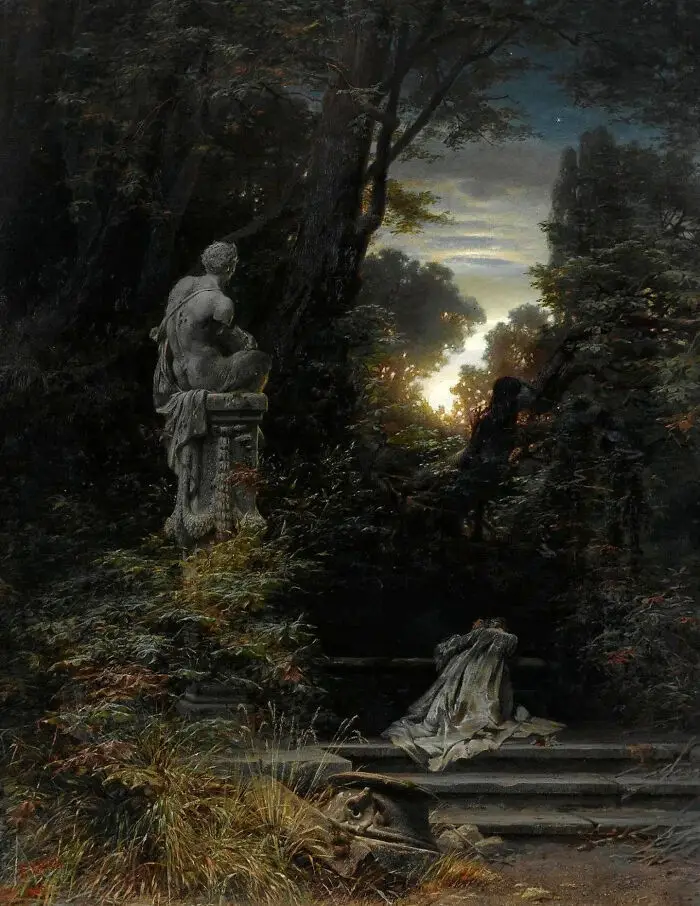
Bathed in deep twilight, this atmospheric scene shows a solitary woman bowed beside a quiet fountain, surrounded by dense trees and ancient statues. The rising moon casts a faint silver glow through the foliage, heightening the sense of silence and melancholy. Knab’s careful use of shadow and soft light transforms the garden into a dreamlike, almost sacred space, where nature, memory, and contemplation seem to merge.
Report
3points
#36 Moonlight At A Rocky Coast By Georg Emil Libert
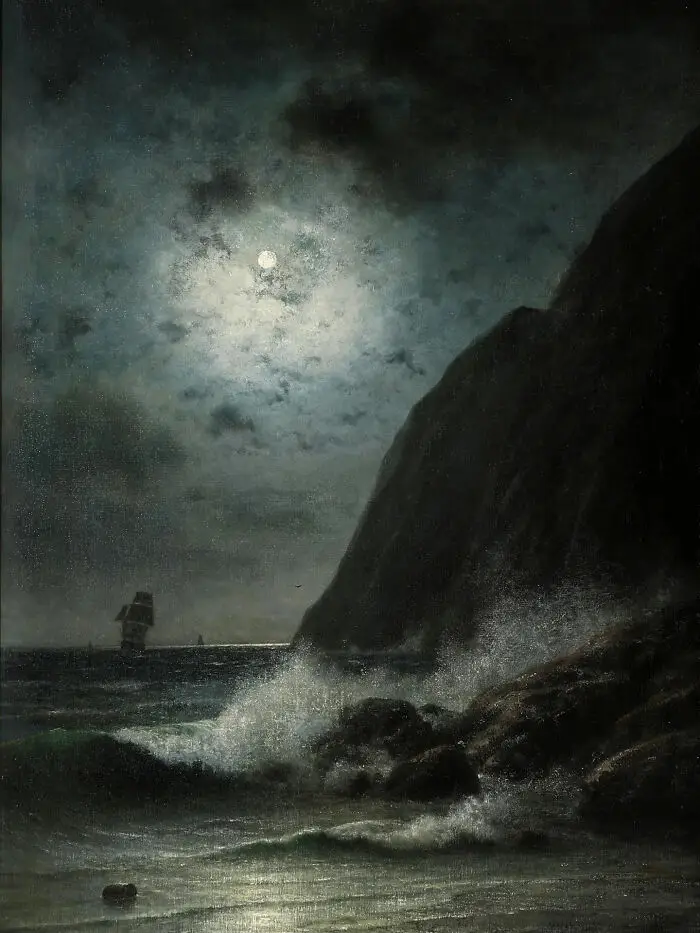
This shows a dramatic nighttime seascape lit by the soft glow of the moon. Waves crash against dark cliffs, and the white spray briefly shines in the moonlight before fading back into shadow. In the distance, a lone sailing ship moves slowly along the horizon, adding a feeling of quiet solitude. With its deep shadows and cool tones, the painting captures a calm yet slightly haunting mood, where the power of nature and the stillness of night create a peaceful, reflective atmosphere.
Report
3points
#37 The Death Of A Gentleman By Florence Lindon “Linden” Travers (British, 1913–2001)
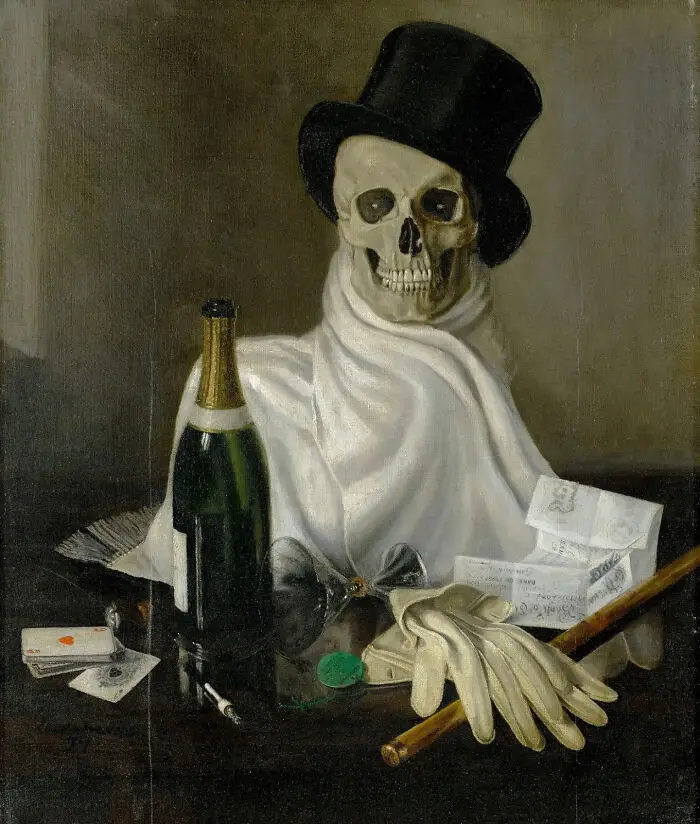
This darkly ironic still life presents Death as an elegant Victorian gentleman, represented by a skull dressed in a top hat and draped in white cloth. Arranged before him are the symbols of refined society — champagne, playing cards, gloves, a cane, and scattered papers — suggesting pleasure, status, and worldly pursuits abruptly abandoned. The carefully ordered objects contrast with the stark presence of the skull, transforming the scene into a modern vanitas: a reminder that wealth, leisure, and sophistication offer no escape from mortality. Quietly theatrical and tinged with dry humour, the painting reflects on the fragility of social identity in the face of inevitable death.
Report
3points
#38 Christ Carrying The Cross, Circa 1530 By Hieronymus Bosch (Or Follower)
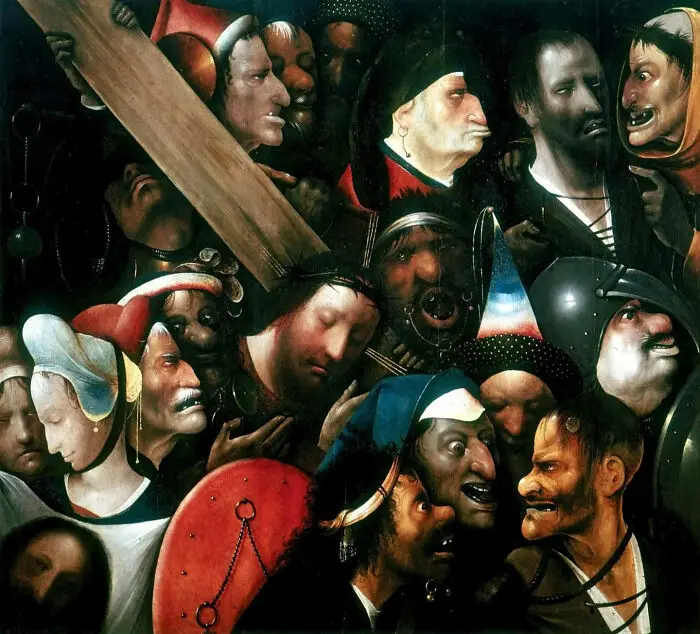
This disturbing composition crowds the frame with grotesque faces pressing in around Christ as he struggles beneath the weight of the cross. While Jesus appears calm and sorrowful at the centre, the surrounding figures twist into exaggerated expressions of cruelty—mocking, shouting, and taunting him as he is led to his crucifixion. The contrast between Christ’s quiet dignity and the distorted, almost monstrous crowd reflects Bosch’s moral vision, portraying human cruelty and spiritual blindness in stark, unsettling detail.
Report
3points
#39 Illustration To “Twenty Years’ Experience As A Ghost Hunter” By Elliot O’donnell, Circa 1917. Illustrated By Phyllis Vere Campbell (1891–1974)
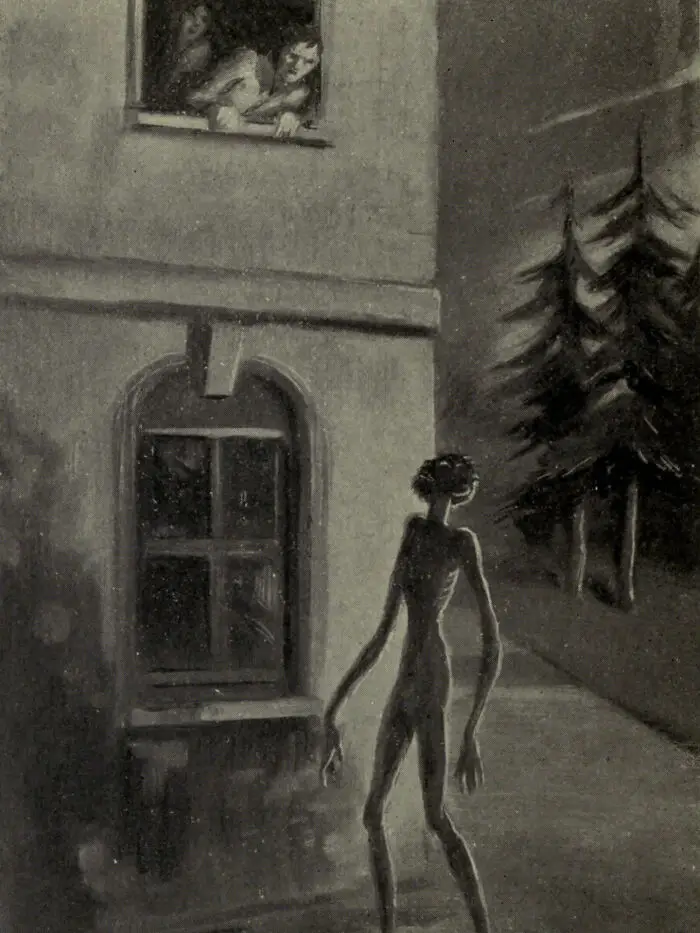
This illustration by Phyllis Vere Campbell shows a ghostly, elongated figure moving through a moonlit scene, its pale form standing out against the dark building and trees. Several frightened figures watch from an upper window, adding a strong sense of tension and unease. The restrained palette and stark contrasts give the apparition a chilling, otherworldly presence, effectively capturing the mood of supernatural fear described in Elliot O’Donnell’s Twenty Years’ Experience as a Ghost Hunter (1917).
Report
2points
#40 Sad Times, Circa 1897 By Antonio Ambrogio Alciati
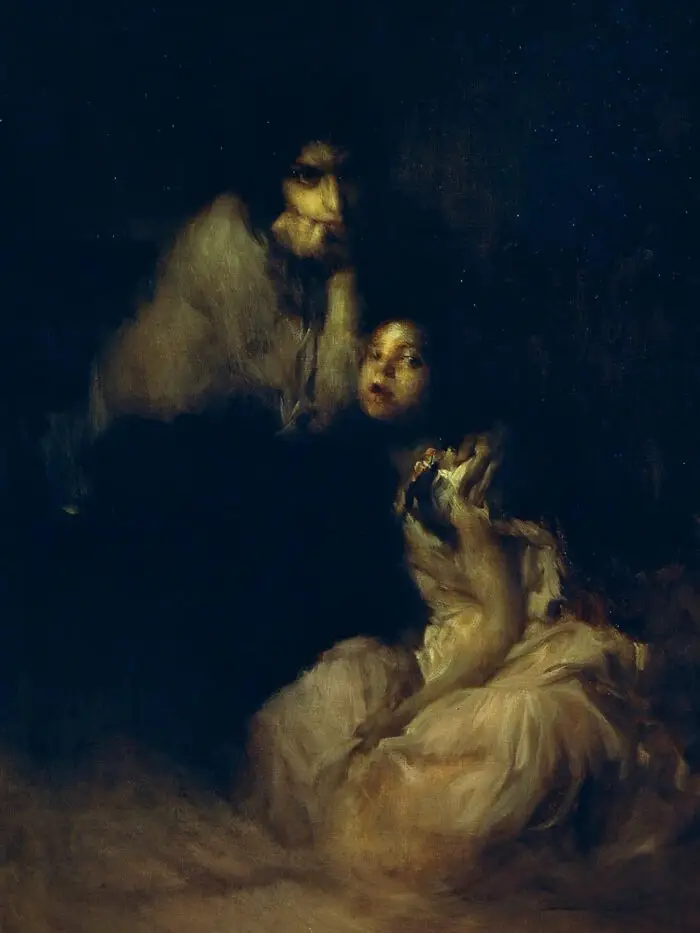
This haunting and emotionally charged work, is steeped in a dark and oppressive atmosphere. Emerging from deep shadow, the figures are only partially revealed, as if swallowed by the surrounding gloom, heightening the sense of unease and psychological tension. The child’s wide, unsettling gaze and the adult’s somber, almost spectral expression introduce a distinctly disturbing note, transforming the intimate scene into a quiet vision of anxiety and sorrow. Through muted tones and veiled light, Alciati creates a powerful meditation on fear, vulnerability, and the darker undercurrents of human experience.
Report
2points