


According to a Lithuanian saying, the deeper you go into the forest, the more trees you find. It means that the closer you examine something, the more questions and complexity you’ll uncover.
History works the same way. What first appears straightforward on the surface branches into much greater detail, contradictions, and unexpected connections once you spend time with it.
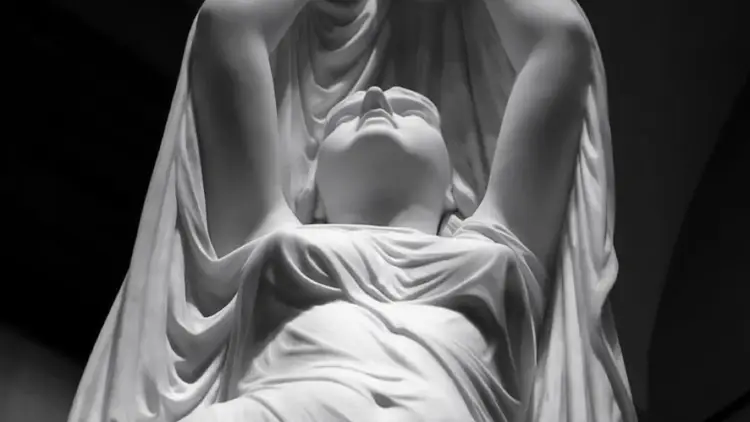
Just take a look at the posts by the Instagram account ‘Historica Leaks.’ Whether it’s the intricacy of ancient Greek sculpture or local life in a quiet corner of Norway, it captures both the grand and the ordinary in equal measure.
More info: Instagram

#103
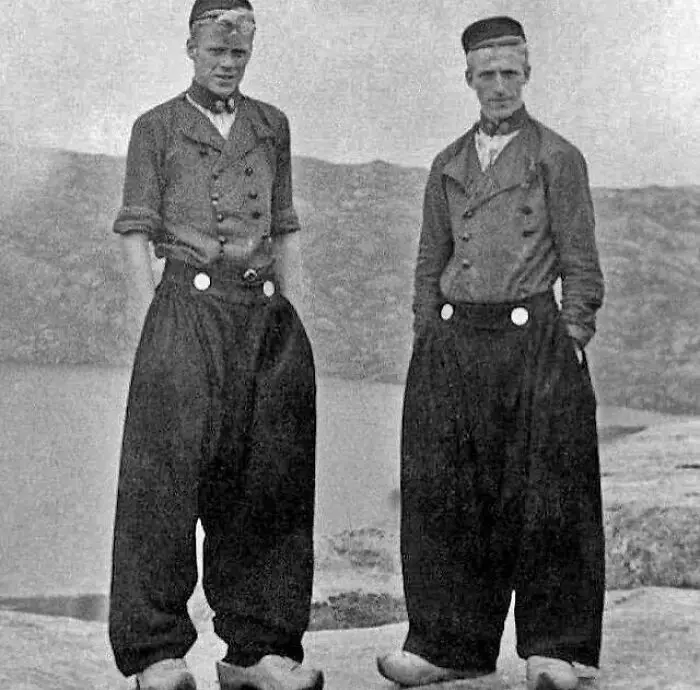
Dutch men in traditional trousers, 1900. Weather conditions determine appropriate clothing in the Netherlands. Otherwise, clothes appear similar to those worn elsewhere. Netherlands culture has unique traditional clothes, although people in the Netherlands only wear traditional clothes during special occasions. The traditional male costume includes woolen pants with silver buttons on the front square flap, as well as wooden clogs, a shirt, a jacket and a hat. The shape and design of the hat varies according to region.
Report
13points
#104
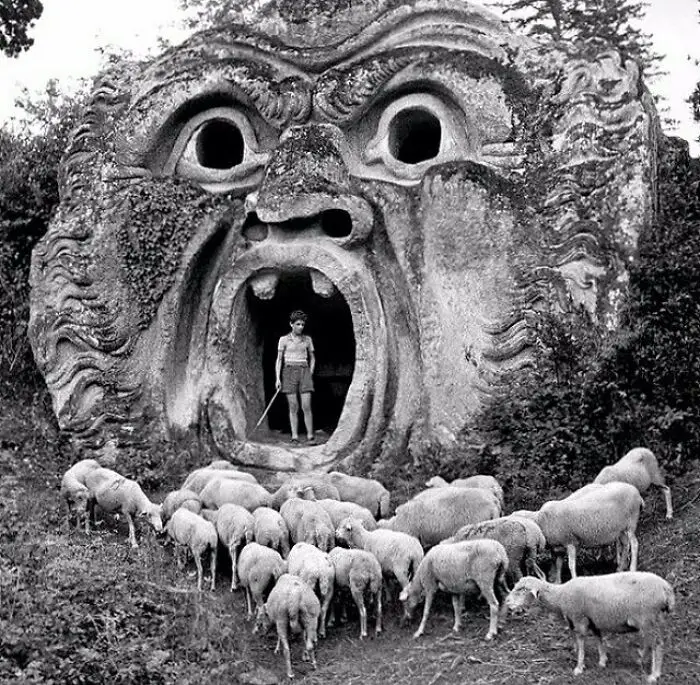
Pictured above is a young boy in the Gardens of Bomarzo, 1952. The Sacro Bosco ("Sacred Grove"), also called Park of the Monsters (Parco dei Mostri in Italian), also named Garden of Bomarzo, is a Mannerist monumental complex located in Bomarzo, in the province of Viterbo, in northern Lazio, Italy. The park was created in the 16th century. The monster in the photograph is the Orcus Mouth. It is the God of the underworld, and “punisher of broken oaths” in Italic and Roman mythology.
Report
13points
#106
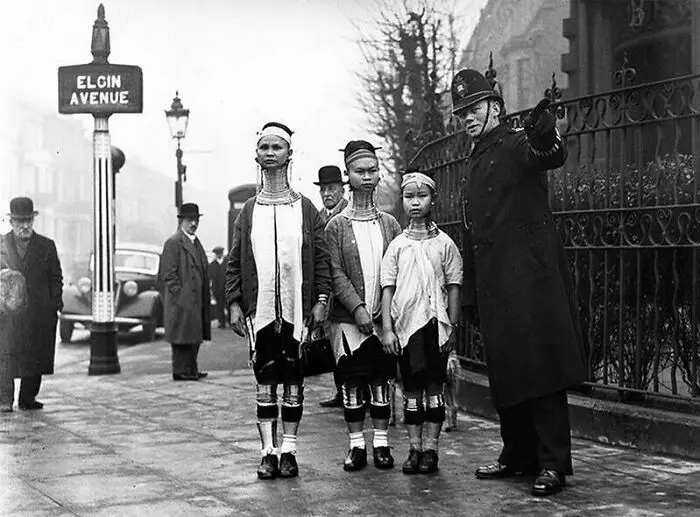
Padaung women asking a London policeman for directions, 1935. The Kayan are a sub-group of Red Karen (Karenni people), Tibeto-Burman ethnic minority of Myanmar. Girls first start to wear rings when they are around 5 years old. Over the years, the coil is replaced by a longer one and more turns are added. The weight of the brass pushes the collar bone down and compresses the rib cage. The neck itself is not lengthened; the appearance of a stretched neck is created by the deformation of the clavicle. Many Padaung girls have their necks fitted with the first spiral at the age of 5; after 2 years, a second coil is added. Coils are then added until a limit of 21 - 25 is reached. The origin of this custom is shrouded in mystery. Many believe that it is a way to make women less attractive to s***e traders. Some think that it’s the tribe's way to protect their throat from tigers. The most commonly accepted theory, however, is that the purpose of the coils to establish cultural identity, one associated with beauty - a long neck is considered a mark of great beauty. In 1935 a group of Padaung women visited London. In the 1930s, circuses and shows were popular in the United Kingdom and the Padaung women, advertised as “giraffe women,” were star attractions, drawing huge crowds.
Report
13points
#107
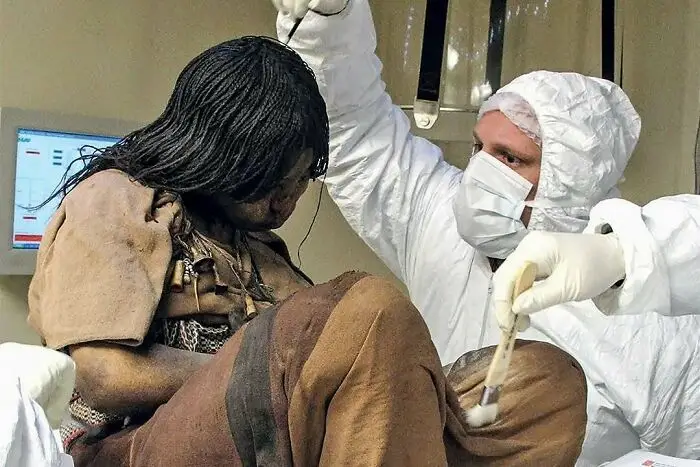
Pictured above is La Doncella or “The Maiden”, a 15-year-old mummy who lived in the Inca Empire, being examined by researchers after her discovery. In a startling discovery made in 1999, Dr. Johan Reinhard and his team of archaeologists stumbled upon ancient, well-preserved mummified bodies of three children, which dated back to more than five centuries ago. At the peak of Mount Llullaillaco, a dormant volcano bordering Chile and Argentina, inside a tomb-like structure, the mummies of Children of Llullaillaco, as they have been named, were found, thus bringing a spine-chilling Inca ritual to the fore. As per the disturbing religious custom, commonly known as capacocha, young individuals from Cuzco, the capital city of the Incan Empire, were chosen as gifts for the Sun God Inti. Little girls and boys, probably the best among the lot, in terms of looks, statuses and health were handpicked, well-fed and taken good care of, weeks or even years before it was time for them to ascend the volcano hundreds of kilometers away, where superior priests made the supreme sacrifice. As the chosen day drew closer, the children, as young as six years of age and a maximum of 16, were dressed in their best attires, adorned in fine jewellery and along with a hundred other offerings like gold, silver and various miscellaneous items, left near the summit of the titular volcano to be sacrificed. This ritual was undertaken during ceremonies like the passing away of the emperor or with a purpose to curb natural calamities or even please the gods. As per Incan beliefs, it was an act of great honour to be chosen for the sacrifice, where after the children died; they would join their ancestors in the afterlife and look over the village as angels, keeping their kin from harm. Surprisingly, the sacrifices were ordered by the Emperor himself. Before the children began their journey towards their extreme end, they were presented before the monarch, who held a feast in their honour, as the chosen ones would be given up to the gods.
Report
13points
#108
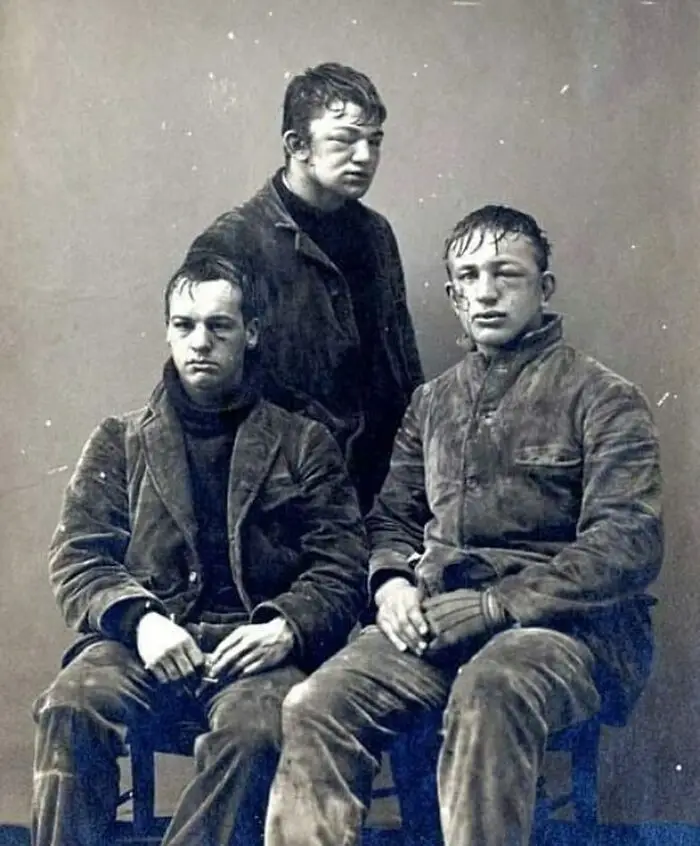
Princeton university students after a snowball fight, 1893. In the photo are, from left, Darwin R. James, John P. Poe, and Arthur L. Wheeler. Before the turn of the 20th century, it was tradition for Princeton students to have snowball fights between the freshman and sophomore classes.
Report
11points
#109
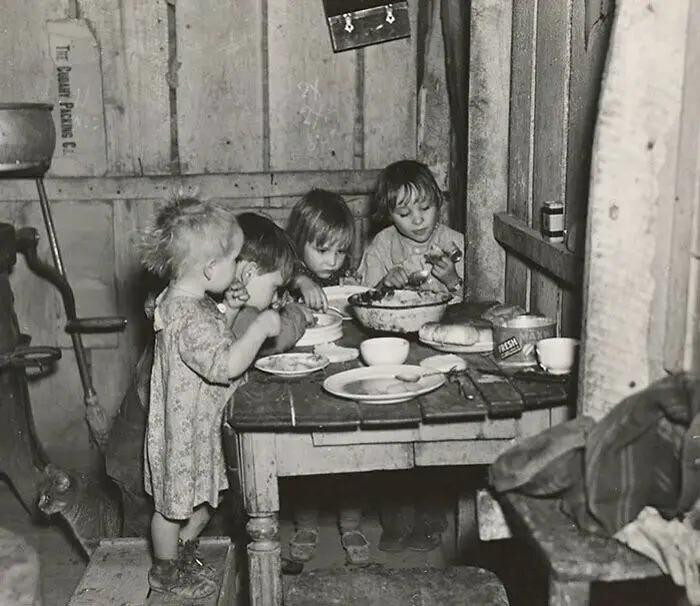
A Great Depression Christmas dinner in home of Earl Pauley, near Smithfield, Iowa, 1936. The dinner consisted of potatoes, cabbage and pie, 1936. Many years later, Helen Pauley Hopkins, one of the children in the photo was interviewed when she was in her 70s. “I remember one Christmas where Dad made us a whistle out of a corn cob. He put three feathers on the top of the cob. He’d throw it in the air and it would make a whistle on its way down. I was two when this picture was taken. We lived one day at a time. We always waited for father to get home from work, so we could sit at the table and eat with him. I worked as a janitor at Maple Valley school. But I kind of put my life aside to care for family members. I was with both of my parents and my siblings when they died. I think my mother had to put up with h**l to live like this. She was such a wonderful person. Truth be known, she went without to see we had what we needed. There wasn’t a night when my parents didn’t tell us all how much they loved us. That meant the world to me.” For most families during the Great Depression, Christmas was not a time for extravagance. Money and jobs were difficult to come by, and it was all some families could do to keep food on the table. The Great Depression was a severe worldwide economic depression in the decade preceding WWII. Farming and rural areas suffered as crop prices fell. The Great Depression began in the United States as an ordinary recession in the summer of 1929. The downturn became markedly worse, however, in late 1929 and continued until early 1933. Real output and prices fell precipitously. Between the peak and the trough of the downturn, industrial production in the United States declined 47 percent and real gross domestic product (GDP) fell 30 percent.
Report
11points
#110
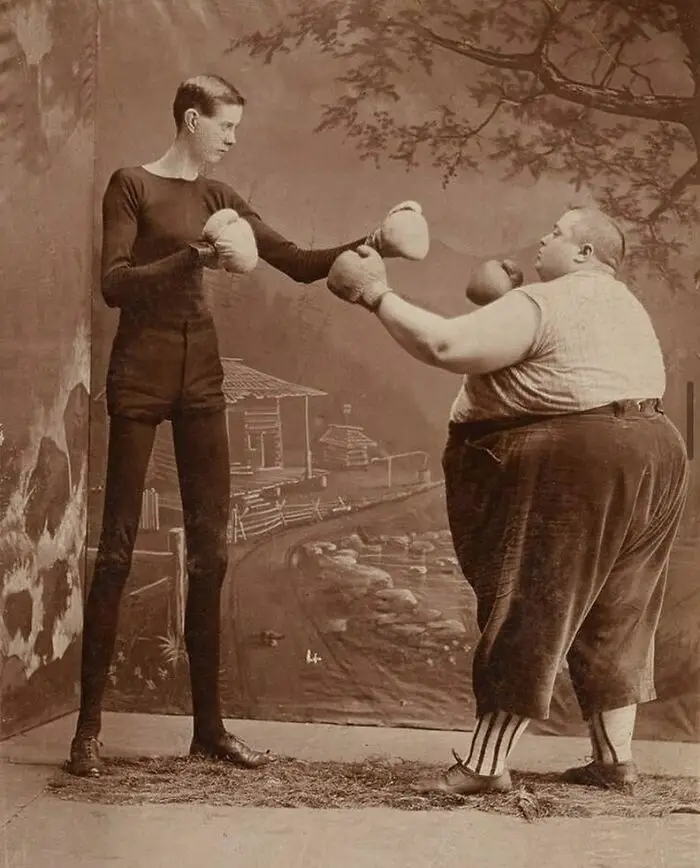
This is George Moore aka the living skeleton and Fred Howe aka the fatman who were sideshow perfomers from the late 19th century. Caption from Strand Magazine, 1897: "...Fred Howe’s father was a carpenter at Alleghany City, Penn., and Fred started to learn the same trade, but soon became too fat. At the age of eighteen he joined the Forepaugh Circus as a “fat boy,” and there met his present sparring partner. George Moore was born in Helena, Montana, where his father had a little dry goods shop. Until he was twenty-one years of age George worked in his father’s shop. But his greatest desire was to see the world. When the first big circus came to Helena, the manager offered him an engagement to exhibit himself as the “living skeleton,” and he closed with the offer at once. Fred Howe, they soon became great friends. The doctors advised both to take as much exercise as possible—the one to gain flesh, and the other to get rid of it. These smart Yankee lads then resolved to combine duty with pleasure, so they went in for boxing. For a long time they practised privately. One day, however, the manager was told of the fun by some of his “freaks,” who had been allowed to see a "set-to” between the two gladiators. The manager then arranged a round or two, and the moment he saw Howe and Moore face each other, he offered them a long engagement at an increased salary, if only they would do their boxing before the public. To-day these funny fellows are not only expert boxers, but also perfect comedians in their “art.” Their boxing is uproariously funny. Moore is 6ft. 3in. in height, and weighs but 97lb., whilst Howe is only 4ft. 2in. h**h, and weighs exactly 422lb."
Report
10points
#111
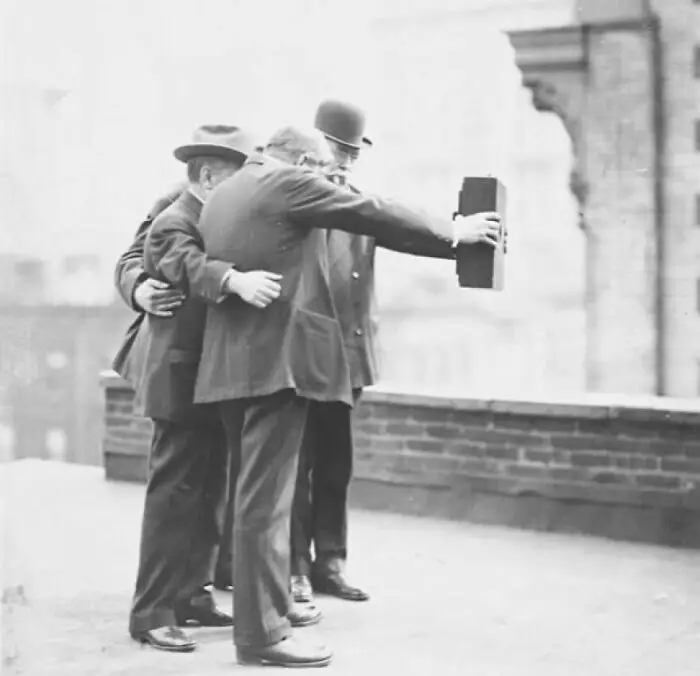
1st photo: Group taking a selfie, 1920. 2nd photo: Old selfie, circa 1920s. The first time a photographic self-portrait was taken using the same process as today, with the photographer holding the camera at arm’s length, was in December 1920. The five men who took the photo were the main photographers of the Byron Company; a photography studio founded in Manhattan in 1892 and still in business today. Another man took a photograph of the men documenting the momentous occasion. The image shows the five men standing on the roof of the Marceau Studio holding an antediluvian analog camera that was so heavy it required two of the men to hold it up. In photography, self-portraits were taking place long before the invention of Facebook and smartphones. One example is American photographer Robert Cornelius, who took a self-portrait daguerreotype (the first practical process of photography) of himself in 1839. The image is also considered one of the earliest photographs of a person. In 1914, 13-year-old Russian Grand Duchess Anastasia Nikolaevna took a self-portrait using a Kodak Brownie box camera (invented in 1900) and sent the photograph to a friend with the following note "I took this picture of myself looking at the mirror. It was very hard as my hands were trembling." Nikolaevna appears to have been the first teenager to take a selfie. The word "selfie" was chosen as the "Word of the Year" in 2013 by the Oxford English Dictionary, which has the following entry for the word: "A photograph that one has taken of oneself, typically with a smartphone or webcam and uploaded to a social media website."
Report
10points
#112
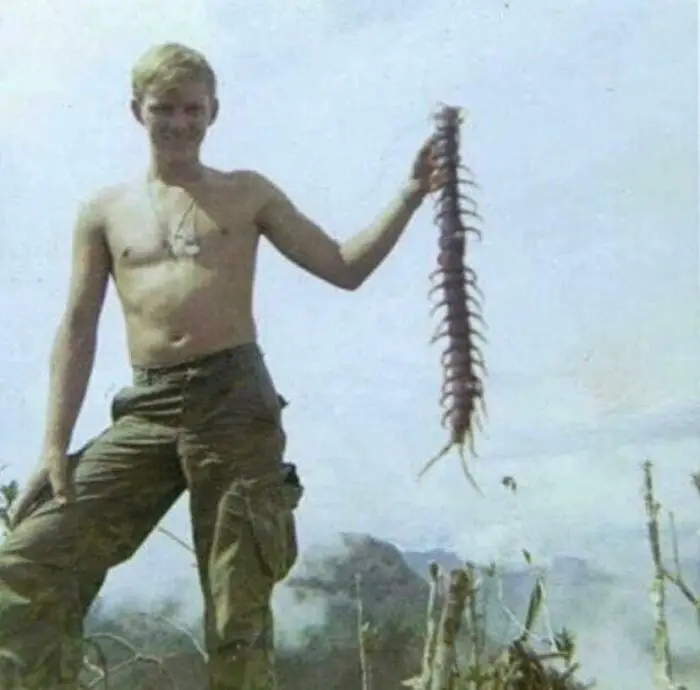
An American soldier holds up a Scolopendra subspinipes (a species of giant centipedes found throughout Asia) during the Vietnam War, 1967. The centipede preys primarily on other insects like spiders and scorpions but has the abilitv to overpower small mammals such as mice or small reptiles. It tends to eat all living creatures that it encounters that are smaller than itself. It employs its venomous jaws while using its other legs to coil and pin its prey until it dies from the fast acting venom. The centipede's body is usually reddish brown and can grow to a maximum length of 12 inches (30 cm). In the photo above, the centipede is being held up by a fishing line and is a lot closer to the camera than where the soldier is standing. He actually isn't even touching the centipede.
Report
9points
#113
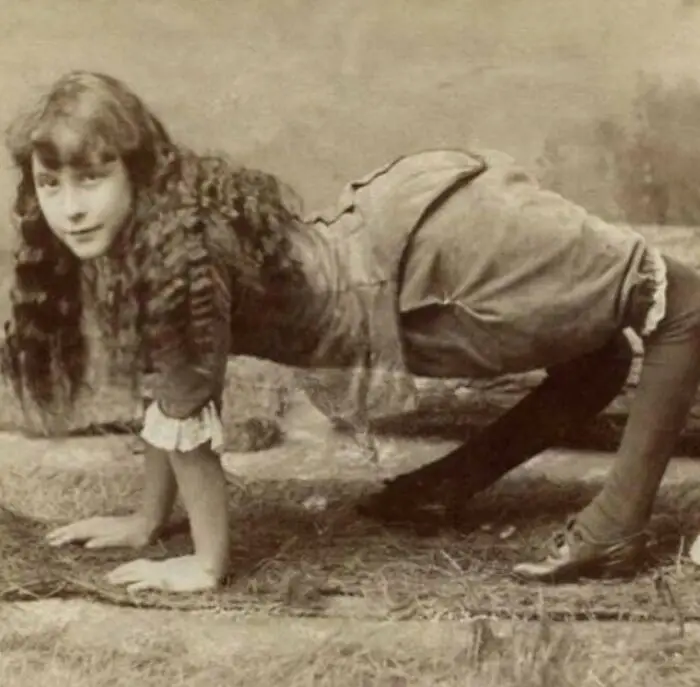
Pictured above is Ella Harper (1870-1921), also known as The Camel Girl. Ella Harper was born with a very rare condition that caused her knees to bend backwards, called congenital genu recurvatum. Her preference to walk on all fours resulted in her nickname Camel Girl. In 1886 she featured as the star in W. H. Harris’s Nick Patel circus, appearing in newspapers wherever the circus visited. Ella Harper received a 200$ salary per week during her career in the circus.
Report
9points
#114
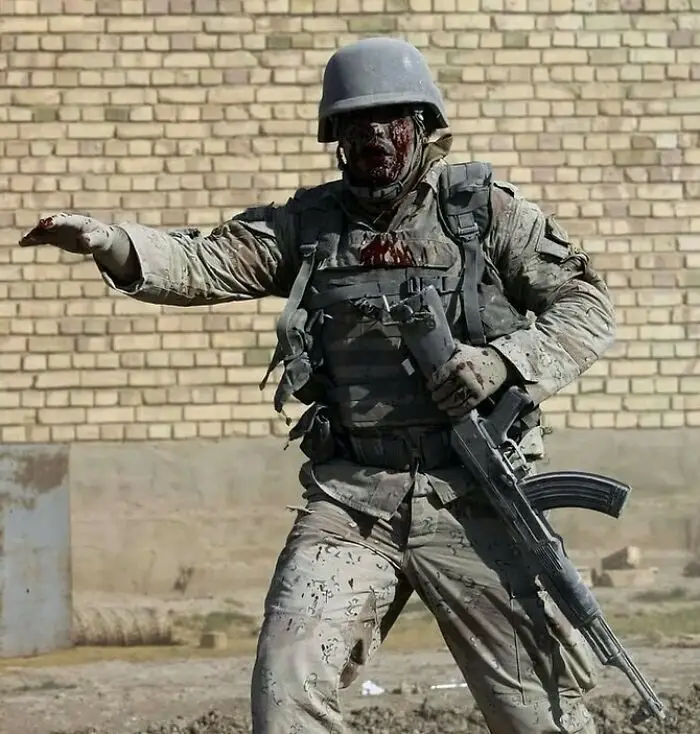
Shell-shocked Iraqi soldier after the explosion of an improvised device, 2008
Report
6points