





It is never too late to learn something new. When it comes down to it, we’re all incredibly curious about the world. But among all the responsibilities, stress, and constant rushing around, some of us temporarily forget it. Often, all it takes is just one truly intriguing and unexpected nugget of information to make you crave more knowledge.
If you’re in the mood to expand your mind, we’ve got you covered. We are featuring some of the most interesting and unusual world, science, history, and entertainment facts and photos to reframe how you perceive the past, as shared on the popular ‘Lost In Time History’ Instagram account. Got your notepad ready? Let’s go.
#41
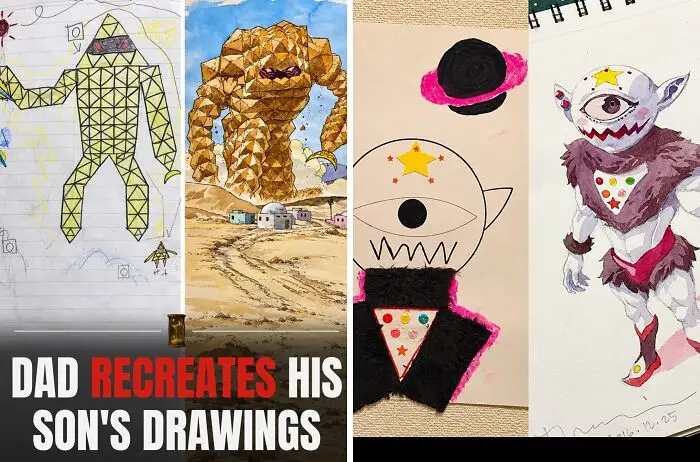
French anime artist Thomas Romain spent years designing worlds for series including Space Dandy, Basquash! and Aria, but some of his strangest characters began with drawings made by his own children. One day, a sketch by one of his sons caught his attention so strongly that he decided to redraw it professionally without changing the original idea.
That became the Father & Sons Design Workshop. His sons invent creatures, robots and characters with almost no restrictions, then Romain turns their rough drawings into detailed anime designs. The two boys even developed completely different styles: one was heavily inspired by video games, while the younger often turned everyday objects like clocks, boomerangs and plants into characters.
What started as something they did together at home eventually grew into books, videos and a huge online audience. Romain has said the project also helped encourage his sons to keep drawing, with his eldest becoming interested in animation himself. A professional career built around designing imaginary worlds ended up giving him some of its best ideas from the two people drawing beside him at home.
Credit: @thomasintokyo
Report
2points
#42
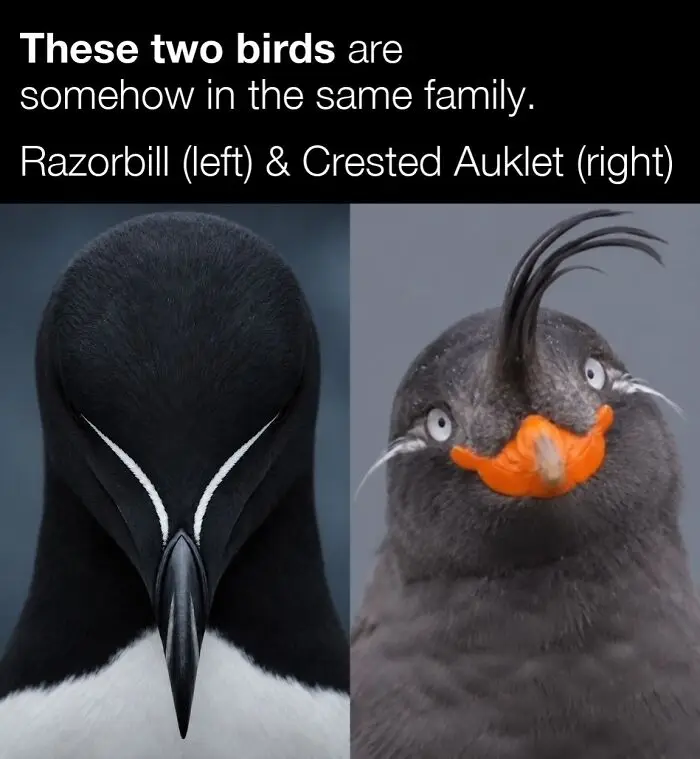
These two birds look like they belong to completely different worlds, yet they’re actually members of the same family. The razorbill (left) and crested auklet (right) both belong to the Alcidae family, a group of seabirds that also includes puffins.
The razorbill lives in the North Atlantic, where its sleek black-and-white feathers, sharp beak and distinctive white facial markings give it a rather intimidating appearance. It spends much of its life at sea, using its wings to propel itself underwater while hunting small fish.
The crested auklet, meanwhile, lives in the North Pacific and looks considerably more unusual. Its bright orange beak, pale eyes and ridiculous forward-curling hairstyle are all part of its breeding-season appearance. The longer feather crests are particularly important during courtship, helping birds attract potential partners.
Even stranger, crested auklets naturally produce a scent resembling tangerines. During courtship, pairs rub against each other’s scented feathers, apparently using smell as part of their social interactions. Once the breeding season ends, their bright beaks become duller, their crests shrink and their white facial plumes disappear.
Report
2points
#43
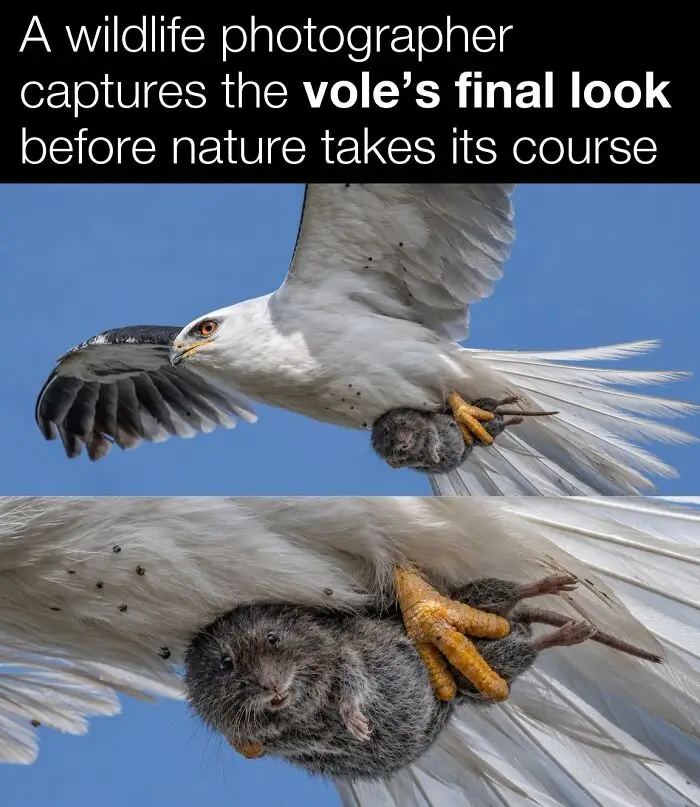
On June 15, 2025, wildlife photographer Sha Lu captured an extraordinary photograph in Mountain View, California, showing a white-tailed kite flying through the air with a vole clutched in its talons. Remarkably, the tiny rodent appeared to be staring directly into the camera with a look of absolute terror.
The photograph was taken as an adult kite prepared to pass its prey to one of its offspring in mid-air. Lu had spent years photographing these food exchanges, but initially thought he had missed the perfect shot because the bird was facing away from him.
It was only when reviewing the photographs afterwards that he noticed the vole’s unforgettable expression. The image quickly went viral, with people comparing it to a scene straight out of an animated film.
Sha Lu (@shaluwtk)
Report
2points
#44
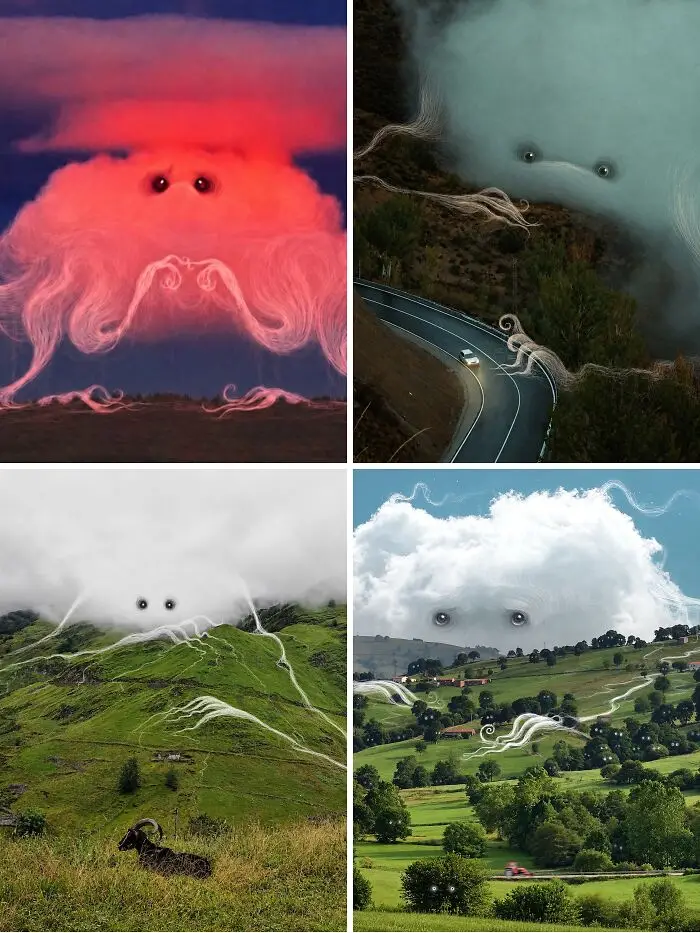
Most people see shapes in clouds for a few seconds before they disappear. Artist Vorja Sánchez takes those imagined creatures and makes them visible.
While walking through forests and landscapes, Sánchez photographs moments when clouds, mist, trees and water seem to suggest something alive. He then draws directly over the photograph, following shapes that were already there. A curling cloud becomes the body of a serpent, mist develops eyes and limbs, and an ordinary landscape suddenly appears to contain enormous spirits hiding in plain sight.
The series is fittingly called Interventions. Sánchez has explained that he tries to find the soul of each landscape rather than simply placing a creature into it. That is what makes the images so convincing. Look back at the original photograph and the monster suddenly feels as though it had been hiding there all along, waiting for someone to notice it.
Artist: @vorjailustracion
Report
2points
#45
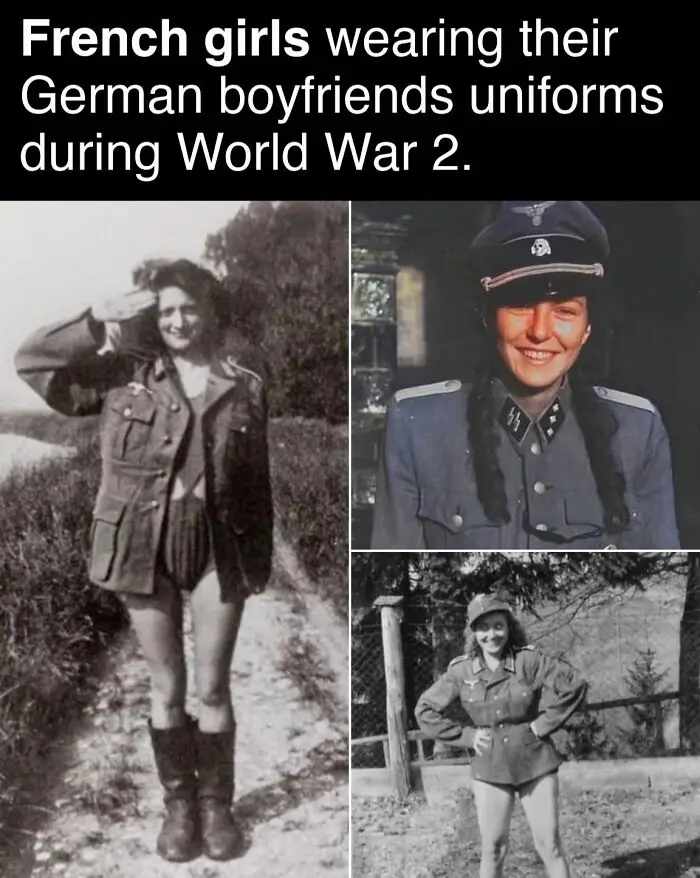
During the Second World War, some women in occupied France formed relationships with German soldiers, and private photographs captured women posing in borrowed military uniforms. Oversized jackets, caps and boots became part of these personal snapshots taken during the occupation.
German forces occupied Paris in June 1940, beginning four years in which military personnel became part of everyday life across the city. Relationships developed under very different circumstances, from personal attachments to arrangements shaped by money, food shortages and the unequal power of occupation.
After liberation, women accused of relationships with Germans could face public punishment. Historians estimate that around 20,000 French women had their heads shaved during the purges of 1944–45, often without a trial.
Some were targeted for romantic relationships, while others were accused over different connections, including work undertaken for the occupying forces. These punishments became some of the most photographed scenes of the liberation, with women paraded through streets before crowds
Report
2points
#46
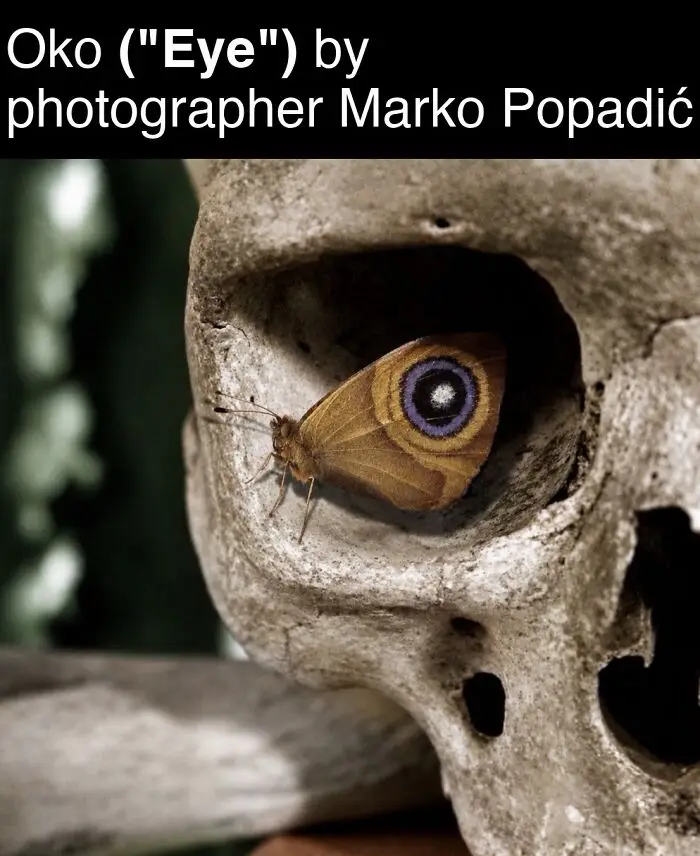
“Oko” by Marko Popadić shows a butterfly inside the empty eye socket of a human skull. Its wing marking aligns so perfectly with the cavity that it creates the eerie illusion of an eyeball staring back at the viewer.
Created using coloured infrared photography, the image brings together two powerful symbols: a skull representing mortality and a butterfly representing rebirth and transformation. Their contrast makes it feel as though life has briefly returned to the skull.
Report
2points
#47
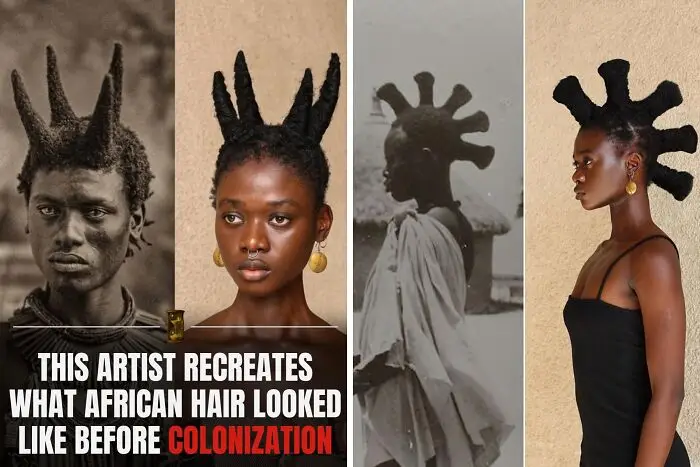
Laetitia Ky is an Ivorian artist who transforms her own hair into striking sculptures using braids, wire and careful shaping. Her creations can form people, animals, symbols and entire scenes, often exploring African culture, identity, feminism and freedom.
The idea began after Ky discovered old photographs of African women wearing elaborate pre-colonial hairstyles. She realised many of these styles had once carried deep meaning but had been largely forgotten or overlooked.
Across different African societies, hairstyles could reveal someone’s age, marital status, social position, ethnicity or beliefs. Ky reimagines that history in a modern way, turning her own hair into a living form of art that connects the present with the past.
Artist: @lae
Follow @lostintimehistory for more!
Report
2points
#48

When the FBI hired a hitman to do its dirty work
In 1966, the FBI was struggling to break the Klan’s grip on Mississippi. Civil rights leaders were being violently targeted, yet every legal attempt to catch those responsible had failed.
One of the victims was Vernon Dahmer, a farmer and NAACP leader who allowed Black residents to register to vote at his store. After Klansmen firebombed his home during the night, Dahmer lost his life and investigators were left with no solid leads.
With nowhere else to turn, the FBI reportedly tried something far more unconventional.
They called Gregory Scarpa, an infamous Colombo family hitman who had secretly worked as an FBI informant since 1962. Known as the “Grim Reaper,” Scarpa claimed he had stopped counting his victims after 50.
Scarpa was flown to Mississippi and briefed on the case. He reportedly entered a Klansman’s TV shop, bought a television and asked the man to help load it. Scarpa then took him into the woods.
Weeks later, the Klansman signed a 22-page confession that finally broke the case open.
The story has now inspired the film By Any Means, arriving September 4 and starring Mark Wahlberg as Gregory Scarpa alongside Yahya Abdul-Mateen II as the FBI agent partnered with him.
Report
2points
#49
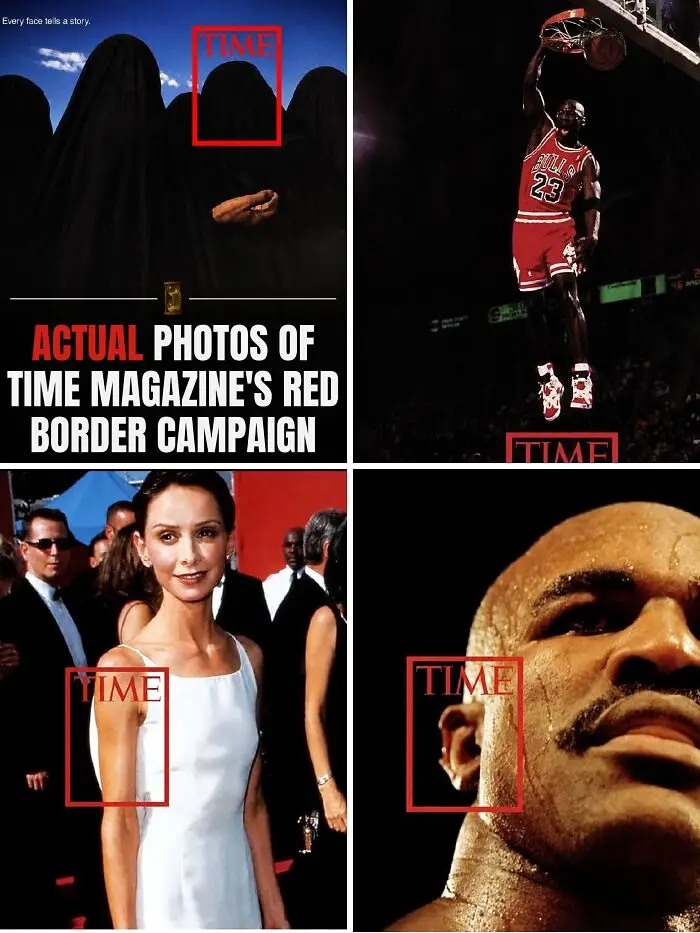
TIME’s famous “World’s Most Interesting Magazine” campaign began in 1996 with a brilliantly simple idea. Its instantly recognisable red cover border was reduced to a small box and placed around one revealing detail in a photograph—suggesting that even the smallest part of an image could contain an entire story.
More than 50 different adverts were eventually created. After Mike Tyson bit Evander Holyfield’s ear during their infamous 1997 rematch, TIME needed only to frame Holyfield’s ear for viewers to understand the reference. Another advert highlighted the gorilla that protected a three-year-old boy after he fell into its enclosure, presenting the remarkable moment as proof that the world could still surprise and inspire us.
Perhaps the campaign’s cleverest advert appeared during the Monica Lewinsky scandal. Rather than explaining the controversy, TIME simply placed its red frame around Bill Clinton visibly sweating. The audience already knew the story; the photograph only had to capture the pressure surrounding it.
Report
2points
#50
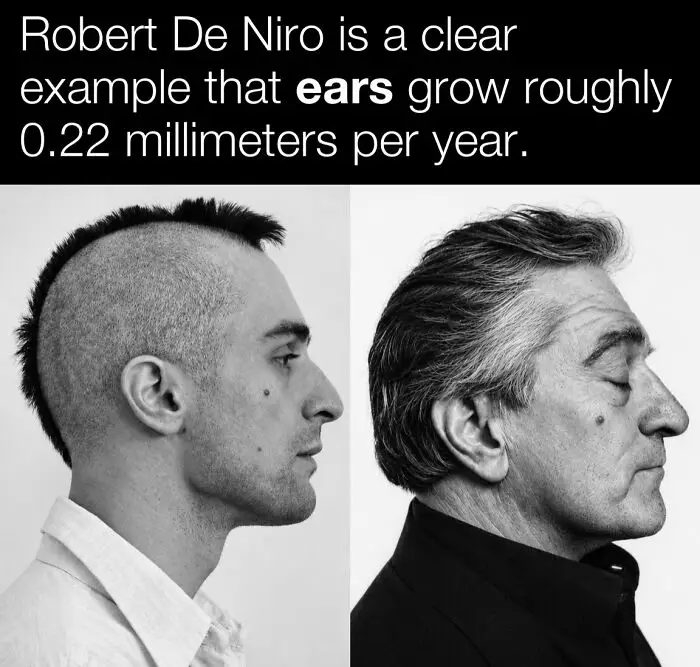
Robert De Niro’s changing appearance over the decades is a striking example of how our ears continue to get larger as we age, even after the rest of our body has stopped growing.
In 1995, a study published in the British Medical Journal examined the ears of 206 people aged between 30 and 93. Researchers discovered that ear length increased by an average of 0.22 millimetres per year. That might sound tiny, but over 50 years, it adds up to approximately 1.1 centimetres.
The change happens partly because the cartilage and surrounding tissues gradually lose their elasticity as we age. Gravity also stretches the earlobes over time, while changes in facial fat can make the ears appear even more prominent. Unlike most parts of the body, these changes can continue well into old age.
Interestingly, a larger study published in 2007, involving 1,353 people, confirmed that ears tend to become longer and wider with age, although the exact rate varies between individuals.
Report
2points
#51
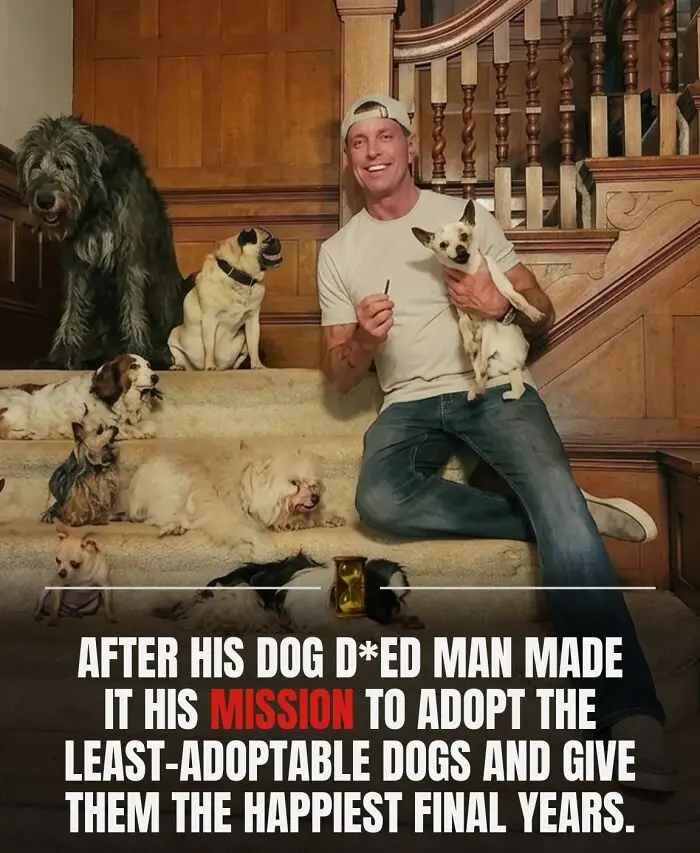
Steve Greig never expected that the passing of his beloved dog, Wolfgang, would completely change his life. After struggling with grief for months, he decided the best way to honour his companion was to visit a local shelter and ask for the dog nobody else wanted. Shelter staff introduced him to Eeyore, a 12-year-old Chihuahua with a heart murmur and four bad knees—an elderly dog who had little chance of being adopted.
Bringing Eeyore home became the start of something much bigger. Steve began adopting senior dogs with medical conditions and disabilities that were often overlooked in shelters, saying each one deserved to spend its final years in a loving home. Over time, his family grew to include not only elderly dogs, but also rescued cats, a pig named Bikini, a turkey named Cranberry, and other animals, each with their own special needs and daily routines.
Today, Steve’s home has become a sanctuary for animals that many people would have passed by. He prepares individual meals, medications, and care plans every day, and whenever one of his rescued dogs passes away, he honours them by giving another overlooked animal the same second chance. His story has inspired millions of people around the world to see senior pets not as the ones left behind, but as companions still full of love to give.
Report
1point
#52
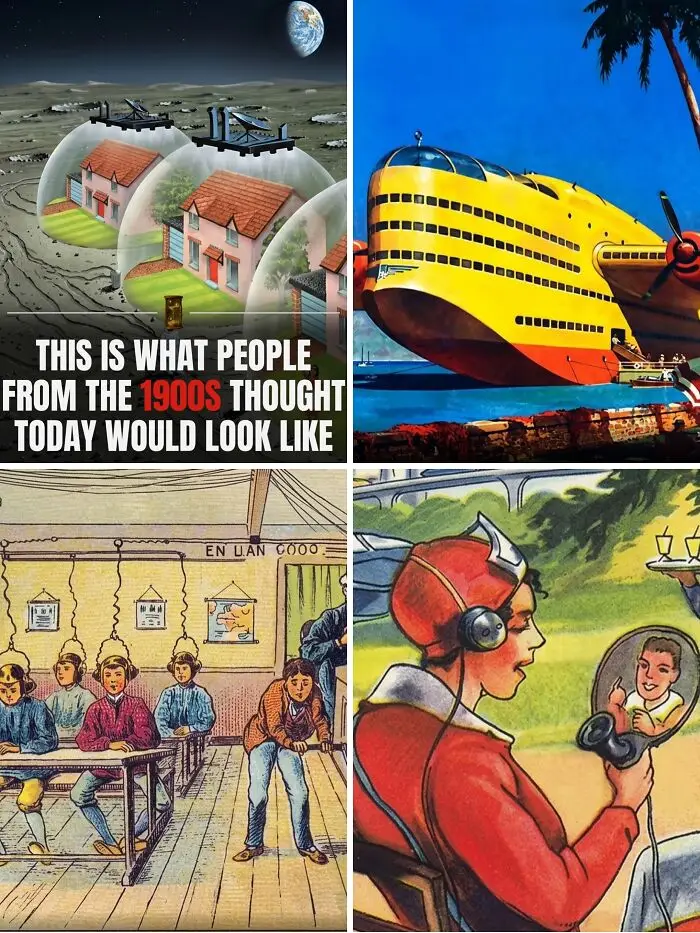
Around the turn of the 20th century, artists were fascinated by what everyday life might look like in the future. One of the most imaginative collections was the French En L’An 2000 series, which pictured people living beneath giant glass domes on the Moon, entire cities protected by enormous transparent shields, and families making face-to-face calls through wall-mounted screens decades before television—or even video calling—existed. Many of the illustrations were created as postcards for the 1900 Paris Exposition, offering a surprisingly optimistic vision of the centuries ahead.
Other predictions imagined technology transforming daily life in unexpected ways. One 1910 illustration showed schoolchildren wearing helmets while books were fed into a machine that supposedly transferred knowledge directly into their brains. Another imagined personal air conditioning units people could carry onto trains, while engineers were pictured preserving food indefinitely using massive electrical discharges instead of refrigerators. Although none of these inventions appeared exactly as imagined, they reflected a growing belief that science would solve almost every problem.
Transportation was perhaps where imaginations ran wildest. Artists drew tiny single-person bubble cars replacing traditional automobiles, enormous flying boats carrying entire floating hotels across oceans, highways lined with rolling spherical homes, and cities linked by layers of elevated skywalks and monorails. More than a century later, many of those predictions never arrived—but they remain a fascinating glimpse into how previous generations imagined the future we would eventually live in.
Report
1point
#53
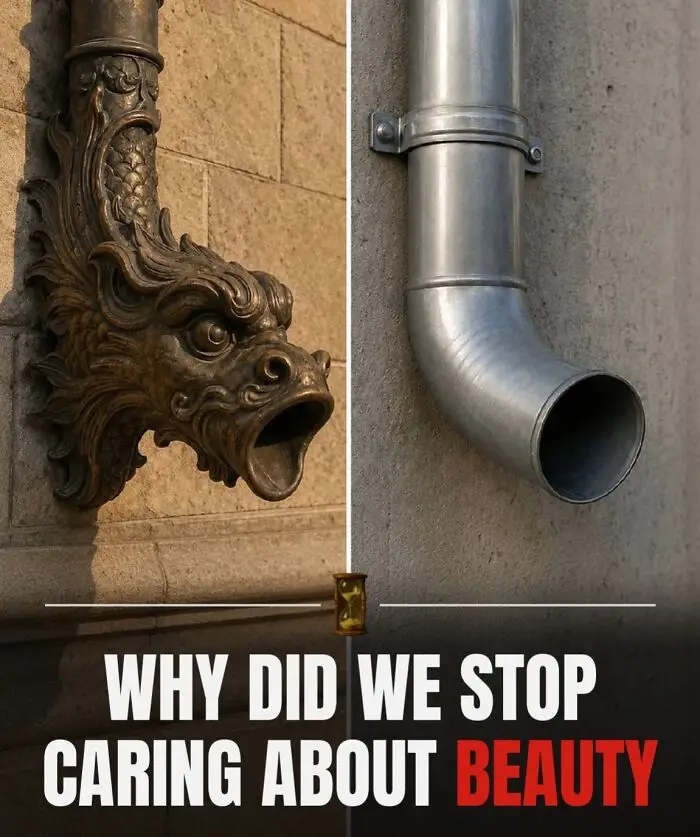
Historic cities often treated everyday objects as works of art. Street clocks, fountains, bridges, doors and lamp posts were designed with detailed carvings, decorative metalwork and craftsmanship meant to last for generations.
Modern cities usually prioritise cost, safety, accessibility, durability and easy maintenance. That often creates cleaner, simpler designs that work efficiently but can feel less distinctive.
The best future cities may combine both approaches: modern function without losing the beauty and character that made older streets memorable
Report
1point