



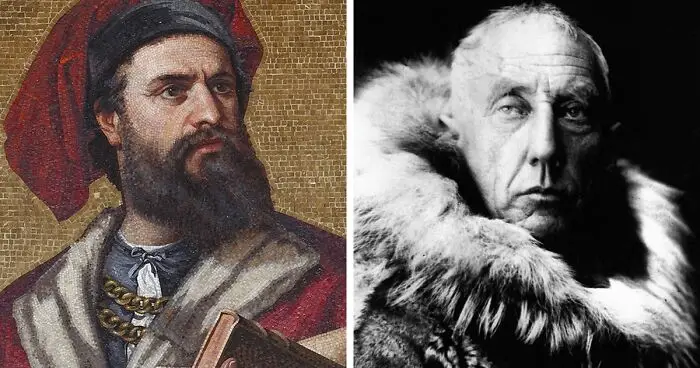


In the vast human history, there existed a unique breed of individuals — they possessed a thirst for the unknown and a great desire to venture beyond the confines of familiarity. These remarkable men and women had a relentless spirit of discovery that helped broaden our knowledge of the world. So today, we’ll go on a thrilling voyage through history and talk about several such famous explorers.
They traveled to the depths of the ocean and scaled inhospitable mountains; they took to the seas in search of trade; they conquered the poles. These famous historical explorers enriched our understanding of the world. Our list includes famous European explorers such as Marco Polo, whose travels across the ancient Silk Road bridged the gap between East and West, and Ferdinand Magellan, who led the first circumnavigation of the globe. We’ll also look at the exploits of famous female explorers, such as Amelia Earhart and Nellie Bly, who undertook solo voyages.
These famous explorers embody the essence of human curiosity and ambition. Their feats will remind you that everyone has the potential to conquer the unknown and embark on their own grand adventures.
Let’s take a look at their extraordinary journeys.
#41 Francisco Serrão

Francisco Serrão was a 16th-century Portuguese naval officer. He joined the expedition led by Afonso de Albuquerque to conquer the Malacca trading port. He is also famous for his travels to the Moluccas (present-day Indonesia) to establish a spice trade. He even received permission from the Sultan of Ternate (an island in Indonesia) to establish a Portuguese trading post. This marked the first European presence in the Spice Islands.
Report
4points
#42 James Cook

James Cook served in the British Royal Navy during the late 18th century. He was a very famous explorer, known for his voyages to eastern Australia and for circumnavigating New Zealand. The Cook Islands near New Zealand are named after him.
Cook was an expert cartographer and also became the first European to establish a friendly dialogue with the Hawaiians.
4points
#43 John Cabot

Cabot was an Italian explorer who led expeditions for King Henry VII of England to explore new trade routes. On his first expedition in 1497, he reached the coast of North America, likely in present-day Newfoundland, Canada. His voyages and accurate maps helped establish England’s claim to North America.
He is believed to have perished at sea during his second exploration in 1498.
Report
4points
#44 George Everest

George Everest was a British geographer who served the British Empire of India from 1830 to 1843. He is best known for his work in surveying the Indian subcontinent, including the measurement of the height of the Himalayan mountain range.
Report
4points
#45 Daniel Boone

Daniel Boone (1734–1820) was an American pioneer who led the westward expansion of the United States. In 1775, Boone created a trail known as the Wilderness Road, which allowed settlers to move through the Appalachian Mountains and into Kentucky. Boone established the settlement of Boonesborough, Kentucky.
Report
3points
#46 Jacques Cartier

Jacques Cartier was a French explorer in the 16th century. He led explorations to the New World and established French colonies in Canada. Originally, he had planned to find a direct route to Asia to establish a permanent colony there. However, his voyages led him to Canada.
Jacques Cartier is considered one of the key figures in the early European exploration of Canada. He is believed to have played a significant role in French colonial history. His voyages laid the groundwork for the establishment of New France, which eventually grew into the French colonies in North America and the foundation of modern-day Quebec.
Report
2points
#47 Juan Ponce De León

Juan Ponce de León (1474–1521) was a Spanish explorer. He is credited with discovering and naming modern-day Florida. He called it “La Florida” (flowery) because he arrived during the Easter season, which is known as “Pascua Florida” in Spanish.
León is also remembered for his quest for the Fountain of Youth, although it is considered more of a legend than a historical fact.
Report
2points
#48 Samuel De Champlain

Samuel de Champlain (1574–1635) is often referred to as the “Father of New France.” He founded Quebec City and New France, which later came to be known as Canada.
The French explorer and cartographer wrote extensively about his voyages and observations of the New World in his works, titled Des Sauvages (Of the Savages) and Les Voyages du Sieur de Champlain (The Voyages of Samuel de Champlain).
Report
2points
#49 Robert Peary

Robert Peary (1856–1920) was an American explorer and naval officer known for his expeditions to the Arctic.
Report
2points
#50 Christopher Columbus

Christopher Columbus was perhaps the most famous (or infamous) explorer of all. The Italian explorer made several voyages across the Atlantic Ocean in the late 15th century. He arrived in the Americas in 1492, which he believed were the Indies (Asia). Amerigo Vespucci, the Italian explorer and cartographer, is credited with realizing that the lands Columbus encountered were in fact a separate continent from Asia.
His exploration led to the discovery of the Americas. On the downside though, it also paved the way for the plundering of Native American land.
Report
1point
#51 Henry Hudson

Henry Hudson was an English explorer in the early 17th century. He is credited with discovering the Hudson River, Hudson Bay, and the Hudson Strait. He is believed to have disappeared in 1611 when his crew mutinied and refused to go on further explorations with him.
Report
1point
#52 Vasco Núñez De Balboa

Vasco Núñez de Balboa (1475–1519) is best known for leading the first European expedition to reach the Pacific Ocean from the Americas. In 1510, Balboa joined an expedition to establish a colony in present-day Panama. He also established the first European settlement on the American mainland, which he named Santa María la Antigua del Darién.
Report
1point
#53 Hernando De Soto

Hernando de Soto was a 16th-century Spanish explorer. He was a part of Francisco Pizarro’s expedition to conquer Peru in 1531 and played a crucial role in the conquest. De Soto was appointed governor of Cuba. However, he wanted to continue exploring new lands. He traveled across what is now the southeastern United States, exploring areas such as Florida, Georgia, Alabama, Mississippi, and Arkansas in a quest to find gold. He passed away in May 1542 from a mysterious fever.
1point
#54 Juan De La Cosa

Juan de la Cosa was a 15th-century Spanish explorer who served under famous explorers such as Christopher Columbus, Alonso de Ojeda, and Rodrigo de Bastidas. He also led his own expeditions to Jamaica and Haiti.
Report
0points
#55 Francisco Pizarro

Spanish conqueror Francisco Pizarro (1471–1541) is most famous for his conquest of the Inca Empire in present-day Peru. He founded the city of Lima, which became the capital of the Spanish Viceroyalty of Peru.
Report
0points


