



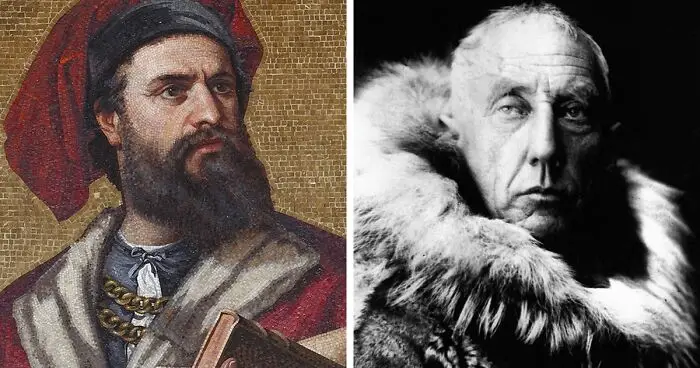


In the vast human history, there existed a unique breed of individuals — they possessed a thirst for the unknown and a great desire to venture beyond the confines of familiarity. These remarkable men and women had a relentless spirit of discovery that helped broaden our knowledge of the world. So today, we’ll go on a thrilling voyage through history and talk about several such famous explorers.
They traveled to the depths of the ocean and scaled inhospitable mountains; they took to the seas in search of trade; they conquered the poles. These famous historical explorers enriched our understanding of the world. Our list includes famous European explorers such as Marco Polo, whose travels across the ancient Silk Road bridged the gap between East and West, and Ferdinand Magellan, who led the first circumnavigation of the globe. We’ll also look at the exploits of famous female explorers, such as Amelia Earhart and Nellie Bly, who undertook solo voyages.
These famous explorers embody the essence of human curiosity and ambition. Their feats will remind you that everyone has the potential to conquer the unknown and embark on their own grand adventures.
Let’s take a look at their extraordinary journeys.
#21 Amerigo Vespucci

The Americas are named in honor of Amerigo Vespucci, an Italian explorer. He lived from the mid-15th to early 16th centuries and wrote extensively about “the New World” in his letters. His explorations led to the discovery that the new ports were not just islands but vast continents.
Report
11points
#22 Edmund Hillary

Edmund Hillary was the first person to reach the summit of Mount Everest along with Nepalese Sherpa, Tenzing Norgay. He also became the first person to explore all three poles — the North Pole (1985), the South Pole (1958) and Mount Everest (1953).
Report
11points
#23 Abel Tasman

He was a Dutch explorer who discovered Fiji, New Zealand, and Tasmania in the 17th century. Tasman’s charts and reports were used by several European navigators to explore the region down under. New Zealand has commemorated his name at various locations, such as the Abel Tasman National Park.
10points
#24 Victor Vescovo

Victor Vescovo is a modern-day explorer. The retired American naval officer has led expeditions to the deepest points in the world’s oceans, including the Challenger Deep in the Mariana Trench. In 2018–2019, he conducted the famous “Five Deeps Expedition” to map the ocean floor.
Vescovo also flew into space aboard the Blue Origin NS-21 mission in 2022. And if that’s not all, he has also climbed Mount Everest!
Report
10points
#25 Matthew Henson

Matthew Henson was an African American explorer. He joined Robert Peary on his explorations. Their most famous expedition was to the North Pole in 1908.
Report
10points
#26 Alfonso De Albuquerque

Afonso de Albuquerque was a Portuguese naval officer posted in Portuguese India in the early 16th century. He played a big role in establishing trade relations with Burma, Ethiopia, Persia, Siam, and Timor. He was crowned with the epithet “the Lion of the Seas” for being the first European to sail into the Red Sea. He was controversial figure as he was sent on colonization missions.
Report
9points
#27 Ferdinand Magellan

Ferdinand Magellan is honored as the first person to circumnavigate the planet. Although he was Portuguese, Magellan is best known for his service to the Spanish crown. He began his explorations in 1519 in search of a western sea route to the lucrative Spice Islands (now Indonesia). Magellan discovered a passage, later named the Strait of Magellan in his honor, which allowed his fleet to access the Pacific Ocean.
Ironically, he never actually completed his entire journey. He breathed his last in the Philippines in 1521, in the famous Battle of Mactan. However, one of his ships managed to complete the circumnavigation and returned to Spain in 1522.
Report
9points
#28 Francis Drake

Sir Francis Drake was an English sea captain who lived in the 16th century. He was the first Englishman to circumnavigate the world. During his voyage, Drake explored the western coast of South America, reaching as far as modern-day California. He claimed new territories for England and plundered Spanish settlements and ships, acquiring substantial wealth in the process. Upon his return to England in 1580, Drake was hailed as a national hero. Queen Elizabeth I even visited his ship known as the “Golden Hind” and knighted him on board.
In 1596, Drake led a failed expedition to the Spanish West Indies. He fell ill during the campaign and passed away fromdysentery off the coast of Panama.
Report
8points
#29 Hernán Cortés

Hernán Cortés is best known for leading the expedition that led to the fall of the Aztec Empire and colonization of Mexico by Spain in the 16th century. Despite being a controversial figure, Cortés played a significant role in shaping the history and culture of Mexico.
Report
8points
#30 Sir Walter Raleigh

Sir Walter Raleigh (1552–1618) was an English explorer during the Elizabethan era. He led several English expeditions to the Americas.
Report
8points
#31 Sir Ranulph Fiennes

Sir Ranulph Fiennes is a British adventurer who was born in 1944. He has traveled to both North and South Poles and has also undertaken the “Transglobe Expedition,” covering over 35,000 miles.
Fiennes has also undertaken multiple expeditions to climb the world’s highest peaks. He summited Mount Everest at the age of 65, becoming the oldest British person to achieve this feat.
Report
8points
#32 Xuanzang

Xuanzang was a Chinese Buddhist monk who lived in the 7th century during the Tang Dynasty. He undertook extensive journeys to India to acquire Buddhist scriptures and promote Buddhist teachings in China.
Report
8points
#33 Alonso De Ojeda

Alonso de Ojeda was a Spanish “conquistador” or conqueror in the late 15th and early 16th centuries. He first served under Christopher Columbus but later set out on his own explorations. He undertook expeditions to Venezuela, Colombia, Guyana, Aruba, Curacao, Trinidad and Tobago.
Ojeda spent his last days in the Dominican Republic repenting the cruelties he committed as a conqueror. In his final days, he wrote a will stating his body be buried at the entrance of a monastery. He wanted visitors to walk over his tomb as his atonement.
Report
7points
#34 Georg August Wallin

Georg August Wallin was a Finnish explorer who lived in the 19th century. He was famous for his scholarly research on the Middle East. Disguised as an Arab named Abd al-Wali, he studied the region’s culture and politics extensively.
Report
7points
#35 Juan Sebastián Elcano

Juan Sebastián Elcano (1476–1526) was a Spanish navigator who was on Ferdinand Magellan’s expedition to circumnavigate the Earth. While Magellan passed away during the voyage in the Philippines, Elcano took command of the expedition’s remaining ship, named Victoria. Under Elcano’s leadership, the Victoria continued westward, crossing the Indian Ocean, rounding the Cape of Good Hope, and finally arriving in Spain in September 1522. This successful completion of the circumnavigation made Elcano and his crew the first people to sail around the world.
Report
6points
#36 Pedro Álvares Cabral

Pedro Álvares Cabral was a Portuguese navigator credited with leading the first European expedition to reach Brazil in 1500. He is believed to have named Brazil after brazilwood, a valuable resource at the time. His exploration marked the beginning of Portuguese trading posts, forts, and eventually colonies in Brazil.
Report
6points
#37 Lewis And Clark

Meriwether Lewis and William Clark led the famous expedition from the Mississippi River to the West Coast and back from 1804 to 1806. The expedition, known as the “Corps of Discovery,” was sanctioned by then-President Thomas Jefferson to map the newly acquired lands in West America.
Report
6points
#38 António De Abreu

António de Abreu led an expedition in the 16th century to the “spice islands” (modern-day Indonesia and Malaysia) and started a trade of nutmeg and cloves. He was a Portuguese officer serving under Afonso de Albuquerque.
Report
5points
#39 Henry The Navigator

Henry the Navigator was a Portuguese prince who lived from 1394 to 1460. He played a crucial role in the Age of Discovery and was a key figure in Portugal’s maritime exploration. Henry never commanded any voyages himself. However, he did an extensive study of cartography, shipbuilding, and astronomy and sponsored numerous expeditions to Africa and Asia. His efforts led to the discovery of several Atlantic islands.
5points
#40 Bartolomeu Dias

Bartolomeu Dias lived in 15th-century Portugal. He led various trading expeditions to West Africa, particularly Congo. Dias also sailed to Brazil, the Orient and India. He even discovered the Cape of Good Hope in the late 15th century. He had originally named it “the Cape of Storms” for its terrible weather. However, the King of Portugal renamed it “the Cape of Good Hope.” Ironically, his ship sank in a storm near the Cape of Good Hope.
Report
4points


