








Ozzy Osbourne lived a life of great excess. And when he died this year at the age of 76, many were saddened but also surprised that it hadn't happened earlier.
“[He] had lived on the edge for such a long time, the fact he lived as long as he did was a miracle,” the rocker's close friend, Tom Morello said on a radio show.
It turns out the miracle was in his genes. You see, Osbourne had a rare genetic mutation that allowed him to metabolize alcohol and other substances much faster than normal. And this, say scientists, is what kept him alive despite decades of self-destructive behavior.
That interesting fact is one of many that can be found on an Instagram page called Science. The account has amassed a cool 1.7 million followers and it's not difficult to see why. Unlike many other facts pages, which purely share fast and fun tidbits, this one fleshes out each scientific fact and gives the context, explanation and source in a detailed caption.
Bored Panda has put together a list of the best posts from the page for you to scroll through instead of watching mindless shorts this weekend. So sit back, relax and let your brain thank you later. Don't forget to upvote your favorites.
#21
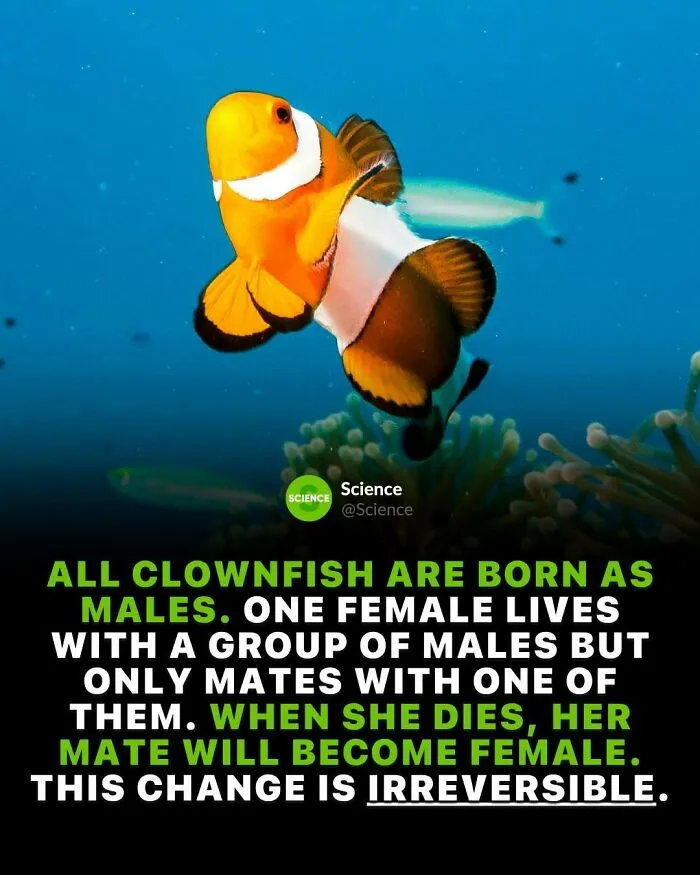
Clownfish are all born males, and the dominant male of a group will turn female when the female of that group dies.
Clownfish, also known as anemonefish, are sequential hermaphrodites that first develop into males. They live in regimented schools made up of all males and just one female, the lone female being the dominant and generally the largest fish in a given group. The second in command of the school is usually the largest and most aggressive male of the group. Due to his dominance over the other males, he tends to ensure they stay small by taking the best food opportunities for himself and his kind. Besides the perks of more food, he’s also the only one who gets to breed with the female.
During breeding, the female will sometimes lay thousands of eggs, depending on the species and her size, usually on a pre-cleaned rock or coral close to the anemone they live in. After the eggs are laid, the male will go along and fertilize them.
_____
From here, if a given egg is poor quality, whether damaged or it becomes infected by a fungus or the like, the male will typically eat the egg. Likewise, if the egg is infertile, or if the clownfish is an inexperienced breeder or stressed, he may also simply eat the eggs.
Otherwise, the male, and rarely the female, will guard the fish for the 6-10 days it takes to hatch, as well as regularly fan them, which increases the chances of the eggs successfully developing. After the eggs hatch, the parents’ job is done, and they have nothing to do with the baby fish, who ascend to the surface and feed on plankton until maturation.
If the female dies, the dominant male will get the first choice of food and begin to gain weight, ultimately becoming female. She will then choose a breeding partner among the available males, which is usually the largest and most aggressive male available.
Clownfish, also known as anemonefish, are sequential hermaphrodites that first develop into males. They live in regimented schools made up of all males and just one female, the lone female being the dominant and generally the largest fish in a given group. The second in command of the school is usually the largest and most aggressive male of the group. Due to his dominance over the other males, he tends to ensure they stay small by taking the best food opportunities for himself and his kind. Besides the perks of more food, he’s also the only one who gets to breed with the female.
During breeding, the female will sometimes lay thousands of eggs, depending on the species and her size, usually on a pre-cleaned rock or coral close to the anemone they live in. After the eggs are laid, the male will go along and fertilize them.
_____
From here, if a given egg is poor quality, whether damaged or it becomes infected by a fungus or the like, the male will typically eat the egg. Likewise, if the egg is infertile, or if the clownfish is an inexperienced breeder or stressed, he may also simply eat the eggs.
Otherwise, the male, and rarely the female, will guard the fish for the 6-10 days it takes to hatch, as well as regularly fan them, which increases the chances of the eggs successfully developing. After the eggs hatch, the parents’ job is done, and they have nothing to do with the baby fish, who ascend to the surface and feed on plankton until maturation.
If the female dies, the dominant male will get the first choice of food and begin to gain weight, ultimately becoming female. She will then choose a breeding partner among the available males, which is usually the largest and most aggressive male available.
Report
33points
#22

Relaxation has been linked to plenty of health benefits, including reduced stress and muscle tension, and a decreased risk of depression, anxiety, and other mental health issues.
In fact, according to Yale University, it is essential to schedule relaxation time on a weekly calendar, emphasizing that it’s just as important as other commitments. Although this downtime may seem unproductive, it’s vital for destressing, Yale said.
However, balance is key. If you’re spending so much time relaxing that you’re neglecting exercise, socializing, or getting enough sleep, it might be time to reevaluate.
Regardless of when or which activity you choose, marriage and family therapist Colleen Marshall advised in Yahoo News to be fully present in the moment and enjoy the chosen activity without distractions. “When we feel better, we’re more productive and successful,” she concluded.
In fact, according to Yale University, it is essential to schedule relaxation time on a weekly calendar, emphasizing that it’s just as important as other commitments. Although this downtime may seem unproductive, it’s vital for destressing, Yale said.
However, balance is key. If you’re spending so much time relaxing that you’re neglecting exercise, socializing, or getting enough sleep, it might be time to reevaluate.
Regardless of when or which activity you choose, marriage and family therapist Colleen Marshall advised in Yahoo News to be fully present in the moment and enjoy the chosen activity without distractions. “When we feel better, we’re more productive and successful,” she concluded.
Report
32points
#23

420 earthquakes in a short time ripped a 35-mile gash through Africa—and scientists say it's the birth of Earth's next ocean.
In 2005, Ethiopia's Afar region shuddered as the ground split open at breakneck speed. What normally takes centuries happened in mere days, creating a 60-kilometer (~37 mi) fissure up to 10 meters (~393 in) deep. This wasn't just another earthquake disaster—it marked the moment Africa began tearing itself in two.
The East African Rift stretches 4,000 miles from Mozambique to the Red Sea, where three tectonic plates pull apart at 0.8 centimeters (0.3 in) annually. Scientists once believed this continental breakup would take tens of millions of years. New research slashes that timeline to just 1 million years—possibly even 500,000.
Beneath the Afar, researchers discovered something extraordinary: Earth has a geological heartbeat. Rhythmic pulses of molten rock surge upward from the mantle, channeled by the splitting plates above. These ascending waves carry distinct chemical signatures, behaving like blood flowing through arteries of different sizes.
The rift offers scientists the only real-time view on Earth of continental crust transforming into oceanic crust—the same process that birthed the Atlantic Ocean 200 million years ago. As the plates diverge, magma fills the gaps, creating new seafloor that will eventually flood with water from the Red Sea.
The implications stretch far beyond geology. Landlocked nations like Uganda and Zambia could gain coastlines, transforming their economies overnight. Marine ecosystems will colonize the emerging waters. Africa's map will be redrawn—not in millions of years, but soon enough that today's planning decisions matter.
In 2005, Ethiopia's Afar region shuddered as the ground split open at breakneck speed. What normally takes centuries happened in mere days, creating a 60-kilometer (~37 mi) fissure up to 10 meters (~393 in) deep. This wasn't just another earthquake disaster—it marked the moment Africa began tearing itself in two.
The East African Rift stretches 4,000 miles from Mozambique to the Red Sea, where three tectonic plates pull apart at 0.8 centimeters (0.3 in) annually. Scientists once believed this continental breakup would take tens of millions of years. New research slashes that timeline to just 1 million years—possibly even 500,000.
Beneath the Afar, researchers discovered something extraordinary: Earth has a geological heartbeat. Rhythmic pulses of molten rock surge upward from the mantle, channeled by the splitting plates above. These ascending waves carry distinct chemical signatures, behaving like blood flowing through arteries of different sizes.
The rift offers scientists the only real-time view on Earth of continental crust transforming into oceanic crust—the same process that birthed the Atlantic Ocean 200 million years ago. As the plates diverge, magma fills the gaps, creating new seafloor that will eventually flood with water from the Red Sea.
The implications stretch far beyond geology. Landlocked nations like Uganda and Zambia could gain coastlines, transforming their economies overnight. Marine ecosystems will colonize the emerging waters. Africa's map will be redrawn—not in millions of years, but soon enough that today's planning decisions matter.
Report
30points
#24

A laboratory study published in Oncotarget found that dandelion root extract induced programmed cell death in over 95% of colorectal cancer cells within 48 hours!
The research, led by Dr. Siyaram Pandey at the University of Windsor, tested aqueous dandelion root extract (DRE) on colon cancer cell lines HT-29 and HCT116 in laboratory conditions. The extract selectively triggered apoptosis in cancer cells while leaving normal colon mucosal cells unharmed.
The study's most significant finding was that DRE activated multiple death pathways in cancer cells, regardless of their p53 status—a protein often mutated in cancers. When tested in mice, oral administration of the extract reduced tumor growth by more than 90% in human colon cancer xenograft models.
However, these results should be interpreted with caution. The 95% figure refers specifically to colorectal cancer cells grown in laboratory dishes, not human patients. As USA Today's fact-check noted, "it's premature to label it as a potential cure for cancer".
The research identified several bioactive compounds in dandelion root extract, including α-amyrin, β-amyrin, lupeol, and taraxasterol, suggesting the extract targets multiple cancer cell vulnerabilities simultaneously. This multi-target approach could potentially reduce the likelihood of drug resistance.
The research represents promising early-stage findings that warrant further investigation.
Source: 10.18632/oncotarget.11485
The research, led by Dr. Siyaram Pandey at the University of Windsor, tested aqueous dandelion root extract (DRE) on colon cancer cell lines HT-29 and HCT116 in laboratory conditions. The extract selectively triggered apoptosis in cancer cells while leaving normal colon mucosal cells unharmed.
The study's most significant finding was that DRE activated multiple death pathways in cancer cells, regardless of their p53 status—a protein often mutated in cancers. When tested in mice, oral administration of the extract reduced tumor growth by more than 90% in human colon cancer xenograft models.
However, these results should be interpreted with caution. The 95% figure refers specifically to colorectal cancer cells grown in laboratory dishes, not human patients. As USA Today's fact-check noted, "it's premature to label it as a potential cure for cancer".
The research identified several bioactive compounds in dandelion root extract, including α-amyrin, β-amyrin, lupeol, and taraxasterol, suggesting the extract targets multiple cancer cell vulnerabilities simultaneously. This multi-target approach could potentially reduce the likelihood of drug resistance.
The research represents promising early-stage findings that warrant further investigation.
Source: 10.18632/oncotarget.11485
Report
30points
#25

A wave of research from the University of Florida is redefining what a cancer vaccine could be. In a series of studies published in Nature Biomedical Engineering, scientists engineered an experimental mRNA vaccine that doesn’t target one cancer type, but instead teaches the immune system to see and attack many tumors. Rather than painstakingly designing a vaccine around unique mutations, the team focused on one goal: waking up dormant immune cells so they can recognize cancer as the threat it truly is.
This vaccine uses the same lipid nanoparticle technology that carried the COVID‑19 mRNA vaccines, but instead of coding for a viral spike protein, it delivers instructions that drive immune cells to flood tumors with a protein called PD‑L1. That protein acts like a beacon, exposing tumors that normally hide in plain sight. When paired with checkpoint inhibitors—d***s already used to release immune brakes—the combination turned stubborn, drug‑resistant melanoma in mice into shrinking or disappearing masses.
Even more striking, in other models involving skin, bone, and brain cancers, the vaccine worked on its own. Tumors that had resisted every other treatment were destroyed after the immune system was primed by this generalized mRNA signal. It is a fundamentally different approach from current cancer vaccines that either hunt a common molecular target or are tailored to each patient’s tumor. Here, the immune system is given no specific map—just a powerful alarm that mobilizes T cells and sparks what researchers call epitope spreading, a chain reaction that broadens the body’s attack.
This vaccine uses the same lipid nanoparticle technology that carried the COVID‑19 mRNA vaccines, but instead of coding for a viral spike protein, it delivers instructions that drive immune cells to flood tumors with a protein called PD‑L1. That protein acts like a beacon, exposing tumors that normally hide in plain sight. When paired with checkpoint inhibitors—d***s already used to release immune brakes—the combination turned stubborn, drug‑resistant melanoma in mice into shrinking or disappearing masses.
Even more striking, in other models involving skin, bone, and brain cancers, the vaccine worked on its own. Tumors that had resisted every other treatment were destroyed after the immune system was primed by this generalized mRNA signal. It is a fundamentally different approach from current cancer vaccines that either hunt a common molecular target or are tailored to each patient’s tumor. Here, the immune system is given no specific map—just a powerful alarm that mobilizes T cells and sparks what researchers call epitope spreading, a chain reaction that broadens the body’s attack.
Report
30points
#26

Scientists just discovered that a single tick bite can turn you into a vegetarian overnight—and this bizarre allergy is silently spreading across the globe.
Alpha-gal syndrome has emerged as one of medicine's strangest phenomena: a tick-borne disease that makes people violently allergic to red meat and dairy products. The culprit is a sugar molecule called galactose-alpha-1,3-galactose that gets injected into your bloodstream through tick saliva, primarily from the lone star tick. But here's what makes this allergy uniquely terrifying—symptoms don't appear until 2-6 hours after eating, making it nearly impossible to connect your steak dinner to the hives, nausea, and potential anaphylactic shock that follows.
The numbers are staggering. Up to 450,000 Americans may now have alpha-gal syndrome, making it the 10th most common food allergen in the country according to CDC estimates. Between 2010 and 2022, over 110,000 suspected cases were documented, with the number of positive test results jumping from 13,371 in 2017 to 18,885 in 2021. But the real shock? This represents only a fraction of actual cases, since nearly half of healthcare providers have little or no knowledge of the condition.
What makes alpha-gal syndrome particularly insidious is its global expansion. Once confined to the southeastern United States, the disease has now been reported on all continents and confirmed in Europe, Australia, Asia, South Africa, and Central America.
The cruelest aspect? There's no cure or treatment beyond complete avoidance of mammalian products. Patients must eliminate not just obvious sources like beef, pork, and lamb, but also hidden alpha-gal in dairy products, gelatin, and even some medications. For many, this life-altering diagnosis comes after months or years of mysterious allergic reactions that doctors couldn't explain, turning every meal into a potential medical emergency.
Alpha-gal syndrome has emerged as one of medicine's strangest phenomena: a tick-borne disease that makes people violently allergic to red meat and dairy products. The culprit is a sugar molecule called galactose-alpha-1,3-galactose that gets injected into your bloodstream through tick saliva, primarily from the lone star tick. But here's what makes this allergy uniquely terrifying—symptoms don't appear until 2-6 hours after eating, making it nearly impossible to connect your steak dinner to the hives, nausea, and potential anaphylactic shock that follows.
The numbers are staggering. Up to 450,000 Americans may now have alpha-gal syndrome, making it the 10th most common food allergen in the country according to CDC estimates. Between 2010 and 2022, over 110,000 suspected cases were documented, with the number of positive test results jumping from 13,371 in 2017 to 18,885 in 2021. But the real shock? This represents only a fraction of actual cases, since nearly half of healthcare providers have little or no knowledge of the condition.
What makes alpha-gal syndrome particularly insidious is its global expansion. Once confined to the southeastern United States, the disease has now been reported on all continents and confirmed in Europe, Australia, Asia, South Africa, and Central America.
The cruelest aspect? There's no cure or treatment beyond complete avoidance of mammalian products. Patients must eliminate not just obvious sources like beef, pork, and lamb, but also hidden alpha-gal in dairy products, gelatin, and even some medications. For many, this life-altering diagnosis comes after months or years of mysterious allergic reactions that doctors couldn't explain, turning every meal into a potential medical emergency.
Report
28points
#27

A study from 2017 claims second-born children are more likely to misbehave, sometimes with severe consequences. According to a report from Joseph Doyle, an economist at the Massachusetts Institute of Technology, the "curse of the second-born child" might be true after all.
Doyle and his colleagues say that second-borns, particularly boys, are inclined to be more rebellious than their older siblings. Their collected data, which looked at thousands of sets of brothers in both the U.S. and Europe, showed that second-born children are 25% to 40% more likely to get in serious trouble at school or with the law.
One possible explanation for these findings is that parenting styles can change according to birth order, according to NPR. For example, first-born kids often receive undivided attention from parents, while younger siblings have to compete for attention. And, as the family grows, dynamics change.
Doyle and his colleagues say that second-borns, particularly boys, are inclined to be more rebellious than their older siblings. Their collected data, which looked at thousands of sets of brothers in both the U.S. and Europe, showed that second-born children are 25% to 40% more likely to get in serious trouble at school or with the law.
One possible explanation for these findings is that parenting styles can change according to birth order, according to NPR. For example, first-born kids often receive undivided attention from parents, while younger siblings have to compete for attention. And, as the family grows, dynamics change.
Report
27points
#28

At the center of a nuclear explosion, temperatures reach 100 million degrees Celsius—five times hotter than the Sun's core. Human bodies don't just burn at that heat. They instantly break down into basic elements like carbon.
That's the terrifying reality scientists face when calculating survival distances from modern nuclear weapons. Next month marks 80 years since the atomic bombings of Hiroshima and Nagasaki k****d over 200,000 people. Today, over 12,200 nuclear warheads still exist worldwide—many far more powerful than those first bombs.
A typical 1-megaton nuclear weapon—80 times stronger than the Hiroshima b**b—would blind you before you even heard the explosion. Thermal radiation travels at light speed, causing flash blindness up to 21 kilometers away on a clear day. At night, when pupils are dilated, that range jumps to 85 kilometers.
Then comes the heat. Third-degree burns that destroy skin tissue can strike anyone within 8 kilometers. First-degree burns extend to 11 kilometers. What you're wearing matters—white clothes reflect some energy while dark clothes absorb it, though that won't help anyone close to ground zero.
The blast wave follows next. Within 6 kilometers, winds exceed 255 kilometers per hour while air pressure generates 180 metric tons of force on building walls. Most people die from falling structures rather than the pressure itself, since humans can technically withstand the force but buildings cannot.
To survive immediate effects, you need at least 6-8 kilometers distance from the explosion. At 20 kilometers, most people avoid fatal blast and heat damage.
But distance alone isn't enough. Radioactive fallout travels incredibly far—particles from Cold War nuclear tests have been found in the Mariana Trench, the deepest part of Earth's oceans. Recent simulations show that nuclear war between major powers would trigger nuclear winter within days, plunging global temperatures and threatening billions with starvation.
The key isn't just being far away—it's finding shelter within 15 minutes and staying there for at least 72 hours while radiation levels decay.
That's the terrifying reality scientists face when calculating survival distances from modern nuclear weapons. Next month marks 80 years since the atomic bombings of Hiroshima and Nagasaki k****d over 200,000 people. Today, over 12,200 nuclear warheads still exist worldwide—many far more powerful than those first bombs.
A typical 1-megaton nuclear weapon—80 times stronger than the Hiroshima b**b—would blind you before you even heard the explosion. Thermal radiation travels at light speed, causing flash blindness up to 21 kilometers away on a clear day. At night, when pupils are dilated, that range jumps to 85 kilometers.
Then comes the heat. Third-degree burns that destroy skin tissue can strike anyone within 8 kilometers. First-degree burns extend to 11 kilometers. What you're wearing matters—white clothes reflect some energy while dark clothes absorb it, though that won't help anyone close to ground zero.
The blast wave follows next. Within 6 kilometers, winds exceed 255 kilometers per hour while air pressure generates 180 metric tons of force on building walls. Most people die from falling structures rather than the pressure itself, since humans can technically withstand the force but buildings cannot.
To survive immediate effects, you need at least 6-8 kilometers distance from the explosion. At 20 kilometers, most people avoid fatal blast and heat damage.
But distance alone isn't enough. Radioactive fallout travels incredibly far—particles from Cold War nuclear tests have been found in the Mariana Trench, the deepest part of Earth's oceans. Recent simulations show that nuclear war between major powers would trigger nuclear winter within days, plunging global temperatures and threatening billions with starvation.
The key isn't just being far away—it's finding shelter within 15 minutes and staying there for at least 72 hours while radiation levels decay.
Report
26points
#29

A study of 408 YouTube videos found that two-thirds of cats prefer to sleep on their left side, a behavior that may serve as an evolutionary survival strategy.
The research, published in Current Biology, was conducted by an international team led by Dr. Sevim Isparta from the University of Bari Aldo Moro and Professor Onur Güntürkün from Ruhr University Bochum. The scientists analyzed videos where individual cats were clearly visible sleeping on one side for at least 10 seconds, excluding any modified or low-quality footage.
Results showed 266 cats (65.1%) slept on their left side compared to 142 cats (34.8%) on their right side. This leftward bias was statistically significant across the population studied.
The researchers believe this preference relates to brain hemisphere specialization. When cats sleep on their left side, their left visual field remains unobstructed, feeding visual information directly to the right brain hemisphere upon waking. The right hemisphere is specialized for spatial awareness, threat detection, and coordinating rapid escape movements.
"Asymmetries in behavior can have advantages because both hemispheres of the brain specialize in different tasks," explains Güntürkün. Since cats spend 12 to 16 hours per day sleeping—roughly 60-65% of their lifetime in a vulnerable state—this sleeping position may provide a survival advantage by enabling faster threat response.
The behavior aligns with cats' preference for elevated sleeping positions, where predators can typically only approach from below. Left-side sleeping ensures their left visual field has an unobstructed view of potential threats from these lower positions.
Source: 10.1016/j.cub.2025.04.043
The research, published in Current Biology, was conducted by an international team led by Dr. Sevim Isparta from the University of Bari Aldo Moro and Professor Onur Güntürkün from Ruhr University Bochum. The scientists analyzed videos where individual cats were clearly visible sleeping on one side for at least 10 seconds, excluding any modified or low-quality footage.
Results showed 266 cats (65.1%) slept on their left side compared to 142 cats (34.8%) on their right side. This leftward bias was statistically significant across the population studied.
The researchers believe this preference relates to brain hemisphere specialization. When cats sleep on their left side, their left visual field remains unobstructed, feeding visual information directly to the right brain hemisphere upon waking. The right hemisphere is specialized for spatial awareness, threat detection, and coordinating rapid escape movements.
"Asymmetries in behavior can have advantages because both hemispheres of the brain specialize in different tasks," explains Güntürkün. Since cats spend 12 to 16 hours per day sleeping—roughly 60-65% of their lifetime in a vulnerable state—this sleeping position may provide a survival advantage by enabling faster threat response.
The behavior aligns with cats' preference for elevated sleeping positions, where predators can typically only approach from below. Left-side sleeping ensures their left visual field has an unobstructed view of potential threats from these lower positions.
Source: 10.1016/j.cub.2025.04.043
Report
26points
#30

For decades, Uranus was thought to be a cold, dull planet. Voyager 2’s 1986 flyby suggested it emitted no internal heat, unlike Jupiter, Saturn, and Neptune. 🌌 But new research has rewritten that story—Uranus is leaking leftover heat from its formation after all.
Using decades of telescope data and advanced computer models, two independent teams measured Uranus’ energy budget and found it releases about 12–15% more heat than it receives from the Sun. That might seem small, but it proves the ice giant isn’t thermally dead. It’s still cooling, still active deep inside. 🔭
Uranus’ tilt—tipped nearly sideways—creates extreme 20‑year seasons, complicating earlier measurements. Scientists now think Voyager 2 caught it at an odd time, leading to decades of misconceptions. Updated models factor in clouds, hazes, and changing reflectivity across its 84‑year orbit, revealing a subtle but undeniable internal glow. ❄️
This discovery helps explain puzzling winds, strange cloud patterns, and unusual magnetism. It also strengthens the case for a long‑proposed Uranus Orbiter and Probe mission—one that could explore its rings, moons (which may hide oceans), and mysterious interior. 🚀
NASA’s priority lists already include a Uranus mission, but it faces funding challenges and might not launch until the 2030s. Until then, scientists will keep refining their models and searching for answers about why Uranus emits so little heat compared to Neptune, and how a giant ancient collision might have shaped it.
A cold world is no longer so cold—and now it’s hotter on astronomers’ wish lists than ever. 🔥
Using decades of telescope data and advanced computer models, two independent teams measured Uranus’ energy budget and found it releases about 12–15% more heat than it receives from the Sun. That might seem small, but it proves the ice giant isn’t thermally dead. It’s still cooling, still active deep inside. 🔭
Uranus’ tilt—tipped nearly sideways—creates extreme 20‑year seasons, complicating earlier measurements. Scientists now think Voyager 2 caught it at an odd time, leading to decades of misconceptions. Updated models factor in clouds, hazes, and changing reflectivity across its 84‑year orbit, revealing a subtle but undeniable internal glow. ❄️
This discovery helps explain puzzling winds, strange cloud patterns, and unusual magnetism. It also strengthens the case for a long‑proposed Uranus Orbiter and Probe mission—one that could explore its rings, moons (which may hide oceans), and mysterious interior. 🚀
NASA’s priority lists already include a Uranus mission, but it faces funding challenges and might not launch until the 2030s. Until then, scientists will keep refining their models and searching for answers about why Uranus emits so little heat compared to Neptune, and how a giant ancient collision might have shaped it.
A cold world is no longer so cold—and now it’s hotter on astronomers’ wish lists than ever. 🔥
Report
24points
#31
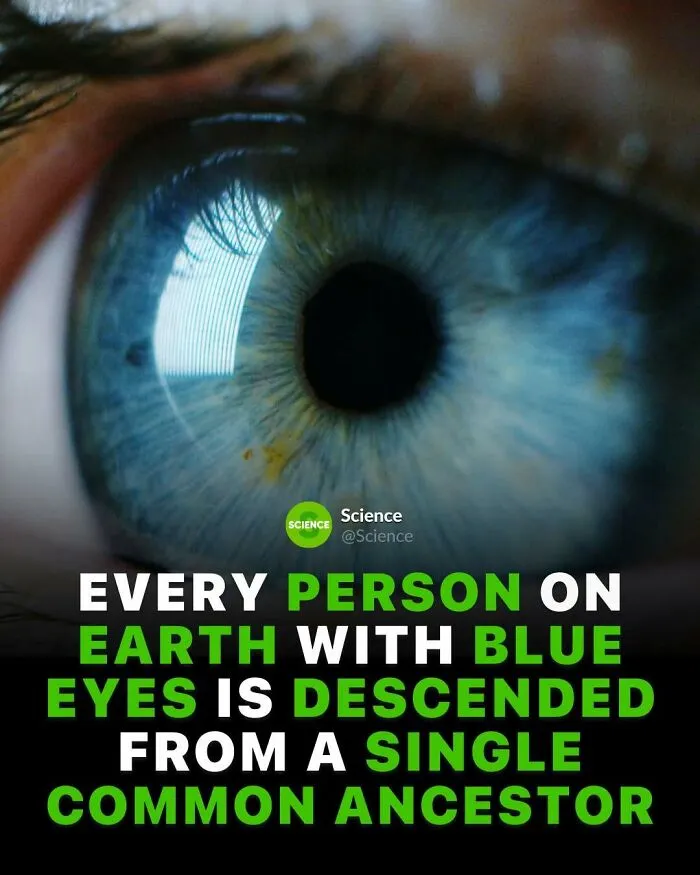
Around 6,000 to 10,000 years ago, a single person in the Black Sea region experienced a genetic mutation that would give rise to every blue-eyed individual alive today. Before this point, all humans had brown eyes. The mutation altered a gene called HERC2, which in turn “switched off” the OCA2 gene responsible for producing large amounts of melanin, the pigment that gives eyes their brown color. Instead of eliminating melanin entirely, the change reduced its production in the iris, creating the optical effect of blue eyes.
This event was rare enough to happen only once, making it an example of a “founder mutation.” DNA analysis shows that nearly all blue-eyed people share the same genetic sequence surrounding this mutation — strong evidence of a single common ancestor. Mitochondrial DNA studies, which trace maternal lineages, confirm that individuals with this trait in regions from Jordan to Denmark carry a shared haplotype.
Blue eyes are a recessive trait, meaning a person must inherit the mutation from both parents for the color to appear. Today, only about 8–10% of the global population has blue eyes, with the highest concentrations in Northern and Eastern Europe. In these lower-sunlight regions, lighter pigmentation may have offered an advantage in producing vitamin D.
While the vast majority of blue-eyed people share this origin, geneticists have found rare cases where different DNA changes also result in blue eyes. Still, these are exceptions to the rule. The enduring spread of the HERC2-OCA2 mutation illustrates how a single genetic event can ripple through millennia, linking hundreds of millions of people to one ancient ancestor.
Source: 10.1007/s00439-007-0460-x
This event was rare enough to happen only once, making it an example of a “founder mutation.” DNA analysis shows that nearly all blue-eyed people share the same genetic sequence surrounding this mutation — strong evidence of a single common ancestor. Mitochondrial DNA studies, which trace maternal lineages, confirm that individuals with this trait in regions from Jordan to Denmark carry a shared haplotype.
Blue eyes are a recessive trait, meaning a person must inherit the mutation from both parents for the color to appear. Today, only about 8–10% of the global population has blue eyes, with the highest concentrations in Northern and Eastern Europe. In these lower-sunlight regions, lighter pigmentation may have offered an advantage in producing vitamin D.
While the vast majority of blue-eyed people share this origin, geneticists have found rare cases where different DNA changes also result in blue eyes. Still, these are exceptions to the rule. The enduring spread of the HERC2-OCA2 mutation illustrates how a single genetic event can ripple through millennia, linking hundreds of millions of people to one ancient ancestor.
Source: 10.1007/s00439-007-0460-x
Report
23points
#32
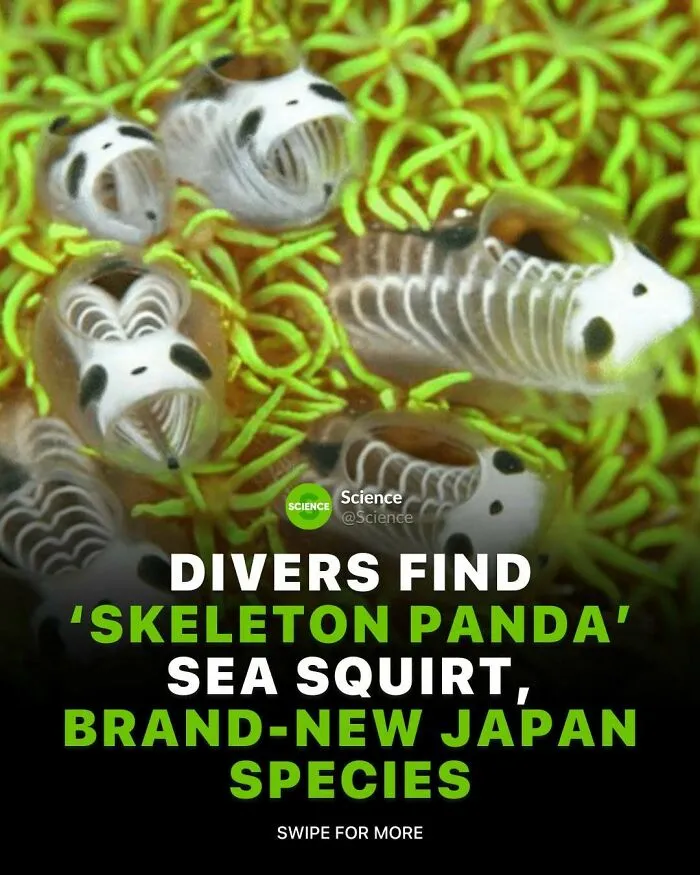
Divers exploring coral outcrops near Kumejima Island in Japan thought they had found novelty props for an aquarium display. Instead, their cameras captured a tiny siphon‑pumping animal whose stark white stripes and dark eye‑like spots looked like a cartoon panda wearing a skeleton costume.
The inch‑tall surprise soon went viral in diver forums, and what began as a curiosity post led researchers to a bona fide species never cataloged before.
Study coauthor Naohiro Hasegawa of Hokkaido University arranged dives, collected specimens, and confirmed that the creature belonged to the genus Clavelina, yet was distinct enough for its own name.
Photos first appeared online in 2017, letting scientists inspect body shapes and color patterns without leaving their desks.
Independent images posted by different dive operators also revealed that the animals occurred at several reef patches between 16 and 66 feet, giving a hint that the oddity was not a photo trick.
Hasegawa’s team located colonies in 2022 and used gentle suction devices to move living clusters into chilled seawater dishes aboard their boat.
Laboratory microscopy then mapped the arrangement of internal vessels, showing transverse white bars that create the “bones” illusion and four discrete black pigment patches on each zooid.
The inch‑tall surprise soon went viral in diver forums, and what began as a curiosity post led researchers to a bona fide species never cataloged before.
Study coauthor Naohiro Hasegawa of Hokkaido University arranged dives, collected specimens, and confirmed that the creature belonged to the genus Clavelina, yet was distinct enough for its own name.
Photos first appeared online in 2017, letting scientists inspect body shapes and color patterns without leaving their desks.
Independent images posted by different dive operators also revealed that the animals occurred at several reef patches between 16 and 66 feet, giving a hint that the oddity was not a photo trick.
Hasegawa’s team located colonies in 2022 and used gentle suction devices to move living clusters into chilled seawater dishes aboard their boat.
Laboratory microscopy then mapped the arrangement of internal vessels, showing transverse white bars that create the “bones” illusion and four discrete black pigment patches on each zooid.
Report
22points
#33

A French woman from the Caribbean is the only person on Earth with a newly discovered blood type—and she can only receive blood from herself.
Scientists just identified the world's 48th blood group system, dubbed "Gwada negative" after the woman's home island of Guadeloupe. The discovery solves a 14-year medical mystery that began when doctors spotted an unusual antibody during her routine pre-surgery tests in 2011.
"She is undoubtedly the only known case in the world," said Thierry Peyrard, a medical biologist at France's Blood Establishment who led the research. "She is the only person in the world who is compatible with herself."
The breakthrough came in 2019 when advanced DNA sequencing finally revealed the genetic mutation behind her unique blood. The woman, now in her 60s, inherited the rare trait from both parents who each carried the mutated gene—making her blood type incredibly unlikely to occur again.
Blood types are determined by specific antigens on red blood cell surfaces. While most people know the basic ABO system, scientists have now cataloged over 365 different antigens. The International Society of Blood Transfusion officially recognized this 48th blood group system in Milan this month.
This isn't the only recent rare blood discovery. Earlier this year, researchers also identified the MAL blood group system after investigating a 50-year-old mystery involving a pregnant woman missing a common antigen found in 99.9% of people.
"Discovering new blood groups means offering patients with rare blood types a better level of care," the French Blood Establishment explained. Researchers are now searching worldwide for other people who might share this extraordinary blood type.
Scientists just identified the world's 48th blood group system, dubbed "Gwada negative" after the woman's home island of Guadeloupe. The discovery solves a 14-year medical mystery that began when doctors spotted an unusual antibody during her routine pre-surgery tests in 2011.
"She is undoubtedly the only known case in the world," said Thierry Peyrard, a medical biologist at France's Blood Establishment who led the research. "She is the only person in the world who is compatible with herself."
The breakthrough came in 2019 when advanced DNA sequencing finally revealed the genetic mutation behind her unique blood. The woman, now in her 60s, inherited the rare trait from both parents who each carried the mutated gene—making her blood type incredibly unlikely to occur again.
Blood types are determined by specific antigens on red blood cell surfaces. While most people know the basic ABO system, scientists have now cataloged over 365 different antigens. The International Society of Blood Transfusion officially recognized this 48th blood group system in Milan this month.
This isn't the only recent rare blood discovery. Earlier this year, researchers also identified the MAL blood group system after investigating a 50-year-old mystery involving a pregnant woman missing a common antigen found in 99.9% of people.
"Discovering new blood groups means offering patients with rare blood types a better level of care," the French Blood Establishment explained. Researchers are now searching worldwide for other people who might share this extraordinary blood type.
Report
22points
#34
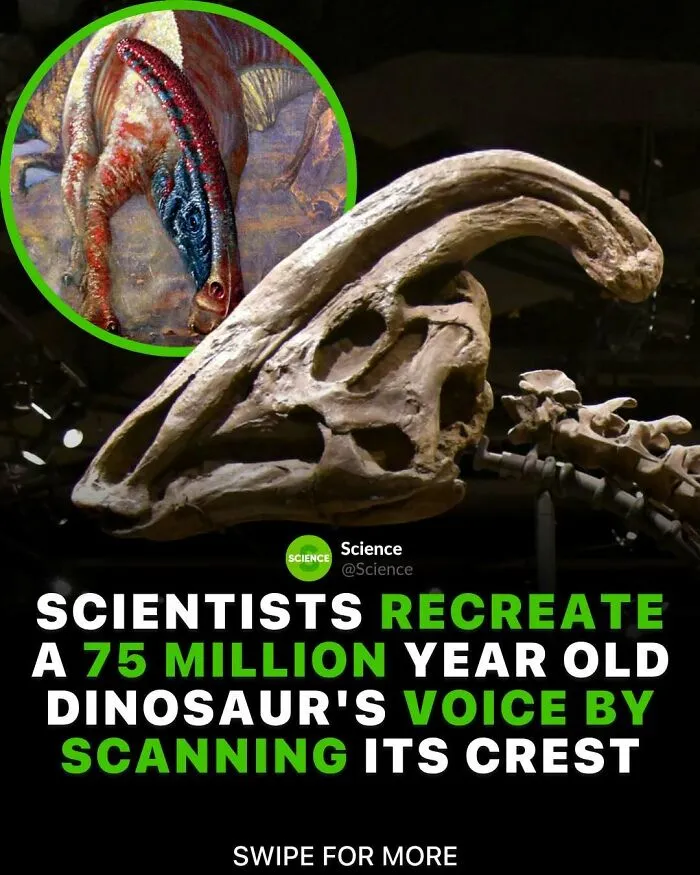
Forget Jurassic Park's terrifying roars. The real voice of Parasaurolophus was far stranger—a deep, resonating bellow that echoed through ancient swamps 75 million years ago. Digital paleontology is letting us hear these extinct giants for the first time.
The breakthrough began in 1995 when scientists discovered a nearly intact Parasaurolophus skull in New Mexico, complete with its signature 4.5-foot tubular crest. This duck-billed dinosaur was a herbivore whose elaborate head ornament functioned like a living trombone, filled with air passages and resonating chambers.
Sandia National Laboratories researchers used CT scans and supercomputers originally designed for nuclear weapons research to digitally reconstruct the crest's internal structure. Their 350 cross-sectional images revealed a labyrinth of airways that produced low-frequency rumbling sounds—each dinosaur having a unique voice, distinctive enough to identify individuals across vast distances.
But the science didn't stop there. NYU researcher Hongjun Lin recently built a physical model called the "Linophone"—3D-printed pipes that replicate the dinosaur's vocal anatomy. His experiments suggest Parasaurolophus sounded like a massive trumpet or saxophone, with resonant frequencies around 581-1056 Hz.
Scientists discovered that without vocal cords, the crest alone could produce haunting calls simply by forcing air through its chambers.
Source: Sandia National Labs
The breakthrough began in 1995 when scientists discovered a nearly intact Parasaurolophus skull in New Mexico, complete with its signature 4.5-foot tubular crest. This duck-billed dinosaur was a herbivore whose elaborate head ornament functioned like a living trombone, filled with air passages and resonating chambers.
Sandia National Laboratories researchers used CT scans and supercomputers originally designed for nuclear weapons research to digitally reconstruct the crest's internal structure. Their 350 cross-sectional images revealed a labyrinth of airways that produced low-frequency rumbling sounds—each dinosaur having a unique voice, distinctive enough to identify individuals across vast distances.
But the science didn't stop there. NYU researcher Hongjun Lin recently built a physical model called the "Linophone"—3D-printed pipes that replicate the dinosaur's vocal anatomy. His experiments suggest Parasaurolophus sounded like a massive trumpet or saxophone, with resonant frequencies around 581-1056 Hz.
Scientists discovered that without vocal cords, the crest alone could produce haunting calls simply by forcing air through its chambers.
Source: Sandia National Labs
Report
22points
#35
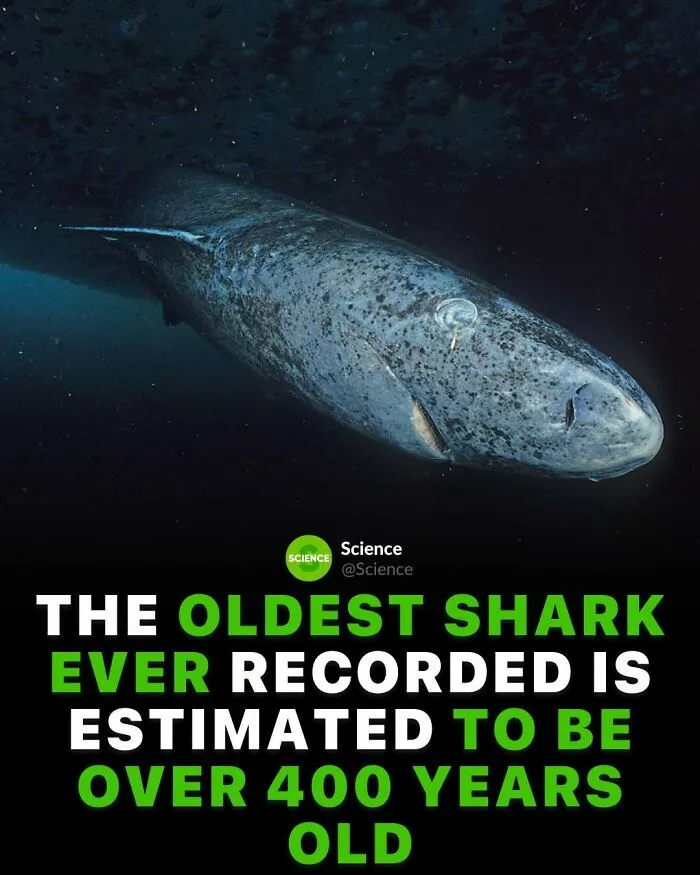
In 2016, scientists made a discovery that rewrote the record books: a female Greenland shark estimated to be 392 ± 120 years old years old, making her the longest-living vertebrate on Earth. Born around 1627, this ancient predator has been silently cruising Arctic waters since before the American colonies existed.
The breakthrough came through an ingenious dating method. Unlike other fish that show growth rings, Greenland sharks have soft cartilage throughout their bodies. So University of Copenhagen researchers turned to the sharks' eyes, using radiocarbon dating on lens proteins that form before birth and never degrade—like fossils preserved in amber.
The results were staggering. Of 28 sharks studied, eight were over 200 years old, and two exceeded 300 years. The oldest specimen measured nearly 16.5 feet long and likely witnessed the rise and fall of entire civilizations.
But the real shock was their growth rate: just 1 centimeter per year. These giants don't even reach sexual maturity until they're 150 years old, meaning centuries pass before they can reproduce.
Recent genome sequencing has revealed the genetic secrets behind their longevity—enhanced DNA repair mechanisms, cancer resistance genes, and anti-inflammatory adaptations. As climate change threatens Arctic ecosystems, these living time capsules face new challenges after surviving four centuries of human history.
The discovery proves that in the planet's coldest waters, evolution created creatures that make human lifespans look like brief flickers—sharks that literally outlive empires.
Source: 10.1126/science.aaf1703
The breakthrough came through an ingenious dating method. Unlike other fish that show growth rings, Greenland sharks have soft cartilage throughout their bodies. So University of Copenhagen researchers turned to the sharks' eyes, using radiocarbon dating on lens proteins that form before birth and never degrade—like fossils preserved in amber.
The results were staggering. Of 28 sharks studied, eight were over 200 years old, and two exceeded 300 years. The oldest specimen measured nearly 16.5 feet long and likely witnessed the rise and fall of entire civilizations.
But the real shock was their growth rate: just 1 centimeter per year. These giants don't even reach sexual maturity until they're 150 years old, meaning centuries pass before they can reproduce.
Recent genome sequencing has revealed the genetic secrets behind their longevity—enhanced DNA repair mechanisms, cancer resistance genes, and anti-inflammatory adaptations. As climate change threatens Arctic ecosystems, these living time capsules face new challenges after surviving four centuries of human history.
The discovery proves that in the planet's coldest waters, evolution created creatures that make human lifespans look like brief flickers—sharks that literally outlive empires.
Source: 10.1126/science.aaf1703
Report
22points
#36

Your brain doesn't show you reality in real-time—it presents a 15-second averaged version of what you've recently seen.
A study published in Science Advances reveals that human perception operates on a significant delay. Instead of processing every visual snapshot as it occurs, your brain automatically smooths visual input over time, creating what researchers call a "previously unknown visual illusion."
Scientists from the University of Aberdeen and UC Berkeley discovered this phenomenon by testing how people perceive faces aging in real-time videos. When participants watched 30-second clips of faces gradually aging, they consistently reported seeing the age of the face that appeared 15 seconds earlier, not the current image.
"Instead of analyzing every single visual snapshot, we perceive in a given moment an average of what we saw in the past 15 seconds," the researchers explain. This temporal averaging helps your brain create the illusion of a stable environment despite constant fluctuations in light, shadow, and movement.
The mechanism works like a biological time machine that keeps sending you back 15 seconds. Without this smoothing effect, the world would feel chaotic—like experiencing constant hallucinations as your brain tried to process every minute visual change in real-time.
This delay explains why subtle changes that occur gradually over time often go unnoticed. Your brain pulls together objects to appear more similar to each other, tricking you into perceiving stability that doesn't actually exist in the moment.
The discovery challenges our understanding of conscious perception and reveals that what feels like the present moment is actually a carefully constructed average of the recent past. Your brain essentially functions as a video editor, continuously creating a smooth, comprehensible version of reality from the chaotic stream of visual information your eyes collect.
This biological mechanism represents millions of years of evolution optimizing for survival—a stable perception of the environment is more useful than a jittery, constantly updating view that would overwhelm cognitive processing.
A study published in Science Advances reveals that human perception operates on a significant delay. Instead of processing every visual snapshot as it occurs, your brain automatically smooths visual input over time, creating what researchers call a "previously unknown visual illusion."
Scientists from the University of Aberdeen and UC Berkeley discovered this phenomenon by testing how people perceive faces aging in real-time videos. When participants watched 30-second clips of faces gradually aging, they consistently reported seeing the age of the face that appeared 15 seconds earlier, not the current image.
"Instead of analyzing every single visual snapshot, we perceive in a given moment an average of what we saw in the past 15 seconds," the researchers explain. This temporal averaging helps your brain create the illusion of a stable environment despite constant fluctuations in light, shadow, and movement.
The mechanism works like a biological time machine that keeps sending you back 15 seconds. Without this smoothing effect, the world would feel chaotic—like experiencing constant hallucinations as your brain tried to process every minute visual change in real-time.
This delay explains why subtle changes that occur gradually over time often go unnoticed. Your brain pulls together objects to appear more similar to each other, tricking you into perceiving stability that doesn't actually exist in the moment.
The discovery challenges our understanding of conscious perception and reveals that what feels like the present moment is actually a carefully constructed average of the recent past. Your brain essentially functions as a video editor, continuously creating a smooth, comprehensible version of reality from the chaotic stream of visual information your eyes collect.
This biological mechanism represents millions of years of evolution optimizing for survival—a stable perception of the environment is more useful than a jittery, constantly updating view that would overwhelm cognitive processing.
Report
21points
#37

Human s***m just broke one of the most fundamental laws of physics!
Newton's third law states that "for every action, there is an equal and opposite reaction." Push against a wall, and the wall pushes back with equal force. But s***m swimming through thick fluids somehow avoid this rule entirely.
Kenta Ishimoto and his team at Kyoto University discovered that s***m tails possess something called "odd elasticity"—a property that lets them whip through viscous fluids without losing energy or provoking resistance from their surroundings.
Here's what should happen: when a s***m's flagella tail waves through fluid, Newton's third law demands the fluid push back with equal force, slowing the s***m down significantly. Highly viscous fluids should dissipate the tail's energy and prevent movement entirely.
Instead, s***m glide through these sticky substances with surprising ease, as if the fluid doesn't even notice they're there.
The researchers studied both human s***m and Chlamydomonas algae, finding that both use hair-like flagella to create wave-like motions that somehow generate "non-reciprocal interactions"—movements that don't trigger the expected equal and opposite reactions.
The study reveals that these microscopic swimmers add their own energy to the system with each tail movement, pushing them "far from equilibrium" where normal physics rules don't apply. It's like they've found a loophole in the laws of nature.
Newton's third law states that "for every action, there is an equal and opposite reaction." Push against a wall, and the wall pushes back with equal force. But s***m swimming through thick fluids somehow avoid this rule entirely.
Kenta Ishimoto and his team at Kyoto University discovered that s***m tails possess something called "odd elasticity"—a property that lets them whip through viscous fluids without losing energy or provoking resistance from their surroundings.
Here's what should happen: when a s***m's flagella tail waves through fluid, Newton's third law demands the fluid push back with equal force, slowing the s***m down significantly. Highly viscous fluids should dissipate the tail's energy and prevent movement entirely.
Instead, s***m glide through these sticky substances with surprising ease, as if the fluid doesn't even notice they're there.
The researchers studied both human s***m and Chlamydomonas algae, finding that both use hair-like flagella to create wave-like motions that somehow generate "non-reciprocal interactions"—movements that don't trigger the expected equal and opposite reactions.
The study reveals that these microscopic swimmers add their own energy to the system with each tail movement, pushing them "far from equilibrium" where normal physics rules don't apply. It's like they've found a loophole in the laws of nature.
Report
20points
#38

The discovery could have implications for agriculture and pest control, opening up possibilities for managing crop health and insect behavior through sound.
While the ultrasonic sounds emitted by plants are outside the range of human hearing, they can be picked up by many insects and some mammals, such as bats.
Investigating this preference, the researchers presented female moths with two healthy tomato plants – one with a speaker playing sounds registered from a drying plant, and one that was silent.
The moths preferred the silent option, suggesting they use these cues to identify optimal sites for laying eggs.
Further experiments confirmed that the moths' choices were guided specifically by sound and only by sounds from the plants.
"Here, we've seen that there are animals that are capable of making sense of these sounds," said Lilach Hadany, professor at the University's Wise Faculty of Life Sciences.
"We think that this is just the beginning. So, many animals may be responding to different plants."
While the ultrasonic sounds emitted by plants are outside the range of human hearing, they can be picked up by many insects and some mammals, such as bats.
Investigating this preference, the researchers presented female moths with two healthy tomato plants – one with a speaker playing sounds registered from a drying plant, and one that was silent.
The moths preferred the silent option, suggesting they use these cues to identify optimal sites for laying eggs.
Further experiments confirmed that the moths' choices were guided specifically by sound and only by sounds from the plants.
"Here, we've seen that there are animals that are capable of making sense of these sounds," said Lilach Hadany, professor at the University's Wise Faculty of Life Sciences.
"We think that this is just the beginning. So, many animals may be responding to different plants."
Report
20points
#39
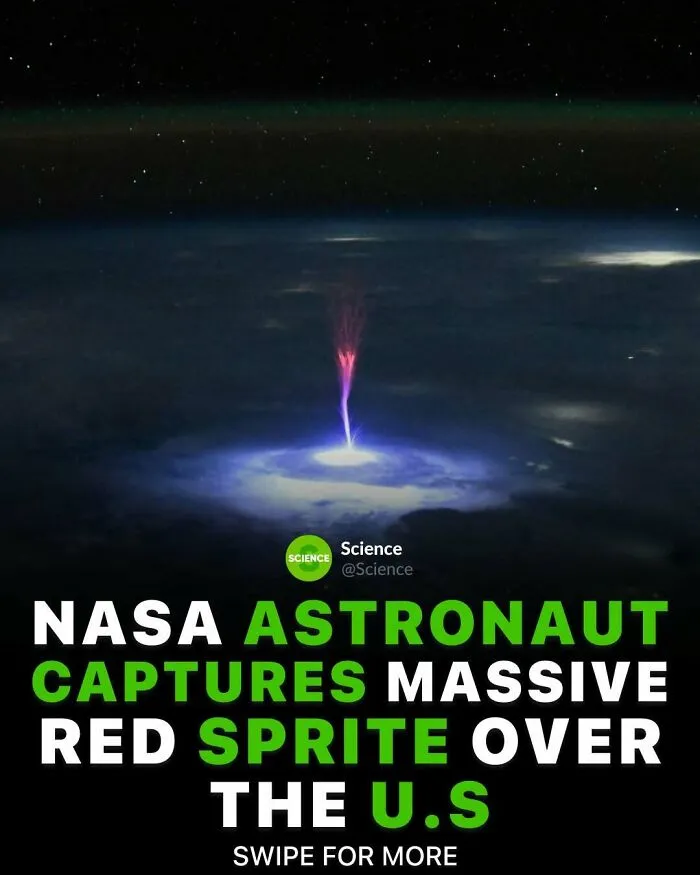
NASA astronaut @astro_ayers captured a rare red sprite shooting 50 miles above a thunderstorm over Mexico and the southern United States.
Sprites are a type of Transient Luminous Event that occurs in the upper atmosphere above intense thunderstorms. Unlike regular lightning that strikes downward, sprites shoot upward into the mesosphere, reaching altitudes of 30 to 60 miles above Earth's surface.
The red coloration comes from nitrogen molecules in the upper atmosphere interacting with h**h-energy electrons. These electrical discharges last only a few milliseconds and appear as jellyfish-shaped formations with tendrils extending both upward and downward.
Red sprites are difficult to observe from ground level because they occur above storm clouds and last for such brief periods. The ISS provides an ideal vantage point 250 miles above Earth, allowing astronauts to capture these phenomena alongside the lightning strikes that trigger them.
Scientists believe sprites form when positive cloud-to-ground lightning strikes leave the top of storm clouds negatively charged. If enough negative charge accumulates, an electrical discharge shoots toward the ionosphere above, creating the sprite.
First observed by airline passengers in the 1950s, sprites were not successfully photographed until 1989. Research indicates they also occur in the atmospheres of Jupiter, Saturn, and Venus.
The image provides valuable data for scientists studying the formation and characteristics of these atmospheric electrical phenomena and their relationship to thunderstorms below.
Sprites are a type of Transient Luminous Event that occurs in the upper atmosphere above intense thunderstorms. Unlike regular lightning that strikes downward, sprites shoot upward into the mesosphere, reaching altitudes of 30 to 60 miles above Earth's surface.
The red coloration comes from nitrogen molecules in the upper atmosphere interacting with h**h-energy electrons. These electrical discharges last only a few milliseconds and appear as jellyfish-shaped formations with tendrils extending both upward and downward.
Red sprites are difficult to observe from ground level because they occur above storm clouds and last for such brief periods. The ISS provides an ideal vantage point 250 miles above Earth, allowing astronauts to capture these phenomena alongside the lightning strikes that trigger them.
Scientists believe sprites form when positive cloud-to-ground lightning strikes leave the top of storm clouds negatively charged. If enough negative charge accumulates, an electrical discharge shoots toward the ionosphere above, creating the sprite.
First observed by airline passengers in the 1950s, sprites were not successfully photographed until 1989. Research indicates they also occur in the atmospheres of Jupiter, Saturn, and Venus.
The image provides valuable data for scientists studying the formation and characteristics of these atmospheric electrical phenomena and their relationship to thunderstorms below.
Report
20points
#40

The U.S. just made one of the most controversial medical decisions in modern history—and experts are calling it a catastrophic mistake.
Health Secretary Robert F. Kennedy Jr. announced that the Department of Health and Human Services is terminating $500 million in federal funding for mRNA vaccine development, effectively ending 22 research projects under the Biomedical Advanced Research and Development Authority (BARDA). The decision affects major pharmaceutical companies including Pfizer, Moderna, Sanofi Pasteur, and CSL Seqirus, halting work on next-generation vaccines for COVID-19, flu, and potential pandemic threats.
Kennedy defended the unprecedented move by claiming that "the data show these vaccines fail to protect effectively against upper respiratory infections like COVID and flu" and that "mRNA technology poses more risks than benefits for respiratory viruses." The announcement comes just weeks after the FDA required stronger warning labels about myocarditis and pericarditis risks, particularly noting 27 cases per million doses in males aged 12-24.
But the medical establishment is pushing back hard. Former Surgeon General Jerome Adams called Kennedy's claims "simply incorrect," emphasizing that "mRNA technology has saved over two million lives" and enabled unprecedented vaccine development speed during COVID-19. The World Health Organization warned this represents a "significant blow" to pandemic preparedness.
The controversy highlights a fundamental clash between Kennedy's long-standing vaccine skepticism and mainstream medical consensus. Paul Offit from Children's Hospital of Philadelphia warned that the decision could leave the U.S. in a "more dangerous" position for future pandemics, as mRNA vaccines can be developed and deployed faster than traditional platforms.
Health Secretary Robert F. Kennedy Jr. announced that the Department of Health and Human Services is terminating $500 million in federal funding for mRNA vaccine development, effectively ending 22 research projects under the Biomedical Advanced Research and Development Authority (BARDA). The decision affects major pharmaceutical companies including Pfizer, Moderna, Sanofi Pasteur, and CSL Seqirus, halting work on next-generation vaccines for COVID-19, flu, and potential pandemic threats.
Kennedy defended the unprecedented move by claiming that "the data show these vaccines fail to protect effectively against upper respiratory infections like COVID and flu" and that "mRNA technology poses more risks than benefits for respiratory viruses." The announcement comes just weeks after the FDA required stronger warning labels about myocarditis and pericarditis risks, particularly noting 27 cases per million doses in males aged 12-24.
But the medical establishment is pushing back hard. Former Surgeon General Jerome Adams called Kennedy's claims "simply incorrect," emphasizing that "mRNA technology has saved over two million lives" and enabled unprecedented vaccine development speed during COVID-19. The World Health Organization warned this represents a "significant blow" to pandemic preparedness.
The controversy highlights a fundamental clash between Kennedy's long-standing vaccine skepticism and mainstream medical consensus. Paul Offit from Children's Hospital of Philadelphia warned that the decision could leave the U.S. in a "more dangerous" position for future pandemics, as mRNA vaccines can be developed and deployed faster than traditional platforms.
Report
19points
