



Our planet never runs out of surprises, and some photographers take it to another level with their work, traveling to the most remote places and capturing some of the most mysterious species in their natural habitats, proving just how extraordinary Earth and everything living on it can be.
We recently covered the 2026 People's Choice Award, featuring some remarkable shots. This time, we'd like to focus on the main competition and highlight some of the most incredible photographs submitted and selected by the jury this year.
The Nature Photographer of the Year competition celebrates the beauty of nature through photography, with the overall winner receiving a €3,000 cash prize, alongside other cash prizes and photography equipment. The contest also supports nature conservation projects. The winning photos were announced at the annual Nature Talks Photo Festival and will be displayed in an exhibition traveling across the Netherlands, Belgium, and France.
#21 Animal Portrait, Runner-Up: Gliding By Pierre Watson
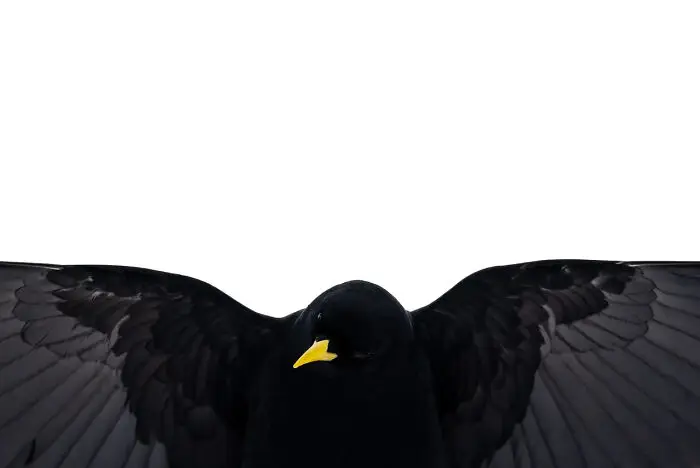
In January 2023, I spent a weekend in the Swiss Alps to photograph the bearded vulture. While waiting for the bearded vulture to appear, I kept myself busy by photographing groups of alpine choughs. A member of the crow family, the alpine chough is an intelligent bird and very resourceful. They are often seen flying around restaurants, hotels and picnic areas in the Alps looking for food scraps.
This photo was taken as an alpine chough glided overhead several metres above me. It hovered effortlessly in the wind for a moment before continuing on its search for food.
Of all the photos taken that day, this photo was my favourite despite it not being of my main target, the bearded vulture. I did manage to take photos of the bearded vulture, but the photos of the alpine choughs ended up being more interesting. Over the years, I have learned that photographing the less popular and often overlooked species can be more rewarding than photographing the superstar species.
4points
#22 Birds, Winner: Painting From The End Of The World By Lucas Mugnier-Lavorel
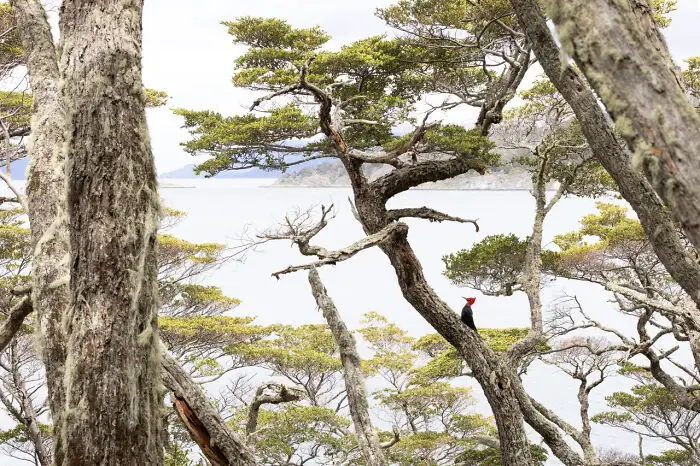
In early December 2025, in a Nothofagus forest in Tierra del Fuego National Park, Argentina, a Magellanic Woodpecker (Campephilus magellanicus) worked its way along a weathered trunk.
These southern beech forests are the signature habitat of the far south of the continent. Twisted and stunted by relentless cold wind, these trees are far more than scenery: their decaying wood harbours the wood-boring beetle larvae that make up the bulk of the woodpecker's diet. The species depends on mature stands with abundant dead wood, a habitat now in decline across much of its range.
I deliberately chose a relatively short focal length. Rather than isolating the bird, I wanted to place it inside the world that sustains it: the tangle of branches, with Lapataia Bay and the Beagle Channel opening out behind. To fit the whole tree into the frame, the image is a panorama assembled from two shots made less than a second apart.
Unlike the woodpeckers I know in France, which vanish at the first footstep, this one seemed almost indifferent to human presence. It fed nearby for close to an hour, entirely untroubled by passing hikers. I photographed it from the trail without stepping off it, so as not to disturb the bird.
3points
#23 Birds, Highly Commended: Hiding In The Green By Raphael De Moliner
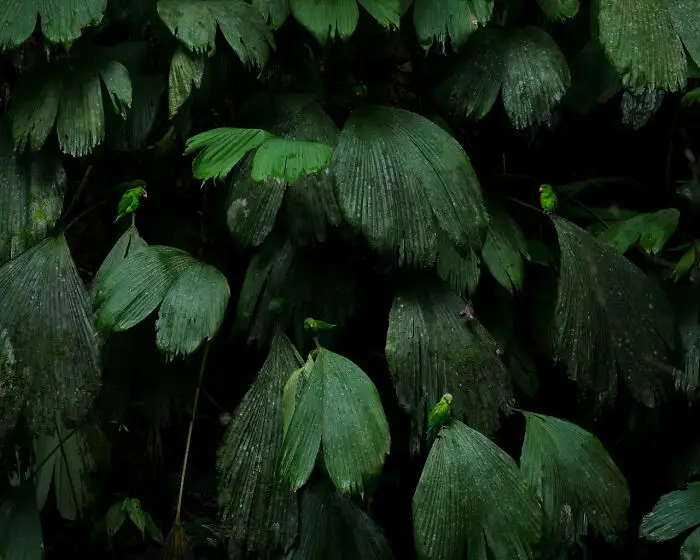
Whilst having the privilege of travelling to the Napo River in Ecuador, part of the Amazon region, we visited a clay lick to see the beautiful scarlet macaws. But what impressed me even more was the appearance and sound of the cobalt-winged parakeets.
Very skittish, they stayed for several hours in the greenery. Their calls seemed to cover everything, yet they were hardly visible. Even when they came out of their hiding places, they seemed to blend in perfectly with the green leaves.
The image shows this perfect camouflage. They were sitting all over the place, communicating with their own kind, until they finally dared to come down to drink water and replenish their bodies with essential minerals. Spotting a handful of them was difficult, even though you could hear hundreds of them.
3points
#24 Mammals, Highly Commended: Out Of The Shadows By Sergey Bystritsky
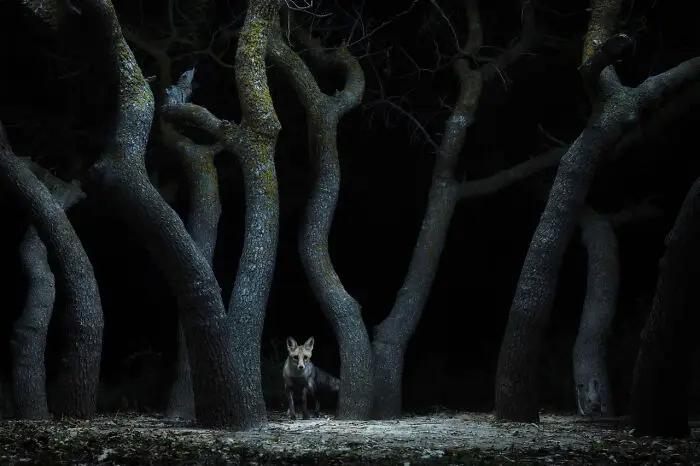
This photograph of the fox was taken in the semi-desert of Samukhi, in Georgia's Vashlovani National Park. Apart from grass, almost nothing grows there, and only occasionally near the hilly outskirts are trees found, which made it all the more surprising to find a spot with such a dense cluster.
At night, many hares and foxes roam these areas, and the terrain suggested the presence of an animal trail near this tree, so I could expect visitors and prepared the shooting setup. In addition to a camera with a motion sensor, I mounted four flashes and two large pieces of fabric in the tree canopy, serving as softboxes to provide soft light.
3points
#25 Mammals, Highly Commended: Aspen Shadows By Devon Pradhuman
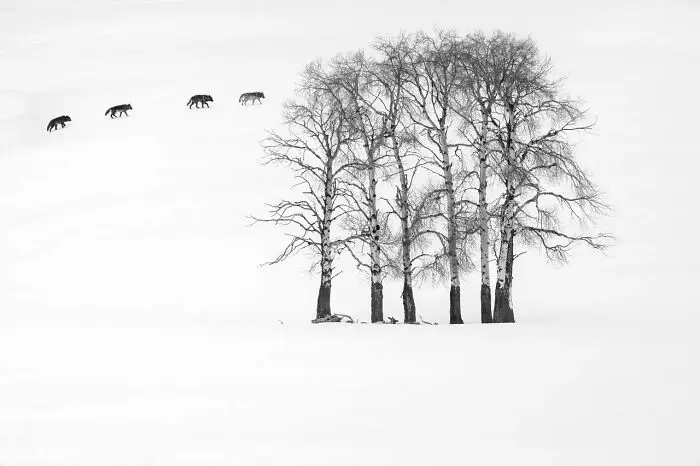
Four grey wolves move through a stand of aspens in Yellowstone's Lamar Valley, their shadows stretching long across fresh snow. I had been watching this pack from a distance, searching for a composition that could hold its own against the scale of the landscape. The wolves were little more than dark punctuation marks against the white.
When they turned towards this line of aspens, I sensed the moment: they passed directly through the trees before continuing along the tree line and disappearing over a distant ridge. The photograph is titled Aspen Shadows because that's what the wolves become in the frame: shadows among shadows, ancient and elusive, patterned into the landscape as though the forest itself had conjured them.
I have spent almost a decade now returning to Yellowstone multiple times a year, chasing the park's natural majesty in every season. Wolves are one of those animals I tend to see when I least expect them, and over the years I have learned not to seek them out directly, but to let the landscape and the moment bring them to me.
I had always wanted to photograph wild wolves up close, but this image is a reminder that closer doesn't always mean better. Here, the wide, zoomed-out view does something an intimate portrait couldn't: it places the wolves within the scale of their unforgiving winter environment, small and moving against a landscape that dwarfs them.
Wolves have long been one of my favourite animals to photograph. There is a rare beauty to them, in the way they move, the way they hold themselves within a pack, the quiet intelligence in how they read a landscape. Yet they remain deeply misunderstood by many people, cast as villains in stories that rarely reflect who they actually are. Spending time watching them in the wild has only deepened my respect for these beautiful animals.
Wolves are one of the most polarising subjects in American conservation. Their reintroduction to Yellowstone in 1995 remains one of the great rewilding success stories, a cascade of ecological restoration that reshaped river courses, revived vegetation, and rebalanced entire food webs. But that success story has a sharp edge at its borders.
Inside Yellowstone, wolves are protected. They roam freely, observed by researchers, photographers, and visitors who travel from across the globe for exactly the kind of encounter I had that morning. But park boundaries are human constructs. A wolf doesn't experience a line on a map. The same animal that walks safely through a meadow in Lamar Valley can cross an invisible threshold and find itself in unprotected territory, where hunting seasons, livestock conflicts, and deeply held disagreements about land management determine its fate.
It's a tension that sits with me every time I photograph these animals. There is something profound and troubling about watching a wolf move through the world with such freedom and confidence, knowing the fragility of the protections that surround them. Aspen Shadows was made from a place of reverence, and I hope it carries that forward to everyone who sees it.
3points
#26 Other Animals, Highly Commended: Flower Of Life By Zhikai Wu
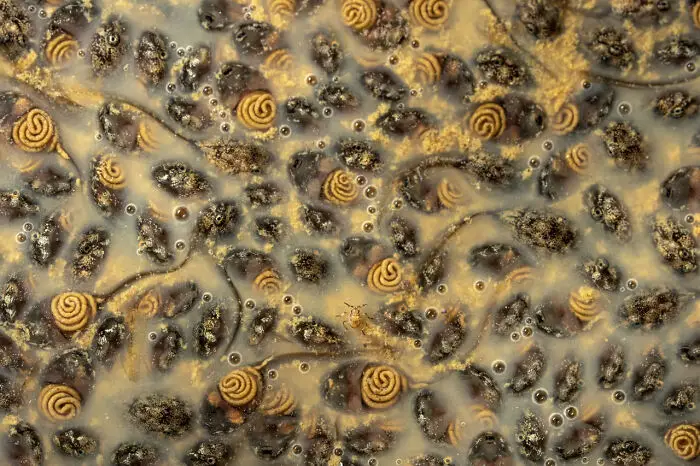
Hiking through the mountains with my macro lens, I walked slowly along a narrow track barely wide enough for one car. Worn down by years of vehicle wheels, the road is pockmarked with deep and shallow ruts on both sides, which fill with puddles after rain. Bending down for a closer look, I found these temporary pools serve as spawning grounds for frogs.
The puddles hold very little water, and the blazing midday sun evaporates it rapidly. As the pools dwindle towards drying up, countless tadpoles huddle together in the murky remaining water, struggling to survive.
I lowered my body, careful not to disturb the cloudy water, and slowly repositioned my camera to shoot close to the surface. Through the haze, the coiled intestines inside their translucent bellies resemble delicate little flowers blooming quietly in the turbid water. An insect weaves its way among the tadpoles, a fellow traveller in this fleeting wetland, silently embodying the harsh laws of survival. At the moment I pressed the shutter, I truly witnessed life teetering on the brink of extinction, utterly fragile, yet stubbornly resilient.
3points
#27 Landscapes, Winner: In The Circle Of Vultures Around The Falls By J Fritz Rumpf
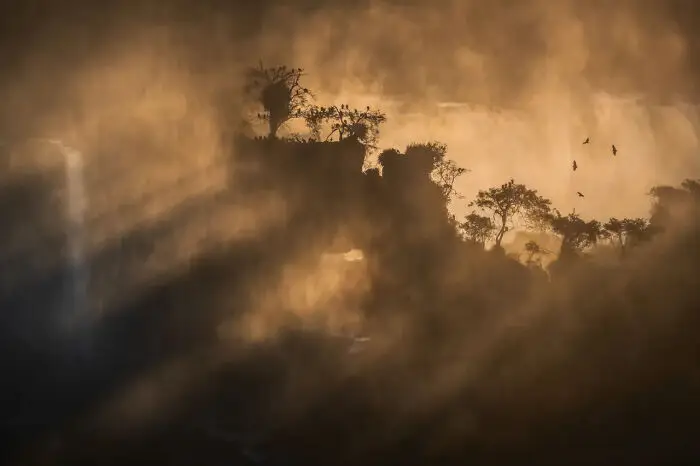
A longtime dream of visiting the famous Iguazú Falls finally became a reality last year (2025). Consisting of approximately 275 waterfalls, which span a width of roughly 2,700 metres (8,858 feet), and an average height of around 80 metres (262 feet), Iguazú Falls straddles the border between Brazil and Argentina. Iguazú National Park and the neighbouring property constitute a significant remnant of the Atlantic Forest. This forest biome covers large parts of the Brazilian coast, extending into Northern Argentina and Uruguay, as well as Eastern Paraguay. It is known for its extreme habitat and species diversity, both animal and plant life alike.
As I marvelled at the beauty and enormity of this natural wonder, I was trying to come up with a different way of photographing this magical place. To capture the enormity of these falls in one image was out of the question, so I set out to find a more intimate composition that still conveyed the beauty and power of this amazing place.
When I finally settled on this scene, I returned to it three consecutive evenings, as I had envisioned almost this exact photo. The last light of day, at just the right angle, brightly lighting up the tumultuous mist of the powerful waterfalls in the back, the trees and the rock outcrop creating deep, mystical shadows, the elegant waterfall all the way to the left adding the subtle finishing touch to this amazing moment.
I was hoping to catch a couple of birds in flight, which would complement the ones sitting on the treetops.
On the final evening, it all came together: the wind was just right, wildly blowing the spray created by the spectacular waterfalls, the resulting mist catching the light that exquisitely illuminated this other-worldly scene, that glorious light also streaming through the hole in the rock at a dramatic angle; and at exactly the right moment, four buzzards completed the image by flying in the perfect circle!
This was a great reminder that it is always good to listen to one's instinct and inner voice, and that perseverance does pay off. In this case, devoting three evenings to one composition, hoping to get all the components to line up. It was amazing to witness how from moment to moment this scene changed, sometimes drastically. Whether it was the angle or intensity of the light, the strength of the wind affecting the mass of the mist produced by the waterfalls, and finally, the presence and positioning of the birds to complete and create one impactful composition. A moment I will not soon forget.
Iguazú Falls, Brazil; July 2025. To the best of my knowledge, Black Vulture (Coragyps atratus).
3points
#28 Humans And Nature, Runner-Up: Helping Hands By Lukas Schaefer
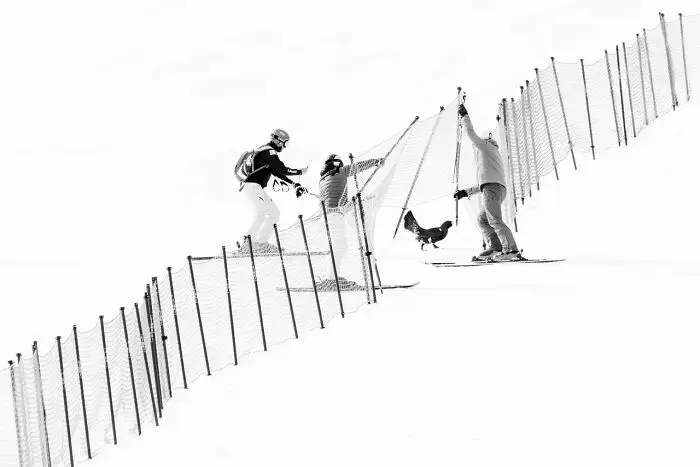
During the lekking season, capercaillies can sometimes lose their natural fear of humans and begin to perceive them as rivals. This happened in a ski resort in my hometown, where one particular male spent several weeks standing on the slope every day, fiercely defending what he seemed to consider his territory.
The bird quickly became something of a local celebrity. News reports covered the unusual encounter, and every day people came to see it, many stopping to film the bird with their phones. One day, a ski race was held on the slope, and the capercaillie found itself displaying right in the middle of the race course. It was clearly not a safe place to be, so people carefully tried to guide it away. Distracted by the safety fence running across the slope, the bird struggled to find its way out, and several people helped it move to safety as respectfully as they could.
Sadly, a year later, the same individual was killed by a skier who simply failed to pay attention. Some people care. Some don't.
I visited the capercaillie several times to photograph the unusual interactions between the bird and the skiers. What fascinated me most was its determination. Even with thirty people standing directly in front of it, the bird continued to display and defend its territory, confronting something it had no real chance of defeating.
There was something almost absurd about the scene, yet also deeply remarkable. Faced with an overwhelming presence, the capercaillie never seemed to question its instinct. It simply stood its ground, driven by an ancient ritual that left no room for doubt. A small glimpse into the wild, persisting stubbornly in a place where nature and human activity collide.
3points
#29 Black And White, Highly Commended: From Dusk Till Dawn By Ronald Zimmerman
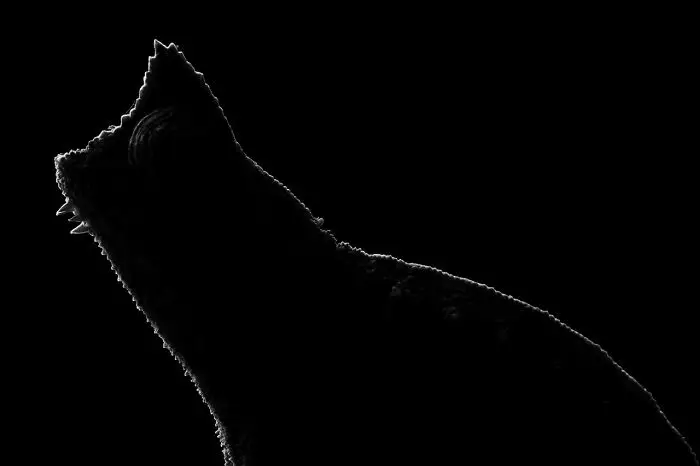
Brown leaf chameleon silhouette in the rainforest of Ranomafana National Park, Madagascar. Most chameleons of the Brookesia genus live in the leaf litter on the ground during the day and climb up to a roosting position at dusk.
This brown leaf chameleon (Brookesia superciliaris) was still perching on a leaf in the early morning. This enabled me to place my off-camera flash behind the chameleon and create a portrait at eye level.
Roosting higher up is much safer during the night. Predators hunting for this relatively small chameleon are active at night. Leaves and thin branches move when a predator approaches. The "shake and wake principle" enables the chameleon to get to safety. During the day, Brookesia chameleons are extremely well camouflaged in the leaf litter.
3points
#30 Underwater, Highly Commended: Different Scales By Nicolas Remy
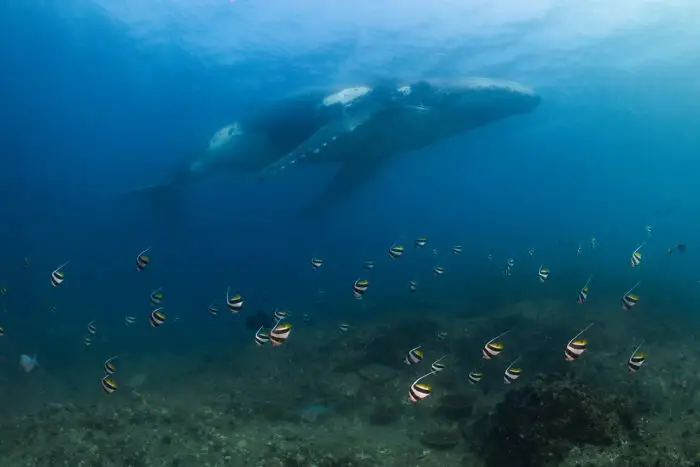
In September, a number of humpback whales are passing by Stradbroke Island (QLD, Australia) on their migration towards Antarctica. During a scuba dive on 19th September 2025, we could hear the whales singing underwater, until the moment when one of them appeared at the limit of visibility, gliding past, behind a school of bannerfish. Seeing whales while scuba diving is very rare, and it was one of my most memorable diving experiences to date.
2points
#31 Birds, Highly Commended: Alpine Law By Benoît Bussard
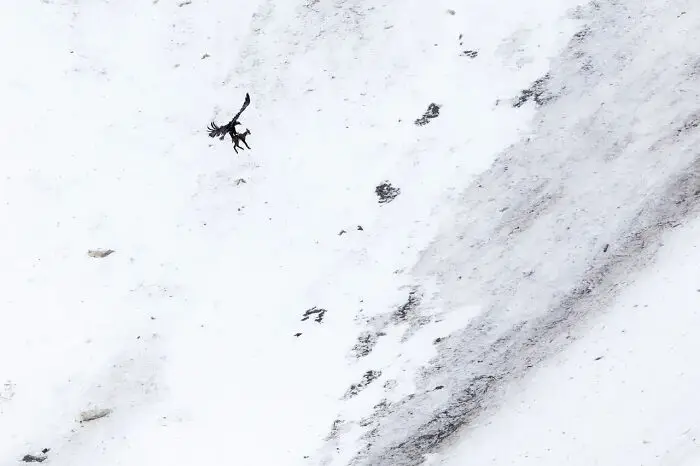
Against a backdrop of snow-covered Alpine slopes in the Swiss Prealps, a golden eagle flies with a newborn chamois firmly clutched in its talons. I had been watching the eagle soaring along the steep mountainsides when it suddenly disappeared from view, only to reappear moments later carrying its prey: a very young chamois, likely only a few days old, during the peak of the spring birthing season in May.
Shortly after this moment was captured, the eagle released the chamois from the air. The young animal fell onto the rocky slope below and died, a hunting strategy occasionally used by large raptors to subdue prey in steep terrain. Although this outcome is not visible in the image itself, it was part of the same brief sequence of events.
Golden eagles are powerful and highly skilled predators, capable of taking advantage of brief moments of vulnerability in their mountain environment. While they may occasionally prey on young ungulates, witnessing and photographing a golden eagle carrying a newborn chamois is exceptionally rare.
Set against the lingering snow and exposed rock of the high Alps, the scene captures the harsh reality of life in a mountain environment, where survival depends on strength, precision and timing, and where the line between life and death can be crossed in a matter of moments.
2points
#32 Mammals, Winner: Play Misty By Paul Goldstein
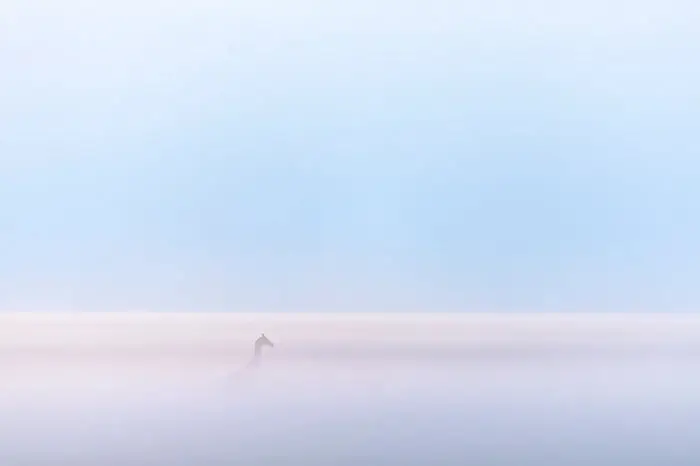
For years I have tried for that misty image when a combination of the previous night's rain, Rift Valley altitude and cold result in fog clinging to the plains for a few precious minutes. The problem is that once in the mist, it is virtually impossible to find anything. Giraffes have always been gold on my fantasy foggy podium, reticulated ones, the cherry on the icing on the sponge on the fruit …. (add any further confection) on this cake.
I have worked with William Wanyika on the northern plains of Laikipia for many years. He likes a rudely early start just as much as I do and we only have to drive eight minutes from camp to be in front of Mt Kenya in the false dawn. This pre-sunrise blush was obscured by this ephemeral phenomenon and, as usual, it was impossible to find anything, until a zephyr of wind cleared the grey curtain for a second and we saw the animal.
Driving away from it a little and 'compressing' it with a six hundred lens gave the desired effect and it thankfully stayed still in the cold. Five minutes later the giraffe was gone, as was the mist. The pastel colours are typical of this area. Thank you, William, right on the Monet.
2points
#33 Other Animals, Runner-Up: Exploring The Terrain By Suliman Alatiqi
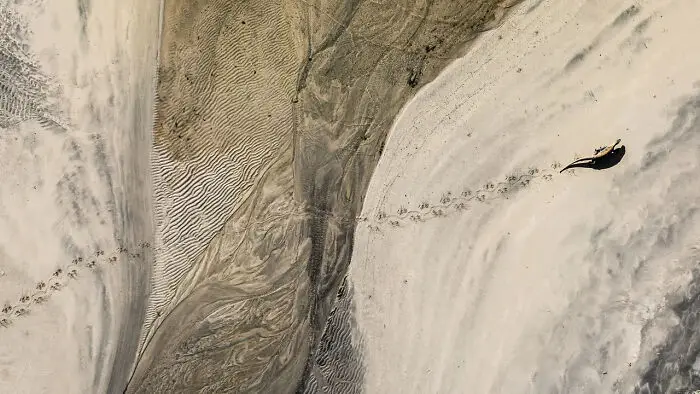
Komodo dragons, native to a few Indonesian islands, primarily inhabit savanna grasslands, which are ideal for their hunting style. Coastal shorelines, however, are also an important part of their environment and lifestyle. This photo was captured during extensive fieldwork with local rangers and aims to shed light on the Komodo dragons’ interactions with this last habitat. During low tide, Komodo dragons will confidently traverse coastal terrain, allowing them to patrol vast territories to locate prey and adapt to the challenges of island life.
2points
#34 Nature Of De Lage Landen, Winner: Fairies By Enikő Kálovics
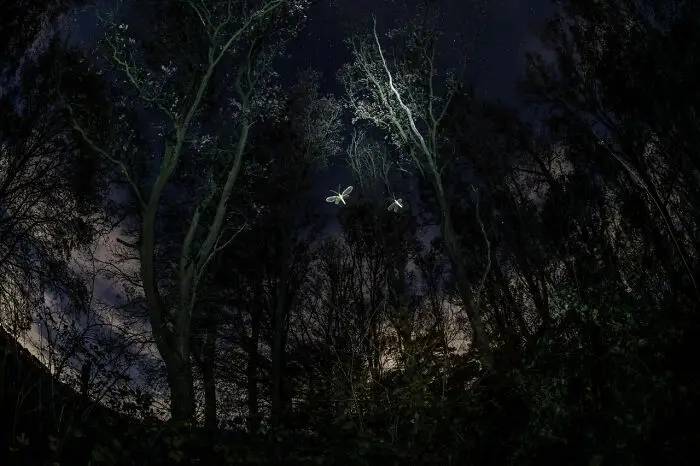
The night was beautiful and clear, with only a few clouds drifting across the sky. In the silent autumn forest of Meterik (Limburg), I noticed tiny green lacewings flying beneath the stars. With their delicate, lace-like wings and slow, wavering flight, they seemed almost like a wandering host of fairies. I photographed them over several evenings, wanting to capture not only the insects themselves but also the atmosphere of their natural habitat.
That night, the sky had an unusual purplish tone, giving the forest a dreamlike quality. Using an in-camera double exposure, I combined the lacewings with the surrounding landscape to recreate the magical impression of that moment. Sometimes, you just need to believe in the tale.
2points
#35 Black And White, Highly Commended: Through The Storm By David Pattyn
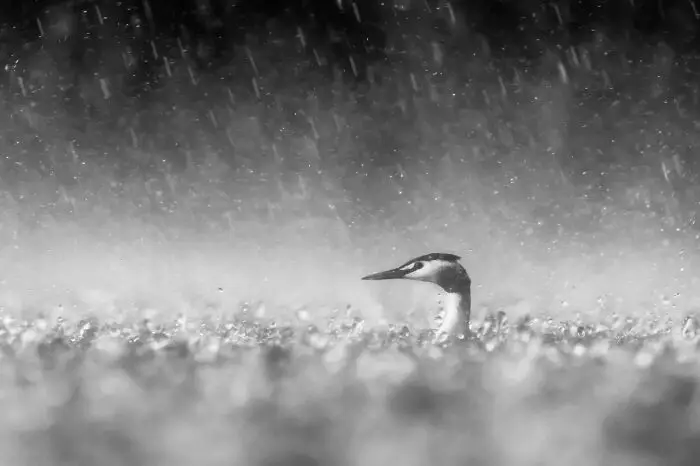
I have been photographing great crested grebes for many years. I had thought about photographing them in the rain but to see this in an image you really need a heavy thunderstorm.
I work together with Brabants Landschap, a nature conservation organisation, and I have permission to use a floating hide in a nature reserve in North Brabant. Because the hide is permanently in the same pond of the reserve, the grebes are completely used to it.
That particular season I was following how the grebes were raising their chicks and one day while at work I knew that there were heavy thunderstorms expected at the end of the day. I had loaded my photo equipment in the car and after work I went straight to the grebes and I arrived before the rain started.
After a short while the storm began and fortunately I had wrapped all the equipment in plastic bags to protect it. The grebes soon lost sight of their chicks and I was lucky that one of the adults was close enough for me to keep track of as visibility was just a few metres. I made some images which I was happy with, but after a while it got so bad that I had to get out because it got too windy.
1point
#36 Youth, Winner: Tree Of Life By Parham Pourahmad
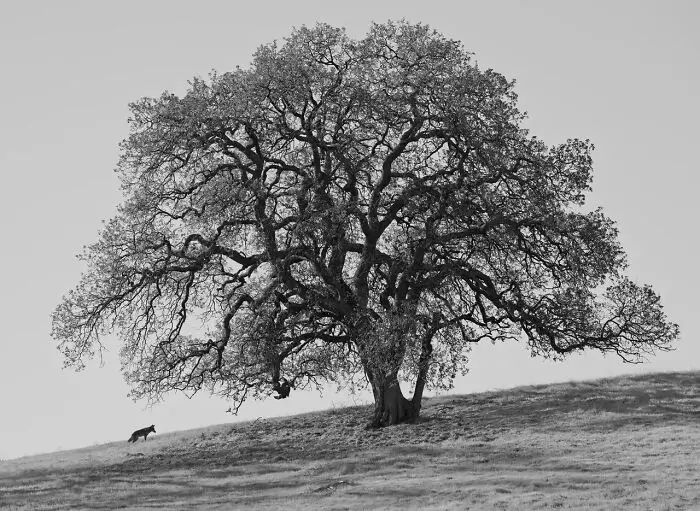
I've been following the group of coyotes that live in the hills by Stanford University for a few years now, and a goal of mine has always been to frame a coyote in the habitat that they call home: the oak savannah.
On this particular day, I found a few coyotes hunting for rodents on the grassy hills. I followed this one as it trotted from place to place while scanning the ground for gophers. However, when it went into a creek, I lost track of it and thought it was gone for good. I waited for fifteen minutes, hoping for it to come back out.
Suddenly, I looked up at a nearby oak tree to find that the coyote had come out and was hunting for rodents beneath the tree! I ran to get to a better position, and took a few pictures. I was lucky enough to get this picture, where its head is down, looking for prey, while the huge oak tree above it shines.
1point
#37 Plants And Fungi, Runner-Up: Guano Blooming By Imre Potyó
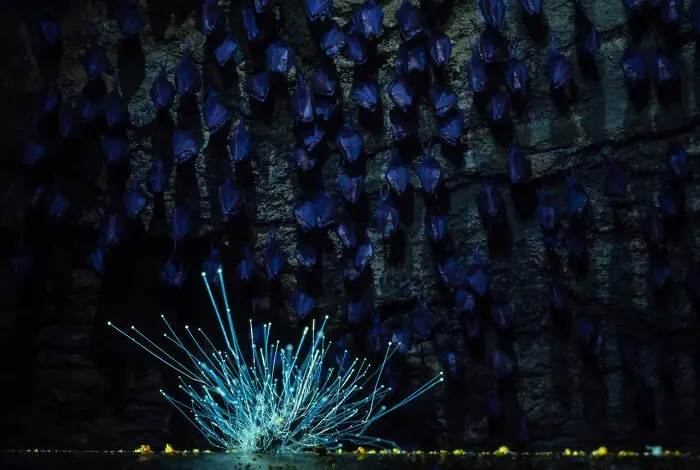
I have been photographing hibernating bats for 13 years in protected restricted mine passages in the Börzsöny hills, but I had never considered this framing before. A key aspect of lesser horseshoe bats is that they may occasionally wake during hibernation, leave the roost to hunt flying insects and leave droppings. So beneath them, the guano forms a continuous dark layer, while elsewhere there are just half-centimetre fragments.
This is where the real wonder begins: in the lamp beam a whitish coating appears on their surface, a dung-inhabiting pin mould fungus, which I explored using a macro lens with additional attachments and high magnification. The photo was taken during a controlled bat count, without any disturbance, and it is a single long exposure using focus shifting during the exposure.
0points
#38 Overall Winner; Plants And Fungi, Winner: The One That Left And The One That Stayed By Hannu Ahonen
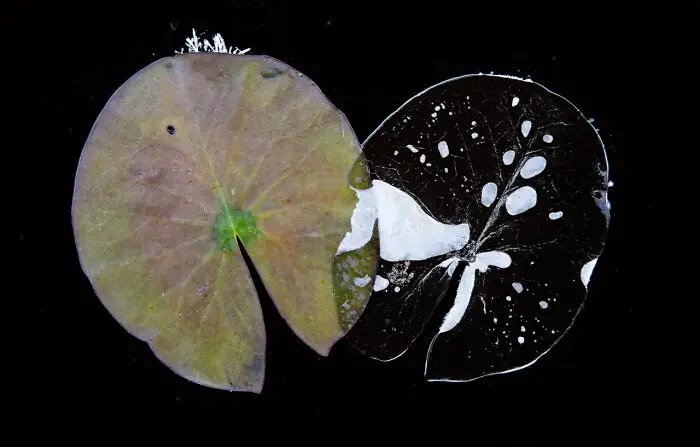
The winter's ice had arrived but it remained snowless for a long time. Some of the pond's lily pad leaves started to crumble on top of the ice. The wind took some of them with it and from those spots I discovered frosty ornaments of the leaves. I was eagerly taking photos of a natural phenomenon I had not witnessed before.
0points
#39 Mammals, Runner-Up: Hidden Away By Anna Terlecka
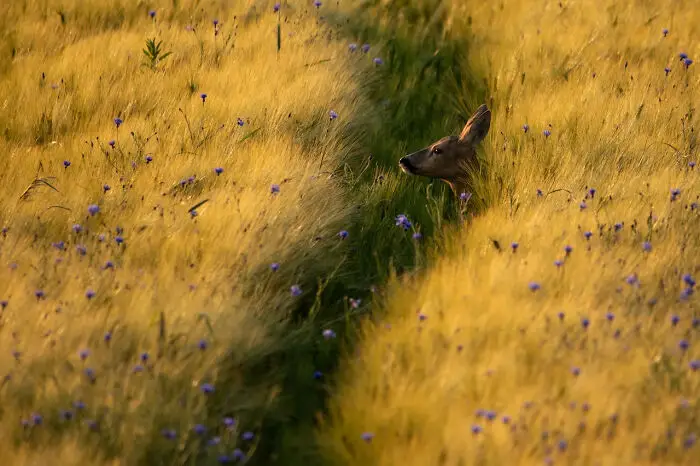
The photograph was taken in Masuria, Poland. It depicts a field with a roe deer concealed among the grain.
Stirred by gusts of wind, the grain rippled like a golden sea, threaded here and there with the blue of cornflowers. For a long while, I watched this extraordinary, tranquil spectacle.
Then, suddenly, a roe deer emerged from deep within the grain. Almost entirely hidden among the stalks, it raised its head and gazed up at the sky. That was the moment I pressed the shutter.
A moment later, the roe deer disappeared once more, swallowed by the golden sea. All that remained was the photograph, a record of a fleeting and singular encounter with the natural world.
0points
#40 Black And White, Runner-Up: Canopy Crawler By Sage Ono
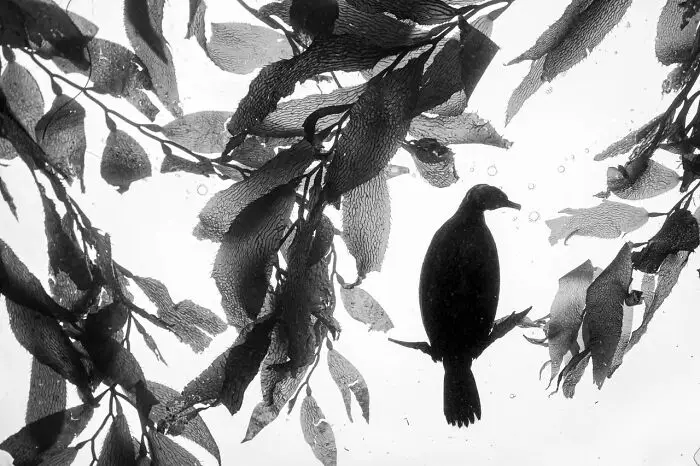
This image features a Brandt's Cormorant floating among a kelp canopy in Monterey Bay, California. In August of 2024, the young cormorants at one particular dive site had become surprisingly active, nipping at passing divers and chasing each other in circles. I spent several days lying in wait to try and photograph various behaviours.
On one of the cloudier days, one of the young birds came to rest directly above me. I took the shot without thinking much of it, but when it came time to edit, I noticed that the silhouette looked like a bird perched among branches against a blank white sky.
This optical illusion is the core idea behind the image. At first, it looks like a fairly standard image, but once one notices the odd translucency of the kelp and the bubbled texture of the surface, it becomes a surprising juxtaposition of a bird on the surface of the ocean.
0points

