
Bored Panda
30 Common Survival Myths That Are Actually Dangerous
CuriositiesJAN 14, 2022

30 Common Survival Myths That Are Actually Dangerous

208
26
If there’s anything we learned from the reality show Man vs Wild, it's that if you happen to be alone in the unlivable wilderness, you gotta have a fair share of survival hacks at hand. Things like: life begins and ends with duct tape, snares are your friends, or the PRWF acronym (Protection, Rescue, Water, Food).
And even if the chances that you and I will ever set foot in the Siberian taiga and will have to survive on eating insects and roots are pretty low, knowledge is power, and survival knowledge is the iron pump of it.
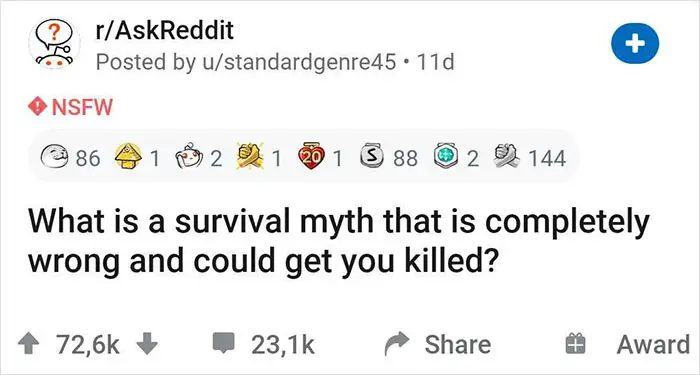
But according to this thread posted on r/AskReddit, not all the common survival tips are actually that useful. People argue that many can do more harm than good, so common sense, a rational mind, and fact-proofing have to always come first. “What is a survival myth that is completely wrong and could get you killed?” the Redditor Standardgenre45 asked people, and the responses flooded in.
Take them with a pinch of salt, or a bag too, or best, scroll down through our in-depth interview with Tony Nester, a survival instructor and multiple-book author who has been teaching wilderness survival and bushcraft courses for the past 30 years. Nester has worked with a diverse range of groups and folks from military special operations units to the Ojibwa Tribe, the Discovery and Travel Channels, and served as a consultant on the film Into the Wild. He happily shared some amazing survival tips and busted some common myths, so take out your notebooks, everyone!

This post may include affiliate links.

#21
30 Common Survival Myths That Are Actually Dangerous
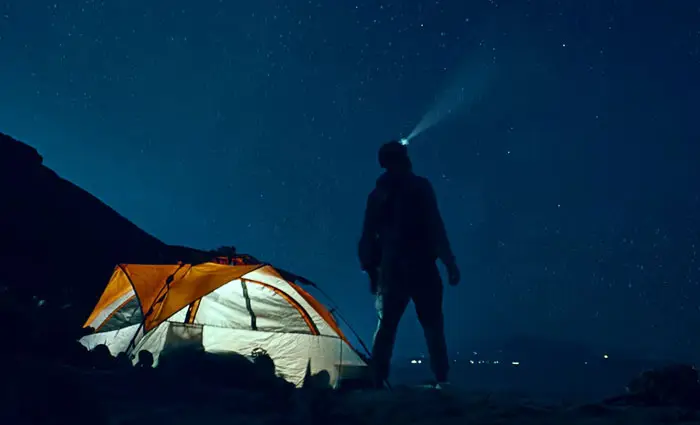
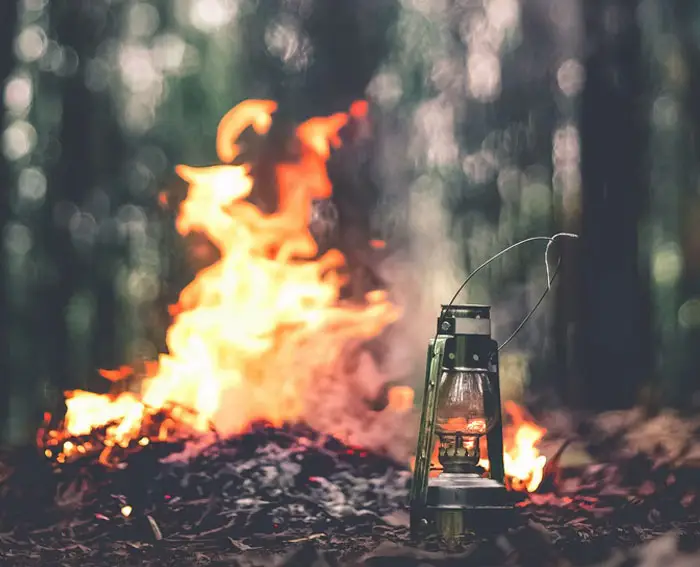
Everyone focuses on food and water but completely underestimates how quickly exposure will kill you dead. In some cases, you wont last 24 hours.
Bonus addition to this: every guide i have ever read says to make fire first. Making fire is f*cking hard sometimes. There are many environments where you flat cannot guarantee a good fire (deserts, because of lack of fuel and anything especially wet).
If you get halfway through the night and realize you cant make fire, you are going to have problems.
So make shelter. You can ALWAYS guarantee a shelter and insulated sleeping spot. Make sure your bedding is at least 4 inches thick when you lay on it. I guarantee youll underestimate just how bad the ground sucks the heat out of you.
Make your shelter as small, thick and weatherproof as possible.
124points

#22

30 Common Survival Myths That Are Actually Dangerous
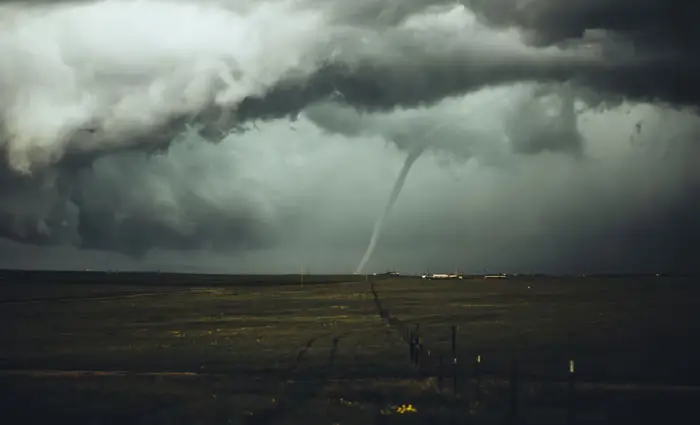
If you’re driving during a tornado warning, don’t get out of your car and climb up the side of an overpass to hide under a bridge. This myth became famous after amateur video of a man and his daughter hiding under an overpass, but the one they chose had some unusual construction that offered them protection in a way most don’t. Wind speed increases the higher you get from the ground, and the narrow passages can create a wind tunnel effect, taking the flying debris picked up by the tornado and sending it straight through you at 200 mph or more.
122points

“The other misconception comes with living off the land. Many of my students assume that it’s similar to pushing a cart through the produce aisle but it takes a considerable knowledge of edible plants (and those poisonous lookalikes), fishing skills and tackle, an understanding of wild game and their tracks, hunting know-how and a lot of time out on the land applying your skills,” Nester explained.

“So, if you are ever lost, stay put and await rescue rather than burning up precious calories searching for wild berries or that elusive trout, and remember that survivors have gone 43+ days without food.”

#23

30 Common Survival Myths That Are Actually Dangerous
Here's a good one: If you're in an elevator in freefall, DO NOT JUMP. It won't make your landing easier, it'll probably paralyze or kill you. Lay yourself flat to try and distribute your weight (as well as the pressure of the crash) more evenly. You'll give yourself a better chance at survival this way.
I mean, it's an elevator, so no guarantee you'll survive, but still small chance is better than none!
113points

#24

30 Common Survival Myths That Are Actually Dangerous
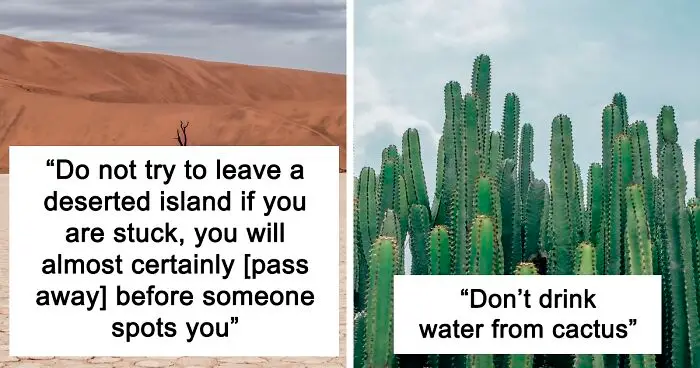
Building a raft to sail to civilization if you ever find yourself marooned on a deserted island. Stay on the island and be found alive vs never found or found dehydrated and dead of exposure.
Also walking to safety if you get lost and your car breaks down. Stay with the vehicle. They always find the vehicle. It’s inhabitants… not so much.
111points

#25

If Bear Grills does it, don’t do it.
If Survivorman Les Stroud does it, consider doing it.
109points

The last misconception is about water requirements. Nester explained that “the range for surviving without water is anywhere from 4 hours to 11 days, depending on what geographic region you’re in, time of year, your physical conditioning, elevation, wind, air temperature, and humidity.”

The survival instructor said that in his desert survival courses in May, they’ve been known to consume 2-3 gallons of water, per person per day. “By comparison, in the mountains, we might only drink 2-3 quarts. Research from the Grand Canyon indicates that you can survive up to 48 hours without water if you stay put, stay in the shade, stay off the hot ground and await rescue rather than burning up your precious sweat trying to locate water (it’s a desert, remember...).”

#26

Lightening doesn’t strike the same place twice. Lies. Obviously the person who coined that phrase didn’t live in Florida.
108points

#27

30 Common Survival Myths That Are Actually Dangerous
“Follow flying birds to find water.” They could be flying anywhere.
102points

#28

30 Common Survival Myths That Are Actually Dangerous
after getting bitten by a snake trying to suck out the venom, do not do that, by sucking the area of the bite your blood flows faster and increases the speed off the venom acting on your body, it'll just get to your heart quicker and kill you
102points

Nester concluded that “most people who get lost in the wilds suffer from the Dayhiker Syndrome, meaning they think: “I’m just going on a short walk, or out for a few hours with the dog, or I’ll only be a few miles from home. It’s the decisions made on the couch at home before the trek that often get people into trouble since they don’t leave a travel plan or bring adequate (or any) gear with them.”

“It always starts with this little disaster-cascade of poor decisions that often leads to someone being stranded in the wilds, so Leave a Travel Plan with someone back home and always carry a small survival kit to take care of those Big 5 Priorities,” he told Bored Panda.

#29

30 Common Survival Myths That Are Actually Dangerous
DO NOT DRINK YOUR PISS!!! I don't give a sh*t what Bear Grylls says...
Albeit, you can briefly drink your piss before getting sick, but urine is literally your body flushing out toxins from your squishy innards. Relying on drinking urine will make you more dehydrated than before, get you extremely sick i.e. fever, infection, etc. and can lead to kidney and liver damage/failure so as a survival myth it's probably one of my favorite to see people try.
98points

#30

30 Common Survival Myths That Are Actually Dangerous
Taking off all your clothes and snuggle with someone to prevent frostbite or hypothermia.
This does not work, you’ll just be found dead and naked.
It is great for survival of the species though.
95points
208
26