





World War I took place from July 28, 1914, to November 11, 1918. The brutal war ended over a century ago, but it’s still an incredibly important part of modern history. And one page that’s dedicated to making sure that people never forget what took place during that time is WWI Stories on Instagram.
We took a trip to this account and compiled a list of their most haunting posts below. We’ll warn you right now, pandas, that some of these images and stories are quite disturbing and upsetting. But these moments from the past deserve to be remembered, so we hope that you learn something new while scrolling through this virtual history museum.
#41
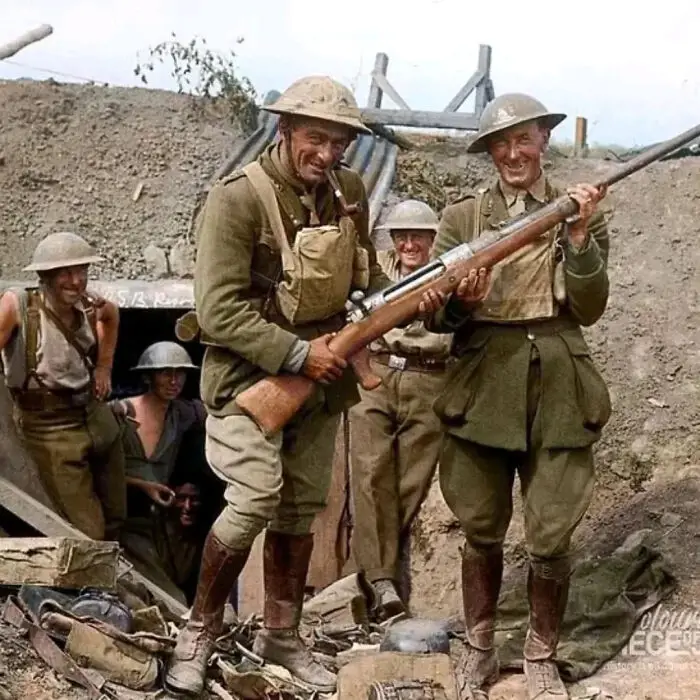
New Zealand Cavalry soldiers pose with a captured German Tankgewehr M1918. The world's first anti-tank rifle!
Report
3points
#42
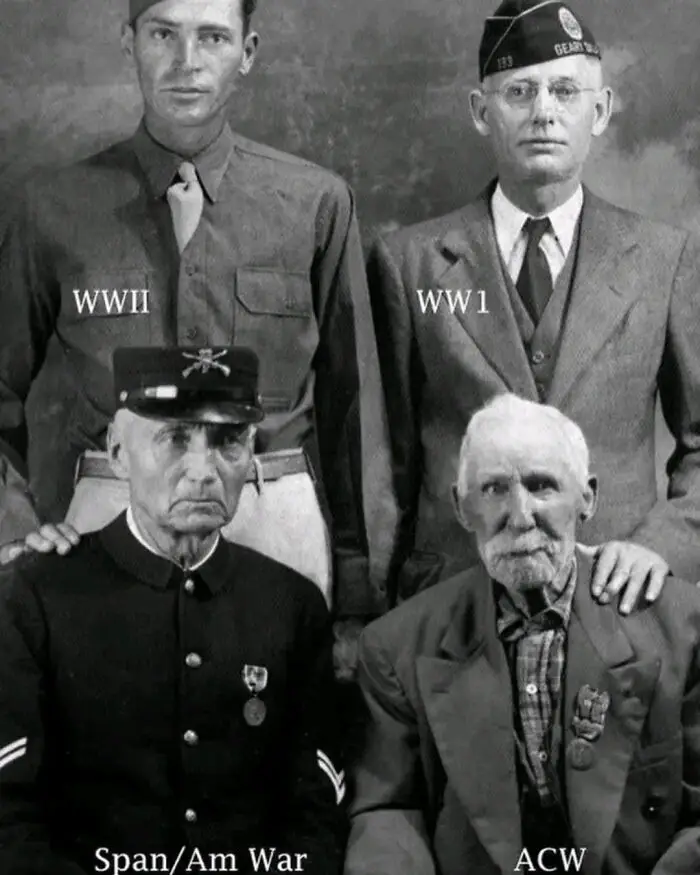
Veterans of four wars from Geary, Oklahoma.
Front: O.P. Ruth, Spanish-American War (1898) and Mr. Everest, American Civil War (1861-1865). Back: Pearl Johnson, World War II (1941-1945) and "Red" Young, World War I (1917-1918). All dates are from the period which the United States was in a state of war.
Front: O.P. Ruth, Spanish-American War (1898) and Mr. Everest, American Civil War (1861-1865). Back: Pearl Johnson, World War II (1941-1945) and "Red" Young, World War I (1917-1918). All dates are from the period which the United States was in a state of war.
Report
3points
#44
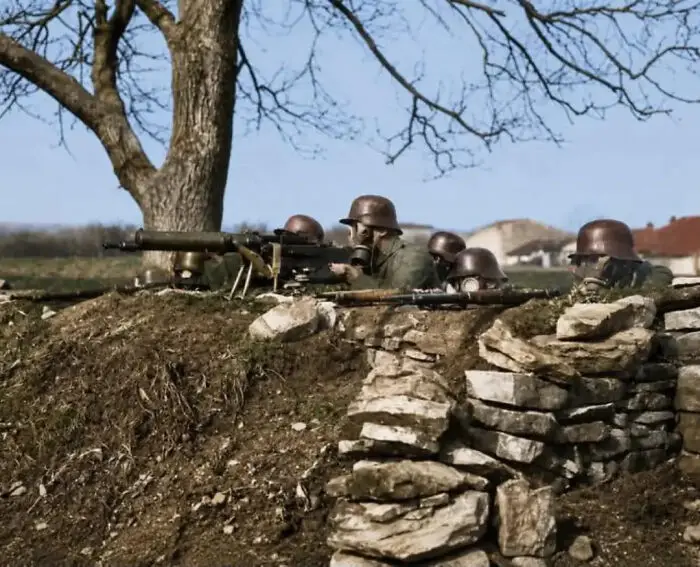
France, 1918. Lt. Alexander Pfeifer photographed men of his shock-troop MG squad in position.
By this stage of the war, Pfeifer was a veteran Stormtrooper company commander who had fought on the Western Front, Eastern Front and Italian Isonzo Front, including the Battle of Caporetto, before returning to France in 1918.
The photograph offers a rare glimpse of the men under his command — part of the personal photographic record preserved alongside his wartime diary in “The Other Trench.”
Report
3points
#45
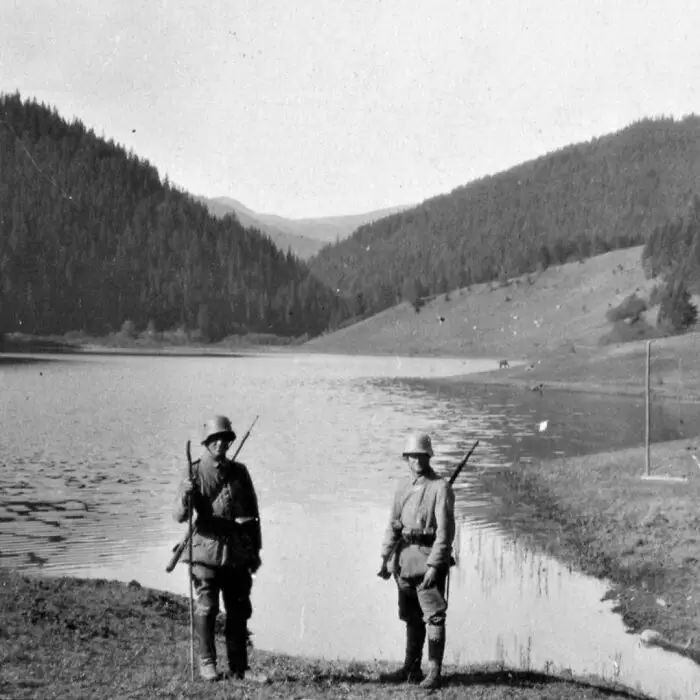
It was June 1916 when Alexander Pfeifer was trained as a stormtrooper company commander and sent to the Carpathian Mountains to fight the Russians. As a specialised mountain unit, he battled the most unfavourable conditions as well the enemy. It was here that he also was awarded his Iron Cross 1st Class. Despite the unfavourable conditions, he writes in his diary how he preferred it here to the Western Front:
“The opinions about our new theatre of war are very varied. Most are thrilled about this wild, adventurous, and truly jäger-like life, yet there are several who long for the cushy and less strenuous life in the West. Anyway, I am happy that I am here.”
His diary and photographs have now been published for the first time in both English and German: The Other Trench / Der Andere Graben.
Report
3points
#46
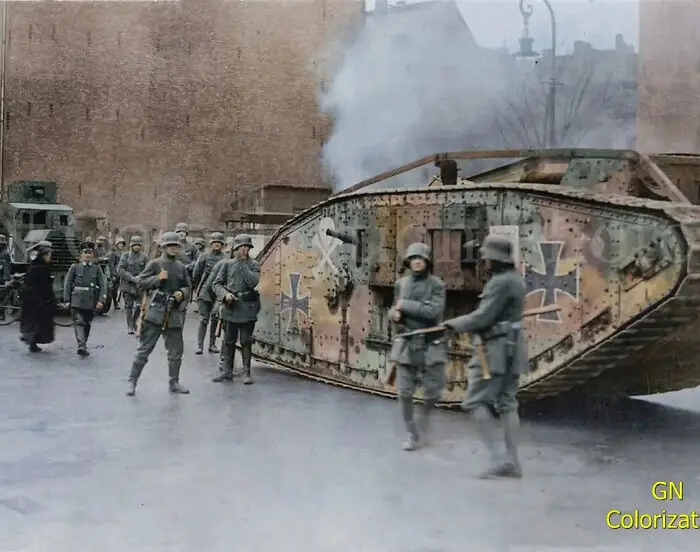
Freikorps utilize a captured British Mk IV tank to put down the Spartacist Uprising, Berlin, 1919
The Spartacist uprising (German: Spartakusaufstand), also known as the January uprising (Januaraufstand) or, more rarely, Bloody Week, was an armed uprising that took place in Berlin from 5 to 12 January 1919. It occurred in connection with the German revolution that broke out just before the end of World War I. The uprising was primarily a power struggle between the supporters of the provisional government led by Friedrich Ebert of the Majority Social Democratic Party of Germany (MSPD), which favored a social democracy, and those who backed the position of the Communist Party of Germany (KPD) led by Karl Liebknecht and Rosa Luxemburg, which wanted to set up a council republic similar to the one established by the Bolsheviks in Russia. The government's forces were victorious in the fighting.
The Spartacist uprising (German: Spartakusaufstand), also known as the January uprising (Januaraufstand) or, more rarely, Bloody Week, was an armed uprising that took place in Berlin from 5 to 12 January 1919. It occurred in connection with the German revolution that broke out just before the end of World War I. The uprising was primarily a power struggle between the supporters of the provisional government led by Friedrich Ebert of the Majority Social Democratic Party of Germany (MSPD), which favored a social democracy, and those who backed the position of the Communist Party of Germany (KPD) led by Karl Liebknecht and Rosa Luxemburg, which wanted to set up a council republic similar to the one established by the Bolsheviks in Russia. The government's forces were victorious in the fighting.
Report
3points
#47
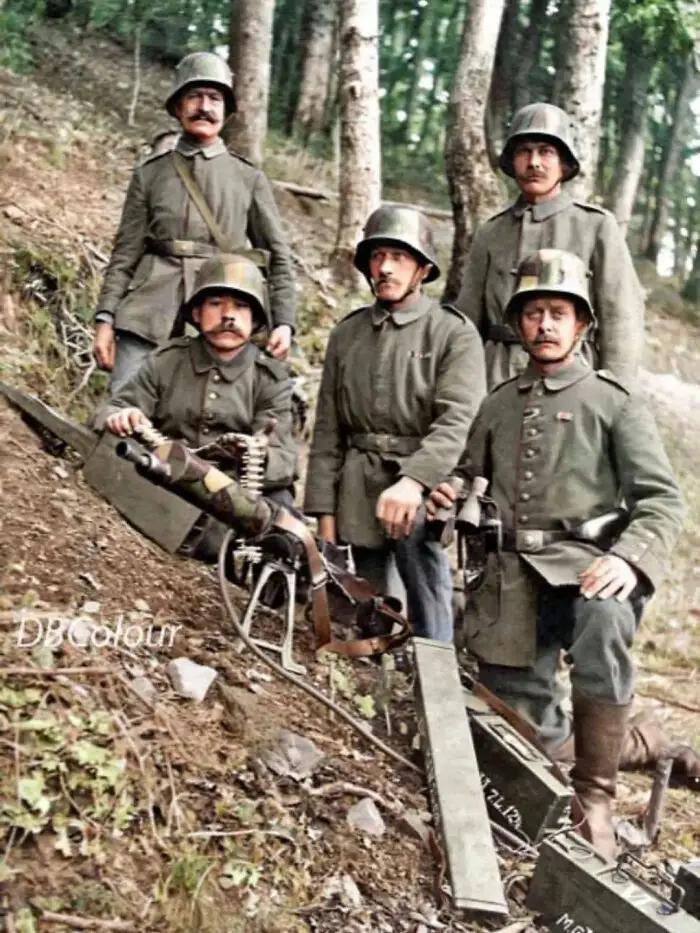
German machine gunners with camouflaged M16 Stahlhelm and MG08/15, summer of 1918.
Report
3points
#48
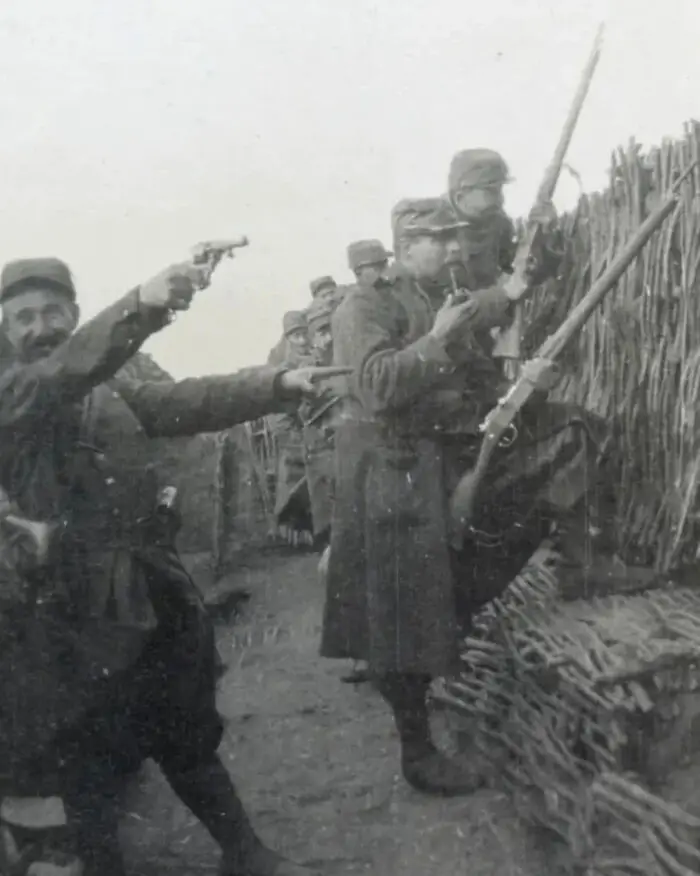
French soldiers in a trench posing as if ready to go over-the-top, 1915.
Report
3points
#49
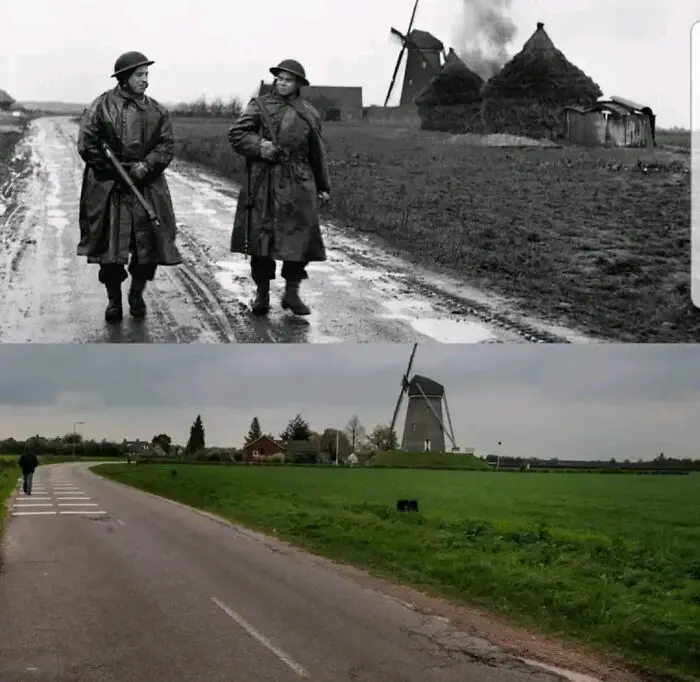
"Wet and Mud"
Scottish soldiers of the 53rd Highland or Welsh Division walking accross the typical Dutch countryside with her windmills near Meijel, The Netherlands. October 1944.
Scottish soldiers of the 53rd Highland or Welsh Division walking accross the typical Dutch countryside with her windmills near Meijel, The Netherlands. October 1944.
Report
3points
#50
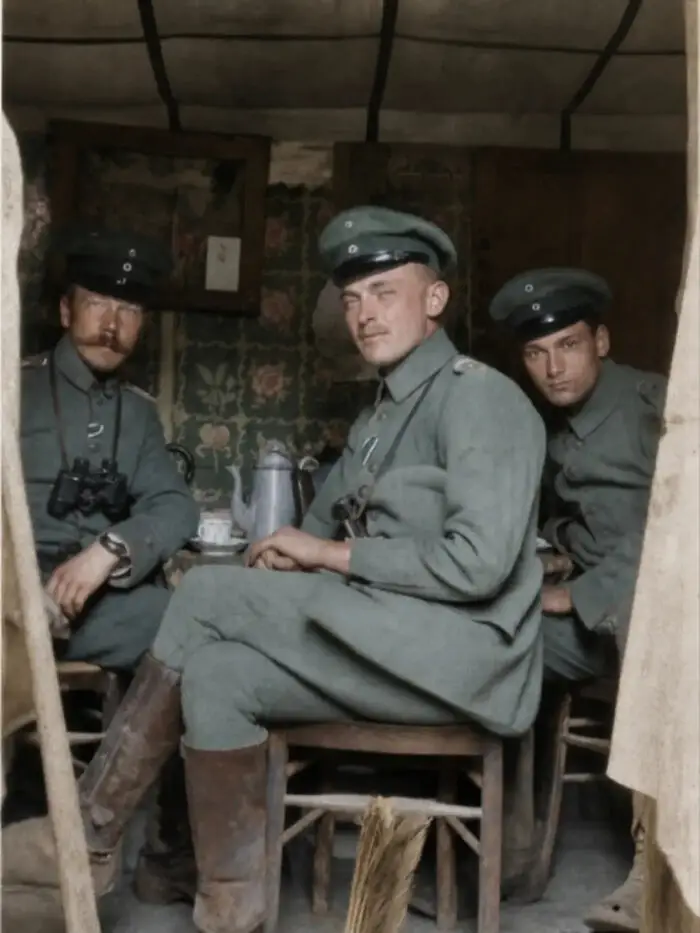
German soldiers in the trench - 1915
By the time this photograph was taken, Lt. Alexander Pfeifer already had numerous battles and war experiences behind him.
After some time away from the front, he returned to the trenches and was struck by how much they had developed in a short period.
Alexander recorded:
“Anyone who hasn’t seen them or helped build them has no idea of the work that goes into these trenches, which are over two metres deep. The walls are covered from top to bottom with thick planks and wicker and braced with beams to prevent them from caving in. The ground is covered with duckboards.”
It is these everyday details that make Alexander’s diary so remarkable — showing not just the battles, but how soldiers actually lived between them.
His diary and hundreds of photographs are preserved in The Other Trench: The WW1 Diary & Photos of a German Officer.
Report
3points
#51
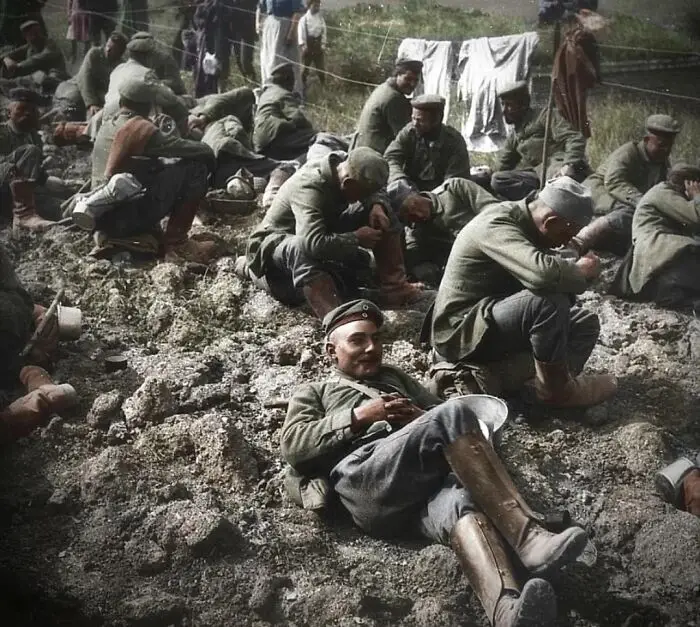
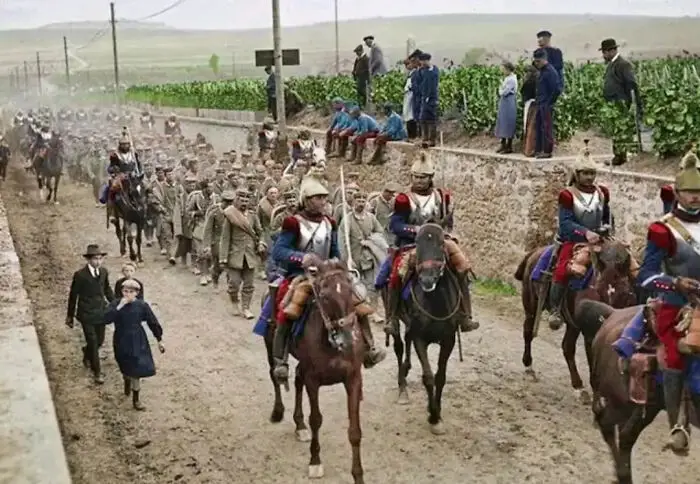
These German prisoners seem content in a field near Villers - Bretonneux in July 1916 early in the Battle of The Somme. On the first day alone 8,000 Germans lost their lives defending the Allied advance which cost 21,000 British soldiers their lives.
Report
3points
#52
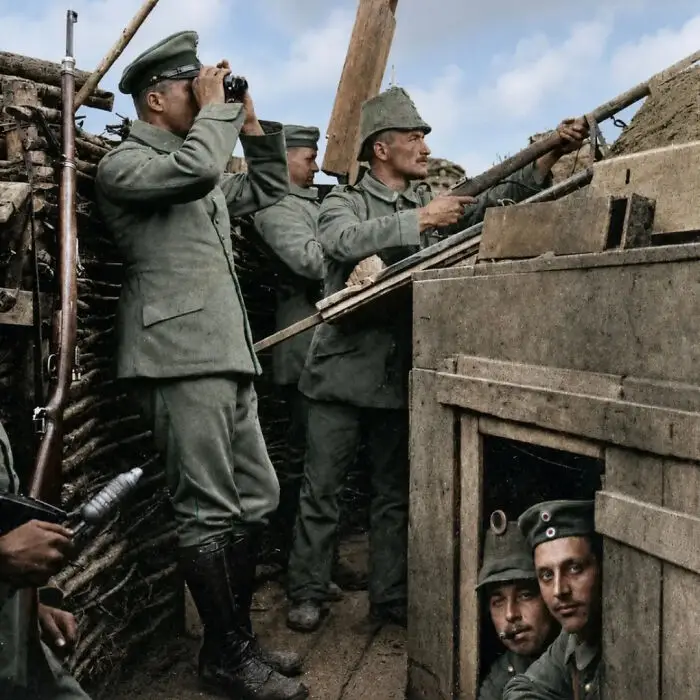
The Western Front, 1915 — German soldiers in the trenches
Taken by Lt. Alexander Pfeifer, an officer of the 11th Kurhessian Jäger Battalion, this photograph offers a rare glimpse into the trenches where he and his men lived and fought.
While being on the frontline, he recorded in his diary:
“Anyone who hasn’t seen them or helped build them has no idea of the work that goes into these trenches, which are over two metres deep. The walls are covered from top to bottom with thick planks and wicker braced with beams to prevent them from sliding together. The ground is covered with duckboards. And yet, this entire huge work has been accomplished only in the d**d of night, under the most unfavourable weather conditions and under enemy fire.”
His wartime diary and hundreds of photographs remained in the family for more than a century before being published in The Other Trench: The WW1 Diary & Photos of a German Officer.
Report
3points
#53
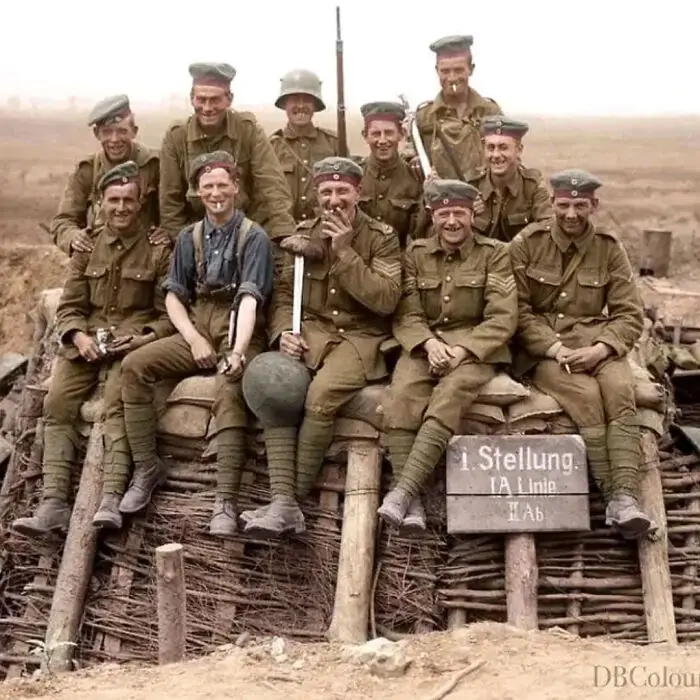
Soldiers of the Duke of Cornwall's Light Infantry wearing German helmets and caps in a captured trench. Note a board with a sign "I.Stellung. IA Linie. II AB". Battlefield near Messines, Belgium, 11th June 1917.
Report
3points
#54
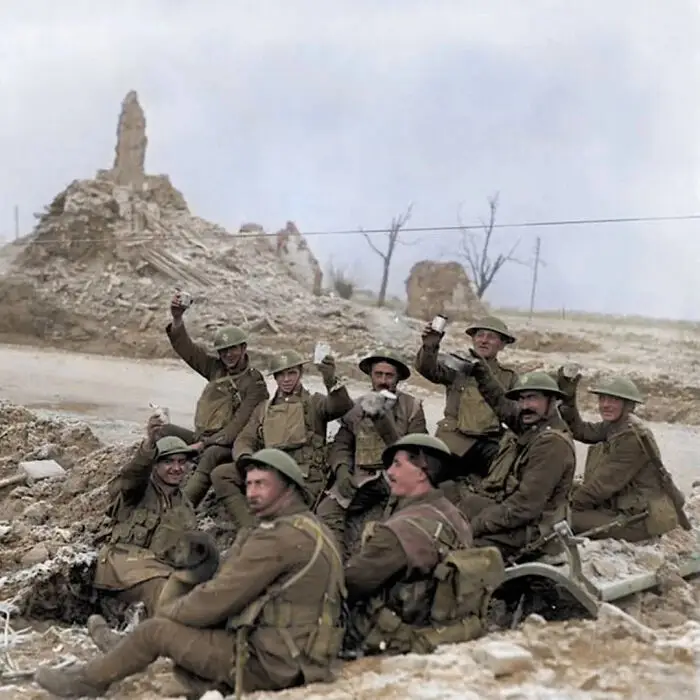
December 1917.
Pioneers of the 11/Liverpool enjoying an alfresco meal in exposed conditions near Ypres.
Pioneers of the 11/Liverpool enjoying an alfresco meal in exposed conditions near Ypres.
Report
3points
#55
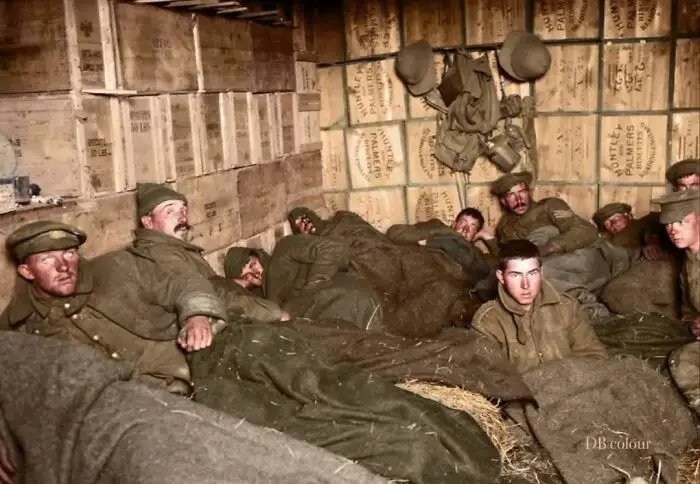
Frost-bitten Allied soldiers lying on straw in shelters constructed of biscuit boxes (Huntley & Palmer) at a store dump at Sulva, Gallipoli, after the frost at the end of November 1915.
Report
3points
#56
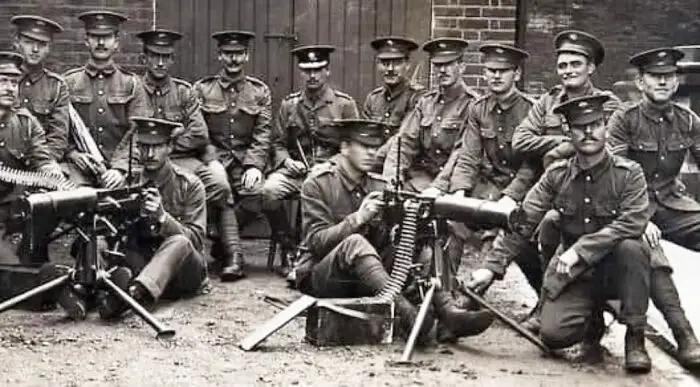
Not a single soldier from this Irish Guards machine-gun team, pictured in 1914, survived the horrific slaughter on the battlefield.
Report
2points
#57
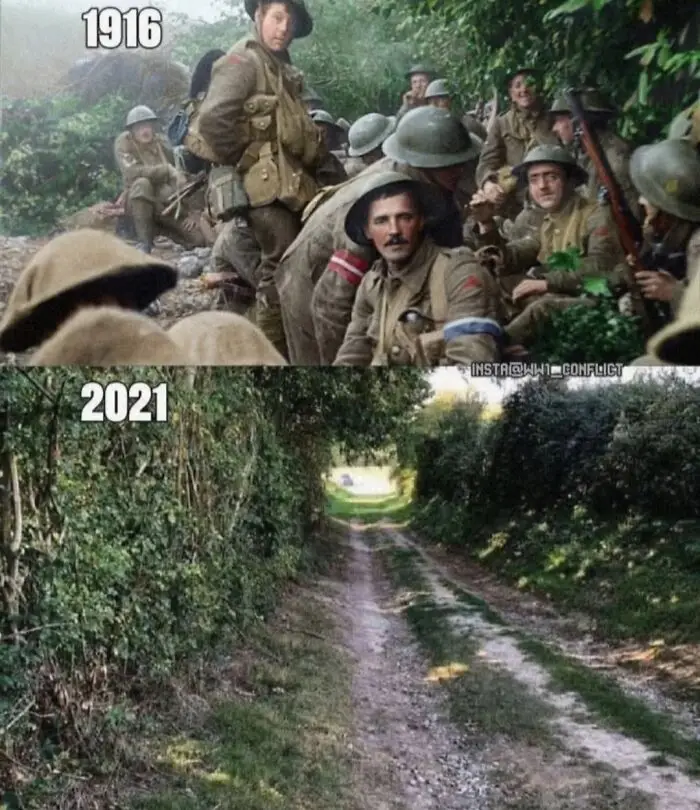
WW1 then & now. (Sunkenlane )
A group of Lancashire Fusiliers wait in the Sunken Lane on the morning of July 1, 1916. At 7:30 a.m. they clamber up the dirt bank to make a rush at the Germans.
This shot was taken about 15 minutes before that attack. What these men don’t know is that the vast majority of them won’t advance more than a dozen paces before being k****d. Inset: The very same spot in 2021.
Report
2points
#58
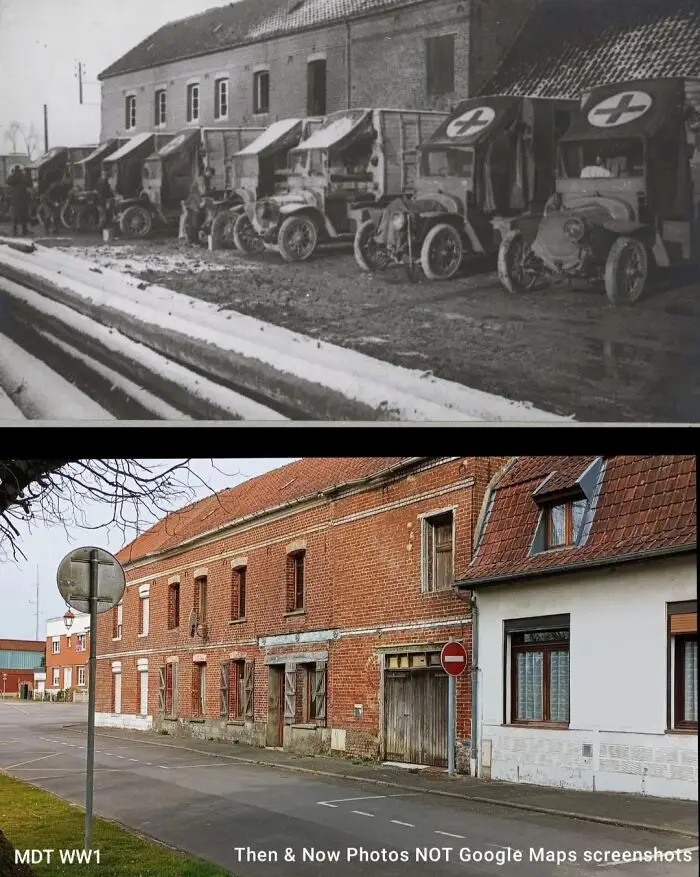
Ww1 then and now, Avesne-le-Comte on November 26, 1915.
Ambulances on what is now Place Louis Mexandeau
Ambulances on what is now Place Louis Mexandeau
Report
2points
#59
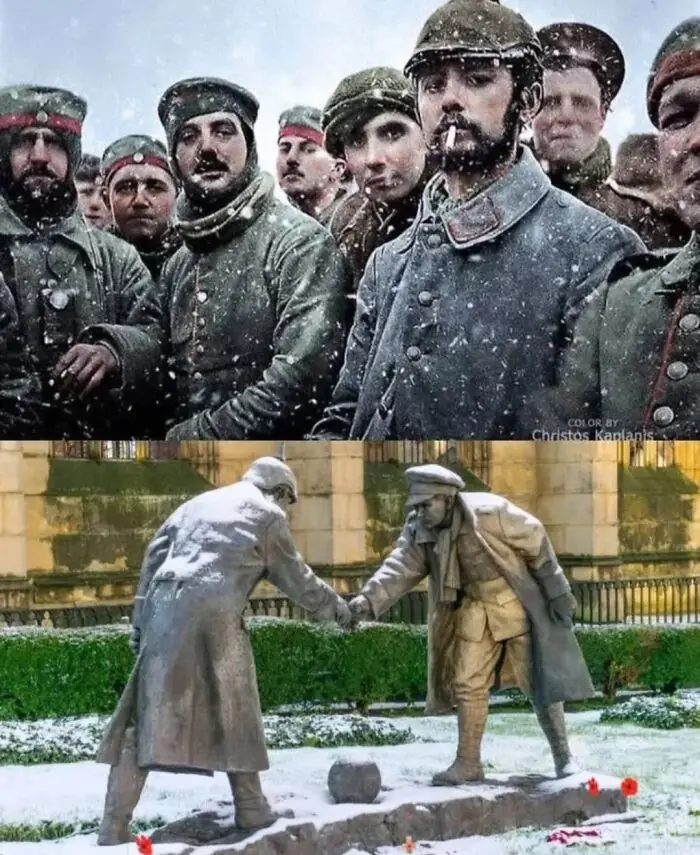
The Christmas Truce shows us that extreme humanity is possible, even in the face of the impossible. World is inspired by the stories from these soldiers who laid down their weapons in a time of war to share in a brief moment of peace.
The Christmas truce also allowed both sides to finally bury their d**d comrades, whose bodies had lain for weeks on “no man's land,” the ground between opposing trenches. The phenomenon took different forms across the Western front.... And of course, it was only ever a truce, not peace.
The Christmas truce also allowed both sides to finally bury their d**d comrades, whose bodies had lain for weeks on “no man's land,” the ground between opposing trenches. The phenomenon took different forms across the Western front.... And of course, it was only ever a truce, not peace.
Report
2points
#60
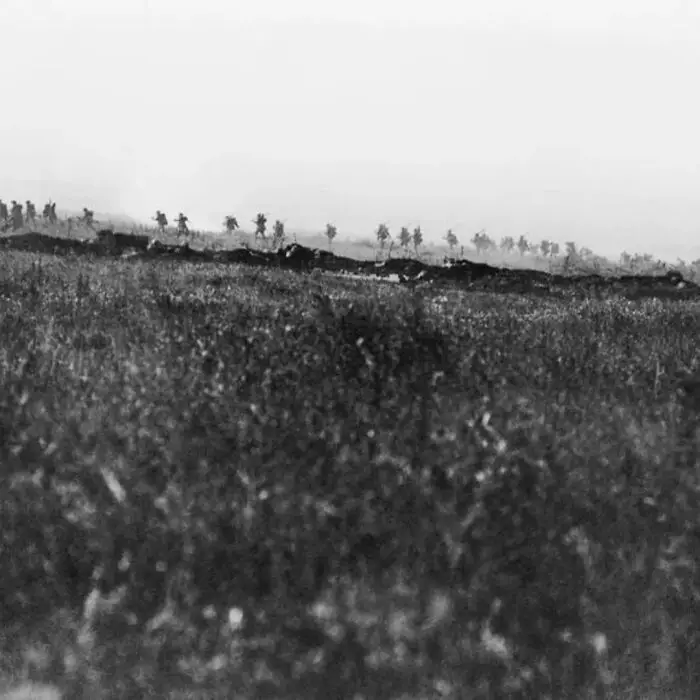
One of the stunning and one of the rare picture of battle of somme. A support company of an a*****t battalion, of the Tyneside Irish Brigade, going forward shortly after zero hour on 1 July 1916 during the attack on La Boisselle.
THE BATTLE OF THE SOMME, JULY-NOVEMBER 1916.
THE BATTLE OF THE SOMME, JULY-NOVEMBER 1916.
Report
2points
