



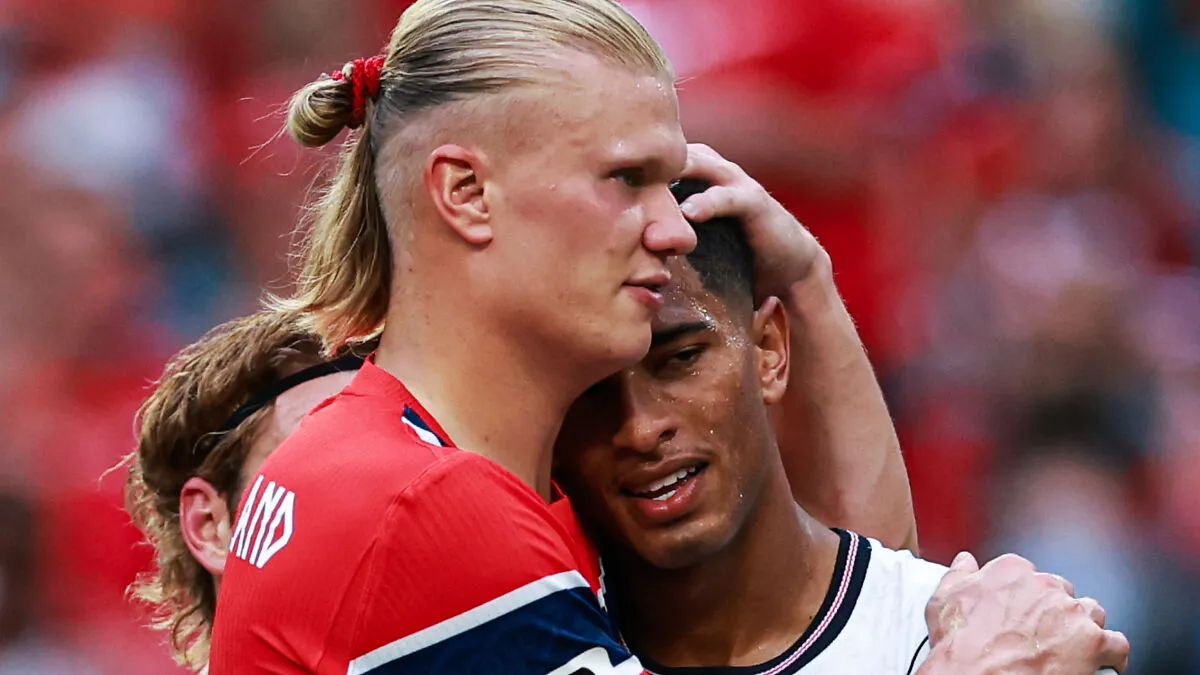


The 2026 FIFA World Cup has always produced unforgettable photographs. A last-minute goal, a breathtaking save, a perfectly timed header, or an emotional celebration can become the image that defines an entire tournament.
During this year’s FIFA World Cup, however, many of those unforgettable moments ended up telling another story.
Without anyone planning it, they looked remarkably similar to famous paintings, sculptures, and masterpieces created by some of history’s greatest artists.
Those unexpected comparisons came from LJ Rader, the creator behind the hugely popular Art But Make It Sports accounts, where he pairs iconic sports photographs with famous works of art that share the same pose, movement, emotion, colours, or composition.
Throughout the tournament, fans from around the world constantly tagged him in photos from different matches, giving him an endless stream of images to explore.
"Everybody is dialed into the same event," Rader told CNN Style.
"The community is constantly sending me things, and there are photographers from everywhere. It ends up getting easier because there's so much to work with."
Even then, finding the right match wasn’t as simple as putting two similar images side by side.
Rader explained that football is actually one of the hardest sports to work with because “there are only so many positions they can be, since they can’t use their hands.”
That’s why he often studies various photographs, revisits match footage frame by frame, and sometimes even reaches out to photographers for a better angle.
"The ideal is getting a sports photo, rather than a screenshot, and pairing it with the best possible artwork," he said, adding that many potential matches never make it online because they don't meet "the editorial bar" he has set for himself.
Some moments, however, instantly reminded him of a masterpiece.
For instance, Cape Verde's defense of Sidny Lopes Cabral’s emotional hug with his girlfriend after scoring against Argentina was one of them.
"Regardless of whether or not Cape Verde was going to win that match, that was the image that would summarise that game," Rader said.
Other pairings took much longer, drawing from what he described as his “mental library” of artworks spanning Renaissance paintings, Impressionist masterpieces, abstract art, and modern sculptures.
Here are 25 World Cup 2026 moments that looked as if they had stepped straight out of an art museum.
#21 Raúl Rangel's Goal-Line Save - The Martyrdom Of Saint Lawrence By Jean-Baptiste De Champaigne
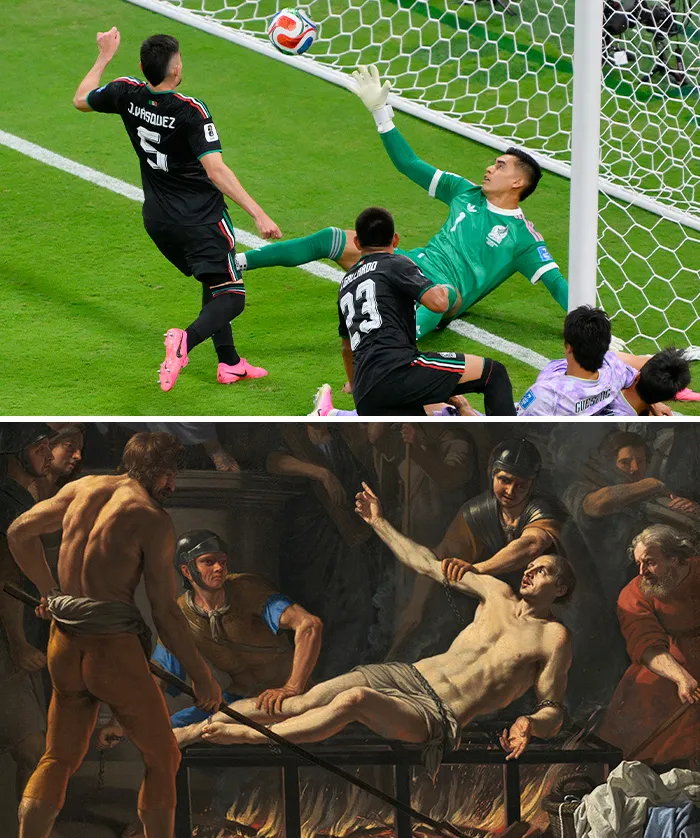
Painted around 1660, Jean-Baptiste de Champaigne’s The Martyrdom of Saint Lawrence depicts the final moment of Saint Lawrence, an early Christian deacon who was sentenced to be executed on a burning gridiron under the Roman Emperor Valerian.
The artist used strong contrasts of light and carefully arranged figures to heighten the tension of the scene.
More than 350 years later, a football moment unexpectedly recreated that same composition.
During Mexico’s World Cup clash with South Korea, goalkeeper Raúl Rangel threw himself backwards across the goal line to make a stunning last-ditch save, while defenders Johan Vásquez and Jesús Gallardo closed in around him.
The goalkeeper’s outstretched body, the positioning of the surrounding players, and the angle of his raised arm closely resembled Saint Lawrence lying across the gridiron as soldiers restrained him in Champaigne’s painting.
Fans also applauded Rader’s eye for visual parallels.
"You always outdo yourself with each new post," one user commented. Another joked, "I'm gonna print this, frame it, and hang it in my living room.”
5points
#22 Leandro Paredes' Sliding Tackle - Composition, No. V By Hans Hofmann
German-American painter Hans Hofmann was one of the pioneers of Abstract Expressionism, and his 1952 work Composition, No. V showcases the energetic style he became known for.
Rather than painting recognisable subjects, Hofmann built his compositions with thick layers of colour, sweeping brushstrokes, and bold shapes.
His famous "push and pull" theory used contrasting colours and textures to create movement and depth, making viewers feel the energy within the painting instead of simply observing it.
That same sense of movement appeared during Argentina's Round of 16 clash with Egypt at the 2026 FIFA World Cup.
In an overhead photograph, Leandro Paredes launches into a perfectly timed sliding tackle on Mohamed Salah, stretching one leg toward the ball while twisting his body across the grass.
From above, the white of Argentina's kit, the deep green pitch, the red of Egypt's jersey, and the sweeping motion of the tackle closely resemble the bold colours and flowing forms in Hofmann's abstract painting.
Rather than matching individual figures, the comparison captures the painting's rhythm and kinetic energy.
Followers once again admired Rader's ability to spot a connection where few others could.
"Bro literally never misses," one fan commented. Another simply wrote, "God bless whatever is happening in your head.”
5points
#23 Erling Haaland's Walkout - B.j.m.c. (Bonjour Monsieur Courbet) By Georg Baselitz
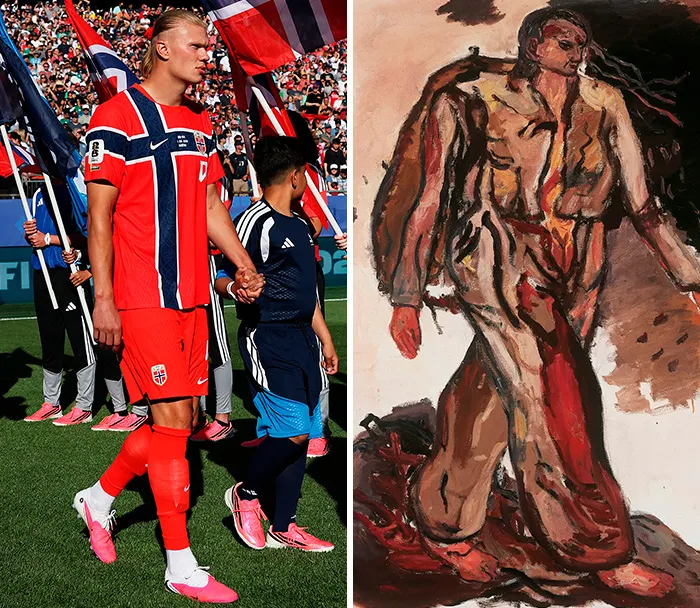
Before Norway's World Cup match got underway, Erling Haaland walked onto the pitch holding hands with a young mascot.
It was an ordinary pre-match moment, but one photograph transformed it into something that looked like it belonged inside an art gallery.
The image was paired with Georg Baselitz's B.J.M.C. (Bonjour Monsieur Courbet), and the resemblance was hard to ignore.
Painted in 1965, the work comes from Baselitz's celebrated Heroes (Die Helden) series, which portrays imposing yet wounded figures wandering through a fractured post-war landscape.
The title references Gustave Courbet's famous The Meeting (Bonjour, Monsieur Courbet), but Baselitz replaced the original scene with distorted forms that reflected uncertainty, resilience, and the changing identity of post-war Germany.
The painting also predates the artist's signature upside-down compositions that later made him internationally famous.
In the comparison, Haaland's towering frame, relaxed stride, and broad shoulders closely echo the solitary figure in Baselitz's painting. Even the red-and-white colours of Norway's kit seem to mirror the expressive streaks of paint running through the artwork.
Fans were just as impressed by the pairing. One user pointed out another detail, writing, "The cross is even on there, crazy.”
5points
#24 Michael Olise's Bicycle Kick - Composition (Petit Univers) By Joan Miró
Painted in 1933, Composition (Petit univers) by Joan Miró is one of the Spanish Surrealists’ playful abstract works, filled with floating shapes, curved lines, stars, and colourful symbols that seem to exist in their own dreamlike universe.
Rather than depicting reality, Miró used bold forms and movement to create images that encouraged viewers to find their own meanings within the composition.
The abstract found a resemblance in France’s match against Sweden at the 2026 FIFA World Cup, when photographer Morgan Tencza captured Michael Olise attempting an acrobatic bicycle kick.
With his body suspended in mid-air, one leg stretched high toward the ball and the other extended behind him, Olise’s silhouette resonated with one of the abstract figures in the painting.
The pairing left many followers amazed by Rader’s eye for detail.
"Spotting a 1933 Miró in the French squad is actually insane," one person commented. Another admitted, "I wish I could comprehend how your brain works.”
4points
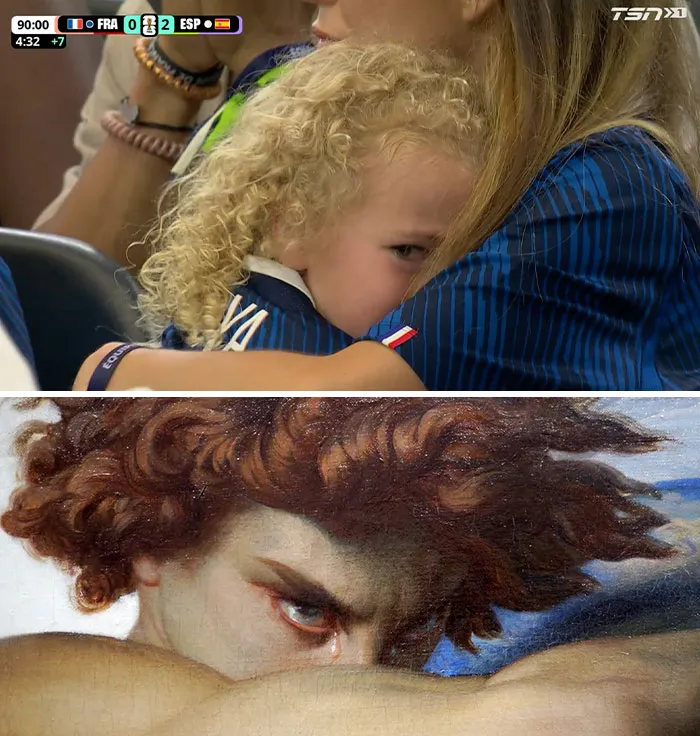
#25 French Fan – The Fallen Angel By Alexandre Cabanel
Given that the FIFA World Cup comes around once every four years, there’s no bigger heartbreak for a soccer fan than watching their team be eliminated from the race, especially so close to the end.
The Kylian Mbappé-led squad sailed past the Group Stage, Round of 32, and the Quarter-finals, but was stopped in the Semi-finals by Spain, who went on to lift the golden trophy on Sunday, June 19, beating Lionel Messi’s Argentina.
The defeat left the Les Bleus devastated, as despite their best efforts, the French could not score, even though they took more shots on goal than their opponents.
As the French trailed 0-2 in the extra time of the Semi-final, a young fan in the crowd at the Dallas Stadium in Arlington was photographed hiding her face in the arms of a grown-up.
The picture quickly went viral, and the heartbroken look in her eyes was compared by netizens to French artist Alexandre Cabanel’s famous 1847 painting, The Fallen Angel.
Currently on display at Musée Fabre in Montpellier, Southern France, the work depicts the Biblical story of Lucifer’s expulsion and subsequent fall from heaven.
Over the years, art experts have analyzed Cabanel's painting, noting that Lucifer is depicted with anger, hurt, and betrayal in his eyes, a single teardrop falling from one corner as he sits, hands crossed on the ground, bare-bodied, nestling in his wings.
The painting’s comparison with the French fan is rooted in the sorrow and grief they both experience, albeit in vividly different contexts.
Most fellow soccer fans empathized with the girl.
One said, “I feel the pain.” Another wrote, “This is how villains are made... they let her experience pain at such a young age.
One fan was surprised to see the girl’s expression, saying, “I wonder what makes the babies sad. Do they even understand what's happening?”
Report
0points