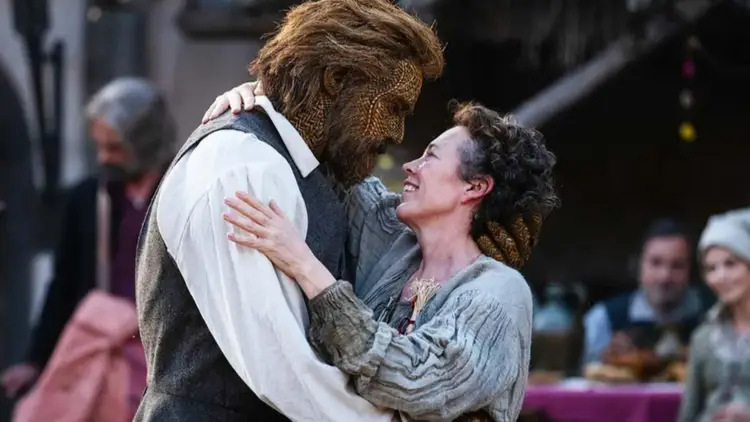
My friend was all giggly when she called me and told me to watch Olivia Coleman and Alexander Skarsgård’s Wicker. I haven’t watched it yet, but just the trailer gave me butterflies. Especially all the steamy scenes and Colman’s character’s more-than-satisfactory post-coital sighs. And it wasn’t just me because the trailer sparked an online frenzy the moment it dropped. The movie is based on a short story written by Ursula Wills-Jones, The Wicker Husband. It’s a fairy tale with a bizarre twist where Coleman’s character, an ostracized Fisherwoman, commissions the local basketmaker, played by Peter Dinklage, to create her a husband. Made of wicker, Alexander Skarsgård plays her perfect spouse, who looks after all her needs and desires. Well, the villagers aren’t the only ones watching their story unfold with envy. However, the movie says a lot about the rise of romantasy and people fantasizing about getting it on with monsters, elves, goblins, and even men made of wicker. It also makes us wonder how this affects real-life relationships. That’s why Bored Panda reached out to experts Emese Taylor and Carla Crivaro for their perspectives. We also got insights from Cassie Carter, an independent urban fantasy and paranormal romance author. In this article, we discuss romantasy, heteropessimism, real relationships, and more with them. Wicker / Black Bear Skarsgård’s character doesn’t really fit the typical male protagonist such as the hot dumb guy, the cool bad boy, or the handsome geek. He’s made of wicker, is “strong as a tree and just as hard,” but women and gays are thirsting after him. Apart from his much-spoken-about penis and ability to sexually satiate the Fisherwoman, there’s more to why his character exploded online and turned so many people horny. The filmmaker couple Alex Huston Fischer and Eleanor Wilson know exactly why folks are lusting after him. “They’re having sex, the roof is leaking, and he just says, ‘I’m going to fix the roof’ – then she has a screaming orgasm,” Huston Fischer told the BBC. “We made him very beautiful,” adds Wilson, “but people are noticing that the best thing about the Wicker Husband is that he did something without being asked, and he doesn’t require a pat on the back for it.” Wilson also explains that entering the dating pool can invite love into your life, but it can also mean being examined more than before. She stresses that the Fisherwoman’s journey is about what it is to be a woman in this world, struggling with your feelings about yourself and everybody else’s feelings about you. Twilight / Lionsgate (not the actual photo) While the story is definitely unique, it’s not the first of its kind. Whether it’s Beauty and the Beast, Twilight, Shape of Water, or Guillermo del Toro’s Frankenstein, the theme of people falling for monsters is nothing new. Clinical sexologist and relationship therapist Emese Taylor says that what’s new is that women are talking about it out loud. “And if you look closely, the goblin or the mothman is never really the point. It’s how he behaves. He’s devoted, he listens, and he’s not embarrassed to want her,” she adds. Sex and relationship expert Carla Crivaro echoes the same point: it’s not so much about the ‘monster’ itself, but the personality and the feeling they get from that character. She believes that romantasy gives women the opportunity to create and consume fantasies where they can experience elements that they might not otherwise be getting in a relationship, such as intensity, devotion, sexual freedom, and a sense of emotional fulfillment away from the day-to-day frustrations and exceptions in real-life relationships. When we asked our experts to speak about heteropessimism, neither of them felt that women have given up on men or that they are losing their desire for men. “I think potentially the question for men, which might be a little uncomfortable, isn’t why women are choosing monsters, but why are fictional characters being imagined as better partners than human men?” expressed Carla. Author Cassie Carter also elaborated on this point. She has written about everything from a synthetic man discovering love and emotional connection in Bound Without Blueprint to a wolf shifter navigating a second-chance romance in The Night Shift. “For me, the appeal isn’t necessarily about replacing real men with imaginary creatures. It’s about exploring different possibilities, experiencing something exciting, and letting our imaginations run wild. I don’t think enjoying those fantasies automatically means women have given up on men. Sometimes we just want a really good love story, even if one of the characters happens to have claws, fangs, or a tail!” she adds. Even Skarsgård’s character proves women haven’t given up on men. After all, Coleman is not having hot sex with a table. Her husband is built like a man, looks like a man, dresses like a man, and also has a penis that gives her orgasms. While women’s loins are burning for monsters, it’s all just a fantasy. However, Emese claims that with any fantasy, the first thing she asks is: what does it give you? She continues, “A wicker man can’t reject you. He won’t comment on your thighs. He doesn’t need his ego looked after, and he won’t go quiet on you the next day. Take all of that away and what’s left is pure attention and being wanted. For a lot of women, that’s the real turn-on. Being desired without having to perform.” Cassie adds that there’s a certain freedom in exploring something that you know isn’t ever going to happen in real life. She has read books where a demon has a tail and puts it to some very creative uses during sex. It’s entertaining and sexy, but it will never happen in reality. There’s a subconscious sense of safety in that. You can enjoy the fantasy without any real-world expectations or consequences. However, Carla points out that it’s not just women who are exploring romance or sex with mythical creatures. freestocks.org / Pexels (not the actual photo) She explains that the top searched term in 2025 for Porn Hub worldwide was ‘Hentai’. Only 38% of traffic came from women. Hentai is Japanese-style porn which often features fictional characters including human, non-human, and fantastical beings. She also talks about the Soulkyn platform where you can generate ‘AI companions’ for role-play. It has many community-created AI chatbots, including anime and fantastical creatures, and around 85% of men use it. Carla notes an overall interest in fantasy creatures and erotic play among both men and women. As the fan base for romantasy is increasing, it does make us think about heterofatalism, the feeling that things are unlikely to get better in real-life relationships. Emese believes that tiredness is the biggest passion killer. “If you’re the one remembering the birthdays, booking the boiler service and noticing the kids need new shoes, it’s really hard to then switch into feeling sexy. A husband literally made to measure, like Olivia Colman’s, takes all of that away. So the fantasy is about rest as much as sex,” she narrates. That’s fine as an escape. She said that she would only worry if it became the one place someone lets themselves feel wanted, and real people stopped getting a chance. Carla also echoes that there is definitely frustration, and when we are in the middle of a difficult period, it can feel like we can’t get out of it. However, she sees lots of people who are frustrated but haven’t given up yet. They are still investing their time and money in finding ways to improve their relationships or dating prospects. “Fantasies of any type can give us the space to escape from a reality that isn’t fulfilling, whether that is romantic or erotic content with a fantasy figure or an AI companion. It’s the ability to create an experience around your own desires without having to negotiate another person’s expectations, insecurities, and needs,” she adds. Vitaly Gariev / Pexels (not the actual photo) Meanwhile, Cassie says that she can absolutely see how dissatisfaction with real-life relationships might influence someone’s interest in romance fiction, because that’s partly where her own writing began. She felt things were missing from her relationship, and writing gave her a place to explore the emotional connection, passion, and intimacy she wanted. Having said that, she wouldn’t assume that’s true for everyone. Plenty of people who enjoy romance fiction are perfectly happy in their relationships, and for some couples, reading romance can actually bring something positive into their own intimacy. It can spark conversations, introduce new ideas, or simply add a little excitement. Cassie explains, “In Marked Clean, for example, I explore a relationship developing within an oppressive, dystopian society, where trust, autonomy and the freedom to choose each other become particularly important. The circumstances are fictional, but the desire to be loved, respected and chosen is something very real.” “Perhaps that’s where some of the frustration with real-life relationships comes into it. It’s not necessarily that women want a monster instead of a man. Maybe they want the attention, passion, consideration, and emotional connection that the fictional character represents.” Carla elaborates on the point that, right now, both men and women feel they aren’t being seen, understood, appreciated, and accepted in their relationships. It makes sense that they are drawn to worlds that fill these gaps in their lives. She doesn’t think the fantasies result from what’s happening in the real world. She also doesn’t think they were created specifically in response to them. However, she and Emese both agree that fantasy is made from what’s missing. When people dream about a partner who listens, where pleasure is equal and nobody keeps score, that tells us a lot about real life. Who does the housework? Whose orgasm usually ends the sex? Emese calls these stories a blueprint more than a complaint. She comments that plenty of what’s in them can be brought into a real bedroom, no wicker needed. Cassie also speaks about emotional connection. She wants her characters to choose each other, earn each other’s trust, and build relationships that feel meaningful, even when they’re living in completely fantastical worlds. She uses another one of her novels to explain this: “In Catalyst, there’s an accidental magical connection between the main characters, and even something as ordinary as making tea becomes part of a magical world. But underneath that, it’s still a story about two people navigating attraction, trust, and their growing feelings for each other.” Perhaps fantasy gives us a way to imagine relationships without some of the social expectations and gender roles we’re used to. But she doesn’t think every fantasy needs deeper social meaning. In fact, people don’t necessarily want to live out every fantasy. Sometimes a woman just wants to read about a ridiculously attractive supernatural creature who’s obsessed with his love interest, and there’s absolutely nothing wrong with that. August de Richelieu / Pexels (not the actual photo) Desires, fantasies, sexual pleasure—these are all part of being human, yet they are frowned upon. Especially when it comes to women’s urges, there are still countries that consider it to be taboo. However, just because it’s considered taboo doesn’t mean that it’s wrong. Carla explains that society tends to pathologize anything outside the ‘norm’. BDSM and kink have been and continue to be subject to scrutiny, both around questioning of trauma or mental health issues, mainly because they are outside what is socially considered ‘acceptable’ or ‘normal’. She believes that we risk doing the same with non-human erotica. Many people still fear judgment, which is why anything outside the ‘norm’ happens on the fringes. Anything sex related, even sex education through social media, experiences significant censorship. This is a reflection of our discomfort as a whole with the topic of sex. “Added to that, anything a little different where we don’t have the space to discuss and explore these fantasies openly gets moved even more to the fringes because they aren’t known to the general public. That’s when pathologizing comes in,” Carla explains. Emese also explains that an unusual fantasy doesn’t mean something is wrong with you. Even the psychiatrists’ manual, the DSM-5, makes this distinction: an unusual interest only counts as a disorder if it causes real distress, gets in the way of your life, or harms someone. syda_productions / Magnific (not the actual photo) Shaming people for their fantasies doesn’t make the fantasies go away; it just makes them a secret. Shame makes people freeze and become anxious, which doesn’t work well with desire. Emese claims this can make people feel isolated. Cassie also thinks that we need to be careful about analyzing every unusual fantasy as though it reveals something psychologically wrong or deeply unsatisfactory about someone’s life. After all, just because someone enjoys something in fiction doesn’t mean they want it to happen in real life. Just like people shouldn’t be shamed for liking non-human erotica, these stories shouldn’t be dismissed as something silly, unhealthy, or less worthy. It overlooks the creativity involved and the genuine emotional connections readers can form with fictional characters. “We know the supernatural elements aren’t real. We know we’re not going to meet a werewolf, a dragon shifter, or a demon in the supermarket. But when the romance is written well, the feelings can be very real. We can recognize the longing, the vulnerability, the excitement of being desired and the comfort of being accepted,” Cassie continues. “There’s still that little part of us that thinks, ‘Wouldn’t it be lovely to have someone feel that way about me?’ And I think that’s a huge part of the appeal. The creature might be impossible, but the emotional connection doesn’t have to be.” However, Emese cautions that if it becomes the only way you can get aroused, if it’s taking the place of the closeness you actually want, or if it involves anyone who can’t or doesn’t consent, that’s when you need to get help. Well, as long as the fantasies stay in our heads, or in our bedrooms while roleplaying with our consenting partners, there’s honestly no harm. After all, everyone deserves to have their sexual desires met, whether it be from their partners or a basket. And why should the Fisherwoman have all the fun, right?