







Every year, we get to witness the most amazing shots of nature and animals in their natural environment taken by talented photographers of all ages. This year is no different as Nature’s Best Photography International Photography Awards has revealed the winners and highly honored images of 2023, which were selected from 15,000 amazing submissions.
In total, there were 11 categories from which we highlighted the winning images and honorable mentions from categories such as Wildlife, Youth, Conservation, and Animal Antics. If you would like to see all the 113 finalists, make sure to visit the site of the NBP International Awards.
The NBP International Awards Grand Prize was claimed by Luis Vilariño from Spain, while Meline Ellwanger of Germany, won the title Youth Photographer of the Year with a photo of a polar bear peering out of an empty hut.
So, without further ado, we invite you to immerse yourselves in the beauty and diversity captured by these photographers, and if you are interested in participating yourself, stay tuned for an upcoming announcement regarding next year's competition.
#21 Animal Antics: Highly Honored – Grevy’s Zebra By Vijayram Harinathan
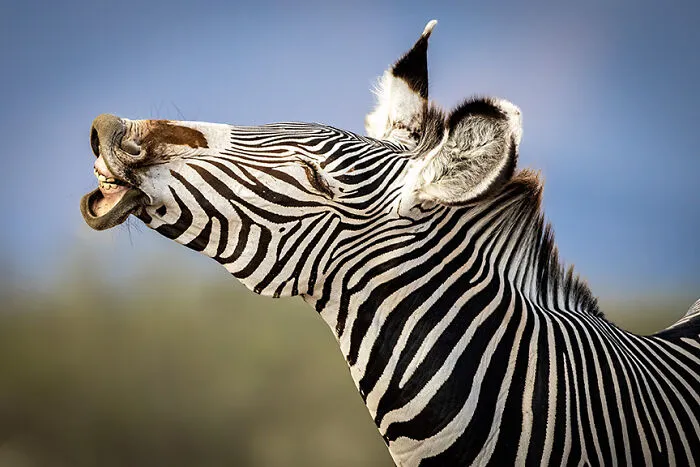
“During a late evening safari, we came across a few zebras. I was taking some close-up portraits when we observed one sniffing the air. The zebra held its head high, lips open, and teeth exposed. This behavior looked as if he was having a hearty laugh. After review, I understood this was a Flehmen response.”
70points
#22 Video | Nature In Motion: Winner – Polar Bears And Beluga Whales By Martin Gregus
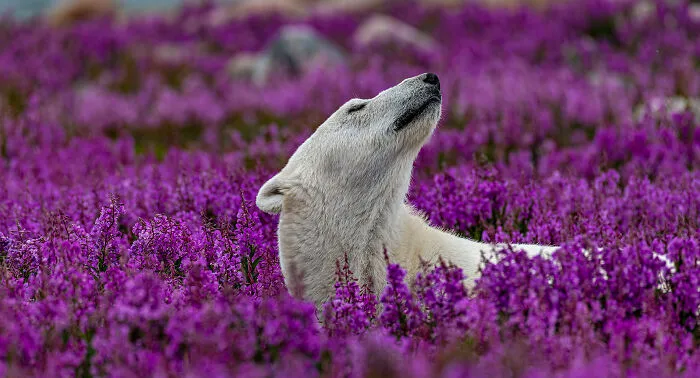
“As the pandemic raged during the summer of 2020 and 2021, I decided to turn my attention to documenting and exploring the Hudson Bay area. Utilizing drones and our custom-built equipment allowed us to observe unique hunting behaviors of beluga whales and get up close and personal with the polar bears, all while staying invisible to be able to capture intimate moments. Observing the wildlife has changed the lives of me and my team forever.” See the video.
69points
#23 Animal Antics: Highly Honored – African Savanna Elephants By Kathy Karn
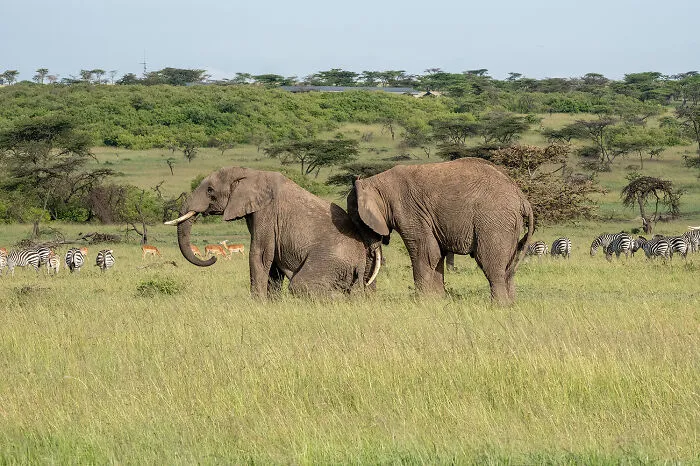
“I laughed out loud watching this pair of adolescent bull elephants tussle with each other like a pair of rambunctious boys on the playground. When one bull had enough, he sat down in resistance. His friend would have none of it! Determined to continue the match, he pushed his buddy back to his feet. Elephants are extraordinary animals capable of a full range of emotions, like love, grief, and compassion. The sense of joy and silliness in this pair was contagious. The grins on their faces added to the playful mood. I smile every time I see this image.”
Report
68points
#24 Wildlife: Highly Honored – African Lion By Gian Luigi Fornari Lanzetti
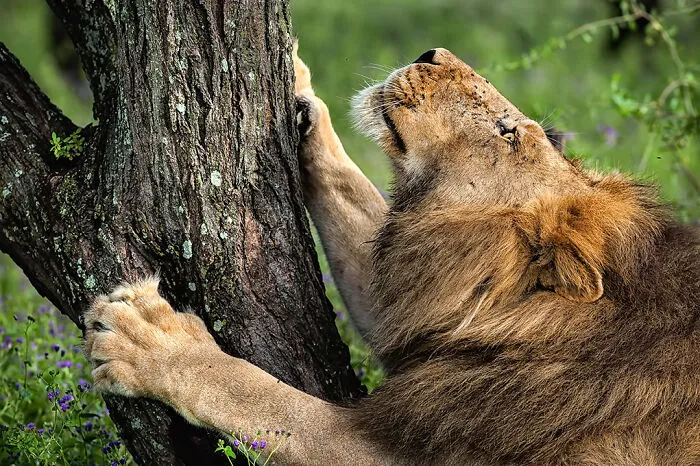
“My local guide and I went out at dawn for a game drive to observe a lion pride based in Ndutu. After a while, a large male lion woke up and moved toward an Acacia tree to sharpen its claws before patrolling his territory. The lion stretched, arching his back inward, and stood facing the tree, bracing his paws against the trunk while he rhythmically extended and pulled back his claws. The grasping motion of the claws repeatedly shook the trunk, and the power shown by the lion was impressive.”
67points
#25 Wildlife: Highly Honored – Wiley’s Glassfrog By Jaime Culebras
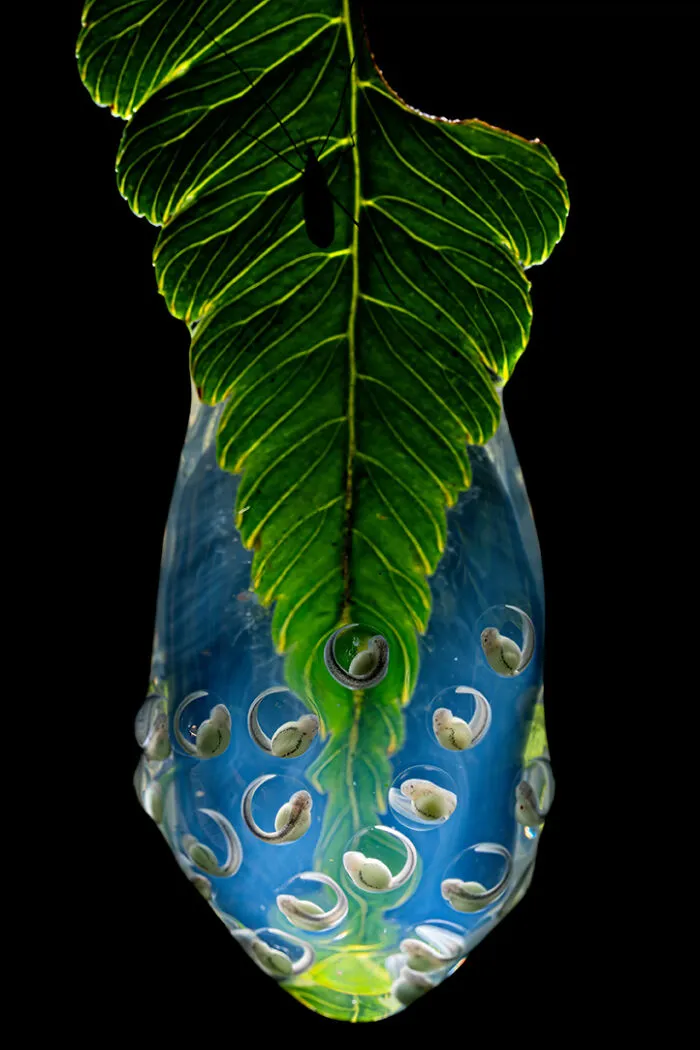
“After a few days of heavy rain, I had the opportunity to photograph a gelatinous mass of developing glass frog embryos hanging from a fern leaf over a stream. It was an image I had in my mind for years. To highlight the embryos, my girlfriend held a flash from behind. Once they hatch, the tadpoles will drop into the water below and continue their metamorphosis into adulthood.”
67points
#26 Youth: Highly Honored – Spotted Owlets By Anirudh Kamakeri
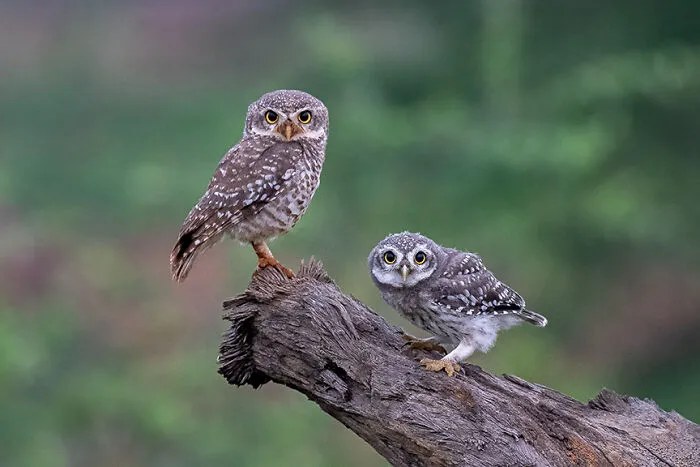
“Here, an adult and a juvenile spotted owl perched on a branch. It was one of the last times I saw these nocturnal owls during the daytime before the tree was removed to widen the highway.”
67points
#27 Conservation Story: Winner – Iberian Lynx By Amit Eshel
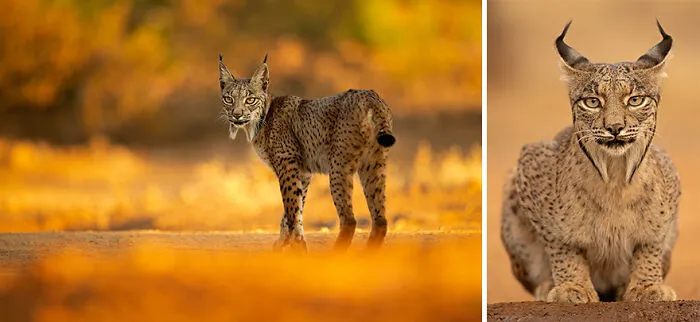
“To observe and photograph the endangered Iberian lynx, I traveled to Peñalajo— a 5,584- acre estate located between Santa Cruz de Mudela and Almuradiel in Ciudad Real, near the northernmost foothills of Sierra Morena in Spain. These Mediterranean forests, where the Iberian lynx makes its home, are some of the most biodiverse ecosystems in Europe. In the early 2000s, just two isolated breeding populations remained worldwide. Located in southern Spain, they totaled about 100 adult animals with only 25 breeding females. It was essential to give the lynx more room to reproduce by creating new populations in other regions. Based on the number of rabbits and the quality of the habitat, sites were selected in eastern Sierra Morena, Montes de Toledo, and the Matachel Valley in Extremadura, as well as the Guadiana Valley in Portugal. Farmers here have been working with local and regional administrations and other NGOs, such as the European Union and WWF, to improve the habitat of the Iberian lynx and expand the local rabbit population. The result, several years later, is that Peñalajo has one of the highest Iberian lynx densities in the Iberian Peninsula, with three breeding populations and ten new cubs spotted. The high density of rabbits has meant that females can successfully breed more than two cubs on average per season and that there is an increased number of young specimens in the area.
In the hot, dry summers where temperatures may climb above 104° Fahrenheit, water holes have been built to help the wildlife survive. I spent many days in a small hide next to a water hole, trying to photograph the elusive cats. Most days, there were no cat sightings, but I got lucky a few times during several trips to Spain and over about three weeks of sitting in the hide. The great news from the field is that due to conservation efforts, the Iberian lynx is now recovering from the brink of extinction, with numbers consistently rising.”
Report
63points
#28 Wildlife: Winner – Three White Rhinoceros By Hector D. Astorga
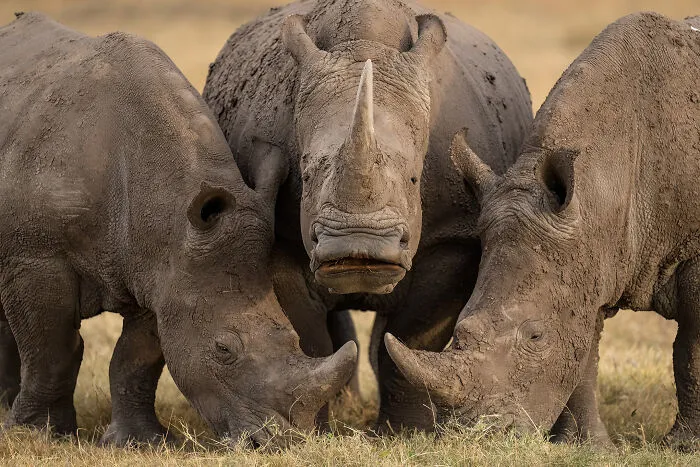
“We were photographing a group of white rhinos as they grazed at the Ol Pejeta Conservancy, where rhinos are abundant. Seeing upwards of 12 to 15 individuals daily in the wildlife reserve is not unusual. On this trip, I noticed three males getting close to one another and asked my driver to position the safari vehicle in front of them, hoping the rhinos would come together. I was ready and got lucky as all three butted heads. The one in the center raised its head to push through the other two. I captured the trio perfectly aligned before they pushed each other out of the way.”
63points
#29 Animal Antics: Highly Honored – Emperor Penguin By Philip Marazzi
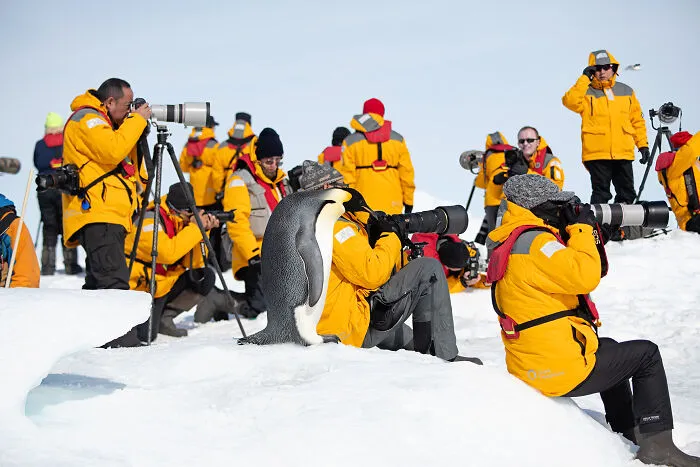
“At the emperor penguin rookery on Snow Hill Island, one of the adults showed its lack of fear for humans by wandering among a group of photographers. The penguin stopped to look alongside someone who was checking his images.”
62points
#30 Animal Antics: Winner – Burrowing Owlet By Shane Keena
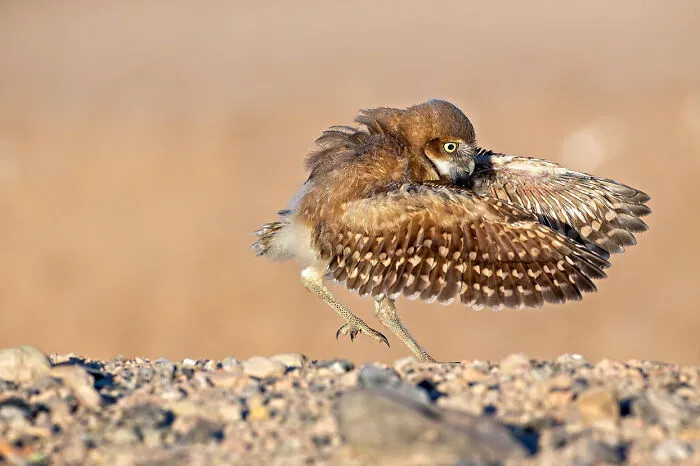
“I spent several weeks photographing the owlets from a particular burrow throughout the late, blistering hot summer months in this Southern California desert. As they got older and grew bolder, each one would venture further away from the burrow, bouncing around and practicing their flight capabilities. I captured this juvenile burrowing owlet in a fully extended yet humorously failed mid-flight attempt.”
Report
59points
#31 Youth: Highly Honored – Rainbow Overlook By Kinley Bollinger
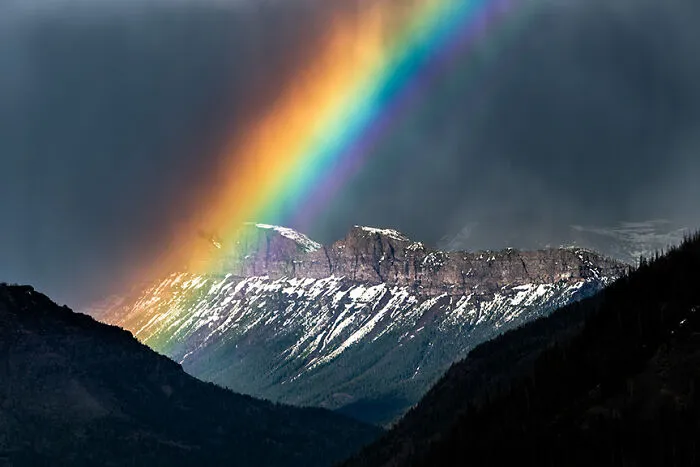
“After spending the day in Yellowstone National Park with my family, we were driving home down the notoriously windy mountain road that is Sylvan Pass. It was raining, and the sky was eerily dark. Making our way around a sharp turn, I asked my dad to stop the car. To our right, an enormous rainbow spread across the sky. The vibrant contrast of colors against the ferocious clouds was striking. I grabbed my camera and took photos until the last bit of color from the rainbow dissipated. To this day, this is one of my favorite moments I have experienced in nature.”
59points
#32 Animal Antics: Highly Honored – Southern Pale Chanting Goshawk And Giant Ground Gecko By Willie Van Schalkwyk
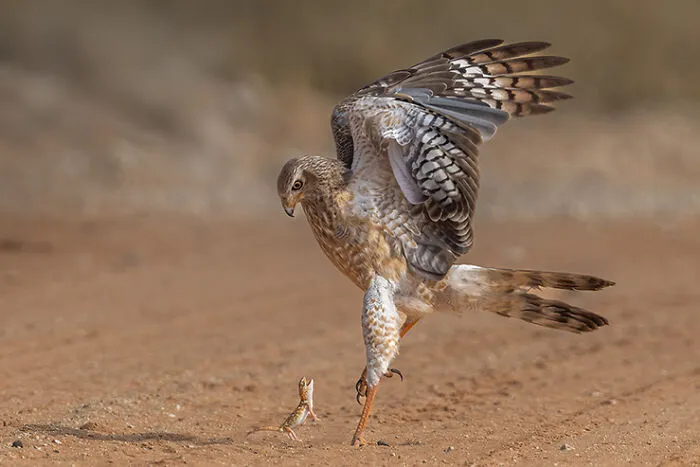
“Here a gecko was putting up a brave fight trying to attack the immature goshawk. Unfortunately for the gecko, there was only one possible outcome—I had to blink back tears.”
59points
#33 Youth Photographer Of The Year: Winner – Polar Bear By Meline Ellwanger
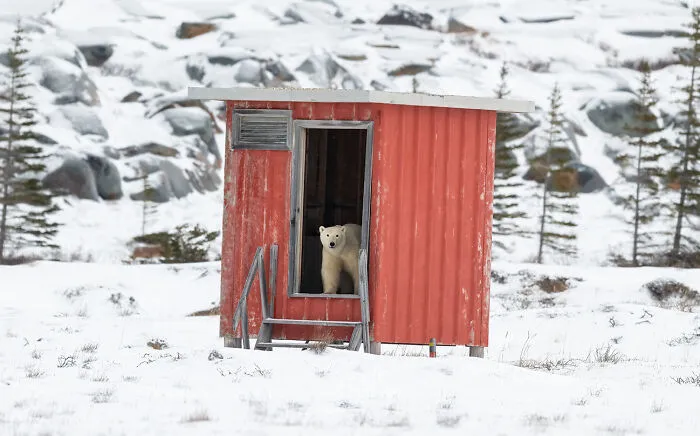
“On a trip to Churchill during November, when the sea ice usually starts to form, the polar bears are typically seen hunting for seals. However, this time, there was still no sea ice, and the bears were waiting patiently. We followed this individual as it came across an empty hut and disappeared inside. It poked out its head and I got this humorous shot. We were all laughing at the funny and unique moment.”
55points
#34 Wildlife: Highly Honored – Galápagos Land Iguana By Marko Dimitrijevic
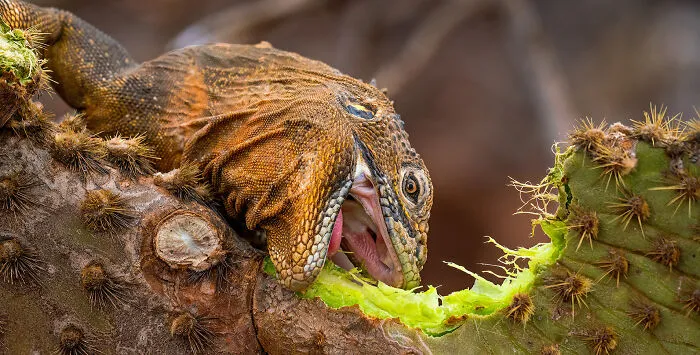
“Finding a soft spot in a cactus, this reptile is feasting on the succulent plant. I could only snap one shot before the iguana changed the angle of its head and had its back to me.”
54points
#35 Wildlife: Highly Honored – Mountain Hare By Kevin Morgans
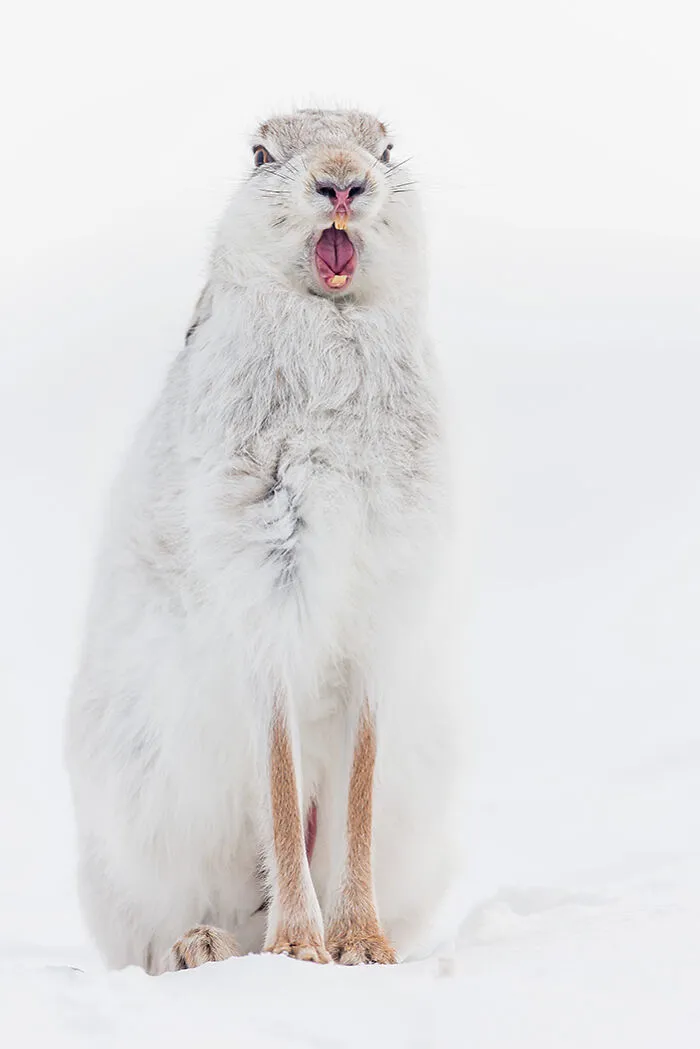
“Mountain hare photography is not a pursuit for the impatient. There can often be long periods of sitting near a hare as they sleep, sleep, and sleep some more with little activity, often only stirring to eat a pellet. This can become a war of attrition, battling against the cold weather side by side with a species far more adapted to the conditions than me. But all the waiting becomes worth it for a split-second moment like this.”
53points
#36 Wildlife: Highly Honored – Gray Puma Hiding By Casey Klebba
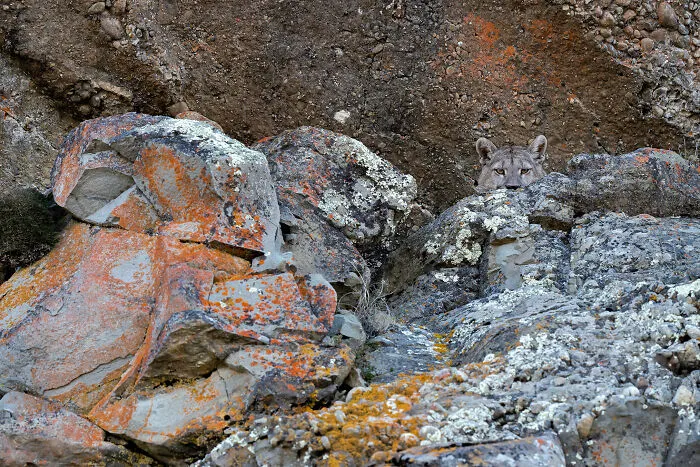
“We parked our Jeep and ventured on foot following a trail in the Patagonia grasslands. This game trail runs along rocky cliffs where pumas may sometimes be seen. After scouring the landscape in the windy, cold air with binoculars, we eventually gave up, and just as we decided to turn back, we finally saw ears and a face hidden in the rocks. The cat was napping on the hillside. Gradually, he stood up, stretched his back, and sauntered off. We followed, hoping to get another glimpse. As the puma looked at us, I got this shot.”
52points
#37 Conservation Story: Highly Honored – Atlantic Puffin By Derrick Z. Jackson
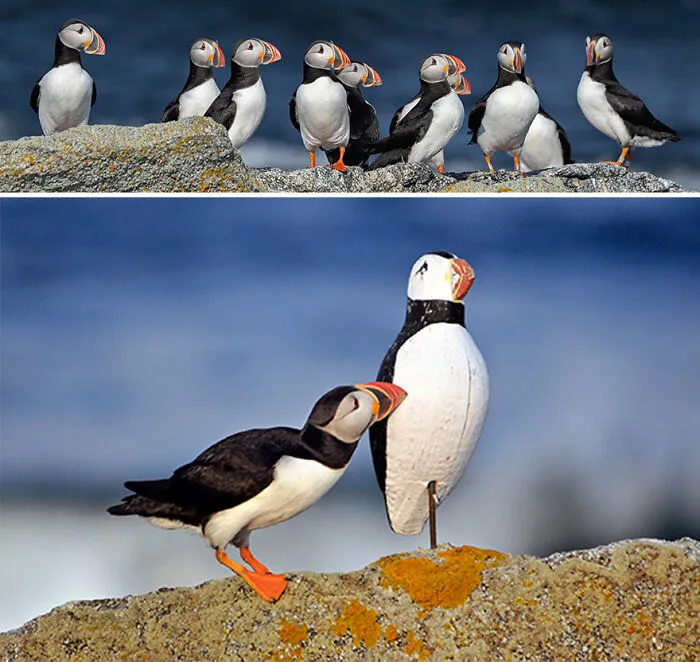
“In 1973, Steve Kress, then an Audubon camp instructor, founded ‘Project Puffin’ to bring these birds back to Maine, where they had been eliminated by hunters in the 1880s. Over the next 15 years, he transported nearly 2,000 puffin chicks from Newfoundland and hand-raised them on Eastern Egg Rock and Seal Island until they began breeding in 1981. It was the world’s first successful seabird restoration to an island. In 1902, there was only one pair of puffins in Maine. Fifty years later, there are more than 1,300 pairs. Techniques of chick translocation and use of decoys (left), mirrors, and taped bird sounds have now been applied in more than 850 seabird restoration projects, assisting nearly 140 species in 36 countries.”
52points
#38 Wildlife: Highly Honored – Brown Bear And Salmon By Daniel D’Auria, Md
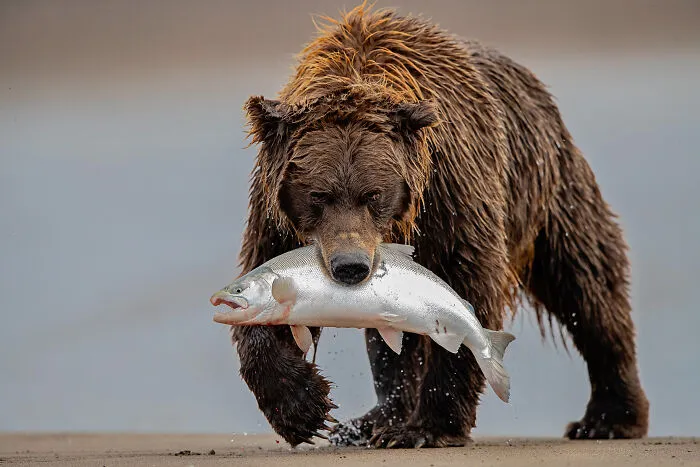
“I am a passionate wildlife advocate and photographer with an affinity for bears. Over the last ten years, I have made multiple trips to Alaska to photograph brown bears, mothers, and their cubs. Mothers have the difficult task of providing food and protection at the same time for their young cubs. When a sow runs off to hunt for fish, cubs remain isolated along the banks of rivers and inlets. In this photo, a sow has captured a salmon and returns to share it with her cubs.”
51points
#39 Youth: Highly Honored – Pier By Cian O'Hagan
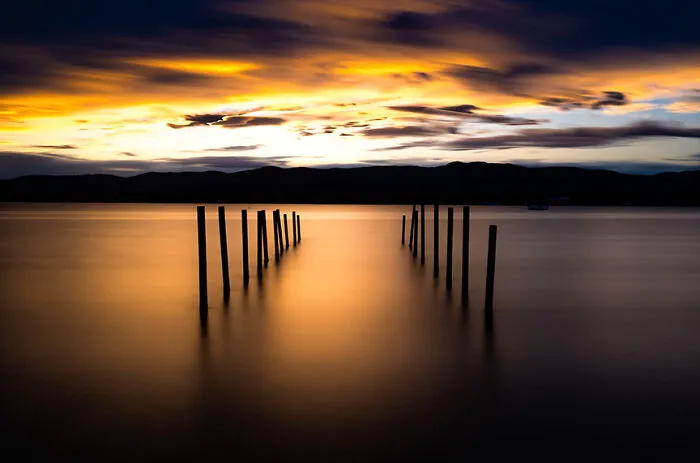
“During an intense sunset, I noticed this composition of a pier leading to the mountains in the background. To depict the motion of the sky and the lake during the windy evening, I decided to use a long exposure. Also, for this image, I used an HDR blend to capture the dynamic contrast between shadows and high- lights created by the overcast conditions.”
49points
#40 Youth: Highly Honored – Weaver Ants By Sudith Rodrigo
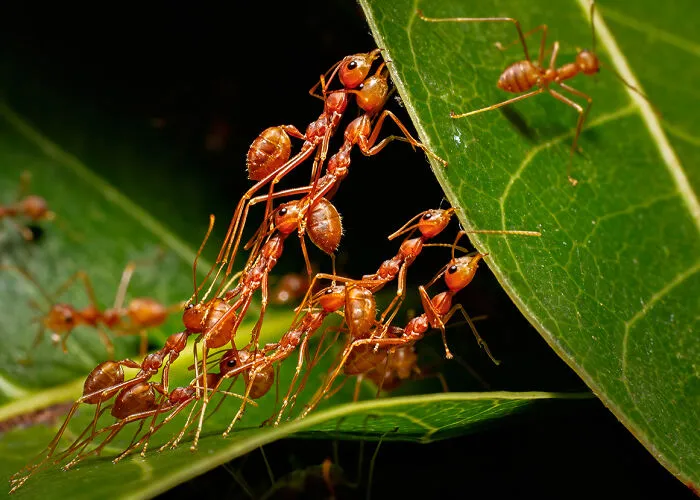
“This photo was taken one day in my garden when I saw weaver ants collecting leaves to build their nests. So I rushed inside to get my camera and started taking different scenarios. This image depicts a situation where the ants are structured in a triangle to support each other like a ladder. The weaver ants use it to move from leaf to leaf, and through this photo, we can see the unity and teamwork of the weaver ants.”
47points


