





The Natural History Museum has just announced the winners of its Wildlife Photographer of the Year competition, and the images are as stunning as always.
The 57th edition of the contest saw 50,000 entries from 95 countries chasing the prize, with shots ranging from a reindeer battle to a venomous spider hiding under a bed.
However, it was the French underwater photographer and biologist Laurent Ballesta who was crowned this year's Wildlife Photographer of the Year for his enigmatic picture, Creation, that captures camouflage groupers exiting their milky cloud of eggs and sperm in Fakarava, French Polynesia.
Every year, for five years, Laurent and his team returned to this lagoon, diving day and night so as not to miss the annual spawning that is so rare, it only takes place around the full moon in July. In total, Ballesta has spent around 3,000 hours trying to capture it.
Continue scrolling to check it out together with the other marvelous shots.
More info: nhm.ac.uk
#21 Highly Commended. Behaviour: Mammals: 'A Deadly Huddle' By Douglas Gimesy
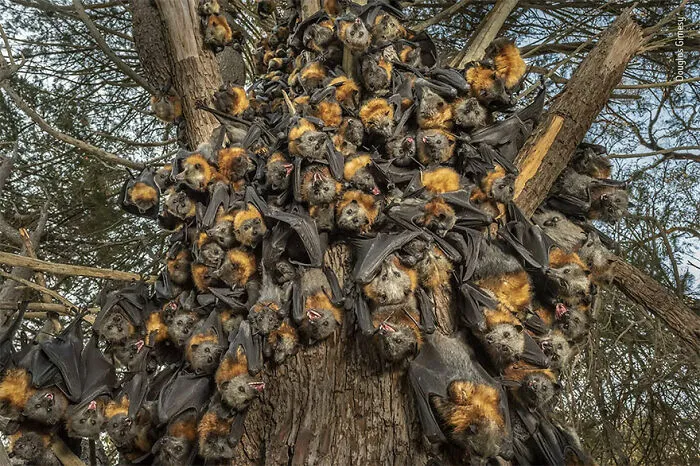
"The extreme heat of the Australian summer caused a group of grey-headed flying foxes to abandon their treetop roosts and collect en masse around a tree trunk, in the hope of escaping the heat of the day.
Sadly, this 'clumping' behaviour only exacerbates their heat stress as the bats crowd together, getting hotter. Eventually one may fall, knocking others down, creating a pile at the bottom of the tree. Unable to move, the bats get even hotter and can suffocate each other.
Doug notes how, at this colony at Yarra Bend, 'hundreds piled up at the base of trees, dead or dying from exhaustion or suffocation'.
Local rescuers tried to save as many bats as possible by spraying them with water to cool down, however more than 4,500 are estimated to have died during this heat stress event - about 10% of the colony.
Large fruit bats like these play an important role in maintaining the health and biodiversity of forest habitats up and down the Australian coast through tree pollination and seed dispersal. They are increasingly facing catastrophic heat stress events which threaten the survival of the species.
How you can help
-If you see a group of flying foxes 'clumping', contact the local wildlife trust or other nature organisation and alert them to the situation.
-Talk to your friends and family about the benefits that fruit bats have to the environment
-Global warming is causing extreme temperatures all over the world, support initiatives that take action to reduce emissions and global heating."
Report
54points
#22 Category Winner. Photojournalism: 'Elephant In The Room' By Adam Oswell
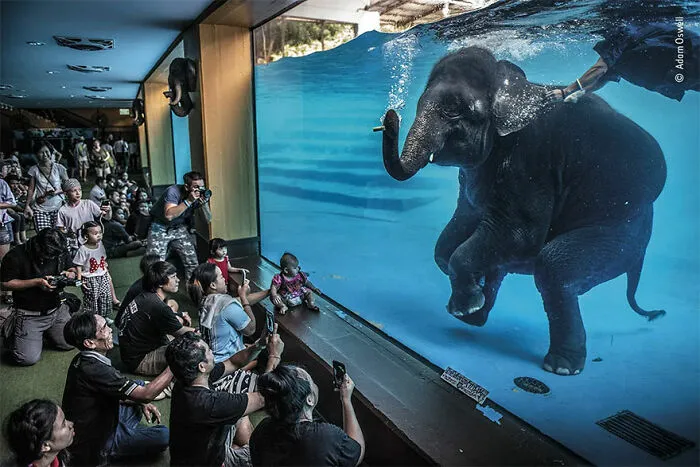
"A group of visitors watch and take photos as a young elephant performs tricks underwater at a zoo in Thailand.
Adam uses his photo to draw attention to the crowd watching, rather than the elephant itself, bringing into question this form of tourist entertainment.
Shows like this one are often promoted as educational and advertised as good exercise for the animals, but rights organisations are concerned for the welfare of the elephants involved. The training for this type of show usually starts with the removal of a calf from its mother and uses fear and pain-based punishment.
An increase in elephant tourism over the last few years combined with the low birth rate of elephants in captivity has driven a rise in poaching young calves from their mothers. There are now more captive elephants in Thailand (possibly 3,800) than wild ones (fewer than 3,600).
Around the world, animals are held captive and deprived of their natural way of life in order to serve as entertainment in zoos and touring shows. As Judge Staffan Widstrand pointed out, 'It could have been any one of us there in the audience, from anywhere in the world, at pretty much any zoo.'
Since the beginning of 2020, the COVID-19 pandemic has caused tourist enterprises across every continent to grind to a halt, leaving many elephant owners without the income needed to keep the animals. Consequently, many sanctuaries have been overwhelmed with abandoned elephants.
How you can help
-Question the places you visit as a tourist. Are the animals being looked after? Avoid visiting places that make money from exploiting the natural world.
-Talk to your friends and family about their impact as tourists.
-Support initiatives which are helping to protect elephants in their natural habitats."
Report
54points
#23 Highly Commended. Oceans - The Bigger Picture: 'Net Loss' By Audun Rikardsen
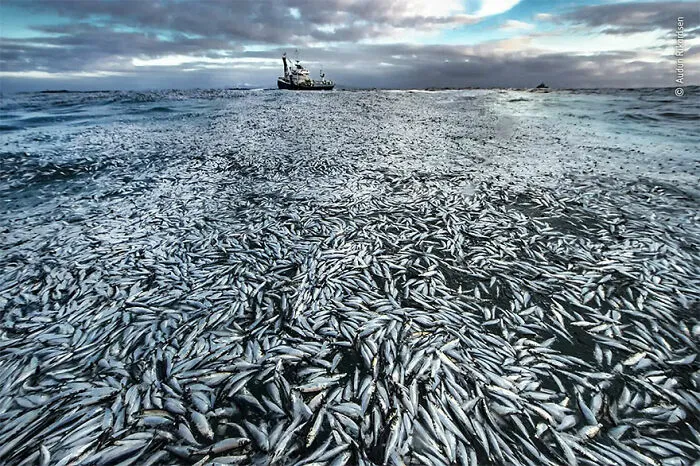
"Marine biologist Audun was on an expedition at sea with the Norwegian coastguard when he spotted this floating mass of dead and dying herring. On the horizon bobbed a fishing boat, which had overloaded and burst its nets.
Overfishing – catching fish faster than their populations can recover – is one of the biggest threats to ocean ecosystems. It is estimated that a third of global fish stocks are being exploited at unsustainable levels."
Report
52points
#24 Highly Commended. 10 Years And Under: 'Lockdown Chicks' By Gagana Mendis Wickramasinghe
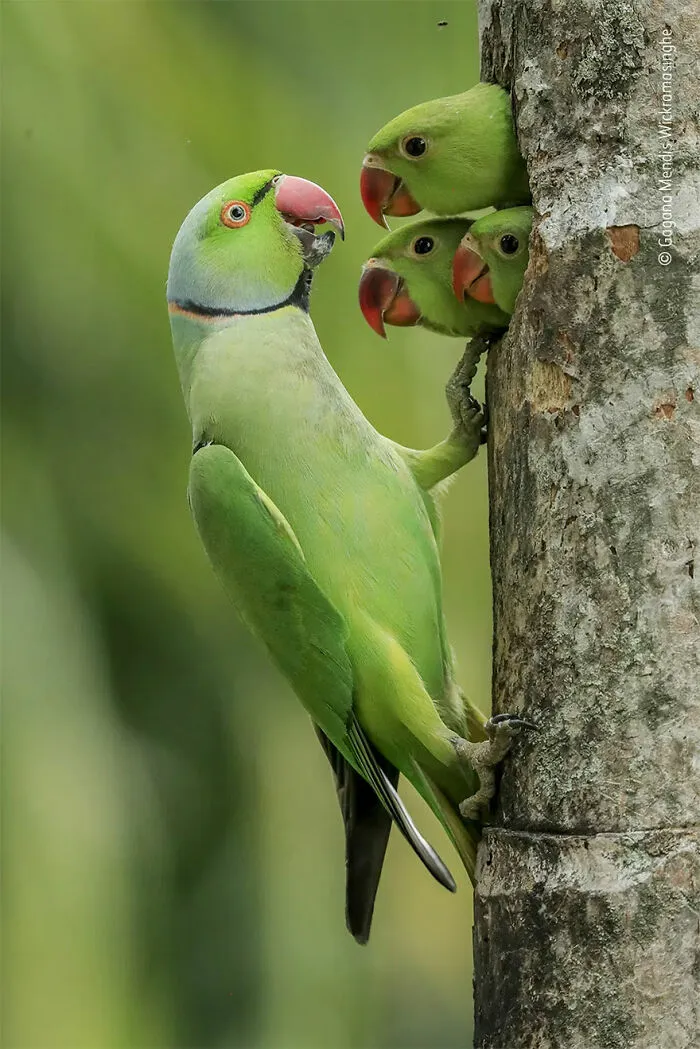
"Through the long days of a lockdown in 2020, Gagana watched a pair of rose-ringed parakeets raise their young inside a dead tree left standing outside his family home in Colombo. From his balcony Gagana captured the moment three chicks peeked out of their nest.
Rose-ringed parakeets are native to South Asia and parts of central Africa. Feral populations of these bright green birds have also become established in cities around the world, where they may compete with local species for nesting sites."
50points
#25 Highly Commended. Behaviour: Birds: 'Up For Grabs' By Jack Zhi
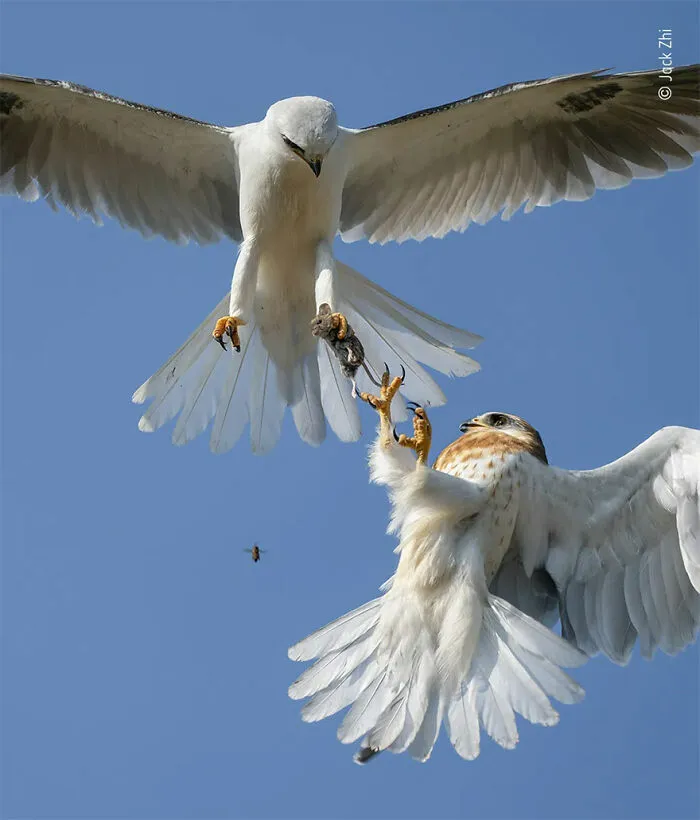
"To get this fleeting shot, Jack had to abandon his tripod, grab his camera and run. The result was the highlight of three years’ work observing white-tailed kites. Finally everything had come together perfectly.
Juvenile white-tailed kites must master aerial food exchange from their parents until they can hunt for themselves – typically by hovering, then dropping down to grab small mammals. Later, they need to perform aerial courtship rituals, where a male offers prey to a female."
Report
46points
#26 Category Winner. Behaviour: Mammals: 'Head To Head' Bystefano Unterthiner
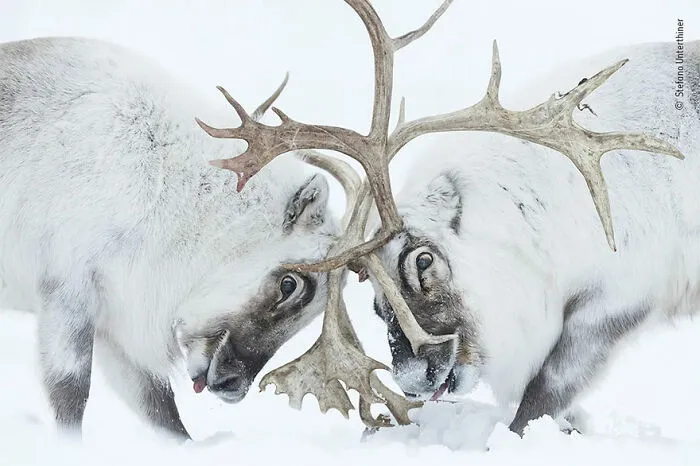
"Stefano followed these reindeer during the rutting season. Watching the fight, he felt immersed in ‘the smell, the noise, the fatigue and the pain’. The reindeer clashed antlers until the dominant male (left) chased its rival away, securing the opportunity to breed.
Reindeer are widespread around the Arctic, but this subspecies occurs only in Svalbard. Populations are affected by climate change, where increased rainfall can freeze on the ground, preventing access to plants that would otherwise sit under soft snow"
Report
46points
#27 Category Winner. Oceans - The Bigger Picture: 'Nursery Meltdown' By Jennifer Hayes

"Following a storm, it took hours of searching by helicopter to find this fractured sea ice used as a birthing platform by harp seals. ‘It was a pulse of life that took your breath away,’ says Jennifer.
Every autumn, harp seals migrate south from the Arctic to their breeding grounds, delaying births until the sea ice forms. Seals depend on the ice, which means that future population numbers are likely to be affected by climate change"
Report
46points
#28 Highly Commended. Urban Wildlife: 'Fossa In A Mess' By Elize Labuschagne-Hull
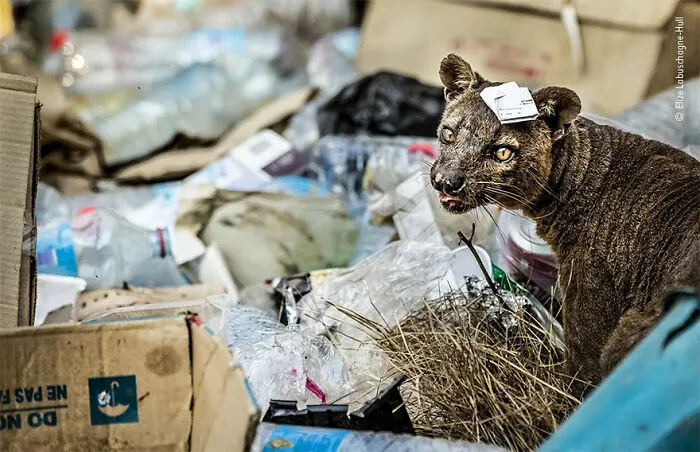
"Elize heard that an elusive fossa was in the area. Having caught sight of the carnivore, she followed as it wandered into a rubbish dump in search of food. Elize captured the moment it glanced up from foraging, a restaurant bill stuck to its head.
Fossas are found only on the island of Madagascar. Researchers are working to better understand these increasingly rare mammals, which are threatened by the destruction of their forest habitat and by human hunting."
Report
46points
#29 Adult Grand Title Winner 2021. Underwater: 'Creation' By Laurent Ballesta
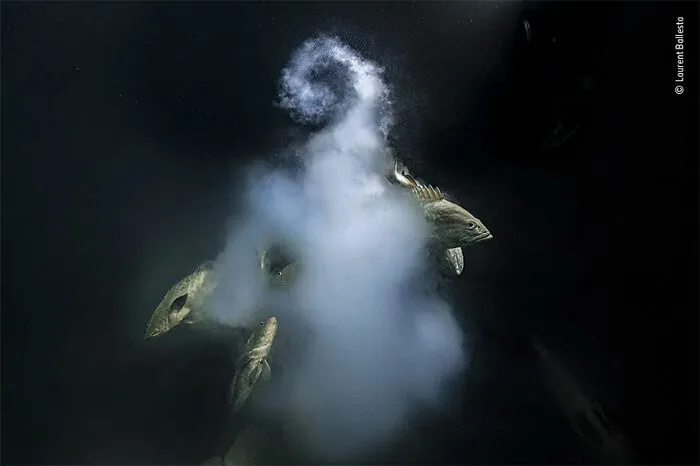
"For five years Laurent and his team returned to this lagoon, diving day and night to see the annual spawning of camouflage groupers. They were joined after dark by reef sharks hunting the fish.
Spawning happens around the full moon in July, when up to 20,000 fish gather in Fakarava in a narrow southern channel linking the lagoon with the ocean. Overfishing threatens this species, but here the fish are protected within a biosphere reserve."
Report
45points
#30 Highly Commended. Urban Wildlife: 'Spot Of Bother' By Georg Kantioler
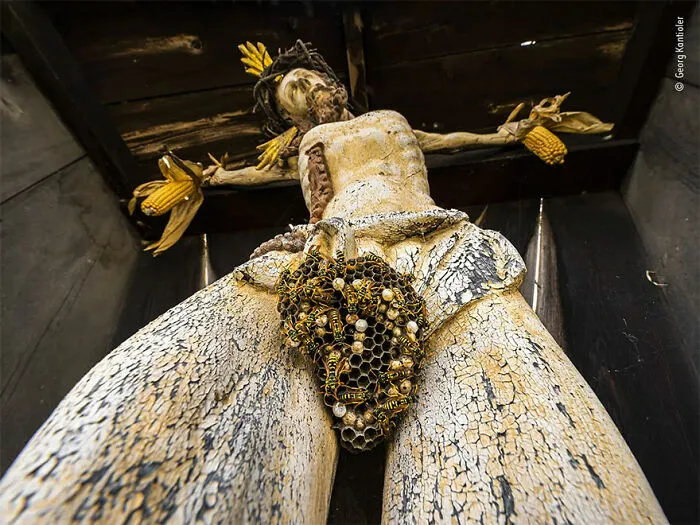
"Following a tip-off, Georg photographed these wasps in the early morning, when they are most docile. He approached with a wide angle for maximum impact. ‘I had to move very slowly and wrap up to avoid too many stings,’ Georg recalls.
The wasps’ cluster of hexagonal cells, where the queen lays its eggs, is made from wood pulp mixed with saliva. This colony was started on a wayside traditional shrine decorated with corn cobs in thanks for the harvest."
Report
45points
