




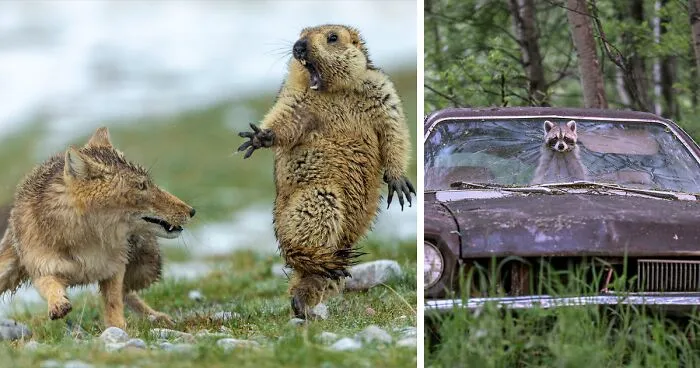


Every year, we eagerly wait to see the fantastic photos that battle it out for fame, glory, and the chance to win their artists the honor of being called the Wildlife Photographer of the Year. This year’s winner is none other than Yongqing Bao, who won the award with his stunning photo called ‘The Moment,’ featuring a young fox and a marmot.
Scroll down, upvote your favorite photos, and share them with your friends. Let us know in the comments which pictures you like the best and why, as well as what you think of Bao's winning entry.
We love wildlife pictures, so be sure to check out Bored Panda’s recent article about (and interview with) photographer Gren Sowerby and his amazing shots of a lion yawning, smiling, and winking.
#21 "Pondworld" By Manuel Plaickner, Italy, Behaviour: Amphibians And Reptiles, Winner 2019
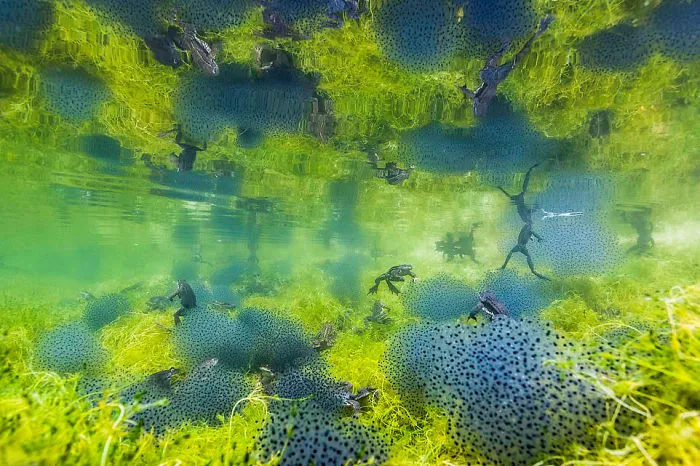
Every spring for more than a decade, Manuel followed the mass migration of common frogs. He took this image by immersing himself and his camera in a large pond where hundreds of frogs had gathered. There he waited until the moment arrived for the picture he had in mind – lingering frogs, harmonious colours, soft, natural light and dreamy reflections.
Rising spring temperatures bring common frogs out of their winter shelters. They head straight to water to breed, often returning to where they were spawned. Though widespread across Europe, their numbers are thought to be declining due to habitat degradation from pollution and drainage of breeding sites.
Report
138points
#22 "Humming Surprise" By Thomas Easterbrook, UK, 10 Years And Under, Winner 2019
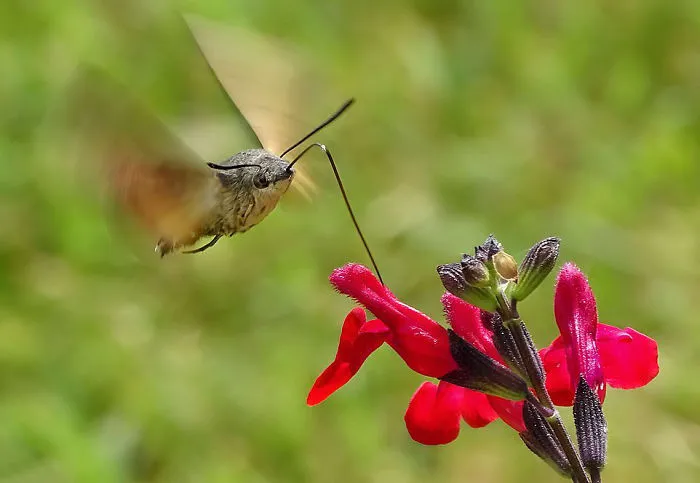
A curious sound drew Thomas to this hummingbird hawkmoth. He watched as it hovered in front of each salvia flower and drank the nectar using its long, straw-like proboscis. Framing the fast-moving insect was challenging, but Thomas was pleased with how he captured the stillness of the moth’s body and the blur of its wings.
Hummingbird hawkmoths are unusual in that they fly by day, so their eyesight is better than most other moths’. In flight they look so similar to hummingbirds that they can be easily confused. This similarity inspired their name, as did the hum created by their wings beating around 85 times each second.
Report
134points
#23 "The Equal Match" By Ingo Arndt, Germany, Behaviour: Mammals, Joint Winner 2019
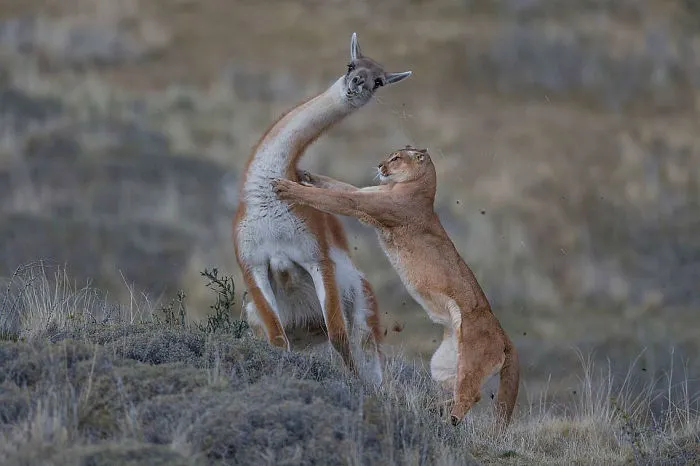
The guanaco turns, terrified, his last mouthful of grass flying in the wind as a female puma attacks. For Ingo, this is the culmination of months of work tracking wild pumas on foot, enduring extreme cold and biting winds. After an intense four-second struggle, the guanaco escaped with his life, leaving the puma to go hungry.
Because they are so abundant in Patagonia, guanacos are common prey of pumas. These big cats are solitary and hunt by patiently stalking before they pounce. Their robust hind legs allow them to take on animals bigger than themselves but they can also feed on smaller animals, such as rodents and birds.
Report
128points
#24 "The Ethereal Drifter" By Angel Fitor, Spain, Under Water, Highly Commended 2019
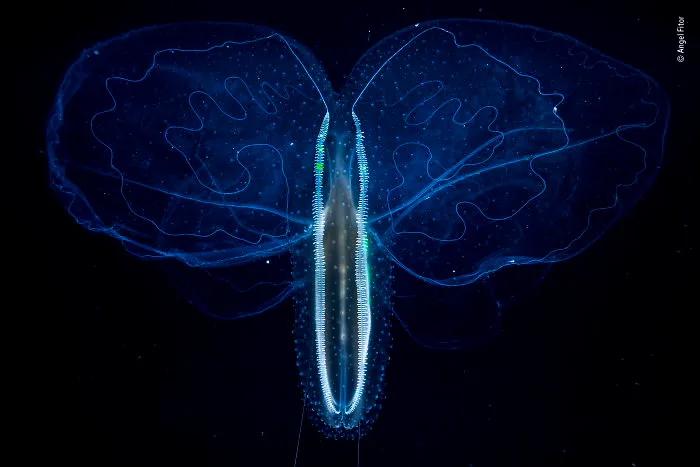
Stretching out its sail-like lobes to ride the Mediterranean currents, this delicate comb jelly is trawling for food. This was a rare sight. The species is normally found with its fragile sails folded or damaged. Angel approached his subject extremely carefully. Describing it as a ‘glass butterfly’, Angel saw that ‘it folded its sails at the slightest vibration’.
This comb jelly steers itself through the water using beating rows of hair-like cilia which form combs along its cylindrical body. The combs scatter light, creating colourful iridescence. Unlike jellyfish, comb jellies do not sting. Instead they catch plankton and other small prey using sticky cells in their lobes and tentacles.
Report
127points
#25 "The Architectural Army" By Daniel Kronauer, Germany/USA, Behaviour: Invertebrates, Winner 2019
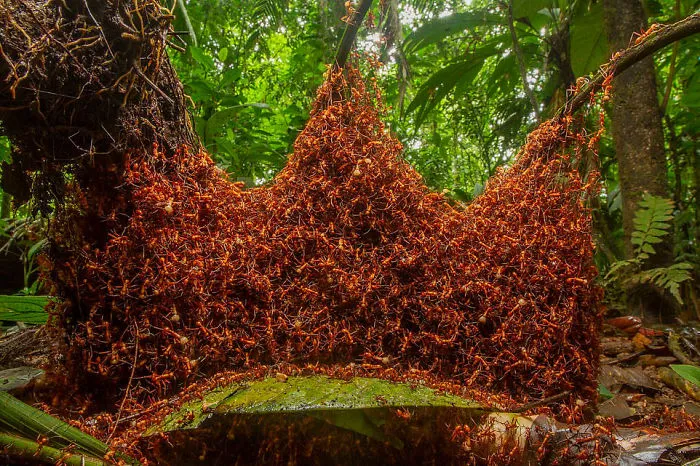
By day this colony of army ants raided their surrounds, mostly hunting other ant species. At dusk they moved on, travelling up to 400 metres before building a nest for the night. Positioning his camera on the forest floor, Daniel was wary of upsetting thousands of venomous army ants. ‘You mustn’t breathe in their direction,’ he says.
Army ants alternate between nomadic and stationary phases. These ants are in a nomadic phase, building a new nest each night using their own bodies. The soldier ants interlock their claws to form a scaffold while the queen stays inside in a network of chambers and tunnels. During the stationary phase they will stay in the same nest while the queen lays new eggs.
Report
123points
#26 "Circle Of Life" By Alex Mustard, UK, Black And White, Highly Commended 2019
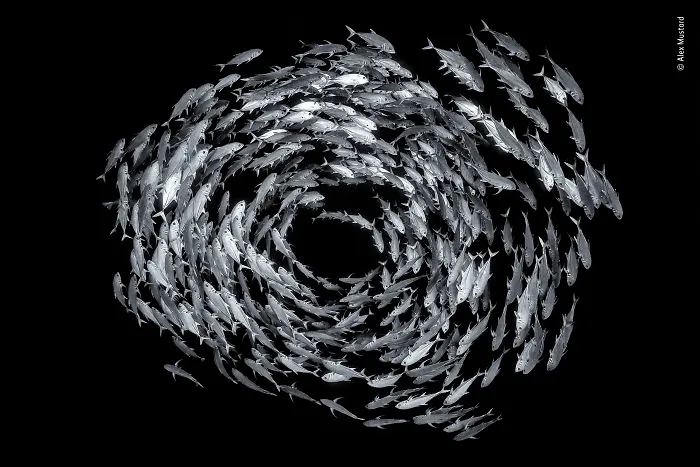
In the crystal-clear waters of the Red Sea a school of bigeye trevally formed a circular shoal a few metres from Alexander’s lens. For 20 years Alexander had been coming to photograph the summer spawning of reef fish. ‘A big lure that sees me return each year is that I always see something new,’ he says.
The spawning population of bigeye trevally is boosted by the protected status of Ras Mohammed National Park as a no-fishing marine reserve. Adult bigeye trevallies are vulnerable to attack from larger fish. During the spawning season they school both to protect themselves and to increase the likelihood of contact between eggs and sperm.
Report
120points
#27 "Migrant Megamoths" By Lorenzo Shoubridge, Italy, Behaviour: Invertebrates, Highly Commended 2019
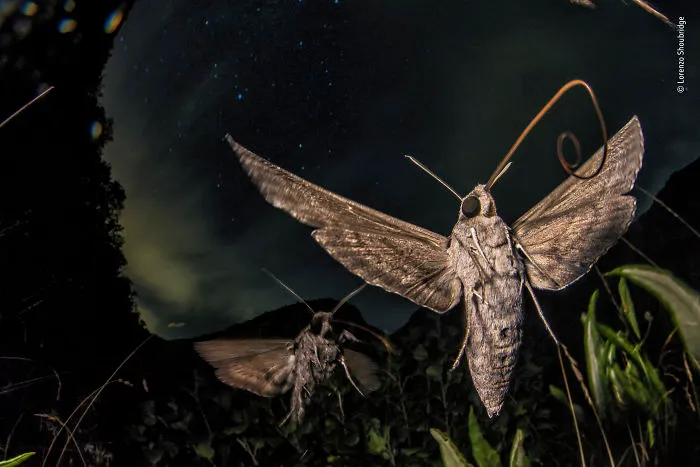
Lorenzo was intrigued to see convolvulus hawkmoths flying back and forth, looking for food. He tracked the moths over several evenings, dulling his torch with a cloth in order not to disturb them and keeping to the road to avoid trampling the vegetation. After many attempts, he finally captured the feeding forays of these two individuals.
Moths often travel very long distances in search of food and suitable environments in which to lay their eggs. In the Apuan Alps the landscape is fast-changing. The extraction of marble from the mountains creates significant air and water pollution, threatening the region’s biodiversity and reducing the moths’ natural habitat.
Report
108points
#28 "Creation" By Luis Vilariño, Spain, Earth’s Environments, Winner 2019
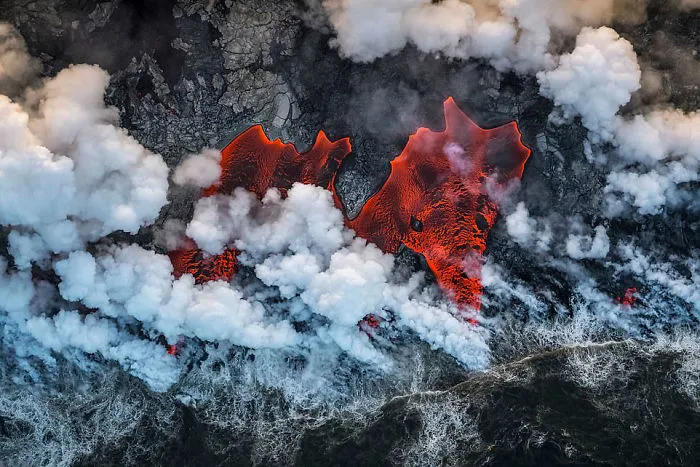
Red-hot lava from Kīlauea volcano instantly boils the cool Pacific Ocean where they meet at the Hawaiian coast. As Luis’s helicopter flew along the coastline a sudden change in wind direction parted the plumes of steam to reveal the fiery river. Quickly framing his shot through the helicopter’s open door, he captured the tumultuous creation of new land.
As the lava boils the seawater, it produces acid steam and tiny shards of glass, which combine to create a lava haze or ‘laze’. This eruption was Kīlauea’s largest in 200 years. For three months in 2018, lava spewed from the summit and surrounding fissures, eventually destroying over 700 homes and solidifying to create hundreds of acres of new land.
Report
103points
#29 "Face Of Deception" By Ripan Biswas, India, Animal Portraits, Winner 2019
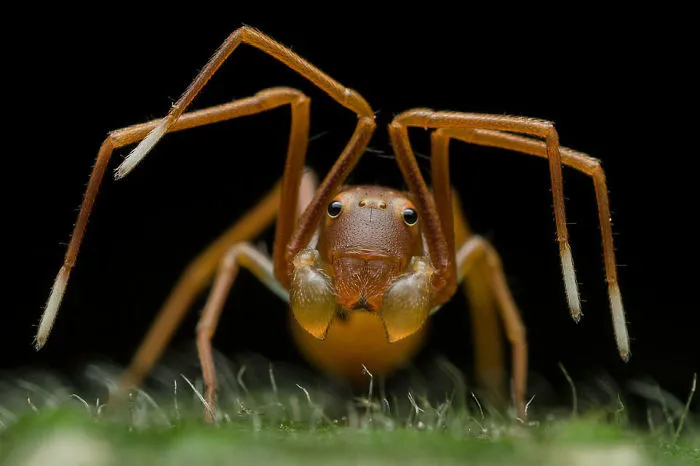
Ripan was photographing a red weaver ant colony when he spotted this slightly strange individual. It may have the face of an ant but its eight legs give it away – on closer inspection Ripan discovered that it was an ant-mimicking crab spider. By reverse mounting his lens, Ripan converted it to a macro capable of taking extreme close-ups.
Many spider species imitate ants in appearance and behaviour. Infiltrating an ant colony can help them prey on unsuspecting ants or avoid being eaten by predators that dislike ants. This particular spider, says Ripan, seemed to be roaming around the colony, looking for a solitary ant that it could grab for a meal.
Report
100points
#30 "The Hair-Net Cocoon" By Minghui Yuan, China, Behaviour: Invertebrates, Highly Commended 2019
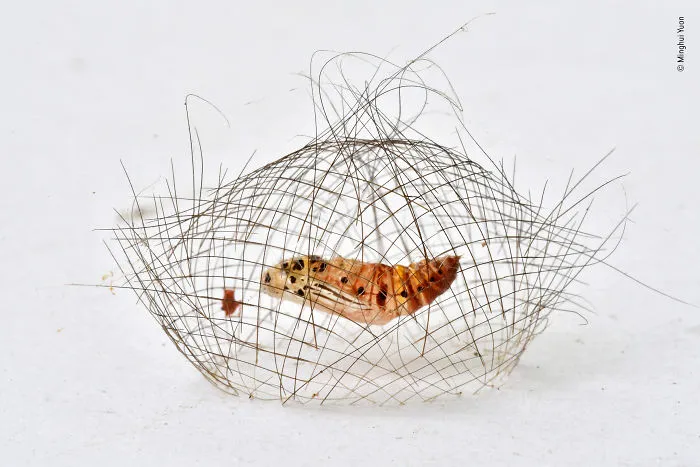
With his face pressed against a wall, Minghui framed this Cyana moth pupa hanging in its remarkable cage-like cocoon. Such delicate structures can be hard to spot but this one stood out against its backdrop in the Xishuangbanna Tropical Botanical Garden.
Although it is not known exactly how the caterpillar architect of this cocoon would have worked, it is known that it wove this intricate mesh from spat-out silk and from the long, hair-like setae that covered its body. It then spun near-invisible threads to suspend itself inside the cocoon, ready to start its transformation into a moth.
Report
99points
#31 "Couch Crew" By Cyril Ruoso, France, Urban Wildlife, Highly Commended 2019
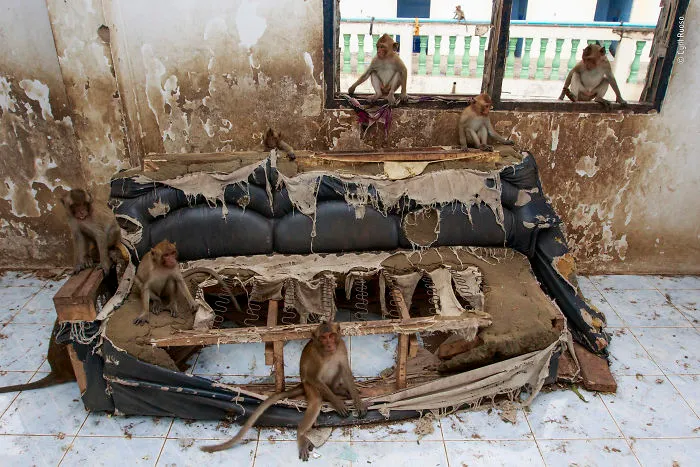
In a disused temple in Hua Hin, young long-tailed macaques relax on a sofa tattered from their playtime antics. Cyril framed a group that had positioned themselves ‘like band members posing for an album cover’, while others leapt back and forth between a statue, his rucksack and even the top of his head.
Long-tailed macaques are very adaptable, thriving in a range of habitats including living alongside humans. In Thailand people have a complex relationship with the monkeys. The macaques are tolerated and sometimes even venerated near temples. At the same time, when they damage farms and property they are regarded as pests.
Report
97points
#32 "Early Riser" By Riccardo Marchegiani, Italy, 15-17 Years Old, Winner 2019
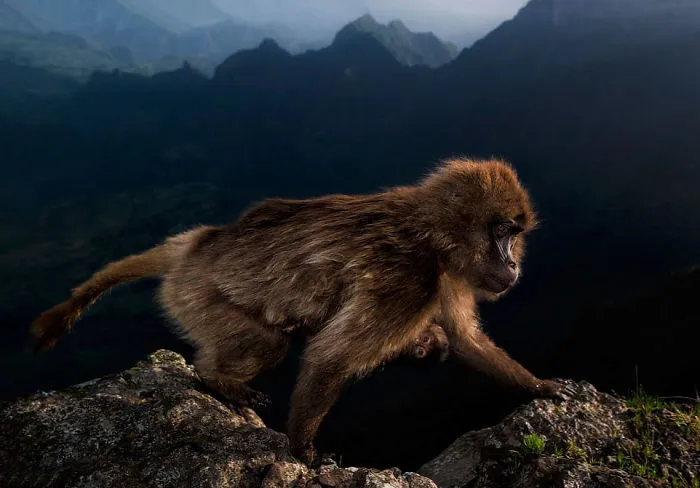
Riccardo could not believe his luck when this female gelada walked along the cliff edge where he had been waiting since before sunrise. Keeping a respectful distance, Riccardo composed his shot using a low flash to highlight the gelada’s light brown fur against the distant mountains. The beam also caught the eye of the inquisitive infant clinging to her belly.
A baby gelada will spend the first few weeks of its life being carried around on its mother’s front before moving to her back. Geladas live on the ground and drop down onto ledges in cliff faces for safety when they sleep. Farmland is encroaching on their native grasslands and their habitat is shrinking.
Report
94points
#33 "Tapestry Of Life" By Zorica Kovacevic, Serbia/USA, Plants And Fungi, Winner 2019
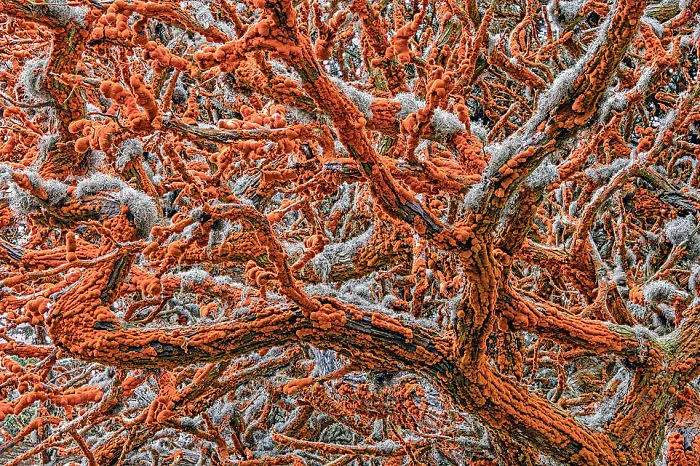
Festooned with bulging orange velvet and trimmed with grey lace, the arms of a Monterey cypress tree twist to create an otherworldly canopy. After several days experimenting, Zorica decided on a close-up frame. She focus-stacked 22 images, merging the sharp features in each of the photographs to reveal the colourful maze in depth.
Point Lobos State Natural Reserve in California is the only place in the world where natural conditions combine to conjure this magical scene. The spongy orange cladding on the Monterey cypress is in fact an alga that gets its colour from beta-carotene, the same pigment that is in carrots. Both the orange alga and the grey lace lichen are harmless to the cypress.
Report
90points
#34 "Another Barred Migrant" By Alejandro Prieto, Mexico, Wildlife Photojournalism, Winner 2019
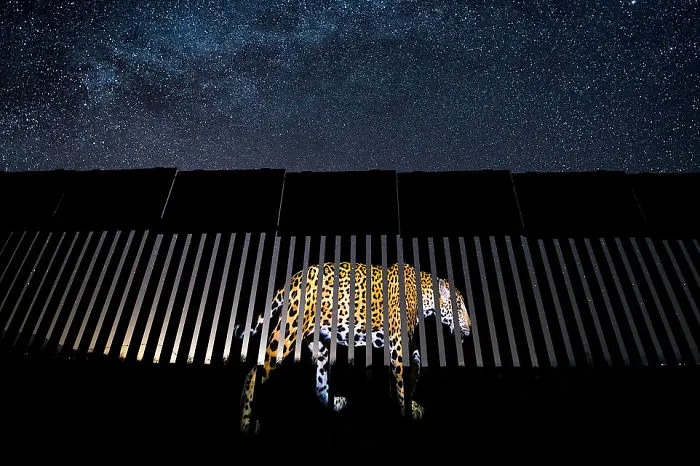
It took Alejandro two years to take the perfect photo of a male jaguar. Under a luminous, star-studded Arizona sky, he projects it onto a section of the US–Mexico border fence to symbolise ‘the jaguar’s past and its possible future presence in the United States. If the wall is built,’ he says, ‘it will destroy the jaguar population in the United States.’
Jaguars are mainly found in South America but historically also roamed the southwest of the United States. Over the past century, hunting and habitat destruction have resulted in the species disappearing from this area. Any hope of establishing a breeding population in this region rests on the contentious border remaining partially open.
Report
79points
#35 "Last Gasp" By Adrian Hirschi, Switzerland, Behaviour: Mammals, Highly Commended 2019
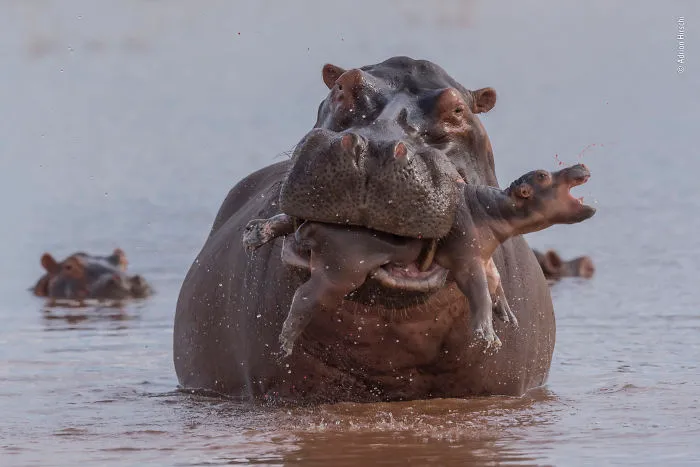
A newborn hippo, just days old, was keeping close to its mother when a large bull hippo suddenly made a beeline for them. He chased the mother away and went after the calf, seizing it violently in his huge gape, clearly intent on killing it. ‘All the while, the distraught mother looked on helplessly,’ says Adrian.
Infanticide among hippos is rare but not unknown. It usually occurs when hippos travel beyond their territory and mix with new groups. By killing the young that are not his, it is believed that a male can increase his reproductive success by bringing females into oestrus, ready to mate with him.
Report
58points
