





Many people, not without reason, believe that childhood is the happiest time in a person's life. A period when you don’t have to solve a huge number of various everyday problems, when you constantly learn something new, when you meet new friends and literally every day is like a true holiday.
Of course, for some, all this is 100% true. And yet, for many people, childhood is far from being as bright as we would like - and as, of course, it should have been. There are many reasons for this, and the main one, alas, is problems in the family or the environment of the child. And then additional troubles are already strung on this rod, leaving people alone with a harsh and sometimes cruel world.
A popular thread appeared in the AskReddit community, the author of which asked only one formally simple, but in fact incredibly complex question: "What's a subtle sign that someone had a rough childhood?" As of today, the thread has over 20.1K upvotes and around 5.6K comments. Behind many of these examples lies a difficult personal story, and many of them are literally woven from pain.
Bored Panda has put together a selection of the most popular comments from the original thread for you, so please feel free to scroll to the very end of this list, mark the submissions you think are the most accurate and just tell us your own ideas on how to spot a person with a rough childhood behind them (and how one could help such a person as well).
More info: Reddit
#21

Someone who is really uncertain in decision making and never wants to put anyone out of their way. They may also be really loving, but are really scared to be hurt
Report
53points
#22

Can't figure out whether or not to permanently cut off contact with s****y parents, or who go back and forth, cutting off and trying again, and cutting off and trying again.
Even considering it means your childhood was X s****y. And if you want to but can't do it, it probably means your childhood was X times shittier than that, to erode your sense of self and healthy boundaries to the point where you know what you have to do, but have been brainwashed by your oppressors to the point where you can't bring yourself to do it.
Report
48points
#23

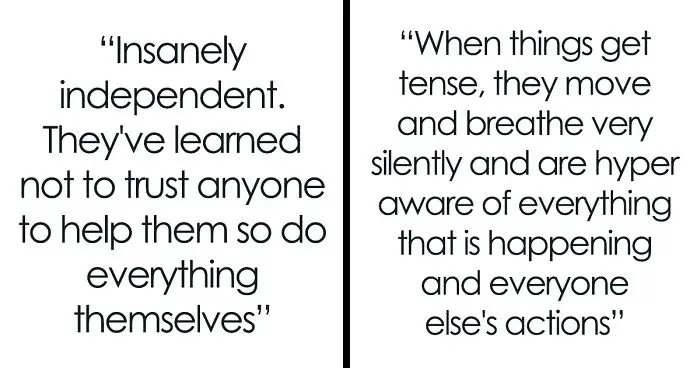
Someone who is very good at staying calm. Like, creepy calm. The room could be on fire and they'd walk out like nothing was wrong.
47points
#24

Everyone is different, but one that automatically raises a red flag for me, and makes me extremely worried is when someone flinches for "no reason". (I wouldn't say It's for no reason, but I don't know what other words to use. So really sorry about that!).
Like, you raise your voice slightly at them and they flinch, you raise your hands to grab something near them and they flinch, you look at them in a certain way and they flinch, you hug them and they flinch, etc., etc.
Report
44points
#25

Someone who rarely shares what happens at home or talk about their family.
Report
40points
#26

Boundary issues are common, but reactions still are an individual thing. What helps to keep in mind is the 4F model of trauma responses: Fight, flight, fawn and freeze. When you notice somebody's reactions are easily categorized as one of those and it is a very persistent pattern, adverse childhood circumstances of some sort are a pretty safe bet.
Edit: to fawn = to court favor by a cringing or flattering manner, so basically the stuff pathological people pleasers are made of.
Report
40points
#27

Watch their table manners.
Meals are forced contact time in bad households and it can easily show. Some examples are becoming less talkative or withdrawn during meals, they realize their elbow is on the table and they jerk it away quickly, or something innocuous like a sneeze at the table causes undue shame or embarrasment.
Conversely, someone who grew up without parental guidance can also develop odd eating habits. In the case of a co-worker of mine, they collect the condiments near them. She would pull the ketchup bottle out of the little rack on the table, use it, and then keep it by her plate instead of putting it back. I asked if she was done with it, and she said, "Oh, sorry. I ate a lot of meals alone growing up." Turns out she grew up with a single mom who worked 2 jobs, and she was used to nobody being there to pass things.
39points
#28

I remember going to summer camp as a kid and meeting Milo. Milo was big on attention seeking and validation, and would take food from the cafeteria back to his bunk, like eggs and toast. I remember thinking he was just weird, but I think looking back and knowing what I know now, he was probably being neglected at home. Thin as a rail and probably malnourished, so he wanted as much food as he could get, and just wanted someone to acknowledge him. Pretty sad stuff.
Report
38points
#29

Jumping at every loud noise, apologizing too much, difficulty maintaing eye contact in stressful situations, if the person suffers from insomnia or severe migraines (this is in my case, the stress from my childhood gave me chronic migraines) and there are many more. These are just from my perspective
Edit: i know that these are also symptoms of anxiety, some are for people/children on the spectrum, these are purely my reactions after suffering a very weird childhood.
Report
35points
#30
If someone has really simple taste in food, eating mostly PB&J or buttered noodles or whatever, there's a good chance they grew up poor.
That isn't to say a poor childhood is necessarily a rough one, just be careful about making fun of someone for only eating "basic" food, that might be all they know.
Report
29points
