








#2 These Directional Markers At My Local Hospital Are Kiwi Footprints. Unfortunately Bird Footprints Look Like Arrows Going The Wrong Way

#3 We Were Looking At Houses In Baltimore This Weekend And Came Across This Gem

Building something impressive takes a lot of planning, skill, and, ideally, a few people willing to double-check the work. But even with all that preparation, things can still go wrong. A material may not behave as expected, a design may overlook something important, or a small mistake may only become obvious once the building is already standing. And when the project is a skyscraper, stadium, bridge, or entire housing complex, fixing that mistake can be anything but simple.


Take Chicago's former Standard Oil/Amoco Building, now known as the Aon Center. Designed by Edward Durell Stone and built between 1970 and 1973, the skyscraper was originally covered in thin slabs of white marble. It looked impressive, but the material proved to be a poor match for Chicago's famously harsh winters. In 1974, a piece of marble fell from the tower and landed on the neighboring Prudential Tower. Over time, repeated freeze-thaw cycles caused the thin marble panels to weaken and bulge, eventually requiring the entire exterior to be replaced with granite. The repair bill? A staggering $180 million.
As architect Raymond Gomez explained, the building was one of the first major structures to use thin-sliced marble cladding, with the panels measuring only around three-quarters of an inch thick. Years of expansion and contraction during Chicago's freezing winters gradually weakened the material. It was a costly reminder that even a beautiful design choice needs to be able to survive the environment it is placed in.


Sometimes, however, the problem becomes obvious almost immediately. Tropicana Field in Florida, which cost around $130 million to build and opened in 1990, has a distinctive domed roof with several catwalks suspended above the baseball field. The issue? Baseballs have a habit of flying upward. The catwalks regularly get in the way, with balls sometimes hitting them, becoming stuck, or bouncing off in unpredictable directions. Even more concerning, some lighting fixtures above the field could potentially send hot pieces of shattered glass raining down if struck. Perhaps not exactly the kind of surprise players were hoping for during a game.
#10 “I’m Sure You’re All Wondering Why I’ve Gathered You Here Today”


Then there is London's Millennium Bridge, which opened in 2000 to celebrate the new millennium. The pedestrian bridge stretches across the River Thames and was designed with a sleek, modern appearance. Unfortunately, the public quickly discovered that the bridge had a rather unexpected feature: it wobbled. When large numbers of people walked across it, many unconsciously fell into the same rhythm, creating a synchronized sideways movement that caused the bridge to sway noticeably.
The problem was serious enough that the bridge had to close just two days after opening. The project had already gone £2 million over its original £16 million budget, and an additional £5 million was eventually spent on modifications. Engineers later installed a passive damping system, similar in principle to shock absorbers, to control the movement. While the wobble was an expensive embarrassment at the time, the experience also changed how engineers understand and design pedestrian bridges.
And despite its rocky start, the Millennium Bridge has clearly managed to win people over. In 2025, the “wobbly bridge” marked 25 years since it first opened, with the BBC reporting that around 90,000 people crossed it on its opening day on June 10, 2000. Reflecting on the bridge's journey, City Bridge Foundation chair Paul Martinelli said, “Despite its teething troubles, the bridge has become firmly established in the hearts of Londoners.” Not a bad comeback for a bridge that once made people wonder whether the ground beneath their feet had suddenly started moving.


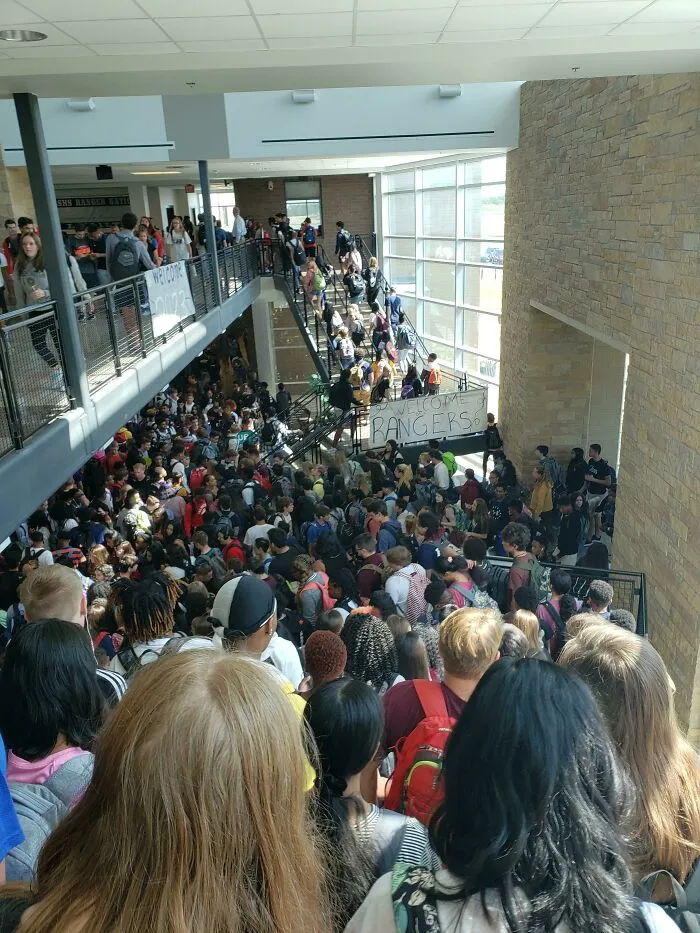
#15 The Absolute Trash Design Of My School. This Is The Place Where Every Hallway Intersects
Not every famous construction mistake was caused by poor planning, either. The Leaning Tower of Pisa began tilting almost as soon as it was being built. Construction started in 1173, and the tower began to lean after the third floor was completed because it was being built on soft, unstable ground made up of clay, sand, and silt. As the builders continued, they tried to compensate by making some of the upper floors slightly taller on one side. The result is a tower that does not simply lean—it also has a subtle curved shape, giving it something of a giant architectural banana appearance.



Of course, building something is only half the job. Keeping it in good condition is just as important. The Pruitt-Igoe housing complex in St. Louis, designed by architect Minoru Yamasaki, was built in the 1950s and consisted of 33 eleven-story buildings. The project reflected modernist architectural ideas and was intended to provide modern housing. However, a lack of proper maintenance, along with wider social and economic problems, contributed to the complex's rapid decline. The buildings were eventually demolished in 1976, becoming one of the most famous examples of how even ambitious architectural projects can fail when long-term maintenance and broader conditions are overlooked.

