






#1
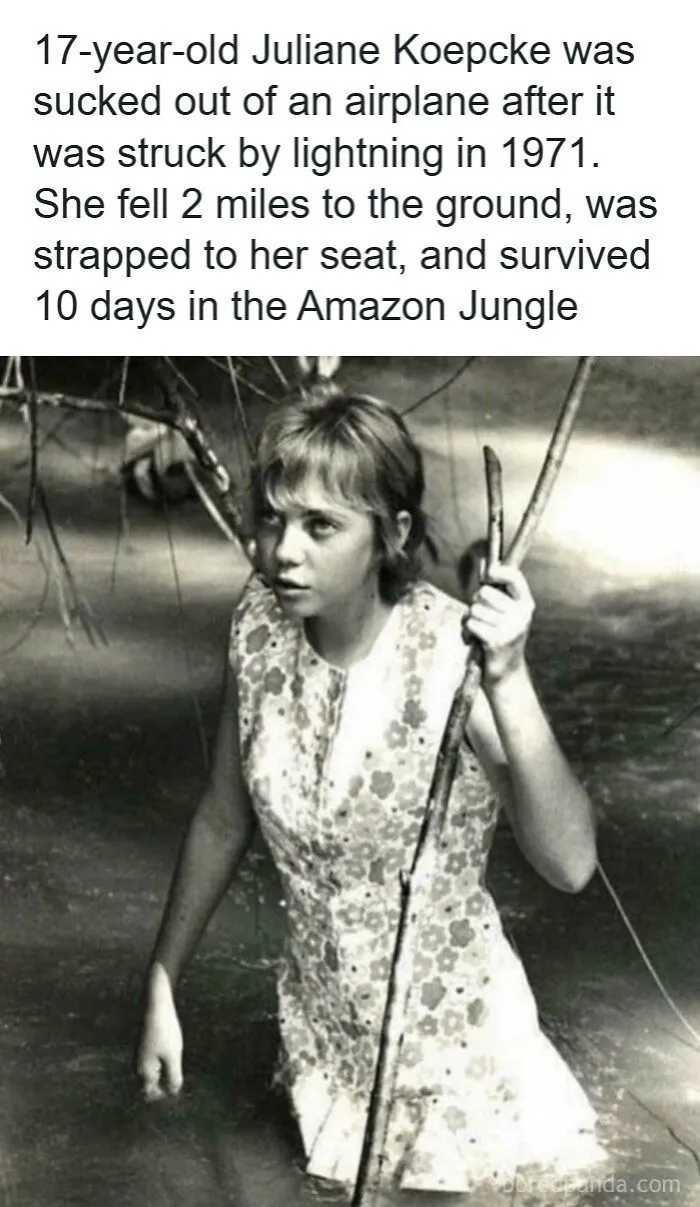
Alone in the Amazon, Koepcke relied on survival skills her parents had taught her, following a stream for 10 days until she found help. She became the sole survivor among the 92 people on board, making her story one of the most extraordinary survival accounts in aviation history.
#2

The compact system was likely designed to help monks record dates, page numbers, and calculations more efficiently. Despite its clever design, Cistercian numerals never gained widespread use and were eventually replaced by the simpler Hindu-Arabic numeral system. Today, they remain one of history’s most fascinating forgotten inventions.
#3

Thirteen years later, in 2023, Juliette made headlines again after buying her first-ever lottery ticket shortly after turning 18. She won the C$48 million Lotto 6/49 Gold Ball jackpot, becoming the youngest Canadian to win a jackpot of that size. When asked whether her childhood donation had somehow brought her good fortune, she said she didn’t know—but expressed gratitude and spoke about her ambition to become a doctor. Her story is a beautiful reminder that kindness matters for what it gives others, not for what might come back in return. Follow for daily interesting facts you probably never knew.
Homer was one of the most influential authors in human history, and he was writing about the past without a source. The Trojan War is traditionally dated to around 1200 BCE, but one of his most notable works, "Iliad," was composed roughly 400 years later, after the Bronze Age world that fought it had collapsed and the Greeks had forgotten how to write.
He had no archives to check, only stories passed from singer to singer. So he did what any good storyteller does with a fuzzy memory and a captive audience and filled in the gaps.
#4
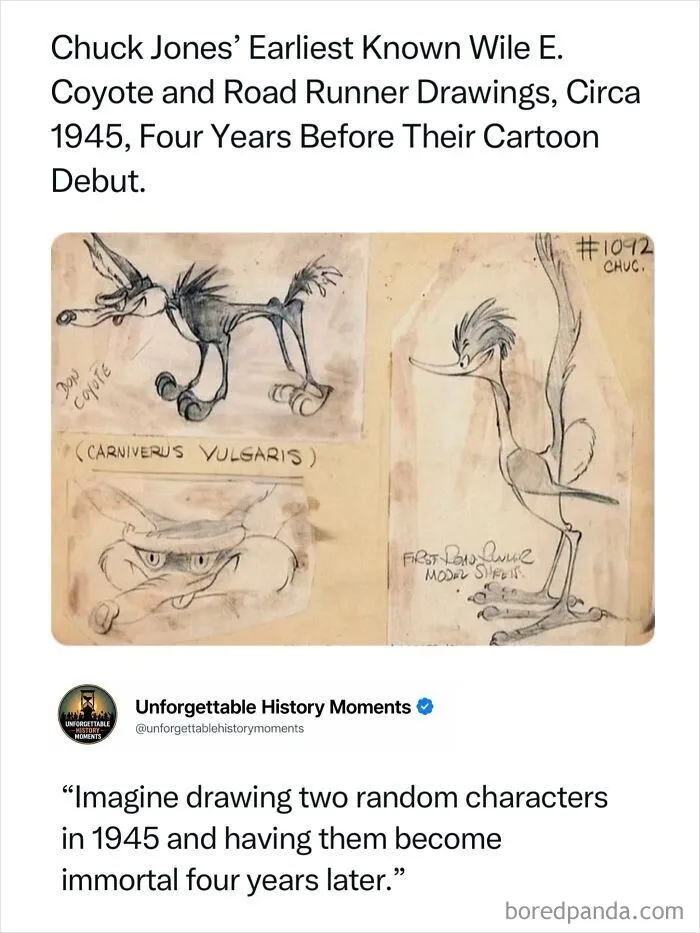
The early designs were different from the characters we eventually knew. Wile E. Coyote was even identified as “Don Coyote” on an early model sheet. Jones later developed the pair into one of animation’s most recognizable rivalries, built around one simple idea: the coyote desperately wants to catch the Road Runner, and somehow every plan goes spectacularly wrong.
#5
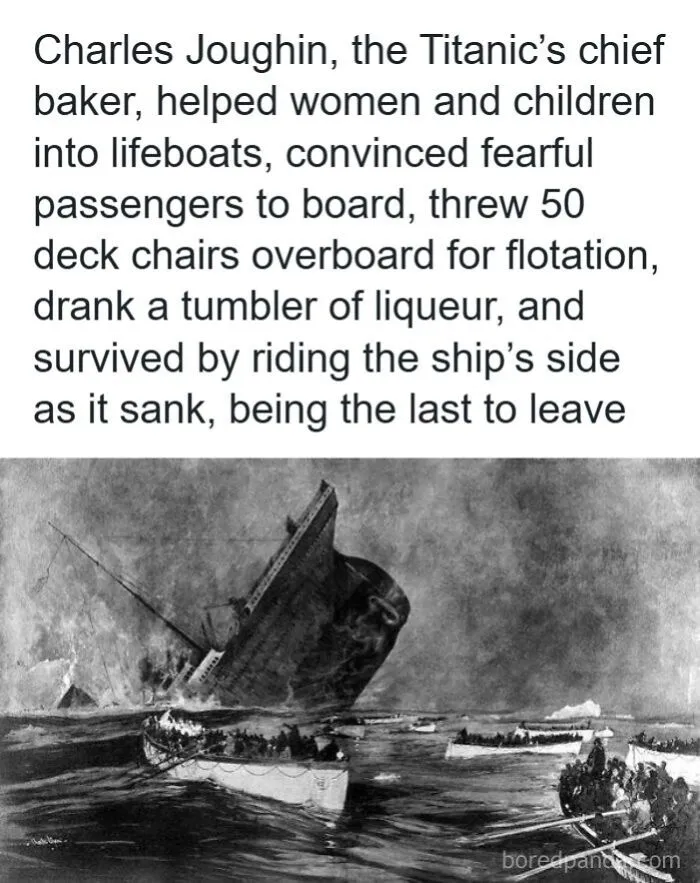
Realizing his chances of escaping were slim, Joughin retreated to his cabin to drink a large tumbler of liqueur before returning to the deck to throw fifty wooden chairs overboard to serve as makeshift flotation devices. As the vessel split in two, he climbed onto the outer railing of the stern and rode the ship down into the ocean like an elevator, stepping into the freezing water without even getting his hair wet. He spent over two hours treading water in the sub-zero Atlantic night, credit for his survival often given to the alcohol keeping his panic at bay, before being pulled onto a collapsible lifeboat at dawn.
#6
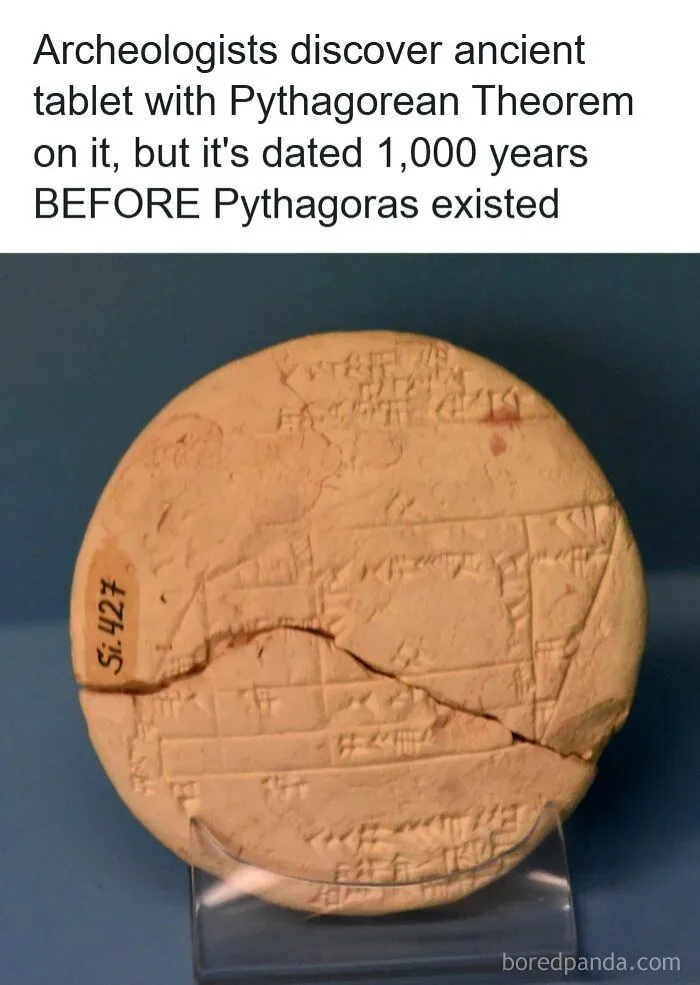
This doesn’t mean Pythagoras stole the theorem. Instead, historians believe he or his followers may have been the first to provide a formal mathematical proof. The discovery is a reminder that many of history’s greatest scientific and mathematical ideas were built upon knowledge developed by earlier civilizations.
Scholars used to wonder how anyone could compose a poem as long as the Iliad, which runs to more than 15,000 lines, without writing it down. In the 1930s, a Harvard classicist named Milman Parry went looking for the answer in Yugoslavia. He traveled through villages in Bosnia and the surrounding region with recording equipment and found singers, many of whom couldn't read or write, performing epic poems about medieval heroes and battles. Some of these songs went on for hours. Beat that, T Swift.
Parry noticed that the singers weren't reciting a memorized script. Every performance came out a little different, because they built each song as they went, using ready-made phrases that already fit the rhythm of the verse. Dropping in a stock phrase bought them a few seconds to think about what came next. Homer does exactly the same thing. "Rosy-fingered dawn" and "swift-footed Achilles" keep appearing because they're the right length to slot into a line. They were the oral poet's building blocks.
#7

Yu’s journey took more than 50 years and required overcoming financial challenges, visa restrictions, language barriers, and global events. Her remarkable achievement proves that extraordinary dreams don’t have an expiration date and has inspired travelers around the world to pursue their own adventures, no matter when they begin.
#8

The mystery was finally solved in 1978 when Gerber confirmed the baby was Ann Turner Cook. She grew up to become an English teacher in Tampa, Florida, and later published mystery novels. Cook lived to be 95, passing away in 2022. Her face had become famous around the world long before most people knew her name. Follow for daily interesting facts you probably never knew.
#9

The unusual slogan was not meant as a modern warning to stay out of other people’s affairs. In the 18th century, it reflected the idea of focusing on one’s own work and responsibilities. Alongside the image of a sundial and the phrase “Fugio,” meaning “I fly” in Latin, the coin carried a message about the value of time and productivity.
That means the Iliad was probably told and retold for generations before anyone wrote it down, with each singer reshaping the story a little. Homer was likely one of the last links in a very long chain, passing on a war nobody alive had seen. Troy itself was treated as pure legend until 1870, when Heinrich Schliemann, a German businessman and amateur archaeologist, started digging at Hisarlik in modern Turkey. He found a real ancient city with several earlier cities buried beneath it, and historians still argue about which layer, if any, matches the story Homer told.
#10
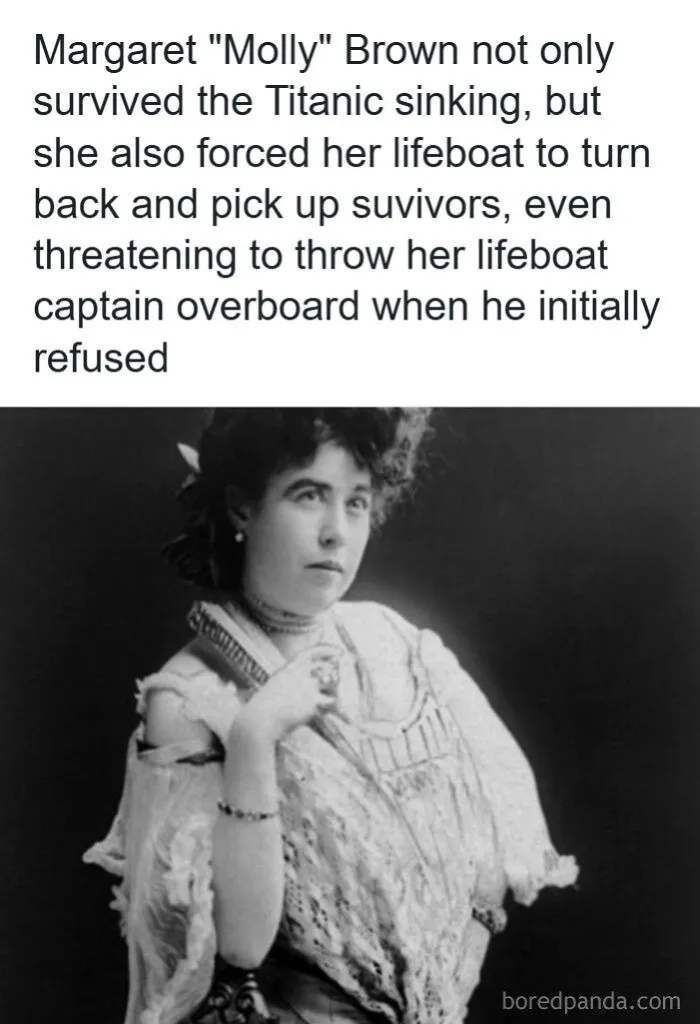
Although the lifeboat eventually turned back only after many people had already passed away from the freezing water, Brown’s determination became one of the defining stories of courage from the disaster. She later helped organize relief efforts for survivors and remained a lifelong advocate for humanitarian causes.
#11

Her simple idea transformed the way coffee was brewed, producing a cleaner, smoother, and more flavorful cup. Bentz went on to found the company that still bears her name, and her invention remains one of the most influential innovations in the history of coffee.
#12
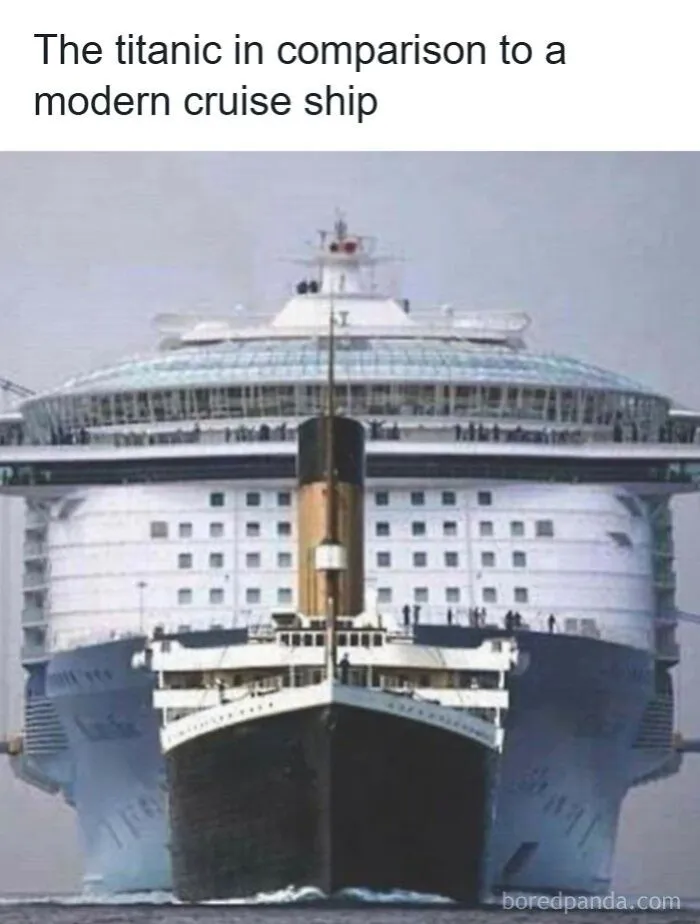
More than a century later, modern cruise ships have grown to astonishing proportions. Vessels like Royal Caribbean’s Icon of the Seas stretch nearly 1,200 feet (365 meters) long and exceed 248,000 gross tons, carrying more than twice as many passengers as the Titanic. This comparison shows just how dramatically shipbuilding has evolved over the last 100 years.
Herodotus, the man we call the Father of History, wasn't much more careful. Around 430 BCE, he reported that India had ants as big as foxes that dug up gold. Cicero gave him the famous title and then pointed out that his work was full of fables, and Plutarch later wrote an entire essay called 'On the Malice of Herodotus.' Some scholars think the giant ants were a garbled account of burrowing marmots. History started life as a mix of reporting and a very good campfire story, and we are here for every word of it!
#13
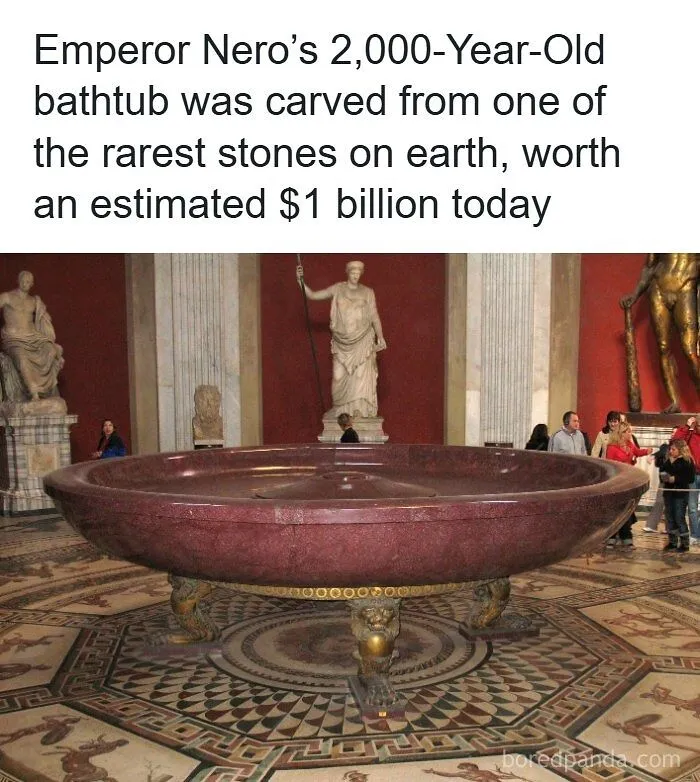
Measuring several meters across and weighing many tons, the basin showcases an extraordinary feat of Roman engineering and craftsmanship. Because the ancient quarry has long been abandoned and purple porphyry is no longer commercially available, experts estimate that obtaining an equivalent amount of the stone today would cost around $1 billion, making it one of the most valuable bathtubs ever created.
#14
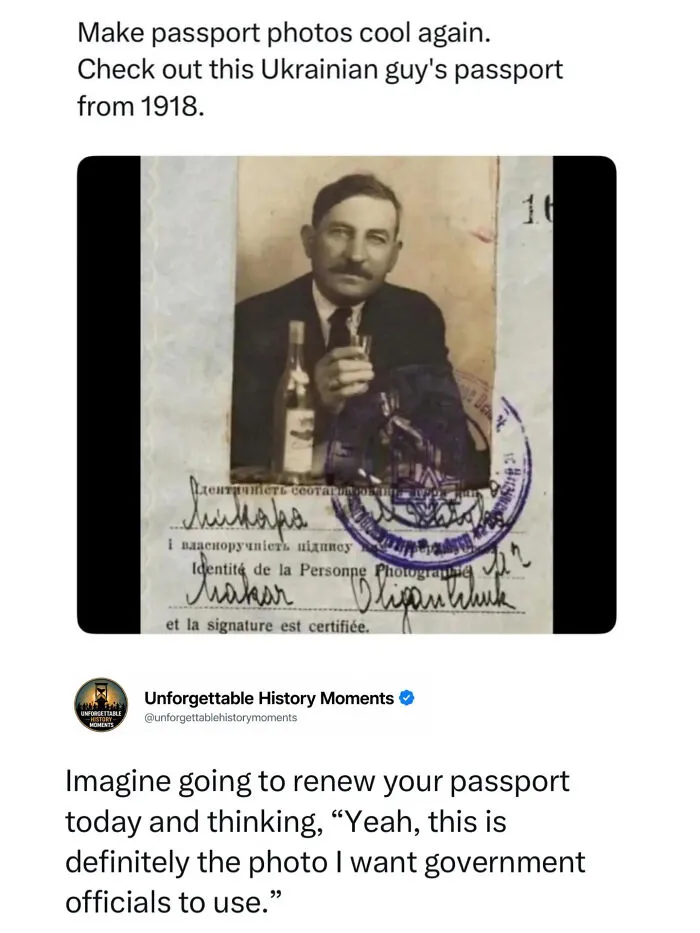
The photo reflects how informal identification photography could still be in the early 20th century, before modern passport-photo standards became widespread. Somehow, Oliynychuk ended up with one of the most unforgettable passport photos in history.
#15

A major earthquake in 1303 AD loosened or displaced many of the Great Pyramid’s remaining casing stones, and casing stones from the Giza pyramids were later removed and reused in buildings around Cairo. Today, only a small portion of Khafre’s original casing survives, most visibly near the top.
Most of the past is missing because most people never wrote anything down, so what survives comes mainly from the people in charge. The exceptions are the best part. A Babylonian clay tablet from around 1750 BCE records a customer named Nanni furiously complaining to a copper merchant called Ea-nasir about bad ingots and the rude way his messenger was treated.
At Vindolanda, a Roman fort near Hadrian's Wall, wooden tablets from around 100 CE include a note sent with socks and underpants for a soldier, and a birthday party invitation from Claudia Severa, whose handwritten greeting is often called the earliest known Latin writing by a woman.
#16
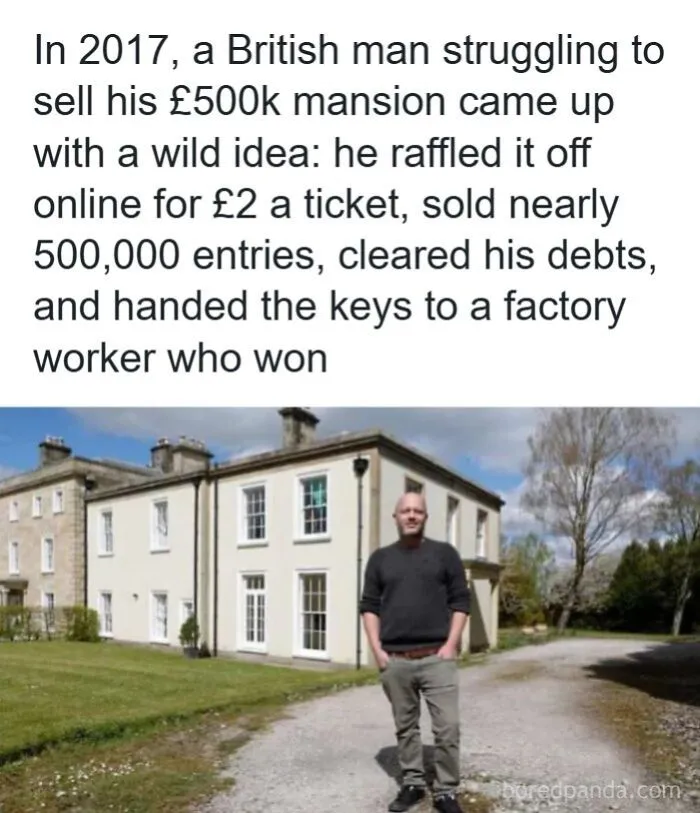
The winner was factory worker Kevin Johnson, who had spent only £10 on five tickets. His life changed overnight as he became the owner of a fully furnished luxury home worth half a million pounds. The unconventional raffle became an internet sensation and inspired similar house giveaways around the world.
#17

As portable music became a more personal experience, the extra headphone jack gradually disappeared from later models because most people preferred listening alone. Today, the original Walkman remains one of the most influential consumer electronics products ever made, forever changing the way people enjoyed music on the go.
#18
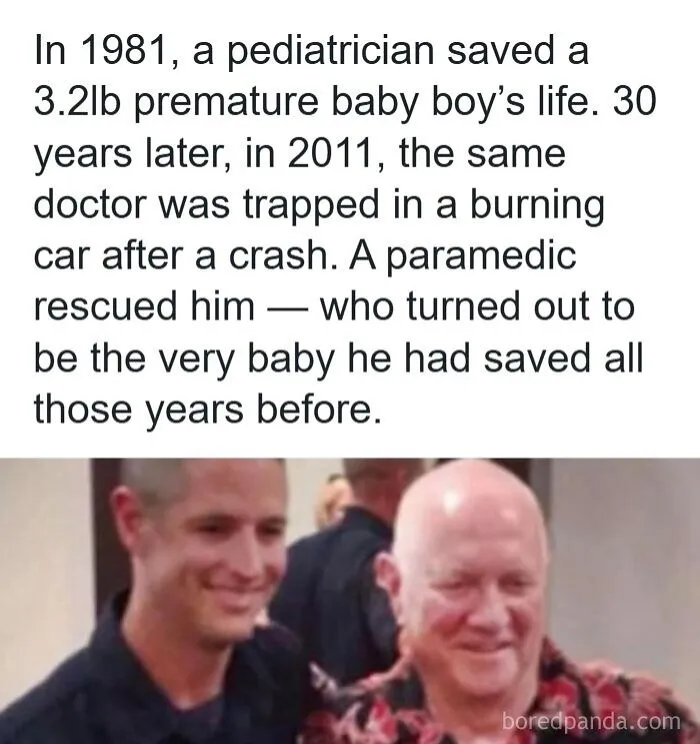
In 2011, after the doctor became trapped inside a burning car following a crash, one of the first paramedics to reach the scene rescued him. According to reports, that paramedic was the very same man whose life the doctor had helped save as a newborn 30 years earlier, creating an unforgettable story of gratitude, chance, and lives coming full circle.
Time also overlaps in ways that wreck your sense of order. Teaching was happening at Oxford by 1096, which means the university is older than the Aztec capital of Tenochtitlan, founded in 1325. History feels like a neat line of chapters, but plenty of it was running at the same time on different continents, with nobody aware of the others.
#19

Its extraordinary lifespan has fascinated engineers, historians, and visitors from around the world. While it has been switched off only a handful of times due to power outages and relocations, it continues to shine today, standing as a symbol of early engineering craftsmanship and one of the most enduring everyday objects in modern history.
#20
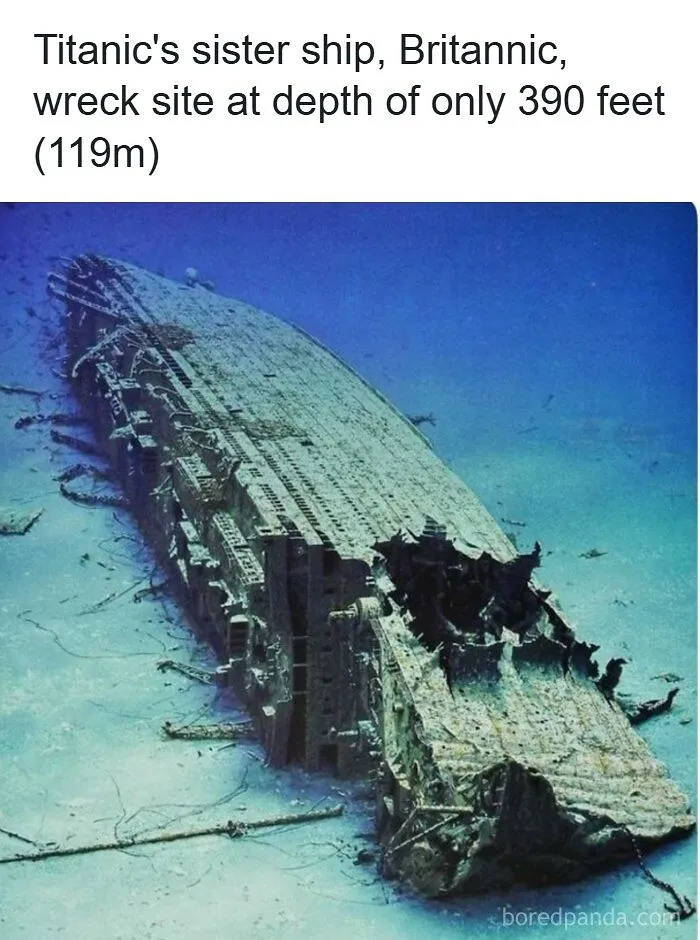
Today, Britannic rests on her starboard side just 390 feet (119 meters) below the surface near the Greek island of Kea. Unlike the Titanic, which lies nearly 12,500 feet (3,800 meters) deep, Britannic’s relatively shallow depth has allowed divers and researchers to explore one of the world’s best-preserved historic shipwrecks.


