




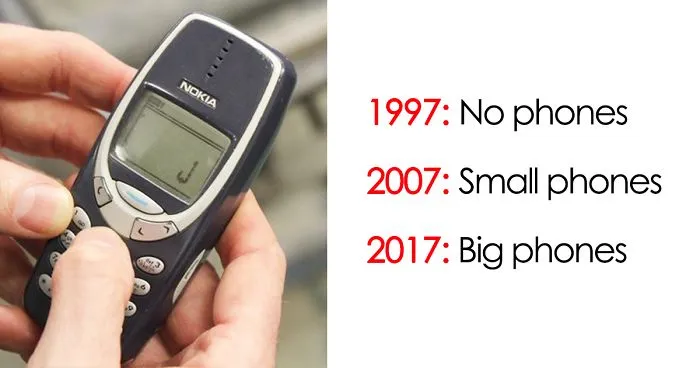

It's obvious that today's students' taste in music, clothes, and technology has massively changed since 2007, and even more since 1997, but what about the way they learn? The teachers of Reddit were asked this very question, and the differences they revealed between students from each decade are both humorous and troubling.
Some educators observed positive changes, like an increase in overall politeness among young people, and the acceptance of diversity in the classroom. Others, however, noted lower self-confidence, higher anxiety, and an unhealthy dependence on technology and the Internet as only the beginning of the problems learners face in 2017.
Scroll down to find out what teachers from 1997, 2007, and 2017 said about how students have changed over each era, and if you're a teacher yourself, add your testimony at the end!
#21
1997: Wasted my time on Super Mario Cart on SNES (HS student)
2007: Wasted my time on Facebook on my computer (Graduate student)
2017: Wasted my time on reddit on my phone. (College professor, aka professional student).
2007: Wasted my time on Facebook on my computer (Graduate student)
2017: Wasted my time on reddit on my phone. (College professor, aka professional student).
Report
22points
#22
Senior Pranks in 1997 were outlandish and acceptable. Senior Pranks in 2007 were less common and more basic. In 2017 Senior Pranks are illegal.
Report
21points
#23
Started teaching in '98. I didn't see a lot of difference between '98 and '07 kids.
But the '17 kiddos are a completely different breed. Very thin-skinned and easily wounded emotionally. Every negative encounter with peers is interpreted as bullying. Any conflict at all and they lose their minds. Also, the sense of entitlement is unbelievable.
But the '17 kiddos are a completely different breed. Very thin-skinned and easily wounded emotionally. Every negative encounter with peers is interpreted as bullying. Any conflict at all and they lose their minds. Also, the sense of entitlement is unbelievable.
Report
21points
#24
1997: Colorful hair and piercings.
2007: no Colorful hair, lots of tattoos.
2017: Colorful hair and tattoos.
(I teach in college)
Oh the other difference was 1997: No one talked about being gay, 2007: students came out to me privately in my office, 2017: Students talk about being gay in class.
2007: no Colorful hair, lots of tattoos.
2017: Colorful hair and tattoos.
(I teach in college)
Oh the other difference was 1997: No one talked about being gay, 2007: students came out to me privately in my office, 2017: Students talk about being gay in class.
Report
19points
#25
97: "You can have the pager back at the end of the day"
07: "You can have the cell phone back at the end of the day"
17: "Ok, everyone go to Google Classrooms on your tablets and pull up today's links."
07: "You can have the cell phone back at the end of the day"
17: "Ok, everyone go to Google Classrooms on your tablets and pull up today's links."
Report
18points
#26
1) '17 kids are professional, polite, and generally better behaved than their counterparts in the past
(therefore?)
2) '17 kids are more responsive to authority, but also afraid of it/reliant on it
3) '17 kids are definitely more tech saavy, no surprises there
4) Ironically, these kids are harder to influence - their sources of knowledge and inspiration go beyond you. So despite being more responsive to authority, they are less responsive to traditional tools for convincing people to change their minds (i.e. discussion, reverse psychology never works when my grandpa and folks older than him said it was a reliable tool, etc...) - odds are good they've been exposed to your information already.
5) When I give kids from '17 free time, without access to technology, they literally can't figure out what to do
(therefore?)
2) '17 kids are more responsive to authority, but also afraid of it/reliant on it
3) '17 kids are definitely more tech saavy, no surprises there
4) Ironically, these kids are harder to influence - their sources of knowledge and inspiration go beyond you. So despite being more responsive to authority, they are less responsive to traditional tools for convincing people to change their minds (i.e. discussion, reverse psychology never works when my grandpa and folks older than him said it was a reliable tool, etc...) - odds are good they've been exposed to your information already.
5) When I give kids from '17 free time, without access to technology, they literally can't figure out what to do
We need to ask whats the difference between 1997, 2007, and 2017 PARENTS?
Report
18points
#28
I can't say with 100% confidence, but I bet kids weren't dabbing on teachers every day in 1997 & 2007.
Report
17points
#29
If a kid got a bad grade in 1997, his parents would ask him why.
If a kid got a bad grade in 2007, his parents would ask the school why.
If a kid got a bad grade in 2017, his parents would ask his teacher why.
If a kid got a bad grade in 2007, his parents would ask the school why.
If a kid got a bad grade in 2017, his parents would ask his teacher why.
Report
14points
#31
In 1997, I was a junior in HS and wanted to be a teacher. I thought it would be the best job in the world! I would get to teach other people to love the subject I loved most in life. Kids were held accountable for their own success or failure.
In 2007 I was a teacher. It was great! I got to teach other people to love the subject I loved most in life. Kids were mostly held accountable for their own success or failure, but NCLB made life hard. YouTube was blocked and wasn't seen as a viable teaching tool. Begin the era of pervasive standardized testing.
Then the recession hit, and I decided to wait it out in grad school. I hoped I'd get a better job when the storm passed.
In 2017, I have a Masters in education, I'm no longer a teacher, and I don't miss the red-tape, political, back-stabbing bullshit that I see happening in districts now. Teachers aren't trusted to be subject matter experts, they're micro-managed to the point they're ineffective. Kids aren't held accountable for failing; instead, the teachers are blamed for failing the kids.
In 2007 I was a teacher. It was great! I got to teach other people to love the subject I loved most in life. Kids were mostly held accountable for their own success or failure, but NCLB made life hard. YouTube was blocked and wasn't seen as a viable teaching tool. Begin the era of pervasive standardized testing.
Then the recession hit, and I decided to wait it out in grad school. I hoped I'd get a better job when the storm passed.
In 2017, I have a Masters in education, I'm no longer a teacher, and I don't miss the red-tape, political, back-stabbing bullshit that I see happening in districts now. Teachers aren't trusted to be subject matter experts, they're micro-managed to the point they're ineffective. Kids aren't held accountable for failing; instead, the teachers are blamed for failing the kids.
Report
13points
#32
I was a student in 1997 at the school I now teach at, so I can answer this one. 2017 students are infinitely more polite, harder working and more intelligent than my cohort ever was. They're much less likely to smoke, they don't drink cider on the playing field at lunchtime, and they don't sell each other shitty weed in industrial quantities (I gather they sell each other excellent quality weed in very small quantities instead).
It's a big secondary school on a fairly deprived estate, so these aren't exactly kids who go to etiquette classes after school, but I literally can't open a door by myself because some 16-year-old with mutton chops will spring out to open it for me. If I'd done that when I was at school, it would have been instant social death.
It's a big secondary school on a fairly deprived estate, so these aren't exactly kids who go to etiquette classes after school, but I literally can't open a door by myself because some 16-year-old with mutton chops will spring out to open it for me. If I'd done that when I was at school, it would have been instant social death.
Report
12points
#33
I think the biggest difference is they are all connected, 24/7 they can all communicate privately and publicly.
They also all carry in their pocket a device that has access to more information then any library.
And, as it turns out, they do always have a calculator with them :o
I suspect the confidence level has dropped and risk aversion is very different. The things that where getting done by kids in '97 vs '17 have changed a lot. Younger kids don't play outdoors independently, they don't explore the neighbourhood as young. Their environment when they are younger is a lot more controlled and monitored.
Things "go viral" in a much faster way now.... suddenly one day out of no where every 10-13 year old is spending the whole day trying to flip water bottles...
Everything is documented. They all have cameras, they are all posting to social media, their parents probably have been posting them on social media. Mom's can't threaten to pull out the photo album for their friends because its all on Facebook already.
They also all carry in their pocket a device that has access to more information then any library.
And, as it turns out, they do always have a calculator with them :o
I suspect the confidence level has dropped and risk aversion is very different. The things that where getting done by kids in '97 vs '17 have changed a lot. Younger kids don't play outdoors independently, they don't explore the neighbourhood as young. Their environment when they are younger is a lot more controlled and monitored.
Things "go viral" in a much faster way now.... suddenly one day out of no where every 10-13 year old is spending the whole day trying to flip water bottles...
Everything is documented. They all have cameras, they are all posting to social media, their parents probably have been posting them on social media. Mom's can't threaten to pull out the photo album for their friends because its all on Facebook already.
Report
12points
#34
The difference between 1997 and 2007 isn't that pronounced. In 2007, we were really just in the early stages of destroying real education with the standards movement. So, students graduating in 2007 still had a chance of knowing something.
2017 - those kids are screwed. They have been educated entirely under a system that denies them any accountability. In 1997, a student could fail. Notice that responsibility lies with the student. Students graduating in 2017 have not been permitted to fail. If they don't achieve, they were "left behind." Notice that responsibility there rests with the school.
2017 - those kids are screwed. They have been educated entirely under a system that denies them any accountability. In 1997, a student could fail. Notice that responsibility lies with the student. Students graduating in 2017 have not been permitted to fail. If they don't achieve, they were "left behind." Notice that responsibility there rests with the school.
Report
11points
#35
I was in high school in 97, started teaching high school in 2007, and I am still teaching high school in 2017. Aside from the having a phone with them most of the time, what I can say that I notice the most is the lack of problem solving abilities. Students have access to the greatest source of information in the history of mankind, but they don't know how to use it. They don't know how to look for things, or how to solve problems that are presented to them. They have a higher expectation of things being handed to them, instead of them looking a way to make it happen. And of course, if everything goes wrong is the teacher's fault.
Report
10points
#36
The biggest thing has to be the extremes in behavior that technology has allowed.
For example, if you had a promiscuous pair of teens in 1997, their friends knew about it and in some instances, the school knew about it. Past that, unless they were really into taking analog pictures, that was it.
Fast forward to 2007, the year the iPhone was announced, this was still pretty much the case but what students could do online had drastically altered behaviors. Online bullying was a thing. Buying illicit drugs online was a thing. Etc. The other thing to consider, at least in the US, is that Columbine happened in 1999. This was essentially education's September 11th. Security became a huge concern and punishments for behaviors that prior to Columbine, wouldn't have been a huge deal, were now very severe.
2017 and really every year after 2007 has brought with it an amplification of behaviors due to the ability to spread and share information between a ubiquitous device that seemingly all students now have, the smartphone. Now, if you have a promiscuous couple of students, kids in other countries may very well have pictures and video of them doing whatever they are doing. Bullying happens much more frequently and insidiously. Everything a kid does now is online and while most of them are very aware of that, they don't care and they don't seem to worry that everything online is there forever. One other big change is many students are now taking classes online and that was in its infancy in 2007.
For example, if you had a promiscuous pair of teens in 1997, their friends knew about it and in some instances, the school knew about it. Past that, unless they were really into taking analog pictures, that was it.
Fast forward to 2007, the year the iPhone was announced, this was still pretty much the case but what students could do online had drastically altered behaviors. Online bullying was a thing. Buying illicit drugs online was a thing. Etc. The other thing to consider, at least in the US, is that Columbine happened in 1999. This was essentially education's September 11th. Security became a huge concern and punishments for behaviors that prior to Columbine, wouldn't have been a huge deal, were now very severe.
2017 and really every year after 2007 has brought with it an amplification of behaviors due to the ability to spread and share information between a ubiquitous device that seemingly all students now have, the smartphone. Now, if you have a promiscuous couple of students, kids in other countries may very well have pictures and video of them doing whatever they are doing. Bullying happens much more frequently and insidiously. Everything a kid does now is online and while most of them are very aware of that, they don't care and they don't seem to worry that everything online is there forever. One other big change is many students are now taking classes online and that was in its infancy in 2007.
Report
10points
#37
Electronics. Hands down. They are the most wonderful gift and the biggest handicap at the same time. Too many students use them as crutches or distractions instead of using it as a tool.
Report
9points
#38
Personalities and general minds are different. 1997 was cool boys who played hockey a lot, talked about girls from neighbour school and mostly guy stuff.
2007 a lot of gamers came about, students generally quieter now, still silly, also less contact with neighbour school. More bored nowadays, harder to motivate them. Generally as predictable as the 1997 classes.
2017 is by far the most different. Memes are everywhere. I pass by conversations that basically consist of my students repeating internet references and being cool about it. The funniest kids in my class now are the ones with the most meme knowledge. They are so unbelievably lazy, they wont go over anything. They're entire home hours are spent on internet or gaming completely. In 2007 and 1997, the nerds were outcast, talking in small groups and social circles. Now I feel like the students who were clasically cool are the uncool ones with their lack of knowledge on popular media. They still talk about the neighbour school but rarely, and just in a acknowledging way but none of them ask the council to organise proms anymore.
2007 a lot of gamers came about, students generally quieter now, still silly, also less contact with neighbour school. More bored nowadays, harder to motivate them. Generally as predictable as the 1997 classes.
2017 is by far the most different. Memes are everywhere. I pass by conversations that basically consist of my students repeating internet references and being cool about it. The funniest kids in my class now are the ones with the most meme knowledge. They are so unbelievably lazy, they wont go over anything. They're entire home hours are spent on internet or gaming completely. In 2007 and 1997, the nerds were outcast, talking in small groups and social circles. Now I feel like the students who were clasically cool are the uncool ones with their lack of knowledge on popular media. They still talk about the neighbour school but rarely, and just in a acknowledging way but none of them ask the council to organise proms anymore.
Report
9points
#39
I taught for a few years up until 2007 before going to grad school, but I'm back in the secondary classroom for this current school year.
The biggest thing I've noticed is that the kids whose families didn't have much money would have had home access to a cheap computer and printer in 2007. Now, they may not have a computer, but they have cell phones. This actually makes it harder to assign essays in some classes now--they'll try to type the full essay on their phones or just not do it at all.
When I was in high school in 1997, and when I was first teaching in 2007, my teachers and colleagues probably didn't think twice about expecting students to type and print essays. Now? It's less reliable (in my experience). In fact, I used my school fees money this year to purchase a handful of Bluetooth keyboards so those students could still type their essays instead of texting them. It's helped, but they still have some trouble composing their writing on their phones. It's been an interesting problem to try to solve.
The biggest thing I've noticed is that the kids whose families didn't have much money would have had home access to a cheap computer and printer in 2007. Now, they may not have a computer, but they have cell phones. This actually makes it harder to assign essays in some classes now--they'll try to type the full essay on their phones or just not do it at all.
When I was in high school in 1997, and when I was first teaching in 2007, my teachers and colleagues probably didn't think twice about expecting students to type and print essays. Now? It's less reliable (in my experience). In fact, I used my school fees money this year to purchase a handful of Bluetooth keyboards so those students could still type their essays instead of texting them. It's helped, but they still have some trouble composing their writing on their phones. It's been an interesting problem to try to solve.
Report
9points
#40
Last year I asked my mom the difference between students from 1976 until now (she retired last year).
She said kids have way less empathy for other people as well as animals.
And they don't know how to play, if they have grown up with modern electronics. ATARI hooked to a tube television was one thing. But tablets and smart phones have transformed childhood.
She said kids have way less empathy for other people as well as animals.
And they don't know how to play, if they have grown up with modern electronics. ATARI hooked to a tube television was one thing. But tablets and smart phones have transformed childhood.
Report
9points