





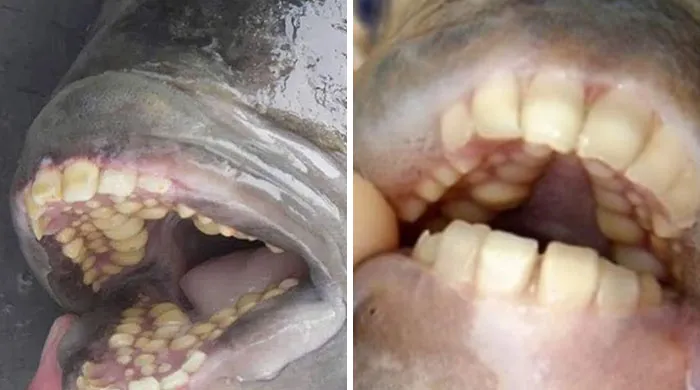
The Sheepshead, a name that evokes a sheep more than a marine predator, is actually a real fish, far from a figment of imagination.
It inhabits the waters of the Atlantic and can reach considerable sizes, up to 76 centimeters. But what makes it truly unique is its teeth: strikingly human-like incisors, followed by a set of molars arranged in three upper rows and two lower rows, all covered in enamel like a primate's mouth. This anatomy is not only bizarre, but functional: the Sheepshead feeds on crustaceans and mollusks, and those teeth are used to crush shells and carapaces with surgical precision. Despite its vaguely disturbing appearance, it is not an aggressive fish. Its dorsal spines can inflict painful stings if handled lightly, and a bite may hurt, but is not dangerous. In essence, it's a perfect example of how evolution can create creatures that look like they came out of a lab, but are simply the result of millions of years of adaptation
It inhabits the waters of the Atlantic and can reach considerable sizes, up to 76 centimeters. But what makes it truly unique is its teeth: strikingly human-like incisors, followed by a set of molars arranged in three upper rows and two lower rows, all covered in enamel like a primate's mouth. This anatomy is not only bizarre, but functional: the Sheepshead feeds on crustaceans and mollusks, and those teeth are used to crush shells and carapaces with surgical precision. Despite its vaguely disturbing appearance, it is not an aggressive fish. Its dorsal spines can inflict painful stings if handled lightly, and a bite may hurt, but is not dangerous. In essence, it's a perfect example of how evolution can create creatures that look like they came out of a lab, but are simply the result of millions of years of adaptation
