







If someone has ever told you that statistics are boring, they clearly lied. We have some interesting, entertaining statistical facts we think you should know. For example, have you ever heard about the myth of the above-average driver? It’s about the fact that, when asked to self-assess, 93% of drivers think they’re above average.
In reality, that’s mathematically impossible. Only 50% of people in a group can be above average, so people tend to see themselves as better drivers than they really are. Statistically, 50% of people are below-average drivers, and 50% are above-average drivers. Psychologists also call this superiority illusion the Lake Wobegone effect, and it also applies to leaders, university professors, and egocentric people in general.


If you had to bet on something, would you choose to bet on the same thing 26 times in a row and expect to win? You might think that it’s statistically impossible to win every time, yet it’s happened before. In 1913, the roulette ball at the famous Monte Carlo casino fell black 26 times in a row, proving that the Gambler’s Fallacy is real.
Most people think that such coincidences aren’t probable. So, when they had to bet, most gamblers at the casino bet on red. Imagine their surprise when, time after time, they had to watch the ball land on black and lost all their money. Reportedly, some people even lost millions of dollars. The Gambler’s Fallacy can be summed up in one example: no matter how many times before a coin toss landed tails, the probability of heads still remains 50%.



The Monty Hall problem may trick our brains in a similar way. There are three doors that a contestant has to choose from. Behind one of the doors is a prize, and behind the other two — nothing. When the contestant picks an empty door, they can change their original answer or stick with the door they chose. Most of us interpret the theory of probability wrong and think that changing our answer gives us a better chance of winning the prize.


The chances of winning if you choose another door when there are only two doors left aren’t 50-50; they’re actually 2/3. The probability that the prize is behind the original door is 1/3, and the probability that it’s behind one of the two doors left later is 2/3. It’s conditional probability — the likelihood of an event might change when we know more information.



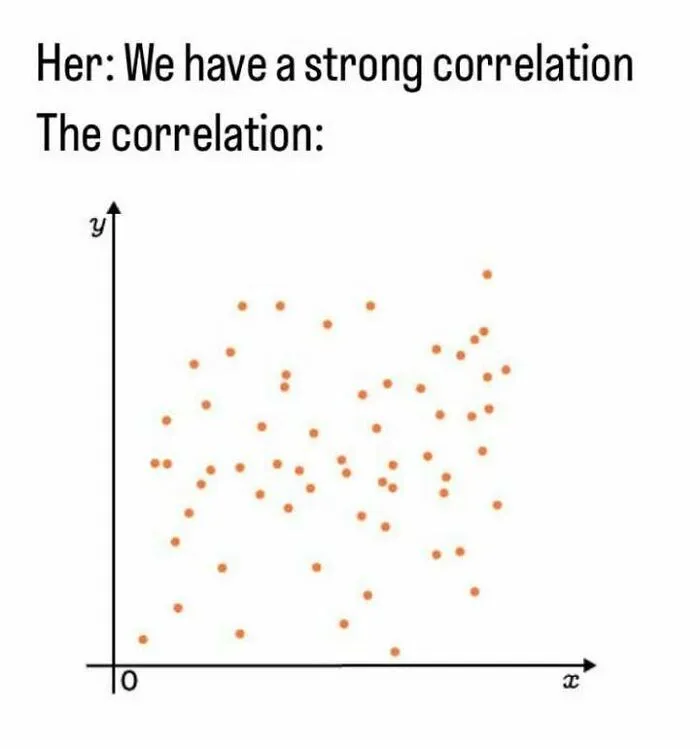
What do shark attacks and ice cream sales have in common? Surprisingly, statistically, they peak at similar times of the year. While there is no direct correlation, both shark attacks and ice cream sales increase during the summer months. It’s one of the best examples that correlation does not equal causation. Both phenomena are unrelated; it’s just that people swim more in the summer and eat more ice cream during hot summer months.



The “correlation doesn’t mean causation” rule has some other funny examples. Like the fact that the divorce rate in Maine has decreased at almost the same pace as margarine consumption in the U.S. Similarly, but not any less hilariously, the popularity of the “This Is Fine” meme correlates with the number of public school students in the U.S. Except for 2021, when the popularity of the meme dropped significantly for some reason.