



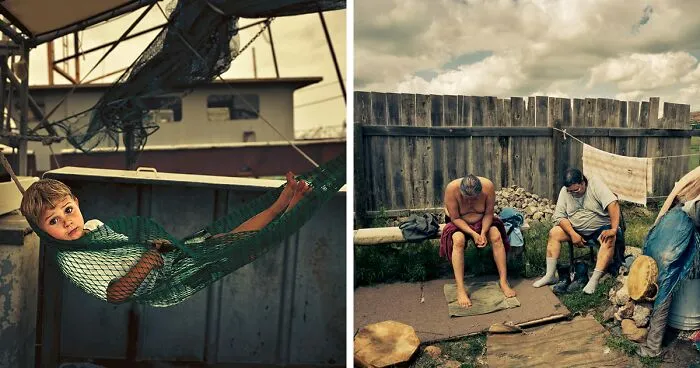

The American Dream for some isn't the reality that they live in. For some, it's still a dream. Others were woken up from the dream by the harsh circumstances of socioeconomic reality. And for others, the American Dream is a nightmare. The people about whom we speak are the disenfranchised people living below the poverty line, scraping by and hanging onto whatever life throws at them.
In 2011, Joakim Eskildsen decided to capture those less fortunate that live in the USA. He successfully reveals the shocking reality of people that live not in the land of the free, but in the land of economic turmoil. And it doesn't affect only a few unlucky individuals, but whole communities. He has worked in collaboration with writer Natasia del Tora, who has helped to bring the stories of these people out into the forefront.
Over time, the collection amounted into a book project which he called American Realities, juxtaposing it to the illusory concept of the American Dream. In it, he gives in-depth details and stories of the people that have to live in poor man's shoes. Here are the 65 stories that may not be comfortable, but they're as real as they can get.
#21 Diane & James Kinley

James Kinley and his wife Diane live in a small but impeccably kept trailer home. After 37 years of working at a local industry, James started having heart problems that eventually forced him to get a pacemaker and quit his job. His longtime insurance company did not honor his claim for disability and is forcing him to pay back the money he received when he left his job. Now that he's turned 65, he finally qualifies for the government’s health insurance for the elderly. The Kinleys have taught their children how to produce their own food through gardening and cultivating honeybees. Their do-it-yourself attitude has helped them get by in tough times. They fear that if Diane’s health were also to decline, rising medical bills would make it impossible for them to keep their home.
Report
46points
#22 Dakeia Johnson & Her Daughter Jes-Zahre

Dakeia Johnson and her daughter Jes-Zahre live with Dakeia’s mother in the Upper Ninth Ward in New Orleans. During Hurricane Katrina, a helicopter rescued the family off the roof of their floating home. Through “sweat labor,” they purchased a new house from an organization, but fear the home has toxic drywall like other homes built in the community. Dakeia earned a college degree in biology, but can barely make ends meet working as a substitute teacher. She says she takes anti-depressants to cope with her financial stress and grief after her brother was shot and killed by gunfire last year.
Report
46points
#23 Ruthann Yellow Earring

Ruthann Yellow Earring lives in one of the poorest neighborhoods in Eagle Butte. Kids call it “The Dark side” due to lack of street lights, fights, drunks loitering in the streets, and domestic abuse.
Report
44points
#24 Martha Andalon

Martha Andalon, a volunteer at a community center in Firebaugh, California, helps distribute bags of free food, enough for 200 families. She knows first-hand the hardships people are facing; she and her farmworker husband are currently unemployed and struggling to feed their four children. Andalon is learning English and computer skills in hopes of landing a job. Volunteering at the community center guarantees her a free bag of food. Others, however, start arriving at 5 am to ensure they’ll get a bag, containing a whole chicken, canned goods, boxed mac and cheese, potatoes, and other staples. Men in cowboy hats, mothers, grandmothers, and small children stand in a line that stretches out into the parking lot. The wait can be several hours long; latecomers sometimes leave empty-handed.
Report
41points
#25 Name Unknown

This homeless man lived in his tent on F Street before the encampment was razed by the city.
Report
40points
#26 Ruthann Yellow Earring

Ruthann Yellow Earring lives in one of the poorest neighborhoods in Eagle Butte. Kids call it “The Dark Side” due to lack of street lights, fights, drunks loitering in the streets, and domestic abuse.
Report
37points
#27 JJ Creppel

JJ Creppel lives in Buras, Louisiana. A shrimp fisherman whose livelihood was destroyed by Katrina, he lives in a trailer with his girlfriend. He doesn’t have enough food to eat so he kills chickens in his yard for food. He says he has been a hard worker his whole life, but is about to give up. He is unable to catch what he used to and his health is deteriorating.
Report
35points
#28 Whitehill Family

Danielsville, Georgia, a small town just north of Athens. Though the Whitehill family had received an eviction notice two months earlier and were planning to move into another house on that same day, the sheriff came by to let them know their time was up. Several workers tossed all of their clothes, toys, furniture, and framed photographs into a soaking heap in the front yard. In this picture, they were collecting their remaining things. The sheriff told them they had to oversee four to six evictions like this one every day. With one in 300 housing units subject to a notice or repossession, Georgia has the nation’s highest rate of foreclosures, triggered by the burst of the real estate bubble and the subprime mortgage crisis that started in 2007.
Report
33points
#29 Gary Taylor & His Kids

Gary Taylor, 47, plays with his kids outside their home in Fresno. More than a year ago, he lost his job at the customer service center of a food bank and has had trouble finding work since. He supports his fiancée, Latoya Lowe, and three kids, aged six, five, and three, with the six hundred dollars he gets from public assistance, though he says the money does not cover all of his bills. “I’ll do any job to provide for my family,” Taylor says. “But if I don’t find anything, that means I’m on the street.” However, he worries that employers will pass him over for someone younger.
Report
30points
#30 T.J. Shelton

T.J. Shelton has been a hard-working citizen his entire life, but he had to stop working when he became blind. Born in Atlanta in 1935, he joined the Air Force at age 17, where he learned how to break down and reassemble a rifle. He became a crack shot, earning his first stripe on the target range and was put in charge of ammunition. He served in Korea with the 94th motor squadron for three years. When he returned to the States, T.J. held different jobs at the same time, at General Motors and as a busboy at a hotel. His strong work ethic gained him a promotion to engineer. He moved on to the Imperial Hotel and then to the Atlanta airport, where he worked as a radar technician. He came to Athens in the 1970s, where he met and married a teacher. He lives in her parents’ home still today. He wishes he could raise chickens, but a local anti-livestock ordinance prohibits citizens from raising their own food. “Things have changed around here,” he says. “I’ve got land for a chicken and the dogs in the neighborhood cause more problems than chickens.” In the late nineties, T.J. worked at Sears and developed glaucoma. He tried to get corrective eye surgery for his condition, but was instead blinded by the surgeon’s poorly calibrated laser. Unable to work, T.J. refuses all government assistance except his Army disability, saying, “I ain’t worried about not being able to see. God has blessed me. You gotta be strong. You gotta do what you gotta do.”
Report
18points


