




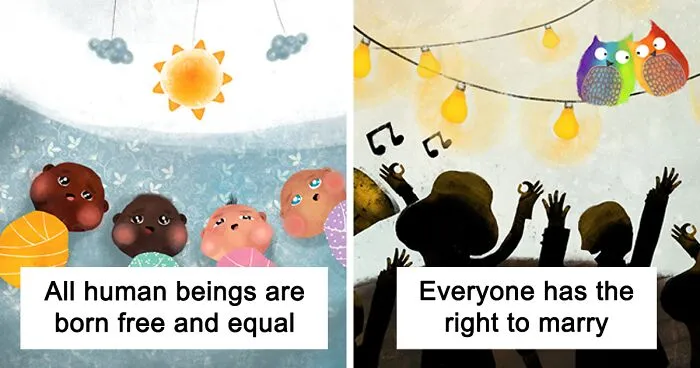

A Turkish illustrator illustrates all 30 articles in the Universal Declaration of Human Rights to create a card game for children for Amnesty International. Ozge Tigli created an imaginary world and illustrated human rights connected with the children’s world, even the ones about slavery, torture, and law.
More info: twitter.com | Instagram
#21 Article 28: Everyone Has The Right To Live In A World Described In This Statement
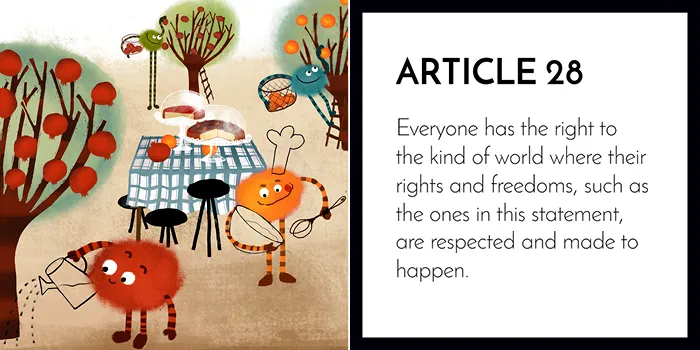
This Article talks about social order in some way which this card tries to convey. You see many trees filled with fruit that represent social rights, and you can climb up the stairs to access these rights. “In this system, everyone contributes to the achievement of these rights. Some are watering trees, some collecting fruits, some making delicious tarts and cakes from the collected fruits.”
At the end of the day, there is room for everyone to gain from the harvested fruit but collectively and communally. Everyone has a place: the tall ones have shorter chairs to sit on, and the short ones have taller chairs.
Report
6points
#22 Article 29: Everyone Has The Duty To Respect For The Rights Of Others
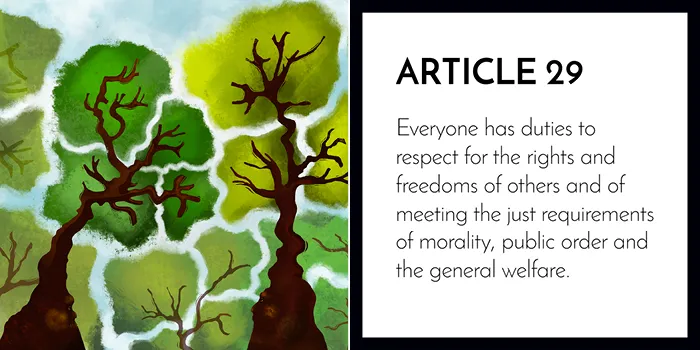
In this card, you see two trees. Their bodies resemble faces and their branches represent communication. Tigli borrowed from the ‘shy tree phenomenon’ where trees do not touch each other but form canopies. In this way, the branches and leaves grow together in harmony without interfering with each other. They live side by side for centuries and express themselves by their height, color and density, with hundreds of trees absorbing sunlight and rain through time.
Report
6points
#23 Article 4: No One Shall Be Held In Slavery
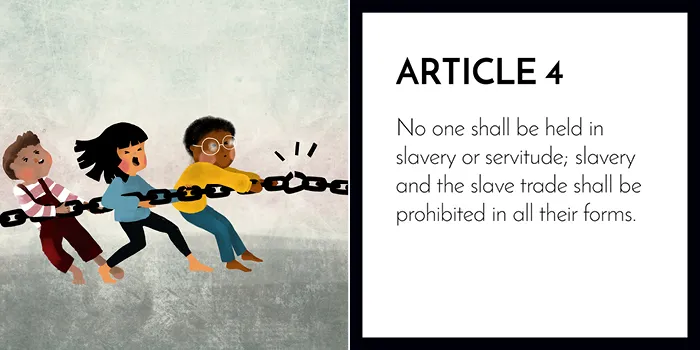
This card is about slavery and the fight against it in the past and present. The Black child in front represents his community’s anti-slavery struggles. The two children at the back have experienced slavery in modern times—a Thai girl who is a victim of child sex tourism and a Bangladeshi boy who works in a factory. They are all barefoot because the fight against slavery is difficult and unfair. The other side of the chain shows the collective struggle to escape slavery, but Tigli left it out as she didn’t want children only to see the dark side of slavery but the collective fight against it.
“In my research for the game, I learned the most shocking information from this card. Right now, worldwide, up to 10 million children are trapped in modern forms of slavery.” She is hopeful that one day the chains of slavery will break.
Report
5points
#24 Article 20: Everyone Has The Right To Peaceful Assembly
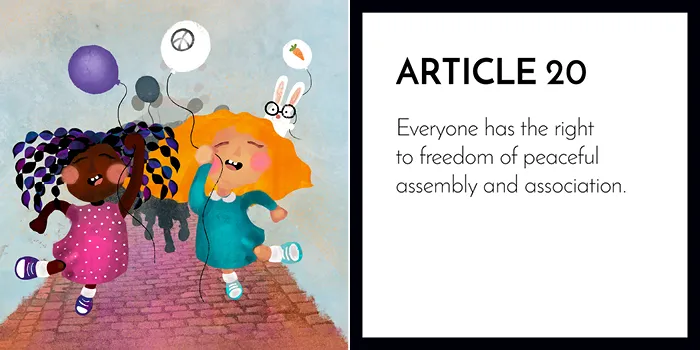
To show the right to peaceful assembly, the children are demonstrating on the street. Everyone can voice their own concerns. The girl on the right wants peace, and the rabbit behind her wants a carrot. At the same time, the girl on the left is happily joining the cause. Tigli explains that she “deliberately drew both of the children demonstrating on the street as girls for the children to absorb the vision that women can comfortably exist on the streets.”
Report
5points
#25 Article 30: Nobody Can Take These Rights From You
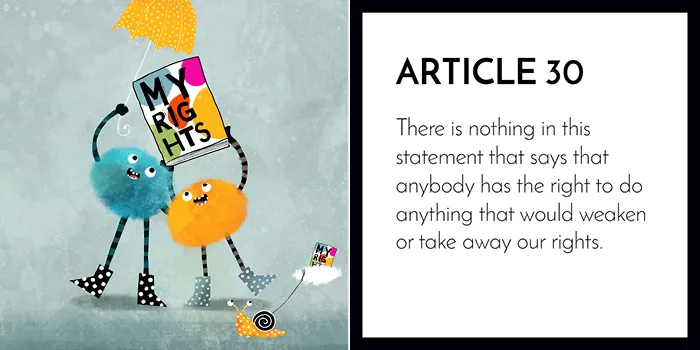
While rights are universal, at the core, they belong to individuals, and this is what the illustration tries to show. No one can take another’s right and no one has to give up their right. You see a little snail at the bottom with a floating cloud to support and carry its rights wherever it goes.
Report
5points
#26 Article 13: Everyone Has The Right To Travel
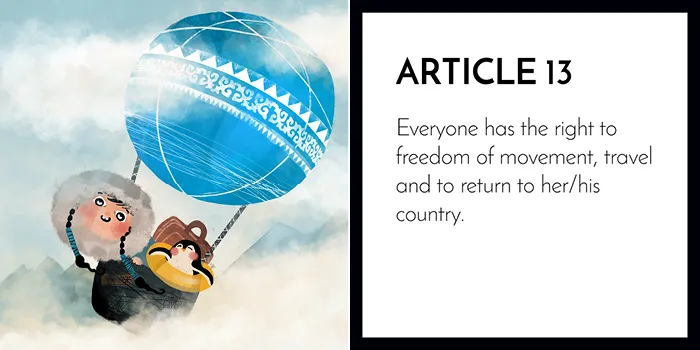
This card shows freedom and happiness. Here, the girl is on a hot air balloon traveling the world without restrictions. The balloon pattern is inspired by tying styles and prints of nomad tents from Central Asia. Maybe she turned her tent into this balloon. The image shows how traveling to different countries can be such an enriching experience for both individuals and the countries. “Every tourist carries the richness of their own culture and their own originality.”
Report
4points
#27 Article 15: Everyone Has The Right To A Nationality
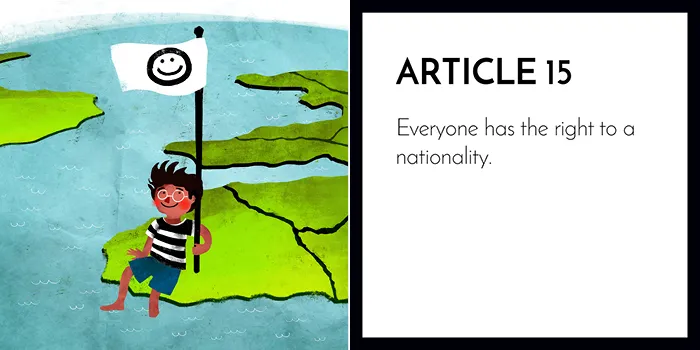
“One should be content and peaceful from the country of which they are a citizen,” says Tigli. A boy casually sits by the sea with his feet in the water, holding a flag with a smiley face on it. This image may connect to the refugee crisis and show refugees positively, but it is really up to the children how they interpret it.
Report
4points
#28 Article 17: Everyone Has The Right To Own A Property
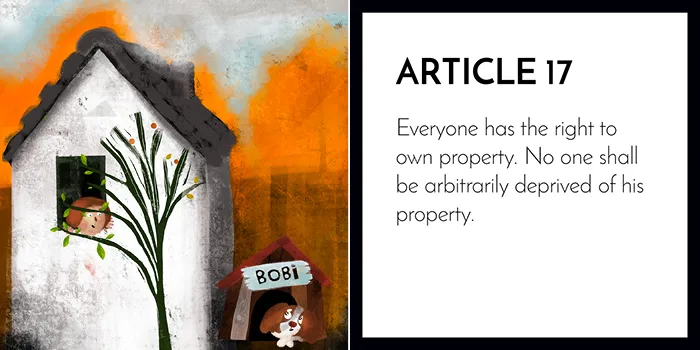
This card has earthy colors representing the concept of having a home on earth that belongs to you and your family. As we all know, property is a controversial topic. And the concept of ownership might be difficult for a child to grasp. The main character in this image, Bobbi, shows that no one can take his property away from him because he has the universal right to own and live in his home.
Report
4points
#29 Article 22: Everyone Is Entitled To Economic, Social And Cultural Rights
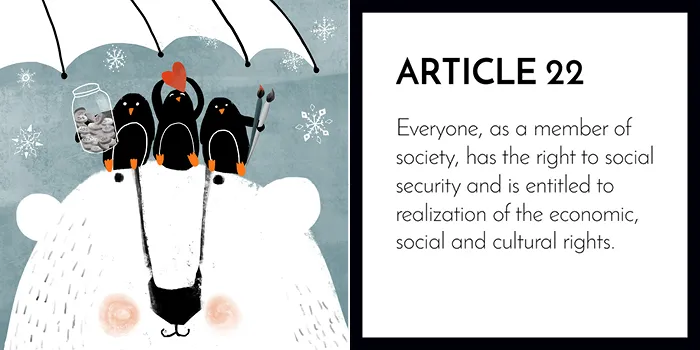
Since this Article covers so many themes, Tigli used symbols as clues. The penguin on the left is holding a glass jar full of coins representing economic rights. The middle penguin is holding a heart that represents social rights. The penguin on the left is holding paintbrushes to represent cultural rights. All of them feel secure under a large umbrella and sitting on top of a friendly polar bear, symbolizing social security.
Report
4points
#30 Article 27: Everyone Has The Right To Enjoy Art And Science
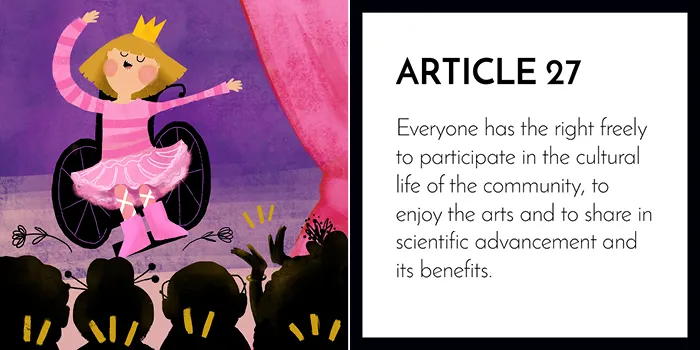
You see a young girl with a walking disability performing in a ballet show. Tigli specifically chose to focus on disabled children because they are mostly represented in stories related to disabilities. But here, you see this girl is happy and confident in performing in front of an audience. The audience seems to be enjoying the show—they are applauding and throwing flowers in appreciation and support.
Report
4points