






We all have a concept of reality. We know what is “fact” and what isn’t. However, the truth of the matter is that the definition of “real” is a mere construct of the brain.
If that didn’t blow your mind, this list has a lot more where that came from. These are responses from a recent Reddit thread, bearing a question originally directed at scientists: “What’s something we know is true but people don’t realize how crazy it is?”
A lot of these answers did not disappoint. You may want to have Google open next to you as you read through, since you'll likely want to do a little more digging.
#41
Your eyes can send way more data than your optic nerve can carry. We don't know how your eyes decide what data to send and what data to ignore.
There doesn't seem to be any sort of decision-making cells or structures, and it's not something as simple as "movement more important" or "brighter more important".
There doesn't seem to be any sort of decision-making cells or structures, and it's not something as simple as "movement more important" or "brighter more important".
Report
11points
#42
We are still in the stone age of our understanding of the human brain.
Metaphorically, have we learned to make fire, create interesting cave paintings, and invented the wheel? Yes!
But, are we missing a fundamental framework for even asking questions like ancient Greek, Arabic, or Chinese philosophers (much less theoretical or applied advancements like quantum mechanics or suspension bridges)? Unfortunately, yes.
We're nowhere near as far along as most people think we are in neuroscience.
Report
11points
#43
An ELI5 one: (I think, does a 5 year old know repel, protons, fusion? hmmm...)
The sun works by getting protons (or hydrogen) close enough that they 'stick' (nuclear fusion) which releases the energy that powers the sun.
Protons repel like north poles of magnets and you have to get them going really fast to get them close enough to stick (like magnets covered in superglue). The hotter the sun, the faster the protons move around. The sun is not hot enough to make protons move fast enough to stick and almost no fusion should happen in the sun.
The only reason it does is because the proton isn't a solid particle like a marble. Place a proton on the desk and theres a small chance you'll find it slightly to the left or right of where you think you placed it. The further it 'jumps' from where you put it, the smaller the probability that its there when you look for it.
So when two protons bang together as close as they can get (which isn't close enough to stick) - there is a small probability that one of them isn't where it 'should' be, but is closer to the other proton - close enough to stick.
This small percentage of collisions that work when they shouldn't match the power output of the sun.
The sun is powered (and all life only exists) because of black magic trickery (otherwise known as quantum tunnelling).
Report
10points
#44
Mathematician here. You can easily memorize an 1031 digit prime number. Here, watch, I'll start typing out the digits: 111111111111111111111111111111111111....
Yep, a 1031 ones is a prime number. And now you can tell people you have an 1031 digit prime memorized.
Yep, a 1031 ones is a prime number. And now you can tell people you have an 1031 digit prime memorized.
Report
10points
#45
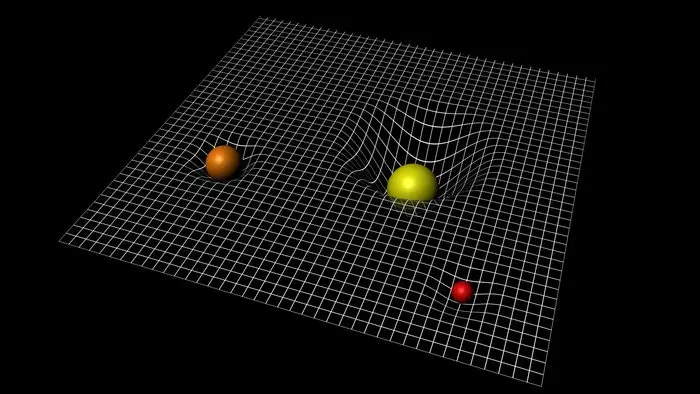
The universe isn’t really 3D space, but 4D spacetime. That's one unified geometric structure, containing ALL events, at EVERY place and time. What we call "now" is not a universal slice shared by everyone. Different states of motion correspond to different slices through that structure, and therefore to different notions of simultaneity.
A simplified analogy is an animator's flipbook. It doesn't make sense to ask what a character is doing "right now" while the book is just sitting on the shelf, because everything the character ever does is already contained within it. To talk about what is happening "now," you first have to choose a page. Once you do, you can describe what the character is doing on that slice. But choosing one page does not mean the others do not exist, nor does it mean another observer could not choose a different page as their "now."
The reality is actually even weirder because slicing at different angles puts different events at different times for different observers, even after compensating for signal delay, and events that aren't causally connected have no absolute time ordering at all.
Report
9points
#46
The sheer scale of the sun is one of those things that just breaks your brain when you really look at the numbers. Like, the fact that we're essentially just 'decimal dust' in terms of mass compared to the rest of the solar system is a wild perspective to have on a Tuesday afternoon.
Report
9points
#47

Your brain made up the entire experience of “reality.”
You’ve never actually seen color, felt texture, or heard sound the way they truly exist. Your brain just translates electrical signals into a fully immersive simulation and goes, “yeah this seems real.”
You are a consciousness piloting a meat suit, trusting a 3-pound organ that hallucinates your entire world in real time… and we all just accept that like it’s normal.
Report
8points
#48
Only about 5% of the stars in our galaxy could theoretically support life as we know it. The solar system is on a minor, isolated spur of the Milky Way called the Orion Arm, rather than one of its major spiral arms. Our location also falls within the galaxy’s “Goldilocks zone” far enough to be safe from the radiation and chaos of the galactic center, but close enough to have the heavy elements needed to build planets and support life, and with no big stars close enough to go supernova and wipe out the atmosphere.
Report
8points
#49
Honestly, all of it is totally crazy. E.g.:
Our sensory systems convert light (radiation) or sound (vibrations) etc. into electricity and chemical reactions that allow us to perceive the world. You can't tell me that's not weirder than sci-fi.
LEDs: we transport electrons through crystals and they glow. Sounds totally fake.
And the list goes on and on. .
Report
7points
#50
It’s wild how much of the universe is basically just hydrogen and helium. everything heavier is leftover star material and we’re part of that. that still doesn’t feel normal to think about.
Report
7points
#51
Certain colours like magenta don’t actually exist in reality—-we’re just not built to deal with the multiple wavelengths of light ‘magenta’ pings back to us so our brain goes ‘here’s magenta- that’ll do’.
Report
6points
#53
I am always intrigued by our vision continually getting worse despite better nutrition.
Report
6points
#54
Light always takes the fastest path to its destination, even if its path is longer than a straight point between its source and its target.
i.e. light can and will take a non-direct path if that path would lead to the light getting it its destination faster, like by refracting through water or scattering in an atmosphere.
i.e. light can and will take a non-direct path if that path would lead to the light getting it its destination faster, like by refracting through water or scattering in an atmosphere.
Report
5points
#56
One of the craziest facts in quantum physics comes from something called Bell’s Theorem. It basically shows that the universe cannot work the way we intuitively think it does.
Imagine you create two particles that are “linked” (this is called entanglement). Then you send them to opposite sides of the galaxy. When you measure one particle, you instantly know what result the other one will give. Not “really fast.” Not “almost instantly.” Instantly.
There are only two logical explanations:
The particles already had their answers decided in advance (like sealed envelopes).
They somehow communicate faster than light when you measure them.
Classical physics says the first must be true, because nothing can travel faster than light. But Bell proved mathematically that cannot work. And this has been experimentally confirmed over and over again.
So nature is forced into something deeply weird.
Either Information travels faster than light OR Particles don’t have definite properties until you measure them. And we’ve tested this in real labs. The universe consistently sides with the weird answer. Einstein called it spooky action at a distance. Now it’s pretty much accepted that the speed of light cannot be violated locally this has also been verified time and time again.
What this means is reality is not built on tiny solid objects with pre-set properties like we assumed. Like little Lego’s building up into a nice conformal structure. At a fundamental level, the universe does not behave like a classical machine. It’s not sci-fi, or speculative meta physics, it’s the reality we live in every day and based on experimentally verified physics.
EDIT:
The title of the thread is what’s something we know is true but people don’t know how crazy it is.
The many worlds interpretation, particles moving backwards in time and other stuff mentioned either have little or no verified experimental evidence.
Some interpretations of many worlds frankly border on meta physics.
Anyway I’m not judging how true these things are what I do know is there is evidence, strong evidence for Bells Theorem, therefore at this moment in time I can conclude it to be true, the other stuff could be true but I don’t ‘know’ it.
Report
4points
#57
Birds, mammals, reptiles and amphibians are all tetrapod fish. An organism cannot evolve out of a clade (on a smaller scale, the same as the fact that birds are dinosaurs - they descend from the most recent common ancestor of * Megalosaurus* and *Iguanadon* and are therefore dinosaurs). Basically everything animal is technically a fish and even has gills in the early stages of development.
Report
4points
#58
There are more unique ways to shuffle a deck of cards ~10^67 than there are atoms in earth ~10^50.
Report
4points
#59
Black holes warp both space and time the closer you get to it. When you cross the event horizon, space and time become so warped they actually switch places.
Report
4points
#60
Your entire life is almost two times less than one Neptunian year. If you’ve lived for a hundred years, Neptune would still have to travel 65 more years after your passing, to complete a single orbit. For people born in late 1930s, Uranus is just about to complete a single orbit. People born in the year 2000 can celebrate their first Saturnian year in 2029.
Report
3points