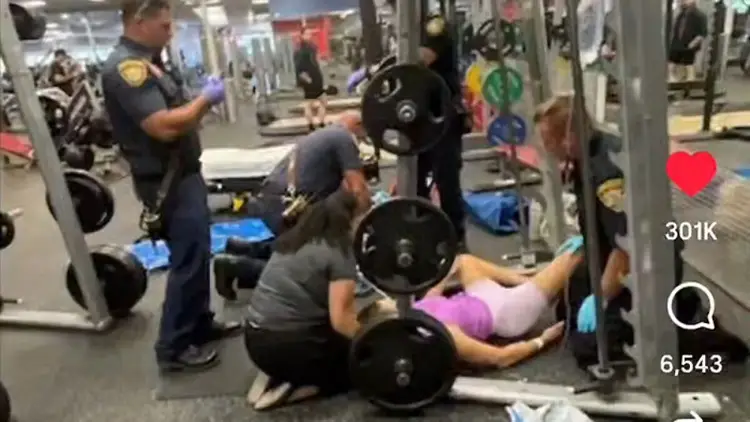
A gym machine, often marketed as a safer, beginner-friendly alternative to traditional weightlifting, has been at the center of accidents with devastating consequences, including spinal fractures and paralysis. The Smith machine is a familiar sight in gyms, helping people tackle squats, presses, and other exercises with a barbell that glides along a fixed track. Its guided movement can make lifting feel less intimidating, but the added sense of security doesn't mean users are immune to serious, potentially life-changing injuries. People have seen their lives completely changed by such accidents, like Sharla Peterson, a bodybuilding competitor left paralyzed from the waist down after suffering a spinal fracture during a Smith machine squat in 2023, and Sophie Butler, a British fitness influencer who suffered a similar fate in 2017. Personal trainer Alex Folacci, who suffered a serious back injury while weightlifting himself, spoke to Bored Panda about what gym-goers need to understand about the machine and how to minimize the risks. ifbbpro_fit_chick_onwheelz/Instagram Sharla Peterson’s life changed in the middle of an ordinary workout. The bodybuilder, who previously competed in five NPC Bikini competitions as a Masters athlete, was visiting her daughter in Utah on July 13, 2023, when the two decided to hit a new gym together. Sharla was preparing to compete at the Ben Weider All Natural 2023 at the time. She was on her fourth set of back squats when she suffered an L1 burst fracture. Part of the fractured vertebra entered her spinal canal, causing instant paralysis from the waist down. “After surgery, I regained movement in my quads but not my glutes, ankles, or toes,” she wrote in an Instagram post. “My story has been out for two years, and during this time I have met several people who have the same injury as mine or similar from doing back squats on the Smith Machine.” ifbbpro_fit_chick_onwheelz/Instagram “5 of us are in wheelchairs. I’m not saying the Smith Machine is bad for everyone, but injuries have happened, including slipped discs and fractures in the spine with spinal cord damage,” she continued. Sharla has managed to turn her life around and has continued exploring her passion for fitness and bodybuilding. The only difference is that she now does it with a wheelchair. British fitness influencer Butler experienced a similarly devastating accident on July 5, 2017. She was performing squats on a Smith machine when she lost her footing, causing the weight to fall on her. The safety latches had not been positioned high enough to catch the bar, which came crashing down onto her back. sophjbutler/Instagram Her attempt at a typical squat had cost her the ability to walk for the rest of her life. “Someone asked me if I could wiggle my toes, and when I couldn’t, I knew it was serious,” she told Metro in 2017. In an account shared with Women's Health, Butler recalled waking up after nine hours of surgery to discover she had been left paralyzed from the waist down. She also described the difficult adjustment that followed, including spending months in hospital and having to make her family home wheelchair-accessible. Despite the injury, Butler eventually returned to the gym and began adapting her workouts. She also decided to pursue a personal training qualification, hoping to help others with spinal injuries return to fitness. ArtPhoto_studio/Magnific (not the real image), ai-assisted image These individual experiences are not the only documented examples of serious injuries associated with the equipment. In August 2018, the U.S. Consumer Product Safety Commission (CPSC) announced a recall of approximately 15,000 Cybex Smith Press machines after the manufacturer received 27 reports of injuries. The models were manufactured during different periods: model 5340 from 1989 to 1993, and model 5341 from 1993 to 2009. According to the CPSC, their weight bars could fall if they were not fully engaged with the latch pins, creating a serious impact hazard. The reported injuries included spinal fractures and paralysis. ifbbpro_fit_chick_onwheelz/Instagram The issue also prompted further scrutiny of the manufacturer, which led to Cybex agreeing to pay a $7.95 million civil penalty in February 2021. At the time, CPSC accused them of not immediately reporting that its Arm Curl and Smith Press Machines contained a defect or created an unreasonable risk of serious injury. The agency specifically noted that the company had received 27 reports of injuries associated with its Smith Press machines but had not immediately notified the regulator. Importantly, this recall concerned specific Cybex models and does not establish that all Smith machines share the same defect. However, it demonstrates how a failure in equipment designed to make weightlifting safer can have catastrophic consequences. Victor Freitas/Pexels (not the real image) Smith machine-specific injury figures are difficult to establish, as there is no comprehensive national database tracking accidents involving individual gym machines. However, broader research offers some insight into the scale of weightlifting-related injuries. A 2010 study published in the American Journal of Sports Medicine examined weight-training injuries treated in US emergency departments between 1990 and 2007. Researchers estimated that nearly 971,000 such injuries occurred nationwide during the 18-year period. So, how much of this risk comes down to the equipment itself, and how much depends on the way people use it? Not every weightlifting accident can be prevented, but proper technique and an understanding of gym equipment can go a long way toward reducing the risks. Personal trainer Alex Folacci weighed in, explaining why Smith machines aren't necessarily as foolproof as they might seem. The internationalist medalist, who has been on the French national team for six years, said his dreams of competing in the Olympics or World Championships in track and field were crushed after breaking his back while weightlifting in 2015. He used a traditional barbell at the time. Courtesy of Alex Folacci The New York based personal trainer believes the Smith machine's reputation as a beginner-friendly alternative to traditional barbells needs some context. He explained that the Smith machine is easier for beginners to use because a traditional barbell squat requires much more practice, technique, stability, and strength. However, its guided movement does not necessarily match everyone's natural squatting mechanics. “The Smith machine is guided, but the bar path is not always completely vertical, at a 90-degree angle to the floor. It is often at a slight angle, which means the machine guides you slightly backward or forward as you squat down, depending on which way you're facing,” he told Bored Panda. Tuti Isnawati/Pexels (not the real image) Another potential hazard is “failing to hook the bar properly after finishing your set,” he added. “If you think you've secured the bar but actually missed the hook, the bar could fall onto you as you try to get out of the Smith machine.” Folacci also emphasized the importance of adjustable safety blocks, which can prevent the bar from descending too far if a lifter cannot complete a repetition. “I always use those with my clients to ensure they can squat deep enough while remaining safe,” he said. The trainer said that personally, he rarely uses Smith machines with his clients unless a traditional barbell isn’t available. He prefers conventional barbells for athletes looking to develop strength, stability, and coordination. However, he does not believe Smith machines are inherently more dangerous than traditional barbell squats. Tima Miroshnichenko/Pexels (not the real image) “I do not believe that Smith machines are more dangerous than a normal barbell squat, and I don't think that more people each year get more injuries squatting on the Smith machine than with a real bar,” he said. “More than 90% of accidents and injuries in the gym could be avoided if people were less negligent and didn't take unnecessary risks,” he continued. Folacci shared three precautions for gym-goers to minimize their risk of injury, and on top of the list was: “Always make sure you hook the bar properly when you finish your set.” “Before releasing your hands or stepping away, make sure the bar is securely locked in place,” he said. driveby71677835 The second precaution was: “Always use the safety blocks.” “Position the safety blocks somewhere just below the bottom of your squat position,” he said. This way, if one struggles to push the weight back up, the blocks will prevent the bar from going any lower and potentially causing a serious injury, he explained. Third on his list of precautions was: “Don't go too heavy, and pay attention to your foot positioning.” greghunkins Beginners should avoid attempting maximum lifts, particularly without supervision. Folacci also stressed the importance of finding a comfortable, consistent foot position that allows the movement to be performed with proper technique. “You should always have a consistent starting position where you feel completely comfortable going all the way down to the bottom of your range of motion,” he said. “Before increasing the weight, make sure you can perform the movement comfortably and with proper technique,” he added. Howlingmutant0 alegretron d4vidBR sinancialtimes JohnnyTwoDucks joeybodybuilder flores_hil73420 bufffakecel AnthonyVil48911 FinalWhistlTalk