



Putting together a Jigsaw puzzle can be delightfully frustrating and Vancouver-based artist Tim Klein wants to add in some extra puzzle pieces. Yes, Klein practices the obscure art of 'puzzle montage,' taking pieces from various jigsaw puzzle sets and re-arranging them to form interesting photos and stunning images.
This puzzle photo montage practitioner said he was inspired by a 1988 magazine article he read on, whom he credits as, the 'pioneer' of the unique art form, Mel Andringa.
So how does it work? "Jigsaw puzzle companies tend to use the same cut patterns for multiple puzzles. This makes the pieces interchangeable. As a result, I sometimes find that I can combine portions from two or more cool puzzles to make a surreal picture that the publisher never imagined," explained Klein.
While for some this sounds like an impossibly hard puzzle to solve, for this artist it is an adventure: "I take great pleasure in “discovering” such bizarre images lying latent, sometimes for decades, within the pieces of ordinary mass-produced puzzles. As I shift the pieces back and forth, trying different combinations, I feel like an archaeologist unearthing a hidden artifact."
Scroll down below to see some of Klein's masterful puzzle montage art!
#21 A Modest Proposal For The Increase Of Attendance At Classical Music Concerts
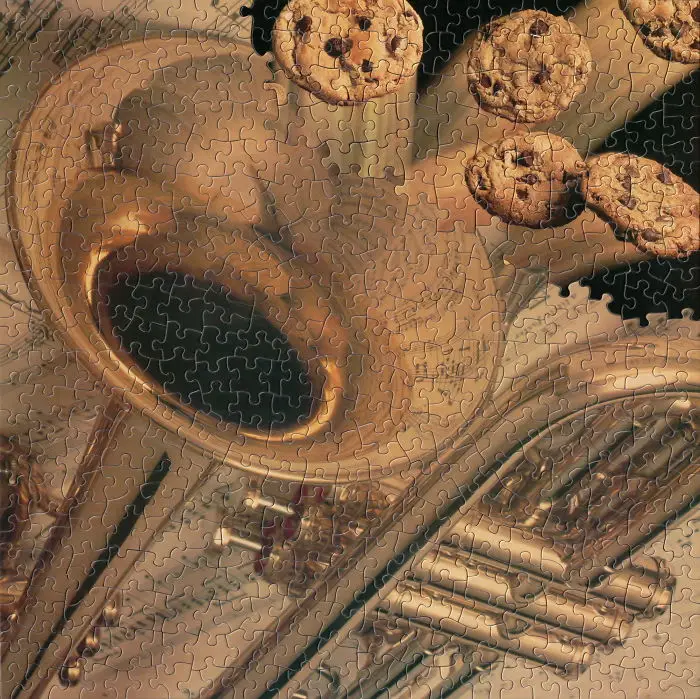
"Made from two Springbok puzzles from the 1980s, one showing a horn and one showing cookies magically flying out of a cookie jar."
Report
30points
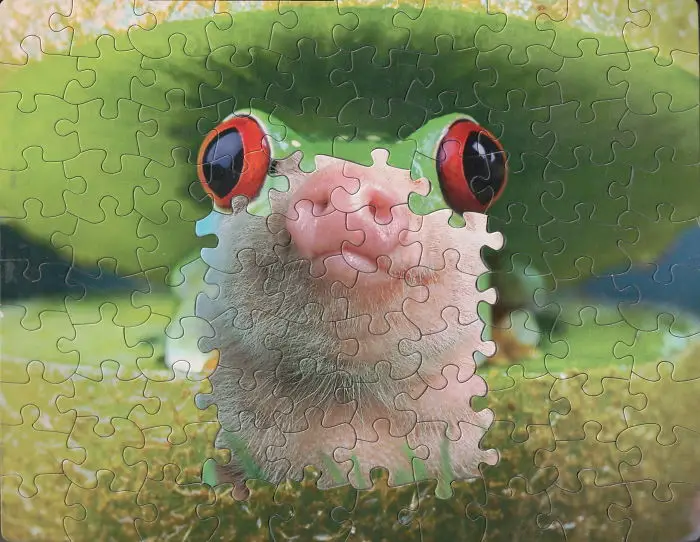
#23 Metamorphosis (Enlightenment)
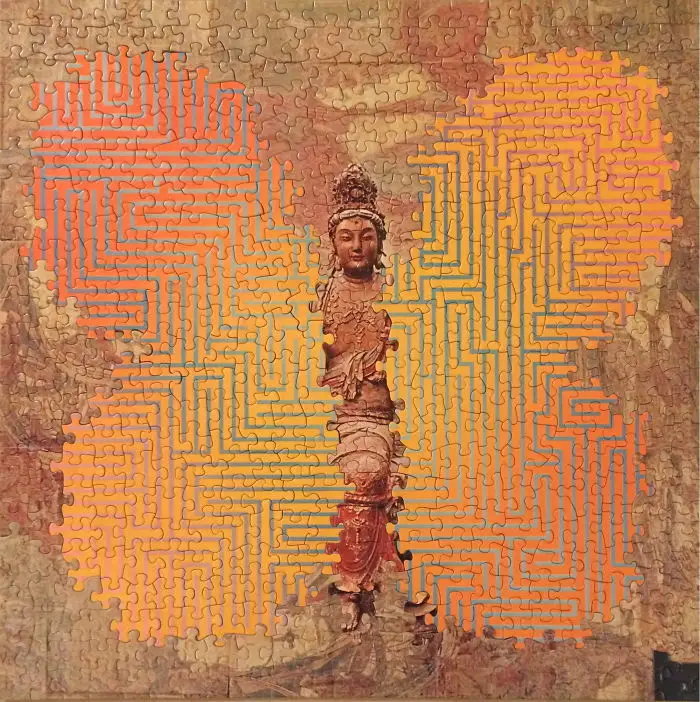
"I made this montage out of three square Springbok puzzles published in the early 1970s. One of the puzzles showed a maze. The others were two copies of the same puzzle, showing a large ancient Chinese statue of a bodhisattva named Kuan-Yin. (I'm told that a bodhisattva is loosely the Buddhist equivalent of a saint.)
In the original image, the statue rests on a dark rocky pedestal visible all along the bottom edge of the puzzle. I found that although my two copies of the Kuan-Yin puzzle shared the same cut pattern, they had been run through the die cutting machine at right angles to each other. This enabled me to eliminate the pedestal from the image by replacing one Kuan-Yin puzzle's bottom edge with pieces from the left-hand edge of the other Kuan-Yin puzzle! Then, by swapping in pieces from the maze puzzle, I gave Kuan-Yin some butterfly wings. The subtitle "Enlightenment" refers not only to the Buddhist principle of enlightenment, but also to the fact that I've "lightened" a big heavy statue and given her flight."
Report
29points
#24 Were-Rabbit
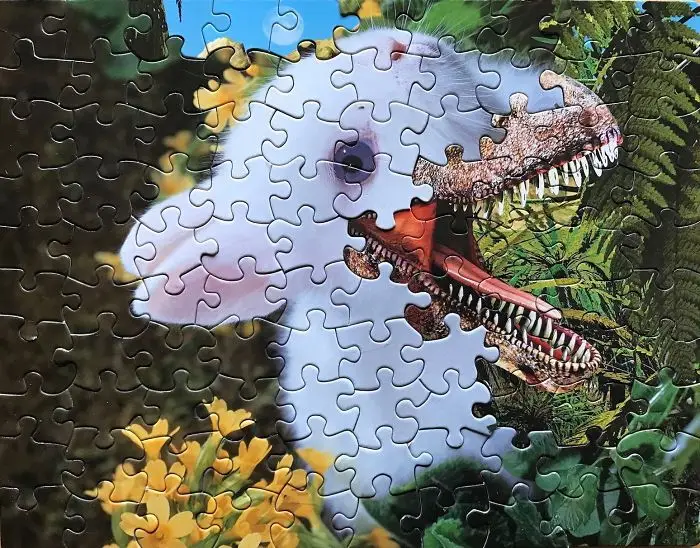
"Made from the pieces of two small Puzzlebug brand puzzles, one showing a bunny and one showing a dinosaur under a full moon"
Report
26points
#25 The Last Night, By Leonardo Da Vincent
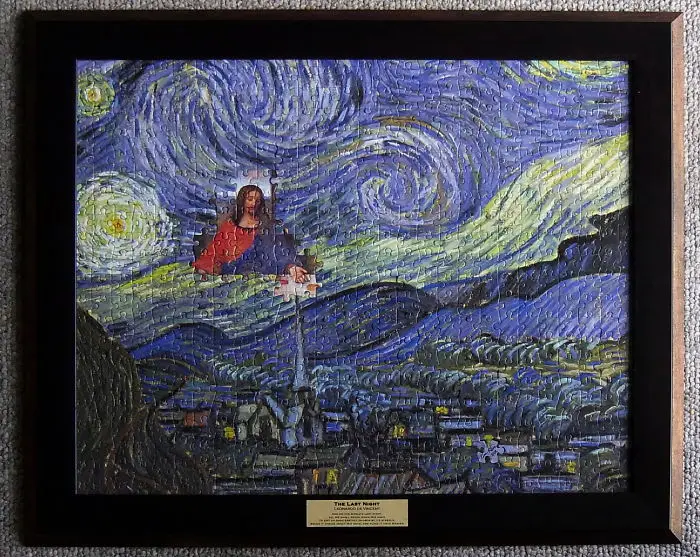
"Made from two puzzles published by Buffalo Games, one showing The Last Supper by Leonardo da Vinci, and one showing Starry Night by Vincent Van Gogh. The title is an amalgam of the two original paintings' titles and the names of the two artists. I normally prefer to float-mount my puzzle artworks rather than frame them, but in this case I needed a frame so I could attach a plaque with a caption in very tiny lettering"
Report
25points
#26 Convergence And Emergence (Shall We Dance?)
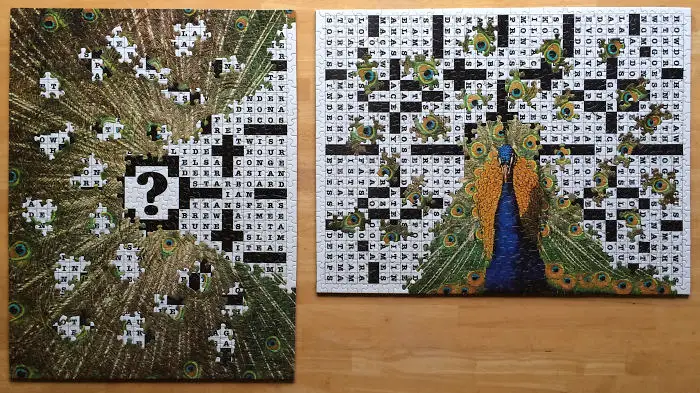
"A diptych made from two Springbok puzzles published in the early 1980s: one showing a peacock, and one showing the solution to a crossword puzzle with a “questions” theme. (The jigsaw puzzle came with a blank crossword puzzle on the box. Solving the crossword would help you complete the jigsaw, and vice versa.) The two halves of the diptych are inverses, each one using all the pieces not used in the other. Click the image above to see more detail.
The subtitle Shall We Dance? is taken from one of the crossword answers appearing in the right half, coupled with the question mark from the left half.
Each half has its own title. Left: Convergence (Neologism). Right: Emergence (The Words Made Flesh).
This made its debut at Gallery 360 in Vancouver, Washington, as part of an exhibit called “Opposites Attract”. Artists were invited to submit works depicting opposing forces in the world."
Report
24points
#27 Sphinx
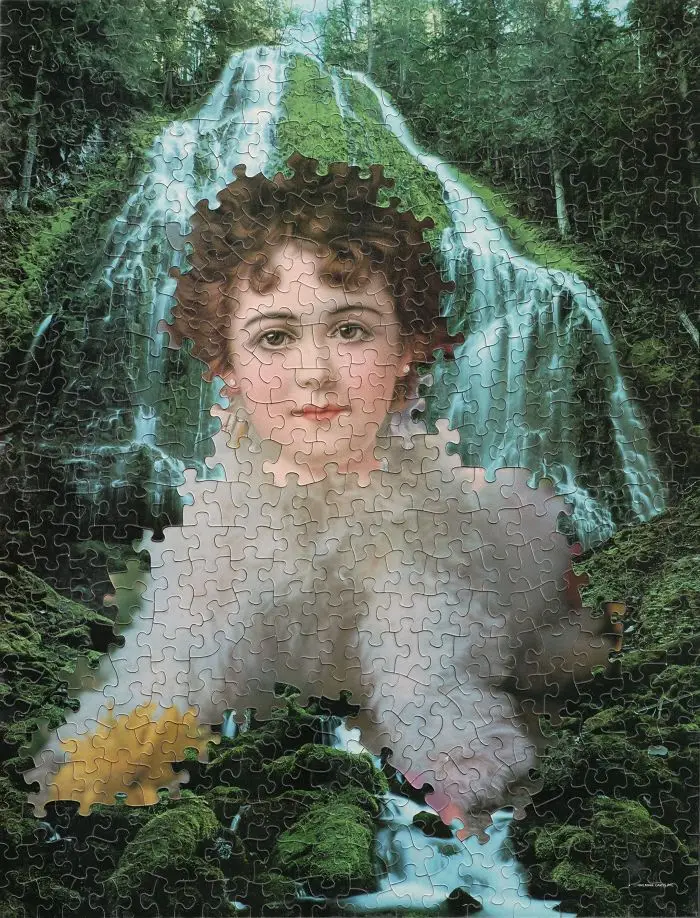
"Made from three Springbok puzzles published in the late 1970s and early 1980s: one showing a waterfall, one showing a puppy, and one showing a late 19th century Coca-Cola advertisement."
Report
24points
#28 Timekeeper
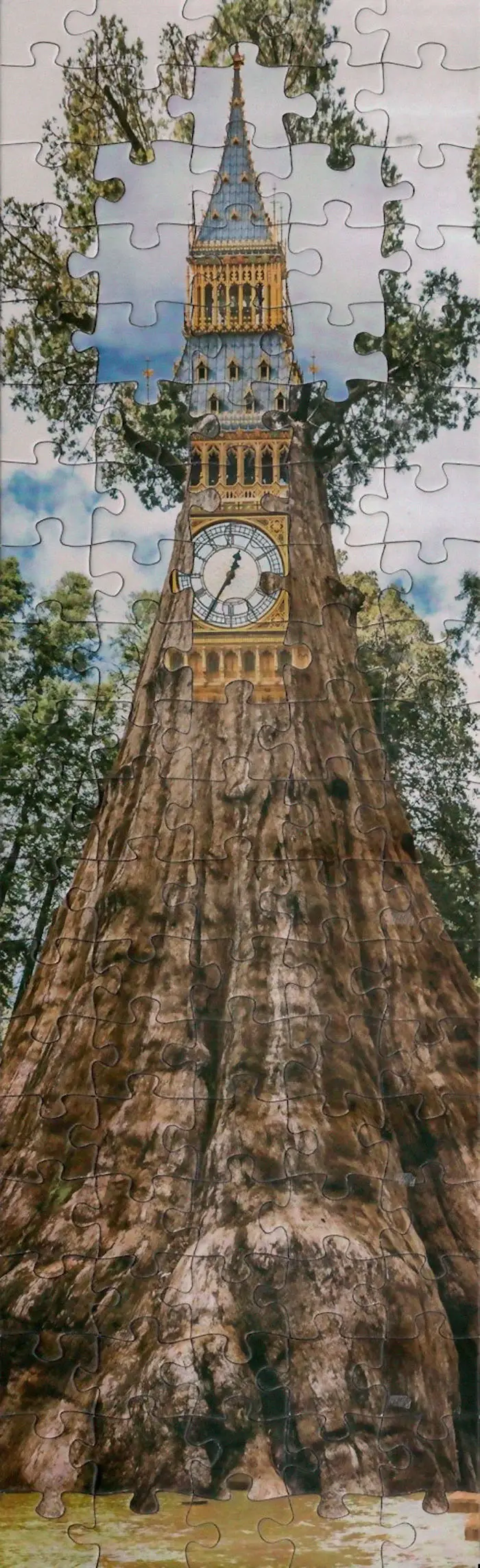
"Made from two small puzzles in a series called Tower Puzzles, published by Greenbrier International."
Report
20points
#29 Prey
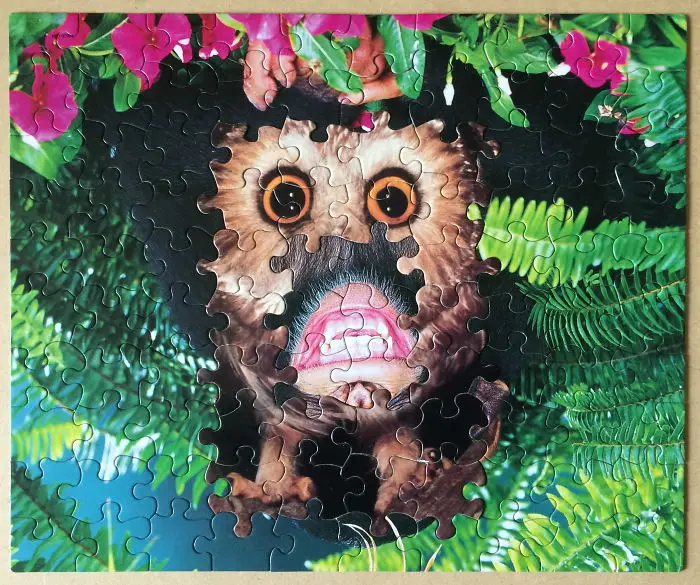
"Made from two Milton Bradley puzzles that had the same cut pattern, but had been run through the cutting machine rotated 180 degrees with respect to each other.
This piece made its debut at Gallery 360 in Vancouver, Washington, as part of an exhibit called “Show Some Emotion”. Most of the other artists' works depicted lovers holding hands, children playing with puppies, etc. And then there was this one. I was the only artist who chose to represent the emotion “mortal terror”."
Report
18points
#30 Mirage
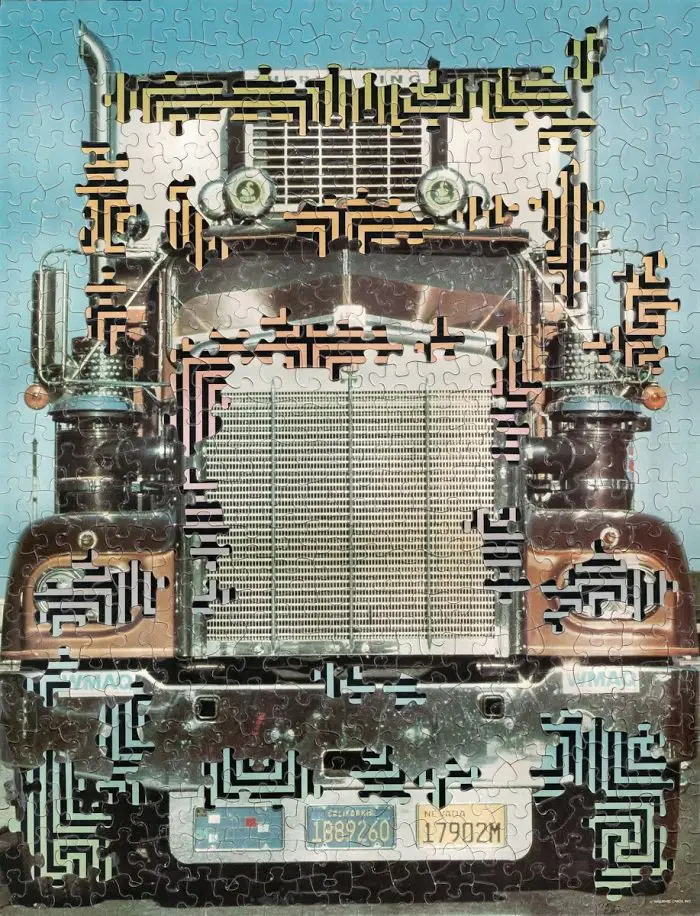
"Made from two Springbok puzzles from the 1970s, one showing a truck and one showing a maze"
Report
16points
#31 Washington
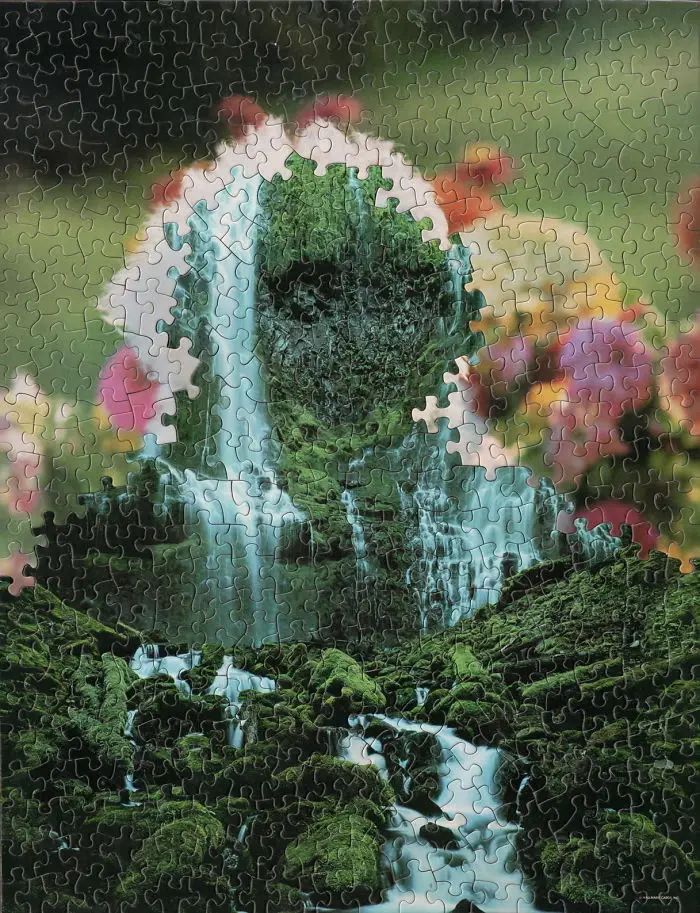
"A tribute to my mossy-rocked home state, and the man for whom it's named. Made from two Springbok puzzles from 1979, one showing a Pacific Northwest waterfall, and one showing a fuzzy white puppy whose head happened to be shaped like a certain famous powdered wig."
Report
12points
#33 Pareidolia
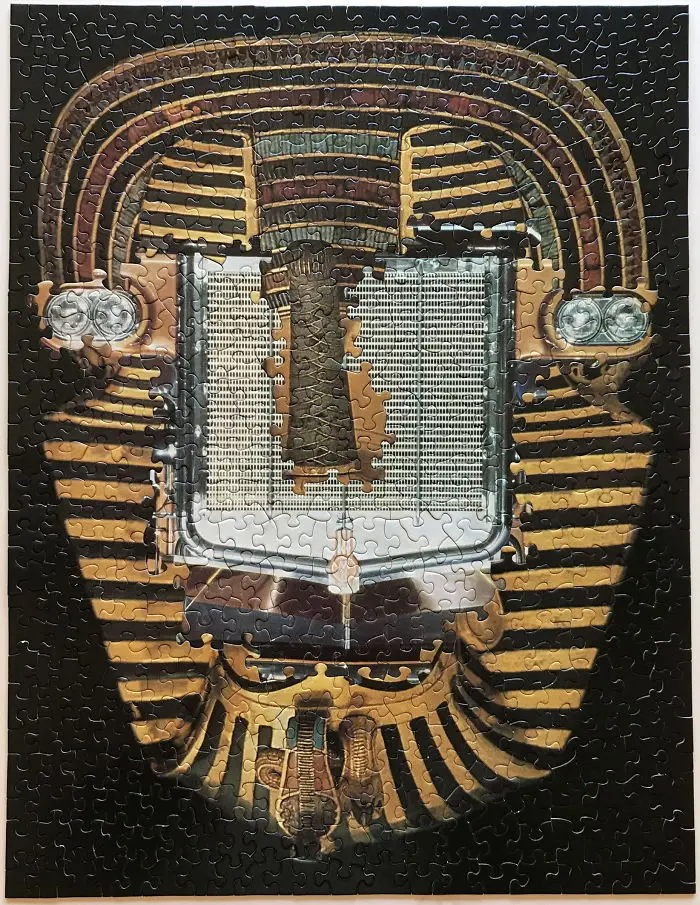
"I constructed this montage from the same two 1970s Springbok puzzles that I used in King of the Road, one showing the burial mask of King Tutankhamun, and the other showing a truck.
The title Pareidolia is a wonderful word that refers to the psychological phenomenon of perceiving faces or other patterns where there are none."
Report
9points