




Although we have always been fascinated with the workings of the mind and the reasons behind human behavior, it wasn’t until the beginning of the 20th century that experiments in psychology took off.
Encompassing a range of areas, from anthropological studies to social behavior and the complex biological processes occurring in the brain, the carefully controlled studies carried out in the name of experimental psychology have taught us so much about the human condition and given us a deeper understanding of why we act the way that we do.
Bored Panda has compiled a list of some of the most famous and thought-provoking psychology experiments that have been carried out in the last century. From simple social experiments to complex behavioral patterns that expose the workings of the subconscious and push the boundaries of ethics, these weird and wonderful psychological experiments are sure to make you think twice about what you know about yourself as a human being. Maybe we are all just a little less in control of ourselves than we really think… Check out the list below, and don’t forget to vote for your favorite psychology study!
#21 The Facebook Experiment

In 2012 Facebook conducted a massive experiment on its users, unbeknownst to them. The social media giant manipulated the news feeds of 689,003 people for one week, prioritizing either positive or negative emotional content. They then tracked the updates that the unwitting users posted, to see if they had been influenced by the manipulated feeds.
What they found was that they could essentially make their users feel happier or sadder, in a process called ‘emotional contagion’. The study concluded by saying: "Emotions expressed by friends, via online social networks, influence our own moods, constituting, to our knowledge, the first experimental evidence for massive-scale emotional contagion via social networks."
While completely legal, we all sign up for Facebook voluntarily after all, the ethics of such mass manipulation are questionable. "People are supposed to be told they are going to be participants in research and then agree to it and have the option not to agree to it without penalty." One academic said in response to the controversial experiment.
The power that social media networks are beginning to exert over our lives is of increasing concern. Do you trust Facebook to look after your best interests? Or are you leaving yourself open to emotional manipulation for the benefit of advertisers? The study, while controversial, has opened a deeper discussion about online ethics and privacy, which can only be a good thing. (Source: Forbes)
Report
30points
#22 Cognitive Dissonance Experiment

The Cognitive Dissonance Experiment is based on the theory that people hold many different cognitions about their world, for example about their environment and their personalities. In an event wherein some of these cognitions clash, an unsettled state of tension occurs and this is called cognitive dissonance.
In 1959 Leon Festinger conducted an experiment where participants were asked to perform a series of painstakingly boring tasks, such as pointlessly turning pegs in a peg board for an hour. Participants responses toward the task were highly negative. They were then paid either $1 or $20 to tell a participant waiting in the lobby that the tasks were really interesting.
When the participants were later asked to evaluate the experiment, the participants who were paid only $1 to lie to the waiting participants rated the tedious task as more fun and enjoyable than the participants who were paid $20 to lie.
It seems that being paid only $1 is not a sufficient incentive for lying, and so those who were paid $1 experienced dissonance. They could only overcome that dissonance by coming to believe that the tasks really were interesting and enjoyable. Being paid $20 provides a reason for turning pegs and there is therefore no dissonance. Therefore people, when persuaded to lie without being given enough justification, will convince themselves of the falsehood, rather than telling a lie. (Source: Explorable)
24points
#23 Surrogate Mother Experiment
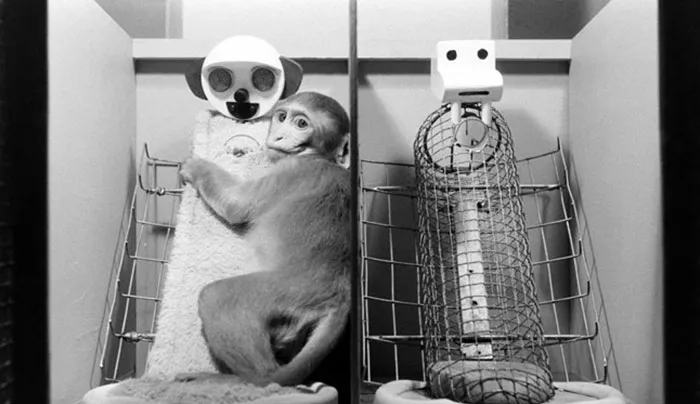
Harry Harlow, during the late 1950s and early 1960s, wanted to study the importance of a mother’s love for healthy childhood development. In order to do so he conducted a series of experiments on rhesus monkeys, observing how isolation and separation can affect the subjects in the latter years of their lives. Harlow’s Monkey experiment ultimately reinforced the importance of mother-and-child bonding.
Harlow separated infant monkeys from their biological mothers within 6 to 12 hours after being born. He then placed these infants in a nursery with inanimate ‘surrogate’ mothers – one who is made of heavy wire mesh and the other made of wood that was covered in soft cloth. Both surrogates were of the same size; however the wire mesh mother did not have any soft surface, while the cloth mother was soft to the touch and appeared to be cuddly.
In the first experiment, both the surrogates were placed with the infant monkeys, so the infants would have a ‘choice’ where to go. Both surrogates are able to provide nourishment to the infants. In the second experiment, the infant monkeys were divided into two groups (wire mesh or terry cloth), and the infants had no choice which one they would go to.
After observing the infant monkeys over time, it was found that even though the infants received nourishment from the wire mesh mother, they still spent more time cuddling and being affectionate with the terry cloth mother. This shows that the bond between mother and infant was not solely based on whether the former is able to give the latter’s physiological needs.
Furthermore, the results of the second experiment showed that while the infants from both groups consumed the same amount of milk from their mother, the infants who grew up with the terry cloth mother exhibited emotional attachment and what is considered as normal behaviour when presented with stressful variables. Whenever they felt threatened, they would come close to the terry cloth mother and cuddle with it until the monkeys were calm.
The results for the wire mesh mother were the opposite. They reacted rather differently with the same stimulus – throwing themselves on the floor, rocking back and forth, and evidently did not go to the wire mesh mother for comfort.
(Source: The Psychology Notes HQ)
Report
24points
#24 “Lost In The Mall” Experiment

The "Lost in the Mall" experiment is a memory implantation technique used to demonstrate that confabulations about events that never took place – such as having been lost in a shopping mall as a child – can be created through suggestions made to experimental subjects. It was first developed by Jim Coan, an undergraduate student of psychologist Elizabeth Loftus as support for the claim that it is possible to implant entirely false memories in people. The technique was developed in the context of the debate about the existence of repressed memories and false memories.
Coan enlisted his mother, sister and brother as subjects. He assembled booklets containing four short narratives describing childhood events, and instructed them to try to remember as much as possible about each of the four events, and to write down those details over the course of six days. Unbeknown to the participants, one of the narratives was false; it described Coan's brother getting lost in a shopping mall at around the age of 5, then being rescued by an elderly person and reunited with his family. During the experiment, Coan's brother unwittingly invented several additional details of the false narrative. At the conclusion of the experiment—during a tape-recorded debriefing—when told that one of the narratives was false, Coan's brother could not identify which one and expressed disbelief when told.
Loftus calls this study "existence proof" for the phenomenon of false memory creation and suggests that the false memory is formed as a result of the suggested event (being lost in a mall) being incorporated into already existing memories of going to the mall. With the passage of time it becomes harder for people to differentiate between what actually happened and what was imagined and they make memory errors.
(Source: Wikipedia)
24points
#25 Stanford Prison Experiment

The Stanford prison experiment was an attempt to investigate the psychological effects of perceived power, focusing on the struggle between prisoners and prison officers. It was conducted at Stanford University in 1971, by a research group led by psychology professor Philip Zimbardo and using college students as subjects.
Zimbardo aimed to test the hypothesis that the inherent personality traits of prisoners and guards are the chief cause of abusive behaviour in prison. Participants were randomly assigned to either the role of prisoner or guard, simulating a prison environment. Prisoners were treated like every other criminal. When they arrived at the prison they were stripped naked, deloused, had all their personal possessions removed and locked away, and were given prison clothes and bedding. They were issued a uniform, and referred to by their number only. The use of ID numbers was a way to make prisoners feel anonymous.
Within hours of beginning the experiment those who were assigned as guards began to harass the prisoners. The prisoners were taunted with insults, given pointless and boring tasks to accomplish, and they were generally dehumanised. In less than a week some of the guards had become sadistic, escalating their abuse of prisoners as the days passed. The prisoners had broken down emotionally and physically.
The results of the study concluded that people conform to the social roles they are expected to play, especially if the roles are as strongly stereotyped as those of the prison guards. It seemed that it was the situation, and not their individual personalities, that had caused the guards brutal and sadistic behaviour. None of the participants who had become guards had shown signs of sadistic personality types before the beginning of the study.
(Source: Wikipedia)
Report
23points
#26 Learned Helplessness Experiment

The concept of “learned helplessness” was investigated by Martin Seligman in 1965. The discovery of this concept was accidental and it occurred during a series of studies about negative reinforcement.
The studies were conducted on dogs and was an attempt to expand on the research of Pavlov – he who made dogs salivate when they heard a bell ring. Seligman wanted to head in the other direction, when he rang his bell instead of providing food, he shocked them lightly with electricity. To keep them still, he restrained them in a harness during the experiment.
After they were conditioned, he put these dogs in a big box with a little fence dividing it into two halves. It was hypothesized that if he rang the bell, the dog would hop over the fence to escape, but it didn’t. It just sat there and braced itself. He decided to try shocking them after ringing the bell, but the dog still just sat there and took it. When they put a dog in the box which had never been shocked before and tried to shock it – it jumped the fence immediately.
As the dogs had learned from the first part of the experiment that there was nothing they could do to avoid the shocks, they gave up and lay there resigned to their fate in the second part of the experiment. This condition is described as learned helplessness, where a human or animal does not attempt to get out of a negative situation because the past has taught them that they are helpless. (Source: You Are Not So Smart)
Report
18points
#27 Little Albert Experiment
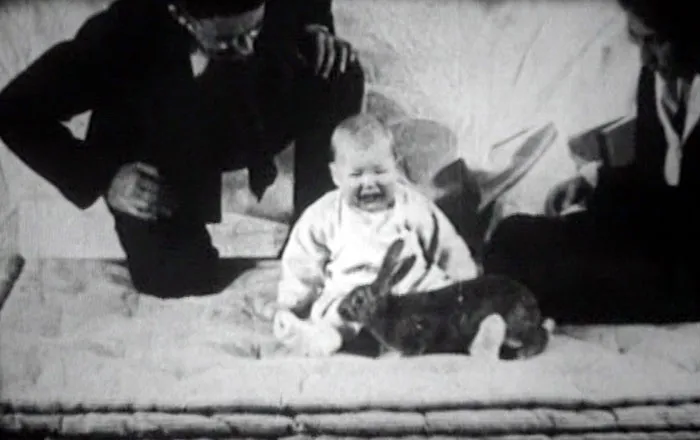
This controversial experiment was conducted in 1920 by John Watson and Rosalie Rayner at Johns Hopkins University. A one-year-old baby called Albert was put on a mattress on a table in the middle of a room. A white laboratory rat was placed near Albert and he was allowed to play with it. At this point the experimenters made a loud sound behind Albert's back by striking a suspended steel bar with a hammer each time the baby touched the rat. Albert responded to the noise by crying and showing fear. After several such pairings of the two stimuli, Albert was presented with only the rat. Upon seeing the rat, Albert got very distressed, crying and crawling away. Apparently, the infant associated the white rat with the noise. The rat, originally a neutral stimulus, had become a conditioned stimulus, and it was eliciting an emotional response (conditioned response) similar to the distress (unconditioned response) originally given to the noise (unconditioned stimulus).
In further experiments, Little Albert seemed to generalize his response to the white rat. He became distressed at the sight of several other furry objects, such as a rabbit, a furry dog, and a seal-skin coat, and even a Santa Claus mask with white cotton balls in the beard.
The experiment had many failings by modern standards. For example, it had only a single subject and no control subjects. Furthermore, such an experiment could be hard to conduct in compliance with current law and regulations, it is now generally considered to be one of the more unethical psychological experiments conducted throughout the years.
(Source: Wikipedia)
18points
#28 Pavlov’s Dog Experiment
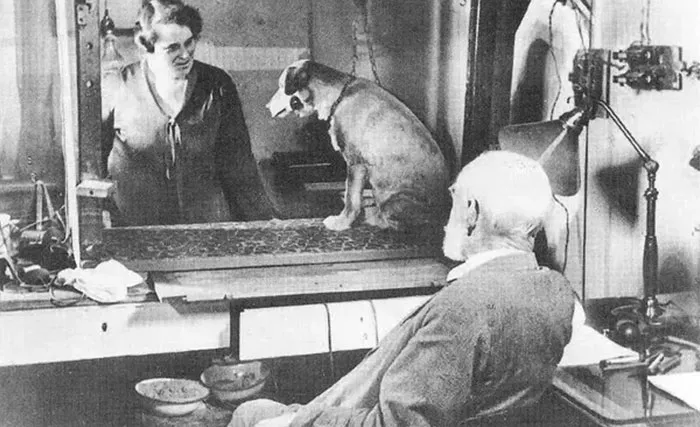
While Ivan Pavlov worked to unveil the secrets of the digestive system, he also studied what signals triggered related phenomena, such as the secretion of saliva. When a dog encounters food, saliva starts to pour from the salivary glands located in the back of its oral cavity. This saliva is needed in order to make the food easier to swallow, and also contains enzymes that break down certain compounds in the food.
Pavlov became interested in studying reflexes when he saw that the dogs drooled without the proper stimulus. Although no food was in sight, their saliva still dribbled. It turned out that the dogs were reacting to lab coats. Every time the dogs were served food, the person who served the food was wearing a lab coat. Therefore, the dogs reacted as if food was on its way whenever they saw a lab coat.
In a series of experiments, Pavlov then tried to figure out how these phenomena were linked. For example, he struck a bell when the dogs were fed. If the bell was sounded in close association with their meal, the dogs learnt to associate the sound of the bell with food. After a while, at the mere sound of the bell, they responded by drooling. The dogs had learned to associate the bell and the food and this learning created a new behaviour.
Pavlov's discovery was that environmental events that previously had no relation to a given reflex (such as a bell sound) could, through experience, trigger a reflex (salivation). This kind of learnt response is called conditioned reflex, and the process whereby dogs or humans learn to connect a stimulus to a reflex is called conditioning. (Source: Nobelprize.org)
Report
15points
