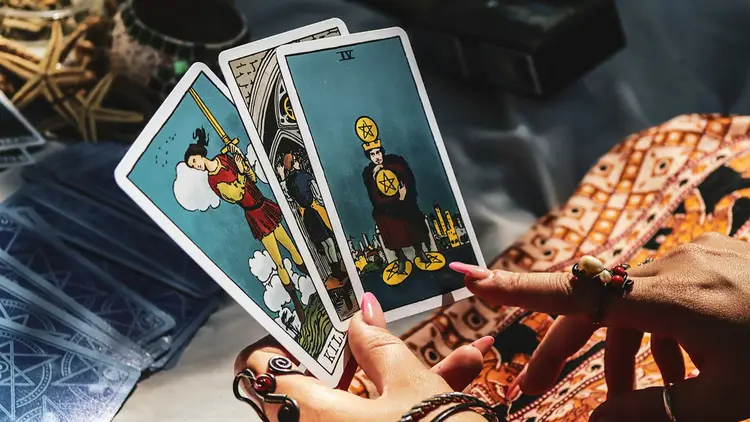
“Come closer. I’ve been looking forward to this question,” Vesper tells me when I ask whether good luck is coming my way. She shuffles her tarot deck, turns over five cards, and predicts that a favorable change may be approaching. Vesper calls herself the “Keeper of possibilities. Interpreter of signs. A friend to the unknown.” But she isn’t a human psychic. In fact, she doesn’t exist at all. She’s a character ChatGPT created after I asked it to become my personal fortune teller, complete with its own name and personality. And she’s far from the only AI psychic out there. From tarot-reading apps to virtual clairvoyants offering personal consultations, artificial intelligence is finding its way into an industry traditionally reserved for human intuition and spiritual connections. But how convincing are these digital fortune tellers, and what are people actually getting from them? To find out, I tested AI fortune-telling services myself and spoke with professional psychics, tarot readers, and AI experts about the technology behind them and whether they can offer anything meaningful. Alex Shuper / Unsplash (not the actual photo) Last month, The Guardian’s technology reporter Kari Paul wrote about the growing popularity of AI-generated psychic readings, and it inspired me to do some research of my own. With AI seemingly making its way into just about every profession, from software development and customer service to medical diagnostics, it’s no wonder people are concerned about which jobs it might take over next. But at first glance, fortune telling seems like an unusual candidate. After all, psychics, mediums, and tarot readers have traditionally relied on something machines aren’t exactly known for: intuition. Yet there’s already a surprisingly wide selection of AI-powered fortune-telling services out there. Take Faladdin, a Turkish app offering tarot readings and coffee-cup fortune telling. It has surpassed 10 million downloads on Google Play alone. Users can enjoy up to 10 free readings a day in exchange for watching ads, or pay around $12 a month for a subscription to skip them. Meanwhile, Quin, an AI tarot-reading app, offers personalized readings for $2.99 each or through a $12.99 monthly subscription. Dedicated apps aren’t the only option. As my conversation with Vesper shows, anyone can ask a general-purpose chatbot like ChatGPT, Claude, or Gemini to play the part of a personal psychic. In my case, I gave ChatGPT the freedom to invent its own identity and approach to readings, and within moments, I had a virtual fortune teller ready to answer all sorts of personal questions. Unlike many psychic services, these chatbots don’t necessarily come with a price tag. ChatGPT, Claude, and Gemini all offer free versions, although usage limits apply. For example, a paid ChatGPT Plus subscription costs $20 a month, giving you more room to spend hours questioning your virtual psychic about love, luck, and whatever else the universe has in store. According to Liz Martinez, a professional psychic, medium, and tarot reader, the appeal of these services isn’t difficult to understand. “A lot of people are in need of quick answers to quiet their anxiety about a situation they’re dealing with,” she told Bored Panda. “AI appears to be a fast, free way to get answers.” Meanwhile, Etsy, the online marketplace usually associated with handmade goods and vintage finds, has become something of a destination for people looking for an online witch. TikTok users have shared stories of hiring witches to cast spells for all sorts of reasons, from landing a job to getting sunny weather on their wedding day. But a quick browse through the listings reveals images that look suspiciously AI-generated. Some customers have also complained in reviews that the psychic readings they purchased seemed to have been written by chatbots. Of course, an AI-generated image doesn’t prove that the service itself involves AI, but it’s certainly worth considering what buyers are actually paying for. ai-generated image With so many options available, I decided to give AI fortune telling a try. I started with Vesper, the psychic I created using ChatGPT. I was particularly curious to see what would happen if I gave the chatbot very little personal information, rather than tailoring its personality and readings to my preferences. After I asked ChatGPT to become my personal psychic and choose its own identity, it introduced itself as Vesper. “I chose my name because Vesper belongs to the evening, that peculiar hour when daylight fades and the ordinary world begins to feel a little less certain,” she explained. Vesper settled into her role, calling me “darling” and speaking in a rather mysterious tone. When I asked her to show me what she looked like, she generated an image of a dark-haired woman surrounded by just about every mystical cliché imaginable. There were tarot cards, a crystal ball, candles, old books, and crystals, with a full moon shining through the window. “There I am, darling,” she announced. “I do hope you like candlelight. I find that secrets are much more willing to reveal themselves after dark.” I asked a fairly general question: “Is good luck coming my way soon, and what areas of my life will it affect the most?” Vesper chose a five-card tarot spread and confidently predicted that favorable changes were approaching, particularly in my career and finances. She also suggested that good fortune might come through my relationships and that the next four to eight weeks could bring promising developments. As expected, Vesper’s reading was overwhelmingly positive. She basically told me everything I wanted to hear, predicting pleasant surprises and promising opportunities ahead. Even the card that was meant to warn me about potential obstacles came with a reassuring message about believing in myself and being open to new possibilities. According to Harsha Gaddipati, founder and CEO of Slashy, that’s exactly what AI chatbots are designed to do. “Models are trained to be agreeable, so in personal-advice contexts they validate rather than challenge,” he said. Overall, the vague predictions were entertaining to a certain extent, but I didn’t find anything particularly special about them. After a while, the reading started to feel repetitive, and I found myself getting a little bored. CHATAROT. AI Then, I came across a website called Chatarot. AI, which offered a slightly different experience. Rather than chatting freely with a virtual psychic, I could ask a question and select three random tarot cards for a free reading. After the digital equivalent of shuffling a real deck, the cards appeared in a globe-shaped animation. As they moved around, I could select three at random. An AI reader named Selene Noir then interpreted them in relation to my question. I asked exactly the same thing I’d asked Vesper, only this time, the response was packed with metaphors and flowery language. Much like a lot of AI-generated prose, it sounded deep and impressive at first, but the more I thought about it, the less it seemed to mean anything at all. “The luck you’re asking about doesn’t arrive like weather. It arrives like a boat reaching shore after a long crossing,” Selene said. When you actually stop to think about that sentence, what does it even mean? The comparison doesn’t make much sense. It seems to imply that weather arrives suddenly, while a boat approaches shore slowly. However, weather can change gradually, and boats can arrive quickly, so the contrast feels rather forced. The metaphor sounds profound until you try to figure out what it’s actually saying. Selene continued: “That’s the Six of Swords in your past—the ferryman poling away from rough water, a woman and child huddled under a cloak, swords standing upright in the bow like things you carried but didn’t fight with. Something in you has already done the hard leaving. You’ve been in transit, and transit is exhausting in a way that doesn’t look dramatic from outside.” This statement was full of elaborate language and symbolism, along with generic remarks about having been through difficult times. Haven’t we all? “AI can spit out words that sound good, but it is vague,” said Martinez. As reassuring as Selene’s reading was, it offered little that was actually specific to my life. Philip Oroni / Unsplash (not the actual photo) Of course, neither Vesper nor Selene had any special knowledge of my future. Instead, their readings relied on the same technology that powers many everyday AI chatbots: large language models, or LLMs. Put simply, an LLM is a type of artificial intelligence trained on enormous amounts of text to recognize patterns in language. When someone asks it a question, it generates a response by predicting which words, or more precisely, pieces of words called tokens, are likely to come next. This allows it to produce remarkably natural conversations. I noticed that AI psychics seem particularly fond of candlelight, darkness, and nighttime. Psychics are associated with mystery. And what is mystery? Essentially, being kept in the dark. From there, it’s only a small leap to literal darkness, and suddenly, you’ve got a mysterious fortune teller surrounded by candles. As Rich Pleeth, co-founder and CEO of Finmile, explained, turning one of these models into a virtual psychic doesn’t necessarily require anything particularly complicated. “For a chatbot-style psychic service, a developer can give a language model instructions to act as a tarot reader, then supply the cards and the customer’s question. The model generates a reading from that context and patterns learned during training.” There’s also plenty of existing material about fortune telling for these models to learn from. “Tarot and astrology have centuries of written material behind them, so the model has absorbed the vocabulary and style completely,” Arizona-based independent AI researcher Dr. K. Mithra told Bored Panda. dilara irem sancar / Unsplash (not the actual photo) There are several reasons people might choose an AI psychic over a human one. For starters, they’re generally cheaper, available around the clock, and can be tailored to individual preferences. While a consultation with a professional psychic usually requires booking an appointment and paying for their time, an AI chatbot can generate a reading almost instantly, sometimes without charging anything. This quick access is particularly appealing when someone is worried about a personal situation. According to Carla, a professional medium known as The 413 Medium, people turning to AI psychic services may be seeking connection and validation during difficult periods. And, as we know, AI chatbots are particularly good at offering reassurance, even when it might not be justified. A 2026 study published in Science found that 11 leading AI models affirmed users’ actions 49% more frequently than human respondents, including in situations involving questionable behavior. Participants also tended to trust and prefer the more agreeable chatbots, regardless of whether their advice was actually helpful. A reading doesn’t necessarily have to offer anything concrete to feel personal, either. This can be explained by the Barnum effect, our tendency to recognize ourselves in vague statements that could apply to almost anyone. Social psychologist Bo Bennett, founder and CEO of Archieboy Holdings and creator of the AI platform PrivateChief, pointed out that horoscopes and similar readings frequently rely on this technique, and AI is perfectly capable of producing the same kinds of descriptions. AI services also offer a degree of anonymity. “Many people are too embarrassed to interact with a human psychic, but are comfortable protected by the anonymity an online service can provide,” Bennett said. He argues AI could become serious competition for human psychics. After all, people are already turning to chatbots for companionship and spiritual guidance. “’AI Jesus’ and similar religious services are becoming even more popular with each AI intelligence update. Even human relationships face AI competition via AI girlfriends and boyfriends,” he pointed out. cottonbro studio / Pexels (not the actual photo) Despite the accessibility of AI fortune tellers, the human psychics I spoke with weren’t particularly concerned about being replaced. They believe these digital readings lack a genuine spiritual connection that technology cannot replicate. Martinez, for instance, explained that her clients seek her services because they believe she can communicate with deceased loved ones and spirit guides. In her view, a chatbot simply doesn’t have those abilities. “There is nothing spiritual about it. It cannot commune with loved ones who have crossed over nor bring forward messages from the spirit guides,” she told Bored Panda. As far as Martinez is concerned, AI isn’t competition for her services. Carla, the 413 Medium, shared a similar opinion. “Energy work can’t be replaced by a bot. True evidential readings can’t be generated by an algorithm,” she said. Carla believes that connecting with a person’s energy is central to her work, whereas AI simply processes information. Neither practitioner reported losing clients to AI psychic services. Martinez said her clients continue to value the personal nature of her readings, and Carla noted that the rise of AI psychics hadn’t affected her business at all. In fact, she hadn’t even heard the subject discussed among her clients or fellow practitioners. However, Carla does use AI for a more practical purpose. She offers clients the option to record their sessions on Zoom and receive an AI-generated summary afterward. This means they can concentrate on the reading instead of trying to write everything down. Although Carla was initially hesitant about introducing the feature, she said her clients have found it helpful. She’s not the only practitioner willing to use AI as an assistant. Certified Hellenistic astrologer Yvette Rose told Bored Panda that she uses it for the technical side of her astrology work, such as calculating planetary positions and identifying relationships between them. However, she still interprets every chart herself. “For me, AI is the assistant and I’m the reader,” she explained. “It handles the math and the quick reference, and I bring the intuition and the meaning that’s personal to you.” “I still read every chart intuitively. I look at where the Sun and Moon are and how they might shape the way someone makes decisions, handles their emotions or moves through change. That part comes from experience and from really tuning in to the person in front of me. AI can’t do that for me.” SHVETS production / Pexels (not the actual photo) However, AI psychic services also raise some ethical concerns. While a reading might seem like harmless entertainment, things become more complicated when someone starts treating a chatbot’s predictions as genuine guidance, particularly when they’re going through a difficult period in their life. Dr. K. Mithra warned that people may turn to these services when they’re dealing with grief, illness, or relationship troubles. In such situations, a confident-sounding prediction could carry more weight than it deserves. “The system giving the advice has no accountability, no duty of care, and no way to know when someone is in real distress,” she said. In July 2026, a California man sued OpenAI, alleging that conversations with ChatGPT worsened a manic episode and reinforced delusional beliefs, eventually contributing to a suicide attempt. Although the lawsuit doesn’t involve an AI psychic specifically, it illustrates the serious concerns surrounding the influence of chatbots on vulnerable users. For that reason, experts believe AI psychic services should be upfront about their limitations. Hussain Abdul Rauf Jatoi, a business growth systems architect who works with AI, argued that companies should clearly identify their readings as AI-generated, avoid promising supernatural accuracy, and protect users’ personal information. “AI can imitate the language of a psychic, but it cannot verify a prediction, contact a spirit or take responsibility for the advice it gives,” he told Bored Panda. As for my own experiments, I found both Vesper and Selene entertaining enough, but neither gave me a spine-tingling experience. Vesper was almost comically eager to reassure me that good things were coming, while Selene wrapped fairly ordinary advice in so much symbolism that I wasn’t always sure what she was trying to say. Whether a real psychic could actually give me the chills I was looking for, that’s something I’ll have to find out another day.