



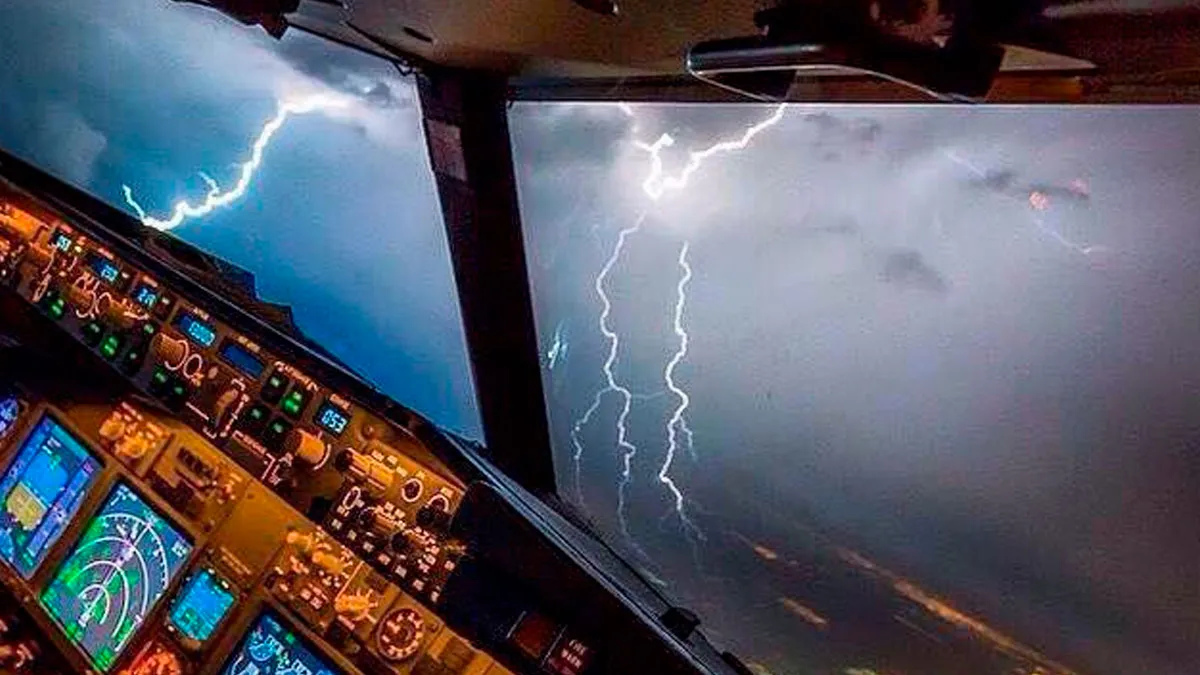

Working as a pilot is stressful enough as it is. But over a long enough time frame, you’re bound to run into some serious emergency situations. The hope is that you’ve got nerves of steel and enough experience to get the entire plane to safety. And when everything is said and done, your passengers might even be blissfully unaware there was a horrendous problem in the first place.
#21

I am a commercial airline captain on a newish embraer 175. Probably one of the scarier things I have had happen was when one of our cabin pressure control channels failed and we started to rapidly lose pressurization.
Pressurization is important because the air is so thin in the flight levels, specifically above 30,000'. The higher up you get the less "time of useful consciousness" you have, down to about 30 seconds. So it is a pretty scary thought and it is a problem requiring immediate action, usually a steep emergency descent, during which you will not hear from the pilots because we are suuuuuuper busy.
Our pressure controller has two channels and automatically switches to the second if one fails. We were flying along about to start our descent and briefing our arrival and our ears started popping, like mad. I looked over and the pressurization was climbing very fast. We started a steep, but not quite emergency descent, while I flipped the pressurization switch to manual and then back to auto. This manually switched the channel to the working one and we could continue without problem.
Pretty sure all the passengers noticed were their ears popping. It gave us about 80 seconds of a scare though.
The funniest part was that when we landed our maintenance control wanted us to "defer" the pressurization channel over the phone, meaning we will fix it later (generally a very safe way to get flights out on time with something minor or redundant broken). I told him I was going to have to insist that someone come over and actually look at the plane to say it was safe to fly.
Edit: I would like to add that the mechanics were NOT being reckless. These channels rarely fail, and having 2 is already a redundancy. They are absolutely able to defer them with very little concern for safety. I was being overly cautious in my request for an inspection and they accommodated me without question. A few mechanics out there must have very charged relationships with pilots, this is rarely the case in my workplace.
Report
6points
#22

Yay, story time. I'm an air traffic controller, for the record.
Had a pilot go NORDO (that's when, for whatever reason, they aren't on my frequency anymore. They didn't get the right one, misheard, or their radios crapped out). It happens fairly often, and there are a number of things we can do to get you back in the right place.
This particular guy, however, went NORDO at precisely the worst time. He was going eastbound, which means he was at an odd altitude. He lost his radio, and his flight plan then had him turn southbound. That means he was supposed to be at an even altitude, which he obviously wasn't.
There were about a dozen different planes going northbound that were at his altitude, so he ended up running one heck of a gauntlet through all these people as I was descending and climbing them to get them out of his way.
Then, apparently in an act of sheer ignorance on the pilot's part, he decided to choose an even altitude all by himself, knowing he should probably be at one.
Remember all those planes I had to move out of his way? He managed to put himself right back into them. When you have closure rates of over 1,000 knots an hour, that's not a lot of time to react to those things. At the end, my [bum] was clenched so tight that when I stood up, the seat came with me.
Report
6points
#23

I fly an older Dash 8, we have lots of little problems, sometimes the nav system blanks out, minor electrical issues. I fly in an area with non-precision ILS, sometimes we only fly VFR approaches, I was landing on a small dirt striip on Baffin Island when a cross wind pushed the aircraft off the approach and we had just enough power to go around, if the plane was a little heavier I may not be here to tell the story.
Report
6points
#24
If your captain is telling you to remain calm, because there is going to be some turbulence, then there is going to be some turbulence. But if he ends that sentence with "cabin crew, be seated", then [it's] is about to go DOWN.
Report
5points
#25

My dad once had one engine quit on his embraer. Didn't even tell the passengers, if I remember correctly.
He also told me a story of a Super 80 (I think) that literally lost an engine. The pilots were like "engine 2 stopped working" but after a passenger spoke to a flight attendant, the flight attendant let the pilot know that they had in fact, literally lost it, it fell off. Can't remember the deets. But I'd love to be the passenger in the back window seat and suddenly getting to actually have a view instead of only seeing an engine.
He also told me a story of a Super 80 (I think) that literally lost an engine. The pilots were like "engine 2 stopped working" but after a passenger spoke to a flight attendant, the flight attendant let the pilot know that they had in fact, literally lost it, it fell off. Can't remember the deets. But I'd love to be the passenger in the back window seat and suddenly getting to actually have a view instead of only seeing an engine.
Report
5points
#26

Flew tourists and odd jobs in Phoenix for a couple years in an R44. Going in for a landing at a remote site in the middle of the desert. Just as I was about to drop into a hover, drain my speed, I noticed just above my feet a trike motor paraglider just cruising under me only a couple feet above the ground and maybe 5 feet under me.
Very cool like, did a 180 and told pax I was worried about the landing spot, so I went pretty far in a different direction while watching [him] in my skid mirror. I quick flipped to a couple open channels to try to raise him and didnt get a reply so Im assuming he was without a radio.
Still to this day Im wondering how in the hell did he get in behind and under me so fast when I was probly cruising at 80mph? How in the hell did he keep that thing solid under my rotorwash? And why in the [hell] would it be a good idea to fly under a helicopter when it is about to land. A couple people Ive talked to have said he probably didnt even notice me. Im just gonna go to the grave believing some people wanna live on a razors edge...
5points
#27

I'm late to the party here, but someone might enjoy this. I'm an airline captain and on this particular day I was flying a CRJ-900 into the Washington National Airport. We were on an arrival but due to VIP movement (the president) they took us off of our route with the intention of having us enter a holding pattern over east Maryland.
As we were turning around on the holding pattern, think of it as a big oval with 10 mile sides, we noticed an aircraft coming down the same route we were just in, at our altitude, roughly 10,000ft. They were 20 miles away and we only saw a blip on our screen. Keep in mind that at 10,000ft we're doing close to 300mph, so a closing speed of 600mph. We got sight of them as we got closer and we had to turn to fly on the other side of the oval.
By now we're about 5 miles away, turning towards each other closing at 600mph, so I instinctively put my hand on the yoke and autopilot disconnect button. At about 3 or 4 miles, ATC issues a traffic alert and gives me an immediate left turn and to descend. So I click it off and start handflying. At that same moment the TCAS (Traffic Collision Avoidance System) starts yelling
"Traffic! Traffic! Climb! Climb!"
So I do what I'm trained to do and fly the TCAS maneuver.
We probably came within two miles, maybe less, from colliding. Not that we would've since I saw the Southwest 737 and would've evaded had we gotten closer, and the TCAS did its thing right.
So, since the TCAS told me to climb I got to 11,000ft within a few seconds and leveled off. Then what do you know? A second airplane! TCAS starts freaking out again and telling me to descend, so I did.
We explained the situation to ATC and the controller sounded extremely embarrassed and apologetic. So if the dude controlling Potomac sector where we fly the DEALE arrival that got us into two RAs within seconds of each other is reading this, it's ok. We all have bad days.
Ooohh and when we were getting off some of the passengers asked what the commotion was about. The FA told them that its because we get paid by the minute (true) and we wanted to milk the clock since we were early, in a playful manner of course.
Report
5points
#28

Navy helo pilot here:
I was doing some Deck Landing Qualifications last month, and me and my fellow pilots are going out to land on the boat for the first time with a senior IP. We have 4 pilots in our bird that need to qual, and I was the last to go. The other pilots, then me, get our day and night bounces, and on the last landing of the night, we call for the other people to come out and strap into the helo so we can fly back to base. Just before we get ready to launch from the boat, we get a #1 fuel pressure light, and our #1 engine starts acting wonky and starts flaming out. We troubleshoot on deck and eventually have to shut down the bird and wait for the ship to get in port so we can disembark. Had that #1 fuel pressure light come on literally 10 minutes before, or 2 minutes after it did, our helo would be in the middle of the Pacific Ocean and we would be scrambling out of the helo for our lives and a multi-million dollar helo would be at the bottom of the ocean.
TL;DR We had an air leak in one of our engines right before takeoff. If it happened any earlier or later than it did, I would be swimming in the Pacific ocean right now.
Report
5points
#29

Dad's a pilot, so I get to hear all of these.
Good one that comes to mind (mind you, he flies 737s for a major airline):
Getting ready to take off at night, he sees a plane about to land on the taxiway he's waiting on, he immediately just starts turning on every exterior light on the plane. Other plane pulled out of final descent at like 500 feet.
Edit: Just talked to him on the phone about it. He said it was back when he was flying the 727, so about 15 years ago now. He remembers seeing the plane coming down, and the captain was looking back over his shoulder at another plane, so my dad starts throwing on all of the lights, at which point the captain turns around and starts asking him what he's doing, and sees the plane, and then both of them literally just duck, and wait for something to happen, and after a couple of seconds, when it's clear the plane wasn't going to hit, they both sit up, and my dad starts trying to call the tower. The tower is just not responding at all for a bit, and then a lady comes on (the dispatcher had been a man) and basically says, "when you get to your destination, call this number." And the dispatcher and the pilot of the other plane both lost their licenses.
Report
5points
#30

I'm a bush pilot in Canada. I was working the right seat of a Turbo Otter, my first ever flight in one so I was still getting used to the setup. We were taking off from a short strip in the middle of nowhere with 6 drillers in the back and a bunch of gear. Captain started the engine as I was just finishing up the passenger briefing. He started rolling down the runway as I was just getting seated. I thought he was just positioning the plane to prepare for takeoff, but then he gave it full throttle. I didn't even have my seat belt or headset on yet. I'm focusing on getting this stuff on when I realize something isn't right. Getting closer to the end of the strip, captain starts to panic as we aren't getting airborne (his hands were shaking like mad and he kept reaching for things but he couldn't figure out what was wrong, I think he was too busy looking at the trees and creek right ahead of us).
I realized the problem, he was in such a rush to leave that he didn't do a pre-takeoff check. Propeller was still in full coarse (feathered on shut down), it should have been full fine for takeoff. I yelled/gestured to him the problem and immediately pushed the prop forward, engine had a huge surge and we just barely cleared the trees at the end of the strip. He acted like nothing happened for the rest of the flight. We didn't even speak a single word to each other. I suspect none of the passengers even realized what had happened and how close we were to being another statistic. When we got back to the airport I told him I was leaving, packed my bags and never looked back.
I realized the problem, he was in such a rush to leave that he didn't do a pre-takeoff check. Propeller was still in full coarse (feathered on shut down), it should have been full fine for takeoff. I yelled/gestured to him the problem and immediately pushed the prop forward, engine had a huge surge and we just barely cleared the trees at the end of the strip. He acted like nothing happened for the rest of the flight. We didn't even speak a single word to each other. I suspect none of the passengers even realized what had happened and how close we were to being another statistic. When we got back to the airport I told him I was leaving, packed my bags and never looked back.
Report
5points
#31

I wasn't the crew on either, but my service had 2 pretty severe bird strikes within several weeks of each other. One was a hawk of some kind and the second was a duck. The duck strike happened with a patient loaded, evidently just as the pilot was flipping his NVGs up. The duck came through the windscreen and went to smithereens along with all the plexiglass. I helped clean up the back of the helicopter later, and it looked like a duck had swallowed a duck of lit dynamite. The strike also happened at the exact moment the med crew had pushed a medication that relaxes all the muscles in the patient's body (including breathing muscles), and in spite of the chaos they continued their procedure and successfully controlled the patient's airway. The pilot also continued the flight in spite of being covered in duck blood/guts/feathers, as well as his own blood from his broken nose. The crew (and the other birds strike crew) received commendations for their calm composure under the circumstances.
It's pretty mind boggling the damage a several pound bird can inflict.
It's pretty mind boggling the damage a several pound bird can inflict.
Report
5points
#32
I was asked this question by a passenger while I was experiencing a problem with the rudder/brake pedals in the plane I was flying. He basically asked what was the most urgent situation was I had encountered while in flight. Little did he know that it was happening in real time at that moment.
I had called the tower of my destination airport to report my position and request landing. As I'm going through my checklist I positioned my feet on the rudder pedals to have authority of the toe brakes to slow the aircraft after landing. As I moved my foot on the right pedal it sort of flopped forward.
What does this mean? A couple potential problems, especially while on approach for landing. With the pedal flopped forward it meant the top of the pedal would be pushed into the firewall and severely limit right rudder control. Not having bilateral brake control greatly increases the likelihood of a ground-loop, or spinning out of control and flipping the plane over or off the runway.
I narrated the problem to my passenger as I "acted out" the physical inspection to try to solve the problem. I reached down with my hand and flipped the pedal back up so that it was at least in the right position. Apparently the linkage for the right brake had become disconnected. I knew that if I put the plane on the numbers I had almost 5000 feet to roll out and clear the runway for the next aircraft.
I made an uneventful landing and just rolled and rolled with light left brake and some counter steering to keep the plane under control while it naturally slowed. The controller asked me to expedite clearing the runway and I replied that I would but I still rolled until I could just steer naturally off the runway.
The passenger had no idea that I was encountering my first significant mechanical failure. I was just over 100 hours of flight time and working at a flight school as a dispatcher and front office person on Sundays. My passenger was someone that one of our clients had dropped off at another airport and was unable to pick him up. I told the guy I'd come get him after my shift if he'd cover half the rate of the plane of my choice. I was extremely familiar with the aircraft I chose but a cotter key failed and allowed the brake linkage to disconnect.
Everyone lived.
Report
5points
#33
I was flying the SR-71 out of RAF Mildenhall, England , with my back-seater, Walt Watson; we were returning from a mission over Europe and the Iron Curtain when we received a radio transmission from home base. As we scooted across Denmark in three minutes, we learned that a small RAF base in the English countryside had requested an SR-71 fly-past. The air cadet commander there was a former Blackbird pilot, and thought it would be a motivating moment for the young lads to see the mighty SR-71 perform a low approach. No problem, we were happy to do it. After a quick aerial refueling over the North Sea , we proceeded to find the small airfield.
Walter had a myriad of sophisticated navigation equipment in the back seat, and began to vector me toward the field. Descending to subsonic speeds, we found ourselves over a densely wooded area in a slight haze. Like most former WWII British airfields, the one we were looking for had a small tower and little surrounding infrastructure. Walter told me we were close and that I should be able to see the field, but I saw nothing.
Nothing but trees as far as I could see in the haze. We got a little lower, and I pulled the throttles back from 325 knots we were at. With the gear up, anything under 275 was just uncomfortable. Walt said we were practically over the field—yet; there was nothing in my windscreen. I banked the jet and started a gentle circling maneuver in hopes of picking up anything that looked like a field. Meanwhile, below, the cadet commander had taken the cadets up on the catwalk of the tower in order to get a prime view of the fly-past. It was a quiet, still day with no wind and partial gray overcast.
Walter continued to give me indications that the field should be below us but in the overcast and haze, I couldn't see it.. The longer we continued to peer out the window and circle, the slower we got. With our power back, the awaiting cadets heard nothing. I must have had good instructors in my flying career, as something told me I better cross-check the gauges. As I noticed the airspeed indicator slide below 160 knots, my heart stopped and my adrenalin-filled left hand pushed two throttles full forward. At this point we weren't really flying, but were falling in a slight bank. Just at the moment that both afterburners lit with a thunderous roar of flame (and what a joyous feeling that was) the aircraft fell into full view of the shocked observers on the tower...
Shattering the still quiet of that morning, they now had 107 feet of fire-breathing titanium in their face as the plane leveled and accelerated, in full burner, on the tower side of the infield, closer than expected, maintaining what could only be described as some sort of ultimate knife-edge pass. Quickly reaching the field boundary, we proceeded back to Mildenhall without incident. We didn't say a word for those next 14 minutes.
After landing, our commander greeted us, and we were both certain he was reaching for our wings. Instead, he heartily shook our hands and said the commander had told him it was the greatest SR-71 fly-past he had ever seen, especially how we had surprised them with such a precise maneuver that could only be described as breathtaking. He said that some of the cadet’s hats were blown off and the sight of the plan form of the plane in full afterburner dropping right in front of them was unbelievable. Walt and I both understood the concept of “breathtaking” very well that morning, and sheepishly replied that they were just excited to see our low approach.
As we retired to the equipment room to change from space suits to flight suits, we just sat there-we hadn't spoken a word since “the pass.” Finally, Walter looked at me and said, “One hundred fifty-six knots.
What did you see?” Trying to find my voice, I stammered, “One hundred fifty-two.” We sat in silence for a moment. Then Walt said, “Don’t ever do that to me again!” And I never did.
A year later, Walter and I were having lunch in the Mildenhall Officer’s club, and overheard an officer talking to some cadets about an SR-71 fly-past that he had seen one day. Of course, by now the story included kids falling off the tower and screaming as the heat of the jet singed their eyebrows. Noticing our HABU patches, as we stood there with lunch trays in our hands, he asked us to verify to the cadets that such a thing had occurred. Walt just shook his head and said, “It was probably just a routine low approach; they're pretty impressive in that plane.” Impressive indeed.
Report
5points
#34
Relatively low-time private pilot (me), small plane with another pilot passenger. We filed IFR, took off and promptly flew into a small thunderstorm over North Georgia mountains. Water was streaming under the windshield, and we were bounced around quite vigorously with the thunder and lightning making it impossible for us to hear or talk to ATC. It lasted maybe 2-3 minutes and turned out fine, but that day I learned how stupid I can be.
Report
4points
#35
I was on a flight once that was trying to land in very high winds. We were just about to touch down. Like probably less than 50 feet from the ground when the plane suddenly dipped hard to the left and the pilot pulled up. We circled for a minute and he made another pass. I gave him a fist bump and told him nice landing on the way out.
Report
4points
#36
My grandfather flies small airplanes as a hobby. I fly with him quite a lot and I had two moments so far:
It was winter, about -10°C. But the weather was great so we decide to go out for a spin. So we always fly about 200-300 metres high so we can look into people's back yards. Suddenly, the engine cut out and would not start again. So we landed in a field, only to find out the fuel pump had frozen.
Another time we were flying and suddenly it got really foggy. Problem is, in the Czech Republic (which is where he lives) there is a regulation that states that planes up to a certain weight do not have to have GPS and so on. And this one time we had no GPS with us and we didn't see a bloody thing, it was only white. We also didn't really know at which altitude we were flying, since we couldn't see any mountains and so on. That was really scary.
Report
4points
#37
Cockroach in the cockpit. Redeye from LAX. One of us was strapped in while the other one hunted for [him].
Report
4points
#38
My friend was a co-pilot on a commercial flight I was on from Toronto to Los Angeles and it was the scariest flight I have been on and getting the co-pilot's perspective after the flight made it even scarier.
The flight went very smoothly until we were making the decent into Los Angeles airport (LAX) just after 10-PM. I was looking out the window and it seemed as if we were 20 metres from touching the runway when all the lights began to flicker and the plane went into complete darkness! Immediately, you could feel and hear the engines thunder into overdrive and we pulled back up.
Plane continued rising and we began to circle the air in complete darkness as everyone begins to share concerns. The flight kept circling for about 20 minutes before the pilot came on explaining they were having some technical problems, and they are discussing with the ATC to resolve the issue and make a safe landing. The circling in the air continued for nearly an hour but it seemed like an eternity in pitch black. Lights never came on, and we were notified we were going to make an attempt to land. People say this all the time but I can assure you, THIS was one scary decent! The bumpiest decent I have ever been part of. We were constantly being lifted from our seats, the seatbelt light really had merit this time. People were screaming each time and I was actually holding onto the arm rests and we kept defying gravity and swaying left and right. When we saw the lights on the runway inch closer, the plane slammed onto the runway and we once again heard the engines roaring as we slowed down on the runway. As we came to a stop, the plane just stayed there and waited on the runway for a tow to the docking area. You could feel the relief within the cabin. If everyone was sitting on toilets, I can assure you, each one would need a flush.
After we arrived, I met with the Co-Pilot a few hours later, as we had planned to meet for a day before he had to fly out of town. He explained they lost electrical power and had lost several forms of communication and flight information was not available to the pilots. Ultimately, the pilots had to land the plane manually with nearly no assistance or outside help. Considering it was night time, poor visibility and limited flight information available, this made for a very [bad] landing. He admitted as well it was the scariest flight he has been on.
Tops my list of Moments I thought I was [gone].
Report
4points
#39
Shortly after getting my PPL, I took three workmates for a local pleasure flight one Friday afternoon from an uncontrolled airfield (EGBN).
Within three minutes I'd made my first ever real mistake by taxiing halfway to the wrong holding point - I had every intention of entering and pootling along a live runway without a care in the world before the A/G radio operator called to give me a stern telling off and I realised what I was doing.
Within five minutes made my second ever mistake - I entered the right runway at the right place but with a clearly less-than-stellar look up to final, turned to backtrack and found myself face-to-face with another aircraft on short final. Utterly soiled myself. Steamed straight across the runway onto a taxiway opposite and parked for a few minutes just to calm down.
Passengers all utterly unaware of how close we came to watching someone execute a go-around/being hit by an aeroplane. Flight successfully executed, everyone has a really great time - and I learn to *plan* my taxi route and *triple-check* the runway and approach before steaming past a hold.
I learned at a major controlled airfield where my taxi route was always exactly the same and I never bothered to get into the habit of looking up and down the runway and onto final because, well, ATC cleared me for takeoff. Mentioned the story to my instructor whose sole comment was 'well, that's what you get when you fly from an uncontrolled airfield!'.
Report
3points
#40
I was flying a Piper Navajo that seats 8 passengers out of a small airport, we were making all of our required radio calls, but because this was a small uncontrolled airport some people in small airplanes will operate without radios or just dont care enough to broadcast their position. Anyway we were doing our due diligance but not long after take off and while leaving the traffic pattern my FO says "dang!" And takes control from me and make a relativley aggressive (for passengers at least) turn to the right. As he does this i see a cessna out my left window no more that 150 ft below us. We essentially climbed through the altitude he was crusing at and turned to avoid him. Only one passenger noticed when we got to the destination and he told us it was a "good move".
Good times.
Good times.
Report
3points
