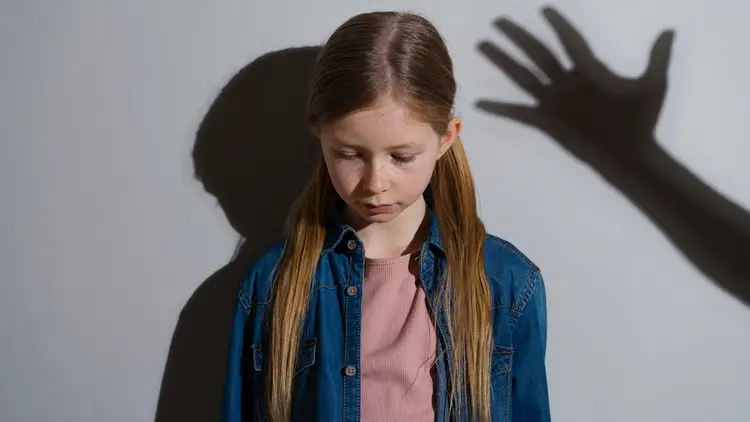
We’re happily playing in my garden, not a care in the world, when her dad’s head suddenly appears over the wall. “Don’t forget you must be back home by 5,” he says in a stern voice. “And go straight to the wardrobe to choose the belt you want.” At not even ten years old, I don't really understand what that last part means but I can instantly feel the mood shift. She looks scared. I decide to ask my neighbor what her father meant by “choose a belt.” “It’s my punishment,” she tells me. Apparently, she'd done something that warranted a spanking (or a lashing) earlier that morning. I'm horrified, even though I, like many others, am not immune to the occasional smack on my behind if I ever dare to misbehave. But mine is never with a belt. A flip-flop, maybe. But never a belt. It wouldn’t be the last time I’d hear my friend’s father telling her to choose a belt for later. And it bothered me every time. Especially because he seemed to always let her stew for hours before meting out the punishment. Decades later, I wonder which was worse: the actual spanking, or the torturous dread of going about her day knowing that there was a leather belt of her choice waiting for her that evening. According to the World Health Organization, approximately 1.2 billion children aged 0–18 globally face home corporal punishment every year, with around 17% being hit on the head, face, or ears, or repeatedly. Some adults will lead with, "This hurts me more than it hurts you." Others will argue, "I got spanked as a child and I turned out fine." But did they really? pikisuperstar / Magnific (not the actual photo) I was chatting to a few parent friends the other day, while we were watching our kids play soccer. All of us seemed to be going through similar issues with our young boys. Defiance, cheekiness, and an attitude that one might only expect to encounter in the terrible teen years. "Just give them a whack on the bum," said one dad. "It works," he claimed. As we continued our discussion, it became apparent that each and every one of us standing there had received our fair share of whacks growing up. Some more than others. I know my brother definitely got more spankings than I did. But that's possibly because I busied myself reading books, playing the violin and generally trying to stay out of trouble. Or in later years, trying my best to avoid being caught. Did we turn out fine? I can only speak for myself, but I'm not so sure. Then again, it really depends what "fine" means. I'm not convinced that having the fear of God struck into me as a child had hugely positive benefits for me as an adult. And I'm not the only one. "It’s almost as if my trauma trained me for adulthood, where I am now comfortably nestled in therapy, deciphering the nuances of panic attacks and imposter syndrome," writes Autumn Walsh from Elements Counseling and Wellness Spa, while remembering her childhood spankings with a wooden spoon. "However," she adds, "I assure you, I turned out 'fine'—whatever that means." Walsh goes on to explain that children subjected to spankings may very well wind up adults who view conflict resolution as a wrestling match rather than a conversation. "Emotional maturity isn’t a side effect of occasional swings from a wooden spoon; rather, it results from understanding and processing emotions effectively," says Walsh. "Children learn emotional regulation when exposed to explanations, empathy, and positive reinforcement—not by dodging slaps like a dodgeball champ in a gym class filled with bullies." pixel-shot.com / Magnific (not the actual photo) Corporal, or physical, punishment is defined by the UN Committee on the Rights of the Child, as “any punishment in which physical force is used and intended to cause some degree of pain or discomfort, however light.” And while corporal punishment of children has been banned in 70 countries, it remains legal in many countries, including the United States, Australia, and parts of the United Kingdom. With so much talk about "gentle parenting" nowadays, you'd be forgiven for thinking that many younger parents wouldn't dare raise their voices, let alone their hands, around their kids. But interestingly, when Canadian parents aged 18 to 27 (Gen Zs) and millennial parents (ages 28 to 42) were recently asked whether they have ever spanked their child or children on their behind with their hand, about 20% said “yes.” 4,000 adults took part in the Canadian Journal of Public Health study. More than half of parents polled reported being spanked (three times or more) when they were young, 40.2% said they were spanked between zero and two times. "Overall, 22.6% reported that the spanking left a mark or bruise, or caused lasting physical pain," notes the study. When participants were asked how they felt about spanking, 15% said they believe “it is necessary to use spanking to properly raise a child.” bearfotos / Magnific (not the actual photo) However, experts disagree. Whether a parent uses their hand, a wooden spoon, a flip-flop or a belt, it's unlikely that the child on the receiving end is going to learn a valuable lesson from the punishment. They might stop whatever naughty thing they were doing, momentarily. But the spanking doesn't guarantee they won't do it again, or that they won't act out in a different way. "Hitting children does not teach them right from wrong," explains Elizabeth Gershoff, PhD, an expert on the effects of corporal punishment on children. "Spanking gets their attention, but they have not internalized why they should do the right thing in the future. They may behave when the adult is there but do whatever they want at other times." Most psychologists also agree that spanking a child hurts, not only on a physical level but on an emotional one, too. And research shows that adults who were spanked as kids are at higher risk of anxiety and depression, as well as physical health issues. “Spanking appears to be empirically similar to physical abuse,” says Tracie Afifi, a psychiatric epidemiologist at University of Manitoba in Canada. “The difference between spanking and abuse is kind of like a grey zone. That’s why it’s so worrisome." A separate 2021 study involved 147 children. Some of them were spanked by their parents in their younger years, and some weren't. "By using MRI assessment, researchers observed changes in brain response while the children viewed a series of images featuring facial expressions that indicate emotional response, such as frowns and smiles," reports the Harvard Graduate School of Education. "They found that children who had been spanked had a higher activity response in the areas of their brain that regulate these emotional responses and detect threats — even to facial expressions that most would consider non-threatening." magnific / Magnific (not the actual photo) In short, they concluded that spanking may alter neural responses to environmental threats in a manner similar to more severe forms of maltreatment. “We know that spanking is not effective and can be harmful for children’s development and increases the chance of mental health issues," explains researcher Jorge Cuartas, who co-authored the study with Katie McLaughlin, a professor at the Department of Psychology at Harvard University. "With these new findings, we also know it can have potential impact on brain development, changing biology, and leading to lasting consequences.” Another study published in The Journal of Pediatrics found that people who got spanked as kids were 1.3 times more likely to become aggressive towards future dating partners. “Not everyone who is spanked will go on to perpetrate violence,” said Jeff Temple, a psychiatry professor and co-author of the study. “But I think that it does prime them a little bit more to see violence as a means to resolve conflict.” So the next time someone tells you that they were spanked as a kid and turned out "fine," you might discover that they're not as "fine" as they think they are.