





Across the vast majority of Planet Earth, paid parental leave is a matter of fact. All that differs is just how many weeks parents get to spend uninterrupted with their newborn munchkins before they get back to the rat race. The average length of leave, globally, is 29 weeks. However, the United States is one of just seven countries with no national paid maternity leave.
A graph published by The New York Times last October, comparing paid maternity leave around the globe, is making the rounds on the internet again, and many Americans are shocked by how much of an outlier their country actually is. Redditors from around the world tuned into a viral thread featuring the graph and started sharing what the situation is like in their own countries. It’s eye-opening. And it’s proof that if the world found a way to make it work, the US can, too.
Scroll down for the most insightful posts we’ve picked out from the thread, and let us know in the comments what the parental leave situation is like at home for you, Pandas. And if we have any parents reading this today, we’d love to hear the advice you’d give to new parents!
Labor and Delivery Nurse Holly D., from Georgia in the United States, was kind enough to explain to Bored Panda. why paid paternal leave in America is so abysmal, and why it's so important for parents to spend a lot of time with their newborns. Scroll down for our full interview with Holly.
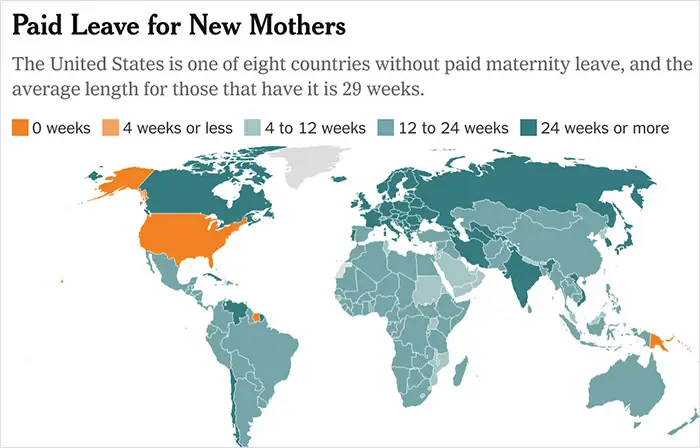
Image credits: nytimes
#21

In Lithuania it's one year paid maternity/paternity leave (77% of your salary). Or you can spread it out over 2 years and get 2 years paid maternity/paternity leave. The other parent also gets one month paid leave when the baby is born
Report
39points
#22

I'm from Kuwait and any woman giving birth gets a minimum of 70 days paid maternity leave by law. And if you work in the public sector, you can get paid leave for up to six months (or up to one year making 50% of your salary). When you are ready to go back to work the employer is not allowed to fire you either.
Report
36points
#23
In France, you get six weeks off before labor and 10 weeks after. You may shift this split to four weeks and then 12 weeks with a doctor's note. This time off is mandatory and your pay is about 90%. For a country that's sometimes touted as 'socialistic,' this paid time off doesn't seem that much. I'm grateful but I would gladly take more!
Report
33points
#24
In New Zealand, you can have up to 36 weeks of paid leave. The government pays either parent about $450 a week after tax regardless of what your salary is. Your employer also has to keep your job for you and follow a full integration process. We also have mandatory four weeks of paid leave each year and ten paid sick days. It’s absolutely scary to think about jobs with no paid leave.
Report
32points
#25
In India, where we are struggling with over-population the women atleast dont have to suffer due to lack of maternity leave.
In order to get maternity leaves, woman employee needs to have minimum 80 working days.
Women employees can avail 8 weeks maternity leave before the expected delivery date and remaining 18 weeks maternity leave will be given after delivery date.
12 weeks of maternity leave will be given to adopting mothers and women employees who have surrogates.
Every employer who has 50 or more than 50 employees will need to arrange creche facilities within 1 km of working areas and 4 visits will be allowed to women employees. These 4 visits include regular intervals of rest. Earlier only 2 visits will be given under nursing breaks for the child less than 15 months old. The above are the changes in maternity benefit act 1961.
The woman employees who are under ESI scheme will get the salary for maternity leave period from ESIC, for remaining women employees employer will pay the salary.
Report
31points
#26
California teacher here. People assume that teachers get paid maternity leave (this is possibly because there are a lot of young professionals and mothers in the field), but the truth is we do NOT. We get zero days of paid leave. We get the federally mandated 12 weeks unpaid leave, but if we need financial support during that time we have to use our sick leave. This means that most of us can’t take the full 12 weeks off.
I think a lot of us go into teaching with the hope that it will fit well into a parenting schedule (kids at school while you’re at work, summer and winter breaks) without realizing that we have very few options when it comes to maternity leave. Furthermore, if you get pregnant before getting tenured, there is a very real chance that you could lose your position. Teachers who are not tenured are on temporary contracts. When the school year ends, so does your job, unless the school 'invites' you back. Being pregnant does not improve your odds.
I think a lot of us go into teaching with the hope that it will fit well into a parenting schedule (kids at school while you’re at work, summer and winter breaks) without realizing that we have very few options when it comes to maternity leave. Furthermore, if you get pregnant before getting tenured, there is a very real chance that you could lose your position. Teachers who are not tenured are on temporary contracts. When the school year ends, so does your job, unless the school 'invites' you back. Being pregnant does not improve your odds.
Report
30points
#27
In Germany, each parent can take up to three years of parental leave per child. In the case of the mother, this three years includes a legally prescribed six weeks after birth, during which the mother must stay home. Fathers can start parental leave at childbirth. Both parents have to take at least a part of parental leave before the child turns three and parental leave must conclude before the child's eighth birthday. Aside from these rules, parents are free to choose the beginning and end of their parental leave.
Report
27points
#28

Russian 166 weeks have their downside. 1) Though they are paid, the amount of payment is capped. It was like 25% of my salary when I worked in Russia (software engineer) 2) Many employers try to avoid hiring a woman of “reproductive” age, as they have to find a temporary worker for her while she is on a maternity leave; also the compensation should be paid by an employer - though it will be reimbursed by the state later, employers don’t like to spend their money that way. (I’ve read in some blog that some manager once told something like: “You have sex, and I have to pay for that”). And even if they hire a woman, they may ask her on a job interview if she is married, or if she plans to have kids (those questions are illegal, but…) 3) Even though it’s illegal to fire a pregnant person or a person who is on maternity leave, may employers find a legal way to do so 4) The maternity leave can’t be shared between parents
Report
24points
#29
In Poland women are usually give something like a sick leave (paid) for always the whole of the pregnancy. You can kinda chose if you want to stay at home or not. Then you have 1 year of paid maternity leave (paid around 70%). I think you can also make it into 2 years and spread the money over 2 years. Even if you are not employed permanently you will get 1000 pln per month (around 250 usd but it so worth much more in Poland).
Report
24points
#30

In Japan, maternity leave refers to the medical leave that mothers are entitled to take on either side of their due date. It is approximately six weeks prior to her due date and eight weeks post). There is no equivalent leave for fathers, but some employers offer leave in addition to the mandatory entitlements (such as a week or two of 'paid paternity leave') to fathers around the time of the birth.
Report
24points