



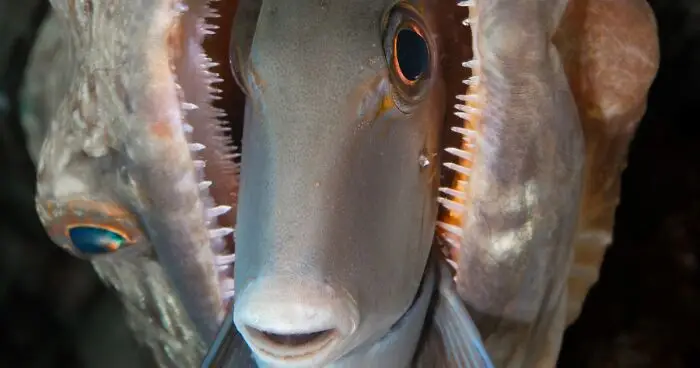


The 2023 Ocean Art Contest winners have been announced by the Underwater Photography Guide! In its 12th year, the competition received images from over 90 countries, celebrating both evolving photography skills and technological advancements.
Winning entries showcased never-before-seen behaviors, captivating blackwater scenes, inspiring messages on ocean conservation, clever lighting techniques, and stunning animal portraits. With 14 diverse categories, the contest provided a challenging platform for photographers of all levels.
Keep scrolling to witness the breathtaking images!
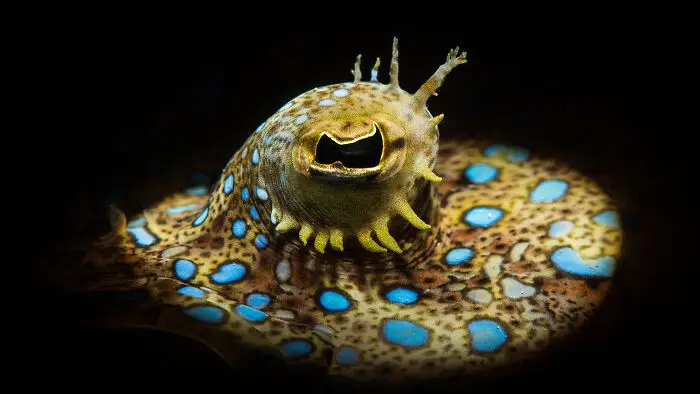
#21 5th Place In Macro Category: "The Eye" By Guillermo Viveros
Playa del Carmen, Mexico
"I was experimenting with my new Marelux Snoot in a Playa del Carmen reef, about 10-12 meters deep. After a while, I spotted a peacock flounder (Bothus lunatus) on the sandy seabed—a common fish in the area. Initially, it seemed wary of me and my photographic equipment, attempting to evade my presence. However, I carefully trailed it until it grew accustomed to me and my gear. Suddenly, it came to a halt and began surveying the surroundings. While adjusting my snoot and focusing to capture the perfect shot, I managed to take five shots as the flounder patiently waited for me to get it right. Eventually, it darted away and disappeared into the vast ocean. This particular shot is one I consider myself fortunate to have captured, as the flounder allowed me to capture its essence."
22points
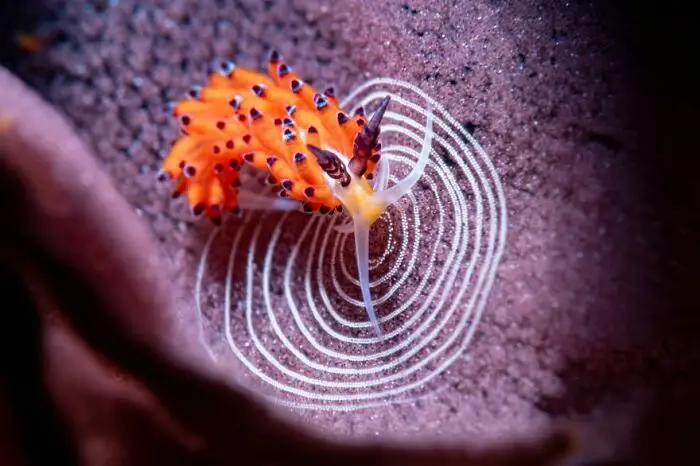
#22 Honorable Mention In In Compact Behavior: "Circle Of Life" By Andrea Michelutti
Anilao, Batangas, Philippines
"I found this Favorinus tsuruganus, along with its eggs, on the egg ribbon of the Spanish dancer (Hexabranchus sanguineus). This image captures a stark contrast between nature’s beauty and its harsh realities. The bright colors and intricate designs of the nudibranchs are captivating, but they hide a harsh reality. The nudibranch in the foreground is feeding of the eggs of another of its kind: the ribbon of purple eggs laid by the Spanish dancer fell prey to the Favorinus tsuruganus, which also deposited its white eggs on top.
This scene illustrates intraspecific predation, a phenomenon where an animal consumes another of its own species, typically targeting the eggs or the young. Shooting this image required a great deal of patience, as the constant movement of the purple eggs, caused by the undertow, obscured the nudibranch and its eggs. After some attempts, I succeeded in capturing this vivid portrayal of the ‘circle of life'."
22points
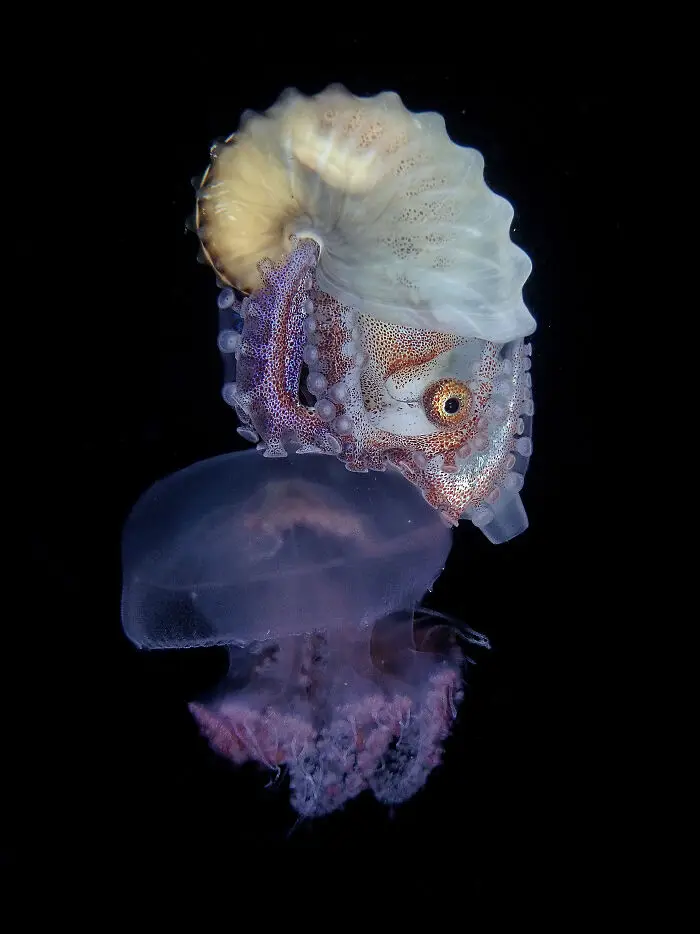
#23 3rd Place In Compact Macro: "Riding" By Regie Casia
Anilao, Batangas, Philippines
"I noticed the paper nautilus riding on the jellyfish at the end of our dive. I had 30 bar left on my tank. I took some photos and then I exited the water."
21points
#24 1st Place In Marine Life Behavior: "The Birthday" By Kenji Sato
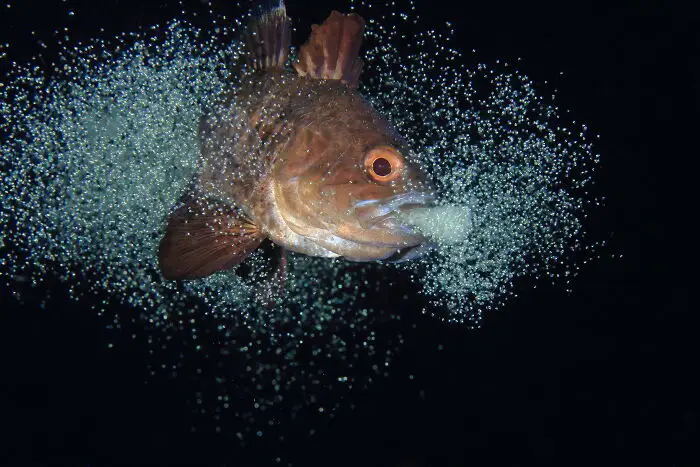
Miura Peninsula in Kanagawa Prefecture, Japan
"Black cardinal fish live in shallow coastal waters, and males raise eggs they receive from females in their mouth (mouth brooder). The eggs hatch in about a week. Until they hatch, males stay still behind a rock and feed the eggs with fresh seawater. At first, I did not know when the eggs would hatch, but after a few observations, I could tell when the eggs would hatch. Hatching occurs within a few hours after sunset. At the moment of hatching, the father swims upward and spits out the babies in an instant. So, it's difficult to take a picture.
It is said that the number of fries in a single hatching is about 20,000, so the moment of hatching is quite impressive. As soon as the babies hatched, they scattered all over the place. I hope that many of the fry will grow up and survive next year."
21points
#25 Honorable Mention In Wide-Angle Category: "Rainbow" By Ipah Uid Lynn
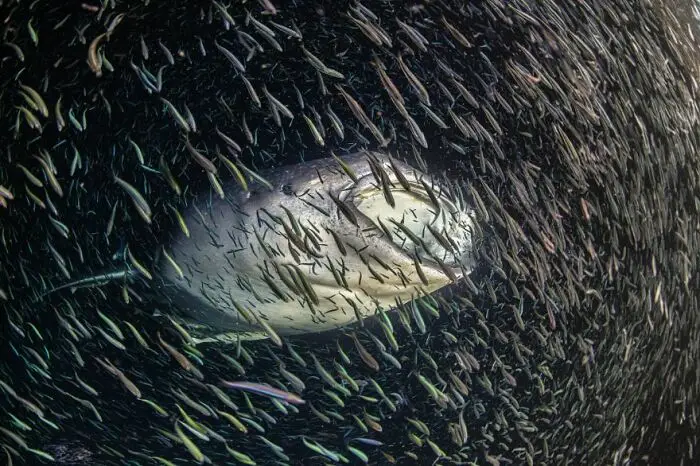
Male, Maldives
"I haven’t seen whale sharks for the longest time. Maldives are known for encountering Whale Sharks. I was very lucky on the first day as I manage to see a few. This one particular whale shark was very friendly. It kept circling around me as I had all the small fishes attracted to my focus lights. I guess for him it was a free buffet as the planktons were a lot that night as well. I stayed there for about an hour until dawn as I wanted the golden light to reflect on the small fishes and it paid off!"
21points
#26 1st Place In Blackwater: "Squid Hunting" By Keigo Kawamura
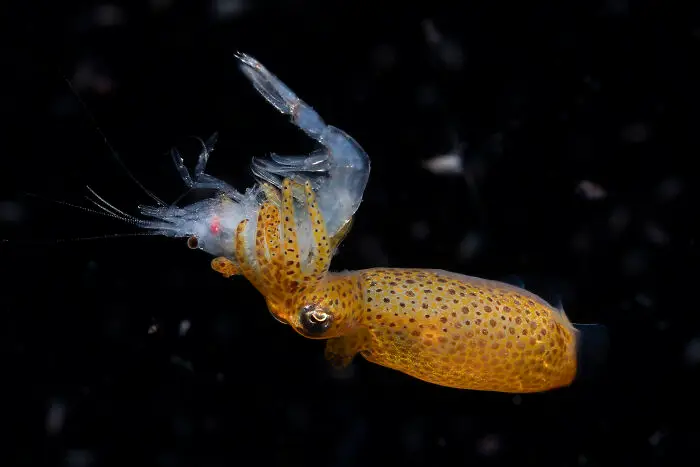
Japan
"I collect and photograph floating creatures at night, Bonfire style. Many squid and shrimp will gather in the underwater torch. The squid in the photo is known to be the smallest in the world, and the pygmy squid successfully preyed on a shrimp as large as its own body. Pygmy squid eat shrimp by inserting their mouths into the gaps between their shells."
19points
#27 Honorable Mention In Macro Category: "Eye See You" By Keith Mash
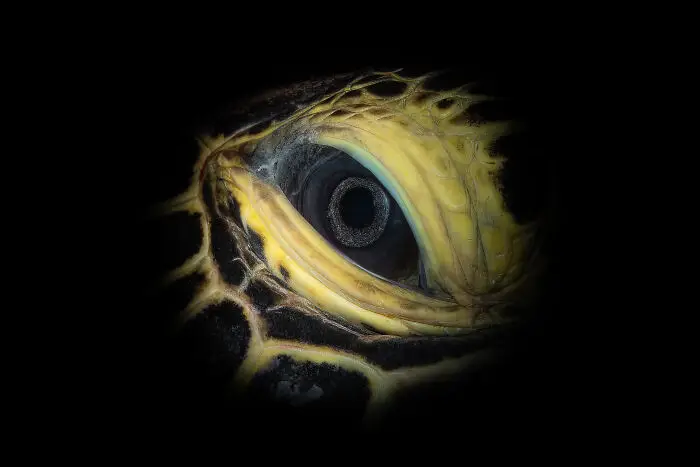
Bunaken Island, Sulawesi, Indonesia
"During my years in Jakarta, Lembeh emerged as our prime spot for critter and macro photography. On a particular expedition, we extended our journey to the islands of Bangka and Bunaken. Little did we know, Bunaken is home to a sizeable green turtle population.
During my years in Jakarta, Lembeh emerged as our prime spot for critter and macro photography. On a particular expedition, we extended our journey to the islands of Bangka and Bunaken. Little did we know, Bunaken is home to a sizeable green turtle population.
A 90mm macro lens would not be my first choice to photograph turtles! My previous attempts at capturing close-ups of turtles, when I have been lucky enough to find one have always been thwarted. Invariably I have found them skittish despite my cautious approach. With this in the back of my mind, I focused on critter hunting along the wall, as the rest of my party enjoyed the turtle activity and what seemed like endless turtle fly-bys.
As luck would have it towards the end of the dive, I spotted a large green turtle nestled in the wall. It seemed to be observing us from afar and showed no signs of swimming off. With slow movements I managed to get within macro range and cautiously maneuvered my camera into position waiting for the right moment. To my surprise the turtle turned its head and gazed directly into the camera as if to check me out. As its eye came into focus, I paused; me looking at the turtle, the turtle looking at me…click… it was done.
On the dive that I obtained this shot, there were only 3 divers in our group, all highly respectful of marine life. This was a unique moment for us all where the turtle was clearly comfortable around us and not skittish in any way allowing me to capture what for me is one of my favorite shots which says 'Eye See you'."
19points
#28 3rd Place In Wide-Angle Category: "In Our Shadow" By Bryant Turffs
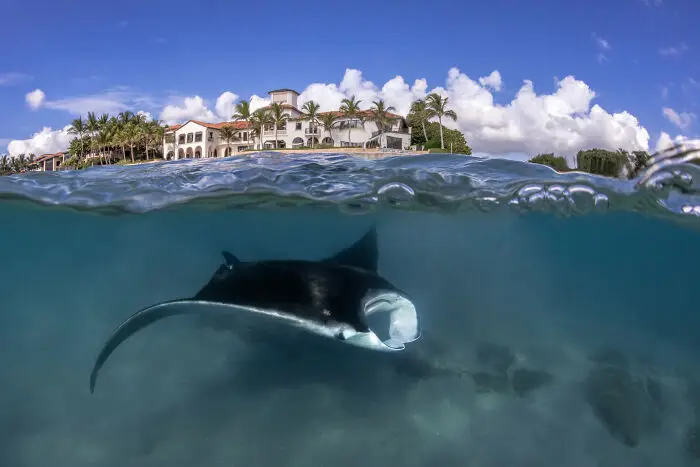
Florida, USA
"Over the past seven years of studying juvenile manta rays in Florida with my partner, marine biologist Jessica Pate, capturing images that illustrate the impact that our world has on these rays has been a priority for me. Easier said than done. Photography usually takes a backseat to science during our field days and Florida's mantas do not behave like mantas elsewhere in the world. They are seldom seen on traditional dive sites and are sparsely populated. On this occasion I was lucky to encounter a tolerant individual in shallow water, which allowed me to capture this split shot of a mansion looming over a juvenile manta named Cricket. Manta rays are listed as endangered by the IUCN, and are listed on the US Endangered Species Act. While they are protected from harvest in Florida waters, they still suffer many anthropogenic impacts along our densely populated coast. Twenty five percent of the rays in our study have been sighted while entangled in fishing lines and eight percent have suffered boat strikes. Further, it is hard to say what impacts coastal development and pollution have on these rays. As the first dedicated long-term study of Florida's manta rays, our Florida Manta Project team seeks not only to gather baseline scientific information, but also to conduct outreach and conservation to protect these rays. This includes educating the public about best practices for fishing around mantas, boating in their vicinity, and limiting disruptive in-water activities like tourism that could negatively impact this vulnerable population. "
19points
#29 3rd Place In Black & White: "Dress For The Sea" By Serge Melesan
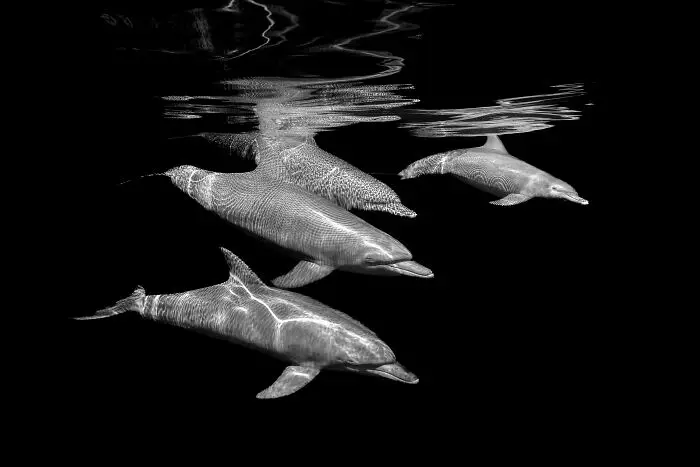
Mayotte Indian Ocean
"Tursiops dolphins living just below the surface in the Mayotte lagoon. This photo shows them as a family and as social animals with a hierarchy. The best place to see them is in the Ocean. It's a magical encounter when they accept you in their environment."
18points
#30 2nd Place In Compact Macro: "Radioactive" By Marcus Commodore
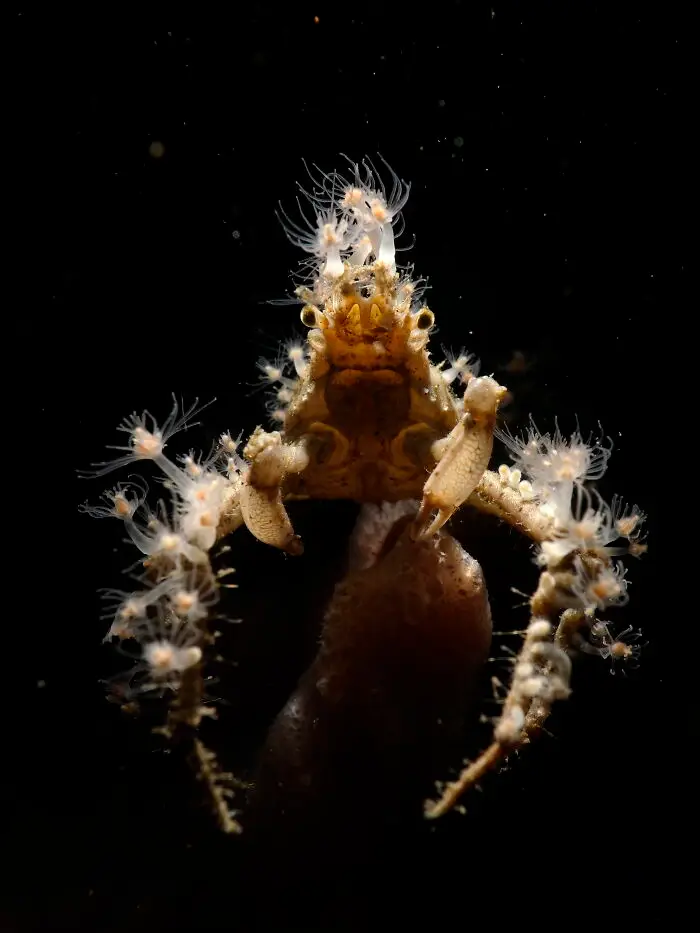
Bali, Indonesia
"For the first time in what felt like a lifetime, I was back in the water. After the years of restrictions and being separated geographically from my passion, I booked my ticket and headed to Bali. It was a rush, feeling the sensations of those first few dives, but also being reunited with my well-worn camera and housing.
The northern shores of Bali have always held a special place in my heart, so naturally I wound up there. After doing several dives around Amed, I found a great dive shop and did a few exploration dives with them. On one of the dives, I found this decorator crab on an enormous barrel sponge at the bottom of a barren slope. Sitting at roughly 30m and completely shrouded in darkness, owing to the depth and overcast conditions, this usually nocturnal species of crab was perched relatively exposed.
I have had an idea for a few years now to use a pair of snoots on this type of subject to backlight and isolate the anemones on its back, while using just a touch of light to illuminate the eyes and “face.” While it took a few shots and some adjustments – especially to get the subject's eyes in focus, the hardest aspect was to isolate the subject from the background of the barrel sponge.
Finally, after a lot of twisting and turning the camera to get the background out of the photo and the subject in frame with the proper lighting, I left this crab to continue its exploration of the sponge- having happily taken some photos showing the beauty of this tiny and cryptic animal."
16points


