




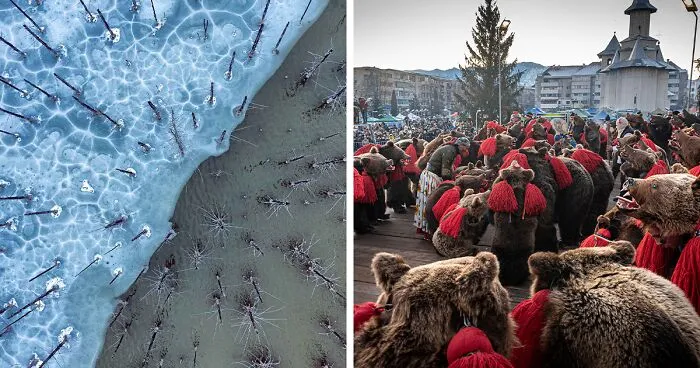


Capturing nature's beauty is a task that will live on forever. Numerous breathtaking landscapes, animals, plants, and unique moments are what photographers seek when looking for the perfect shot.
In this year's Nature Photographer of the Year (NPOTY) contest, judges had to choose from 20,952 images coming from over 96 different countries, making that a new record for this competition. Photographers could enter into 12 different categories, such as Birds, Mammals, Landscape, Underwater, and more. Nature photographer Dmitry Kokh earned the title of “Nature Photographer of the Year 2022” by winning with his photo 'House of Bears'.
#21 Category Nature Of “De Lage Landen”: Runner-Up, 'Tribute To The Starfish' By Franka Slothouber
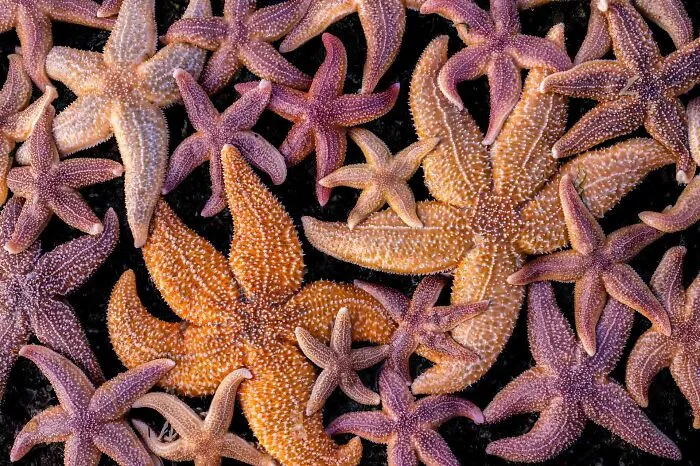
"In January 2022 I visited the beach of IJmuiden and stumbled upon thousands of stranded starfish. I had never seen anything like it before, it must have had something to do with the stormy weather combined with the spring tide the day before. Seeing all these dead animals, made me a little bit sad. When I took a closer look at them I noticed they were all different in size and color, most of them still unaffected by the many feasting birds. Such beautiful creatures, I decided to try and capture them as well as I could. I selected a few dozen and arranged them on a flat part of the dark rocks at the bottom of the pier, making the colorful starfish really stand out."
89points
#22 Category Nature Art: Runner-Up, 'Footprints In Color' By Juan Garcia Lucas
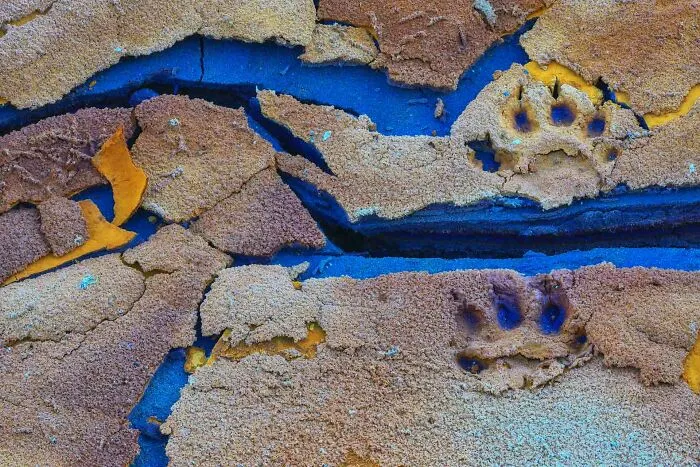
"A 100 km river called Rio Tinto, in Huelva, southern Spain. The color of the river is like wine, hence its name, and this color is derived from minerals such as pyrite or iron + copper sulfide. The bacteria cause oxidation of the minerals and the acidity of the river is caused by sulfuric acid. Photographically it is a paradise for lovers of abstractions and creative photography. Sometimes it looks like an alien world. For four days I went to 40º and they seemed few to me."
88points
#23 Category Plants And Fungi: Winner, 'Cold And Warm' By Soare Laurentiu
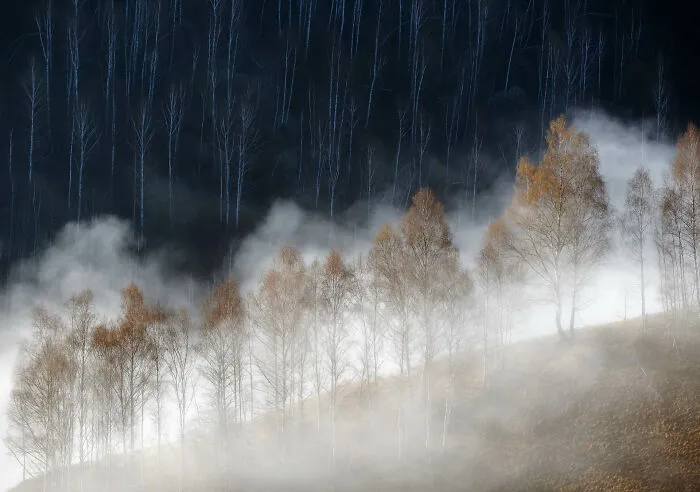
"The picture was taken in a small and lost-in-time village called Dumesti, Alba County. The landscape of this village is characterized by hilly formations dotted with clumps of birch trees. The white trunks of the birch trees make them an interesting subject to photograph. Particularly in spring and autumn, this landscape becomes incredibly attractive for a photographer on sunny morning days when, due to the cold nights and with the appearance of the first rays of the sun, the fog rises and a mystical atmosphere is created in front of your eyes. You cannot help but want to go back to this place after being there once, and therefore I always find myself revisiting Dumesti almost every year, in both spring and autumn. The photo presented in the contest was taken in the spring of this year. I decided to immerse myself and explore the landscape more carefully, and it was not a bad idea, as I discovered a unique viewpoint for taking photographs. Once the warm sunlight made its appearance the show of the rising mist began. Of all the photographs taken that day, I consider the one presented in the competition the most beautiful one, due to the contrast between foreground and background, the atmosphere created by the fog, and the white silhouettes of the birch trees in the second plane."
87points
#24 Category Animal Portraits: Runner-Up, 'Adelie Penguin' By Zhengze Xu
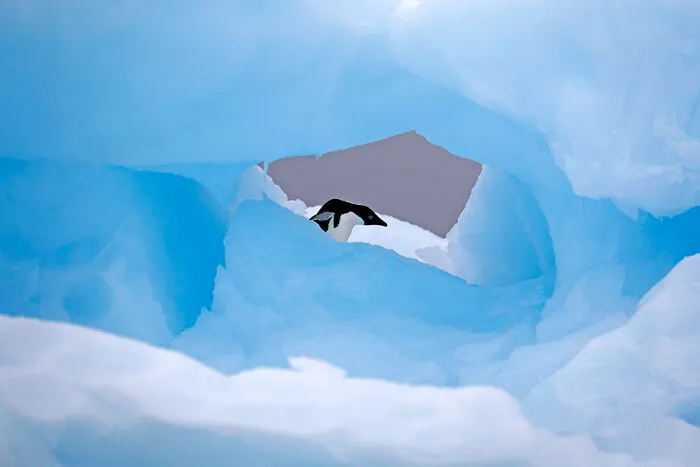
"I took this photo of the Adelie penguin portrait in the Antarctica Peninsula in January 2020. It was summertime in Antarctica and all the penguin adults are busy eating krill in the sea and returning back to feed their chicks on land. This Adelie penguin was resting on one big blue iceberg while we were approaching it on a zodiac. The penguin was hiding behind and looked very curious about us tourists on a zodiac, but it did not escape. I had two lenses at that time, 500mm and 100-400mm, and I chose a 100-400mm lens to include more iceberg background and took this photo at 241mm. The blue iceberg looked like a huge fortress for the penguin and this “Host” looked at us through a big hole as a “window”."
87points
#25 Category Youth: Highly Commended, 'Head First' By Till Clémence
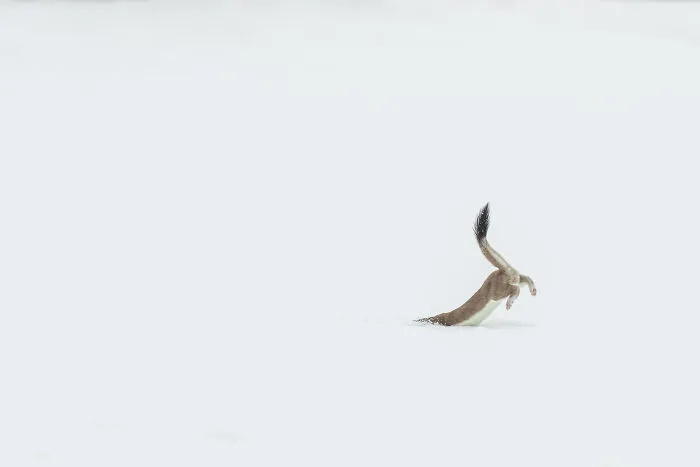
"Near the town where I live, La Chaux-de-Fonds, situated in the Swiss part of the Jura mountain range, there are pastures at one-thousand meters high where some ermines, also named stoats, live. Their scientific name is Mustela erminea. Their coat changes from brown to white at the arrival of winter and becomes brown again in spring. One winter I spotted one, there had been a warm spell that had melted the snow, so its white coat contrasted completely with the green grass. After that, I went back several times to its territory, very often without seeing this beautiful animal. A few weeks later, with the arrival of spring, the ermine’s coat had turned brown. But at the end of March, the stoat was surprised by the late snow that covered the fields with white. Thanks again to this contrast, this time reversed, that I spotted the little mammal more easily."
"This is also a time of vulnerability for them and they become more cautious as well. I was able to observe it from a distance before approaching it with velvet steps once it had dived into one of its prey’s galleries. I lay down in the snow, behind a small pile to remain hidden, my lens placed on a small sandbag. I then waited, staying still, for about an hour until the stoat came out and started running, diving, and jumping around again. This is how ermines hunt, non-stop for several minutes. So I stood there and photographed it in all sorts of extraordinary positions. After a good hour of activity, the stoat returned to his holes under the snow. I took the opportunity to leave."
"A few days later, the snow had disappeared and the brown ermines became more difficult to observe. During this photographic experience, I was able to observe a small predator that when hunting pays little attention to anything other than its prey and potential dangers. This is why I was able to photograph it without frightening it, but I kept a certain distance so as not to disturb it in its search for food. Since then, every year I return to these fields to observe and try to photograph the ermines around my town."
86points
#26 Category Fred Hazelhoff Portfolio Award: Winner, 'A Bear In The Backyard' By David Hup And Michiel Van Noppen
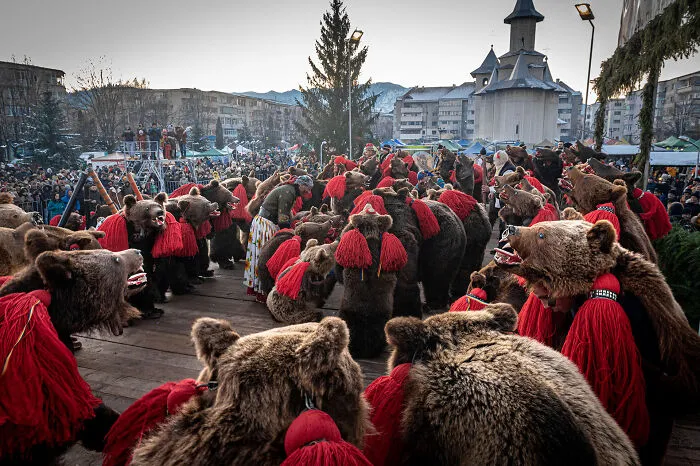
"This story is the work of two young Dutchmen joined by their love for Romania, who have traveled back and forth for four years between work and university in order to document one of the last places on this overpopulated continent that has still true wilderness to offer. With this photo story, they aim to document a beautiful but often overlooked part of Europe and one of the many challenges it faces.
"In villages that lie in the shadows of the Carpathian Mountains, the presence of bears is clearly felt. Due to the illegal logging of the old-growth forests, their habitat and food become increasingly scarce. In search of food, they have to migrate from the ancient forests down to the villages, which regularly leads to conflicts with the inhabitants."
"However, in several towns around Transylvania bears are worshipped every winter through the traditional Ursul dance. A dance to fertilize and cleanse the earth, chase away evil spirits, and welcome the new year."
"The exceptionally dense bear population in Romania is a result of the communist era when Nicolae Ceausescu was in power and banned bear hunting a ban from which only he and his guests were exempt. As a result, Romania now has around 6000 bears, which is half of the European population. The problems of the coexistence of bears and humans have now become a priority on the political agenda, but the debate on the right course of action is very complex due to the many parties involved. And while discussions continue, conflicts keep arising: Shepherds lose sleep trying to protect their sheep, and bears continue to break through fences to feast on scraps."
84points
#27 Category Human And Nature:highly Commended, 'On Stage' By Arne Bivrin
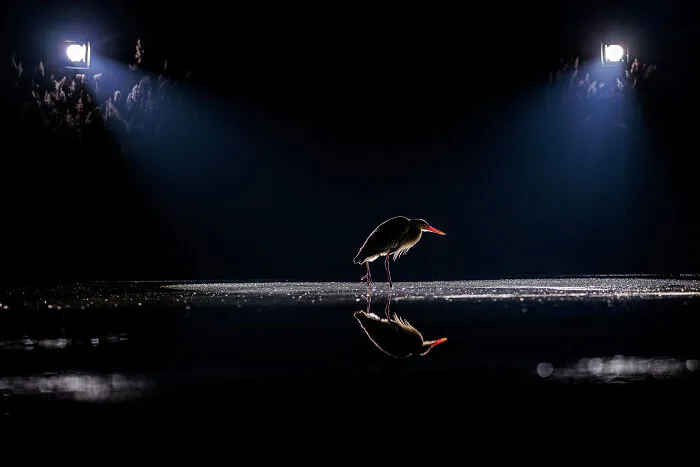
"Herons are such photogenic birds! I’ve spent endless hours in hides trying to catch them fishing, stealth hiding, fighting, or just remaining absolutely motionless. With birds, there is always the problem of coming close enough. Luckily, there are hides, and I often end up with really close-up portraits. I was in Hungary in January 2022 and the sun had set long ago and I was about to pack up my equipment when I saw this single grey heron standing in the center of the light. I chose to switch to a shorter focal length, and the idea of a stage came instantly. Herons don’t have night vision and took of course advantage of the improved visibility. The bird probably knew that fishes were attracted to the light. Most birds aren’t stupid. I set my camera to catch as much light as possible without motion blur. Half a second with aperture f/2.8 and ISO set to 400. Since grey herons are able to stand absolutely still for minutes, the long exposure worked out fine."
77points
#28 Category Mammals: Highly Commended, 'Observer' By Jens Cullmann
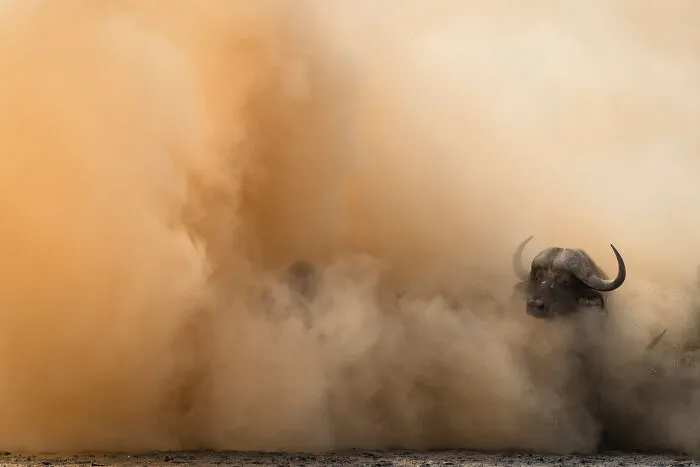
"A herd of Cape buffalo approach a spring in the Zambezi Valley. Location Chitake Springs, Mana Pools National Park, Zimbabwe. For the past 12 years I have spent a few months a year in northern Zimbabwe, where, in untouched wilderness, one can still watch nature’s dramas unfold. In 2021, at the end of the dry season, I spent a couple of weeks at a spring in the interior of Mana Pools National Park. With dwindling food sources, soaring temperatures, and the daily need to drink, the buffalo were drawn to whatever water remained. The image was taken by me on foot and, given the dynamics and unpredictability of encounters, there was a lot to consider."
73points
#29 Category Landscapes: Highly Commended, 'Waves On Waves' By Heather Tonge
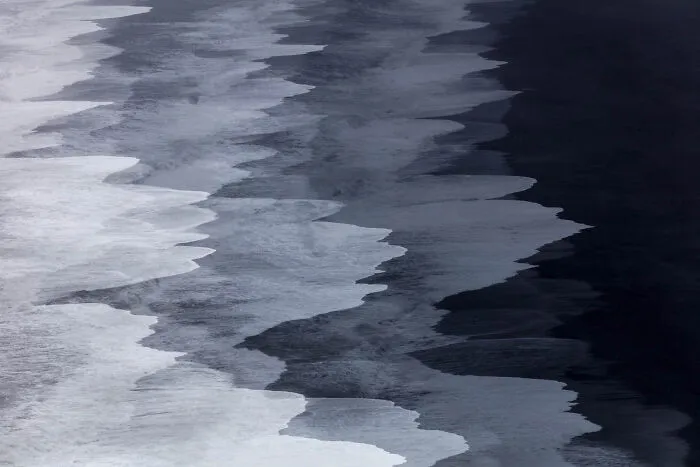
"This image was captured from a dramatic clifftop at Dyrholaey, a former volcanic island, at the southern point of mainland Iceland. The whole area is a nature reserve and incredibly scenic, with views of the Reynisfjara black sand beach and the Reynisdrangar sea stacks to the east, the sea arch, and of course, the ocean waves and the sea birds. To the north, multiple glaciers can be seen. Facing west from the 120-meter high clifftop is an overlook of a stunningly beautiful and seemingly endless stretch of pristine black sand coastline. The waves seemed to roll smoothly and slowly across the sand as if they were painting the beach white, and then recede a little and disappear. This was mesmerizing to watch. The visit was made in November when the winds were notoriously strong, cold, and relentless, and photography was challenging. It was not easy to stand upright although thankfully, the side of a small building did provide some shelter. It was essential to stay away from the cliff edge!"
"Most of my images are usually captured with the camera on a tripod and generally with preferred settings of a low ISO, aperture of f11, and a low shutter speed. I was very much out of my comfort zone here hand-held was the only option, with camera settings contrary to the usual setup. The lens had an image stabilizer which was deemed would make no difference at all in the conditions! There was huge potential here to create a minimal intimate landscape image that would appear to be monochromatic. Although the single-shot images were pleasing, without being able to use a slower shutter speed to capture some movement, I decided to experiment with multiple exposures to try and create something a little different. The camera was held in the ‘approximate’ same position for the 3 shots, which wasn’t easy in the conditions. The result was not only the capture of more wave layering but more grey tones between black and white, and certainly a more abstract ‘art of nature’ feel to the image. This image has also been processed as a rotated portrait crop which appears even more abstract."
71points
#30 Category Plants And Fungi: Highly Commended, 'Eruption' By Imre Potyó
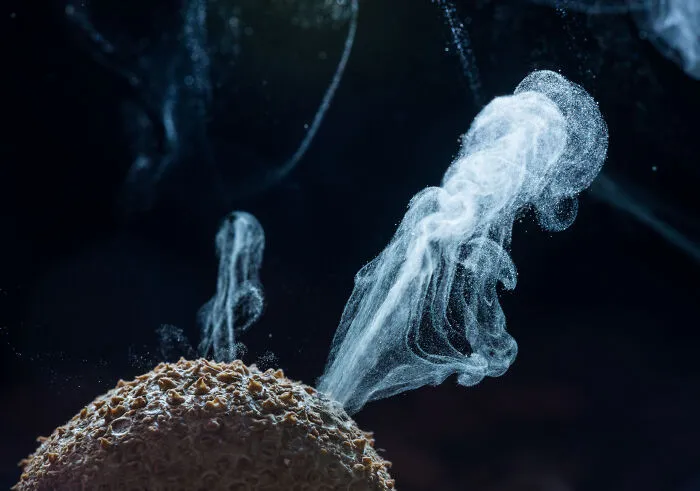
"I have been taking photographs of spore clouds for 8 years, and I found tinder fungi and puffball mushrooms to be the most exciting emitters. When aging, puffball mushroom creates a crusty surface, which after cracking as a result of some disturbance which can be a raindrop emits spore in large filaments. It is very much like action photography to capture the most exciting shapes in the slow turbulent airflow. This eruption is unique as it is located on the side of the mushroom body. I was lying on the ground next to the mushroom holding the camera in my hands. The flash freezes the scene in the low lights, hence there is no need for a tripod. I only used a tripod to support the flash providing the backlight (Börzsöny hill, Hungary)."
"I arrived at dusk to capture the sporulation of puffball mushrooms excluding natural light. Under favorable conditions in September with a sufficient amount of rain, puffballs start to develop fruiting bodies emitting millions of 0.01 mm or smaller spores. This is a form of reproduction of a mushroom transporting its genetic material to larger distances by air movement where it may develop a new fungal colony. Most fungi release spores continuously from their fruiting body typically in moist air in the evening hours. However, the puffball mushroom requires a mechanical trigger to crack on the surface. This trigger can be a raindrop, wind, or collision with animals, and quite rarely mushrooms crack without disturbance to sporulate. Imitating the natural process I gave the mushroom a gentle flick on the bottom so that the flying spores become visible. The light breeze and microturbulence randomly formed this amazing structure."
63points
Both articles highlight the breathtaking power and beauty of nature as captured through photography. In the second article, where nature photographers explore diverse subjects worldwide, the concept of capturing nature's elements fits right in. Reflect on how photographers, like those who participated in NPOTY, seek to capture nature's extraordinary moments.
A splendid example of this is through capturing a magnificent lightning storm over the breathtaking Grand Canyon.


