





Hey there! I'm Marina, a curious student from Ankaran, Slovenia, settled by the Italian border. Living beside the sea has sparked a passion within me for uncovering its hidden treasures.
As I stroll along the shore, my eyes are drawn not just to seashells and driftwood, but to glimmers of glass and bits of ceramics peeking from beneath the sand. Intrigued, I discovered that a century ago, Italian ships left behind remnants of their voyages, now washed ashore by the sea's relentless embrace.
What began as a simple beachcombing hobby evolved into a quest to reclaim these forgotten relics. With each find – whether it's an ancient coin or a shard of sea glass – I'm reminded of the rich history hidden beneath the waves.
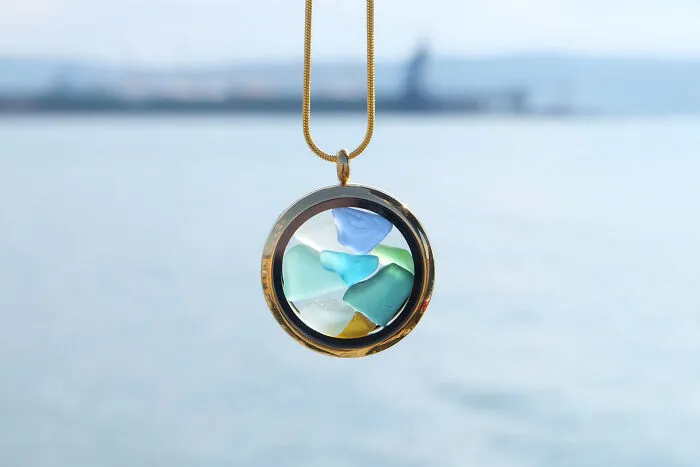
Turning these treasures into unique jewelry and suncatchers is my way of honoring the past while celebrating the present. After all, what was once discarded as trash now shines brightly as a testament to the enduring beauty of the sea.
Join me on this journey of discovery, where every piece tells a story and where the sea's bounty knows no bounds. Together, let's uncover the wonders that lie beneath the surface and rediscover the stories of forgotten history through the photos and descriptions of my finds.
Adventure awaits – are you ready to embark on this journey with me, from the comfort of your screen?
This post may include affiliate links.
#21 Beach In A Bottle
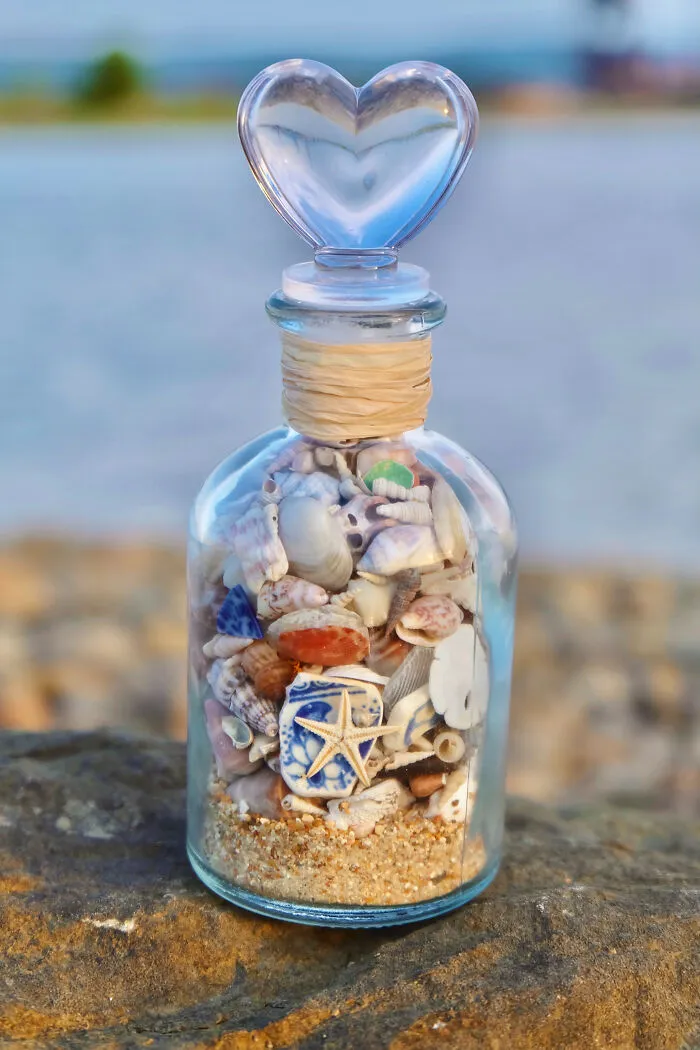
Glass bottle filled with various beach treasures.
0points
#22 G. Piccoli Laibach
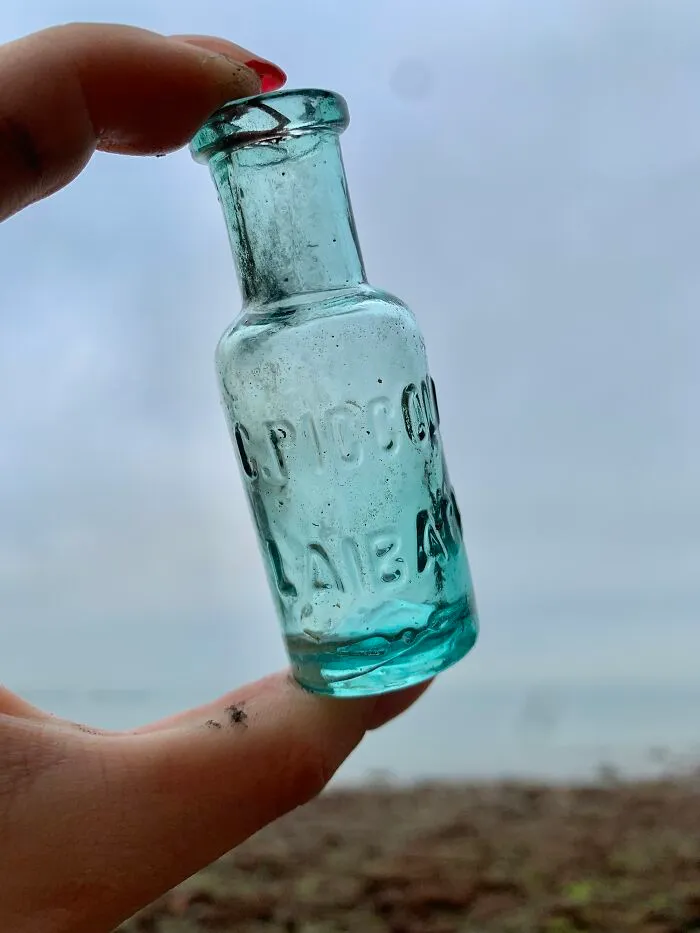
This tiny bottle find with the embossing »G. Piccoli Laibach« is from the Gabriel Piccoli Pharmacy in Ljubljana, Slovenia (Laibach during the Austria-Hungary times) that operated from 1873 to 1946.
Mag. pharm. Gabriel Picolli (born 1850 in Rovinj, Croatia graduated in 1873 in Graz, Austria) bought the pharmacy "pri Angelu" (meaning »at the Angel«) in Ljubljana in 1873.
His son (of the same name) inherited the pharmacy. The pharmacy was known for its solid service, with which it gained regular customers. With the purchase of modern machines, it constantly adapted to the requirements of that time.
0points
#23 Beer Bottle
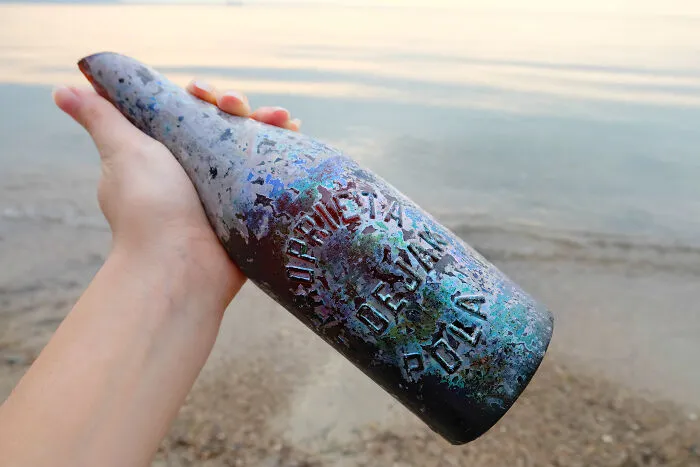
This bottle with the words "Proprieta' L. Dejak Pola" was from a gentleman named Luigi Dejak. He was mostly known for his beer and wine in Pola at the end of the 19th century. His wine received many prizes around Europe for its amazing flavor and quality. This specific bottle was filled with beer.
0points
#24 Collection Of Stamps From Maraschino Liquor
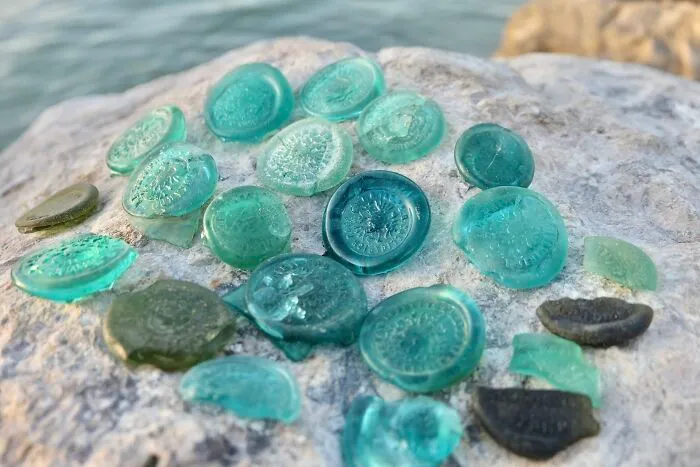
Each Maraschino liquor maker had a stamp on his bottle. The stamp usually had the two headed eagle representing the Austro-Hungarian Empire and the makers surname.
0points
#25 Vlahov Elixir
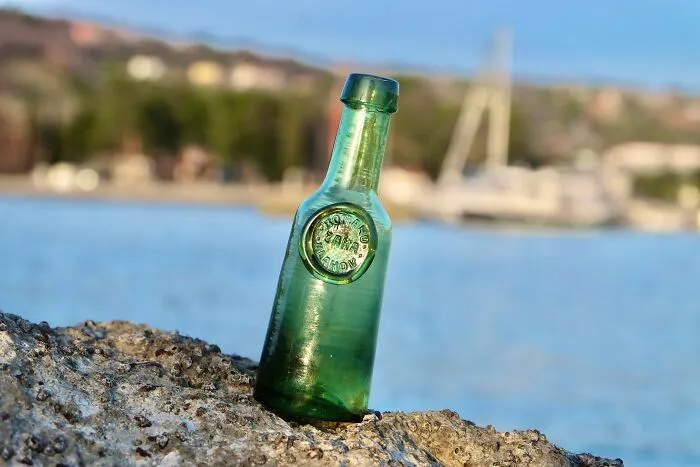
Romano Vlahov started making his first liqueurs in the early 1860s. He founded his first liqueur factory in the city of Šibenik (Sebenico during the Austro-Hungarian Empire) in 1867, and twenty years later in Zadar (Zara), where he became world-renowned for his numerous liqueurs, especially maraschino.
For several years he had been battling a slow illness accompanied by fever. He sought a cure everywhere, but to no avail.
Franciscan Smoje from Split recommended one of his elixirs (liquid used for medical purposes).
Vlahov started taking it, and it helped him. He perfected the recipe with other ingredients, and after a few months, he was completely cured.
And exactly this digestive liqueur (digestif) was inside this 19th-century bottle.
Even today, many, especially after a large meal to facilitate digestion, like to drink "Vlahov" (now under the name "Vlahovac").
0points
#26 Ink Well
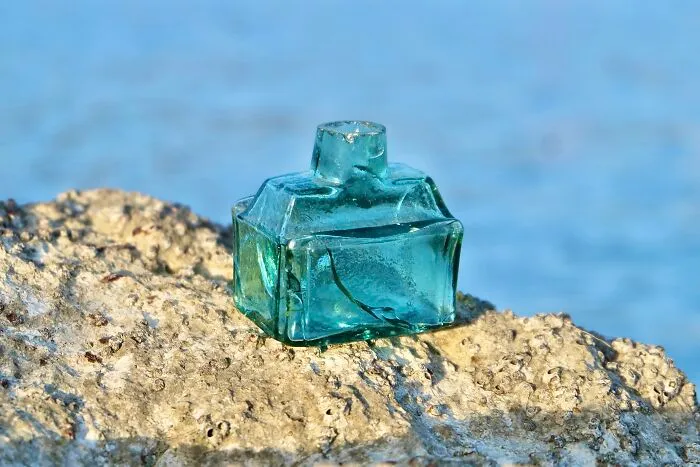
Ink well with a spot to rest your pen.
0points
#27 B. F. P. Bottle
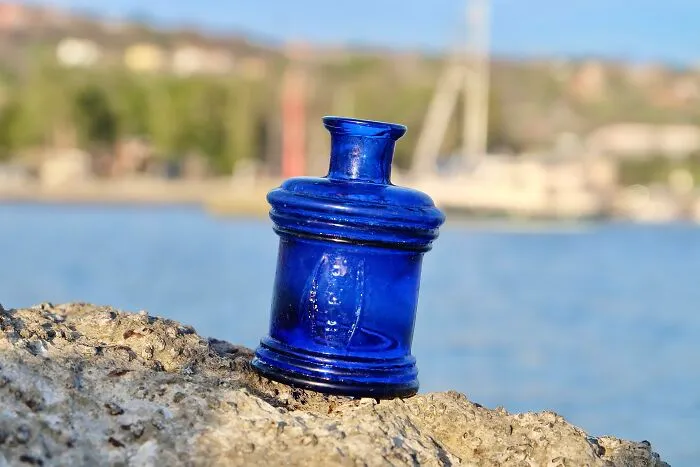
This cobalt blue bottle is shaped like a lot of ink wells I found but this one has an embossing "B. F. P." and I still haven't found any information on it.
0points
#28 120+ Year Old Coins
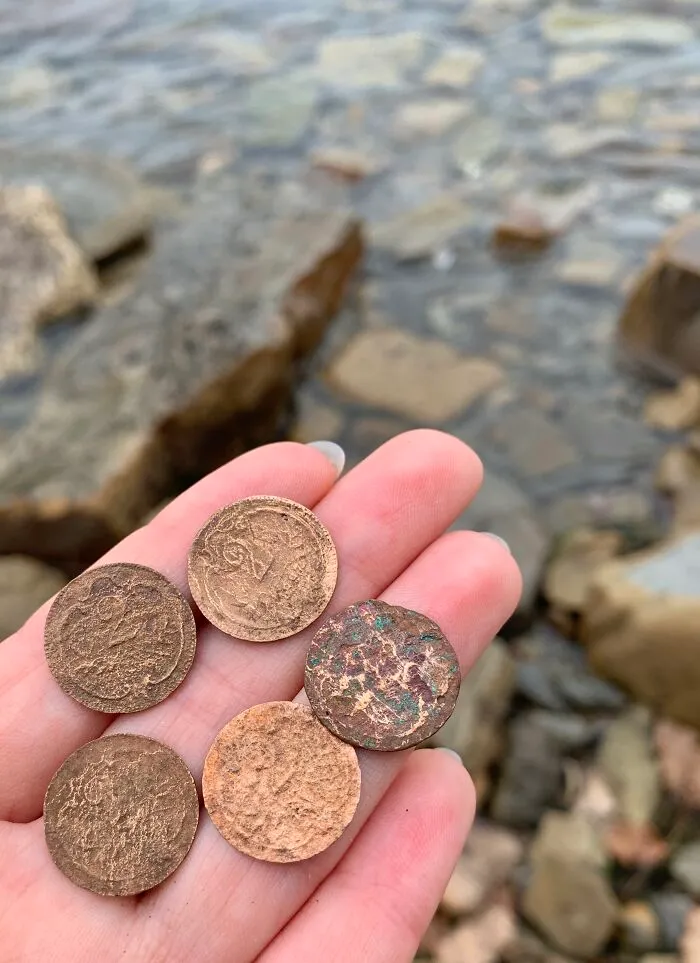
These are "Hellers" from the Austro - Hungarian Empire. On one side there’s a double-headed eagle, on the other side the number 2 and the year it was made. On one piece you can see the year 1897! In Austria-Hungary, Heller was the term used in the Austrian half of the empire for 1/100 of the Austro-Hungarian krone (the other being fillér in the Hungarian half), the currency from 1892 until after the demise (1918) of the Empire.
0points
#29 Half Of A French Plate From The 1860s
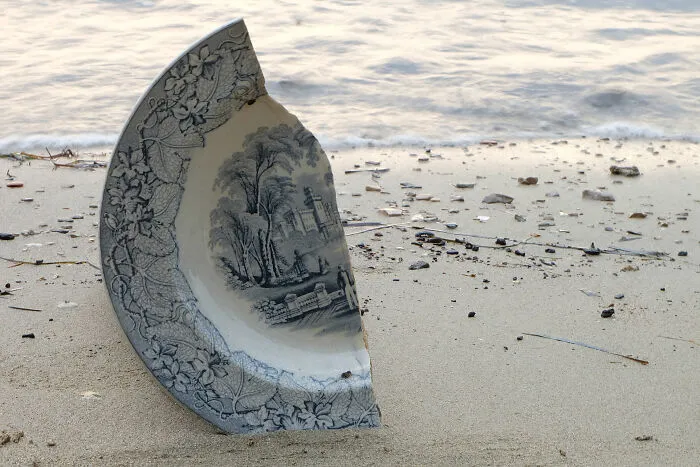
On the back it has half of a stamp of a French maker.
0points
#30 Italian Hotel Plate
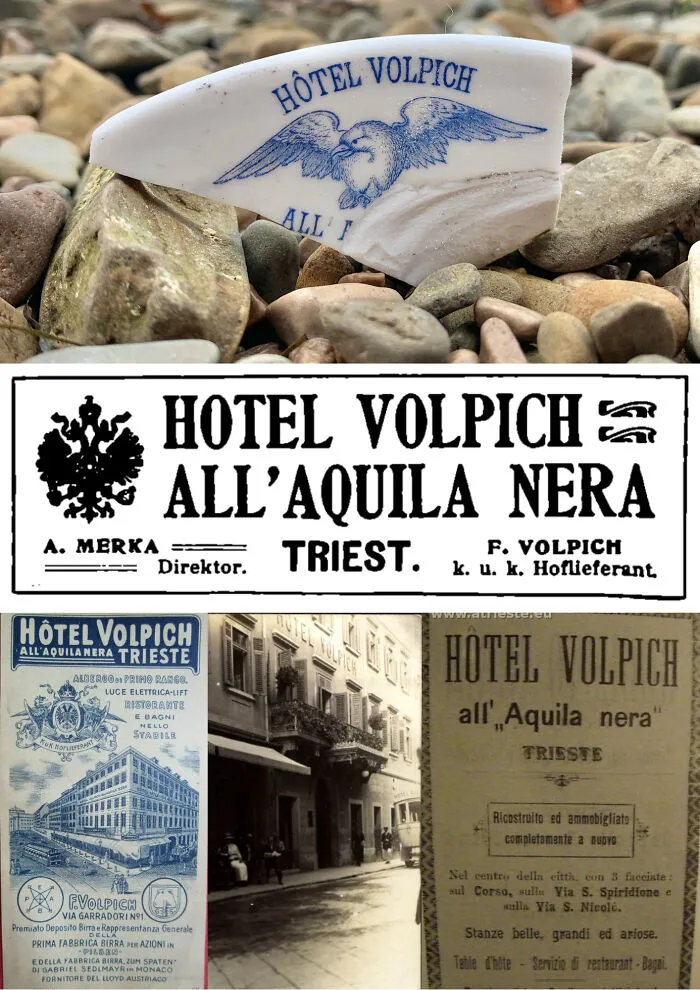
This piece was probably once a part of a plate from a hotel named Hotel Volpich all' »Aquila nera« (black eagle).
It was an inn (a small hotel, providing accommodation, food, and drink, especially for travellers) located in Trieste, Italy.
It became Hotel Volpich in 1896 when it was led by Francesco Volpich. These were the golden years (until 1918).
After the allied invasion of Italy in 1943, the hotel became Hotel Milano and shortly after Hotel Corso. The current owner of the building is Lloyd Adriatico (since 1964) who in 1980 decided on another use of the property.
0points
#31 A Plate And A Cup From The Adriatic "Titanic"
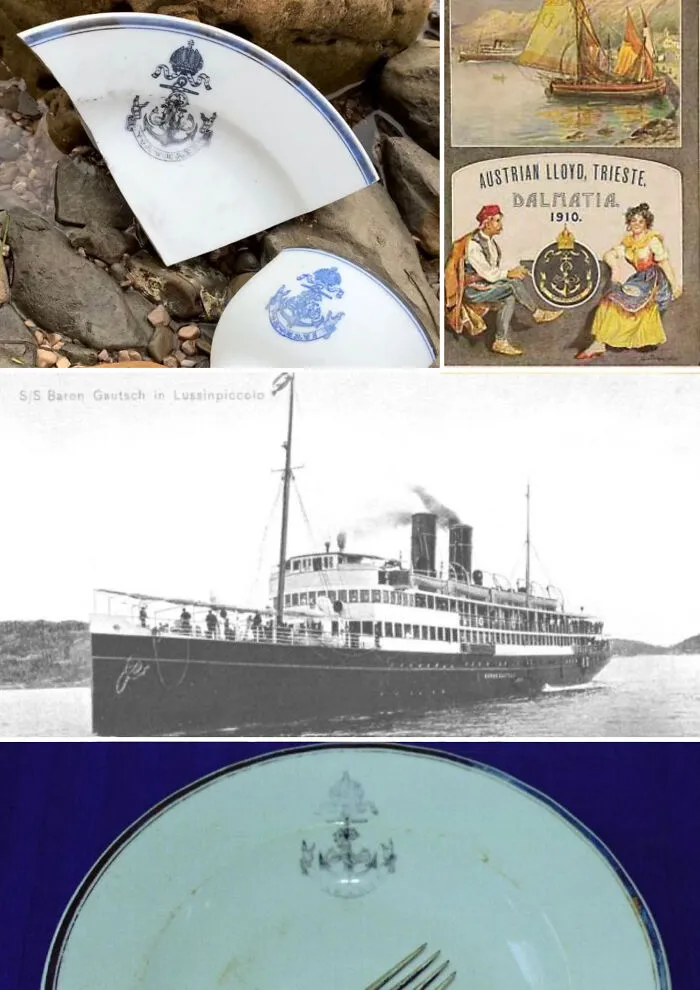
ÖSTERREICHISCHER LLOYD (Italian LLOYD AUSTRIACO) was the biggest shipping company of Austria-Hungary and in the Mediterranean. It was founded in 1833. Its purpose was initially providing information for the participating insurance companies.
From 1836 onwards, the mail service in the Adriatic Sea was also taken over, which laid the foundations for the following expansion in the cargo and passenger area as one of the largest shipping companies in the world.
In 1849, the company launched its flagship Vorwarts (Forward), whose name became its motto. With the opening of the Suez Canal in 1869, the company introduced lines to Mumbai, Colombo, Singapore and Hong Kong.
The passenger ship named Baron Gautsch was one of the most beautiful and modern passenger ships of the Austrian Lloyd. It sailed from the Bay of Kotor on August 12, 1914 on his last, tragic voyage to Trieste, and therefore, given the number of victims, we can call it the Adriatic Titanic. It was less than two weeks after the outbreak of World War I.
On the very next day, the ship sailed too close to the shore into the area of minefields. As soon as the minesweepers noticed that the ship was entering a minefield, they started sending different danger signals, however, there was no reaction from the ship.
At 14.45 a high pillar of the sea rose on the port side of the ship and then a terrible explosion was heard. In the blink of an eye, the sea turned into a terrifying sight of scattered parts of the ship and discarded bodies of passengers floating helplessly and calling for help.
A small part of the assembled crew managed to lower only one of the eight rescue boats. The ship sank in just ten minutes.
Since around 1992, souvenirs from the ship, from silver cutlery to liqueur glasses, have repeatedly appeared on the flea market and in antique shops. The wreck position must have been known to Croatian fishermen, who repeatedly offered divers the opportunity to dive the "Baron Gautsch" - for good payment, but with no guarantee of finding the wreck.
0points
#32 Clay Marbles
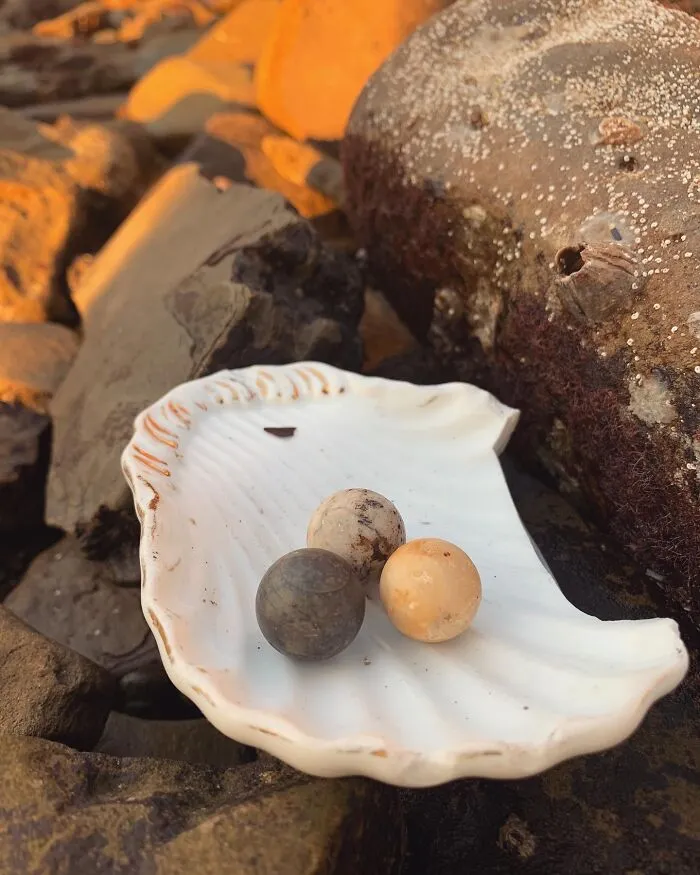
Antique clay marbles, a popular Victorian toy - dating from the 1800s.
These are much more common to find than glass marbles because they were easier to make and more affordable.
0points
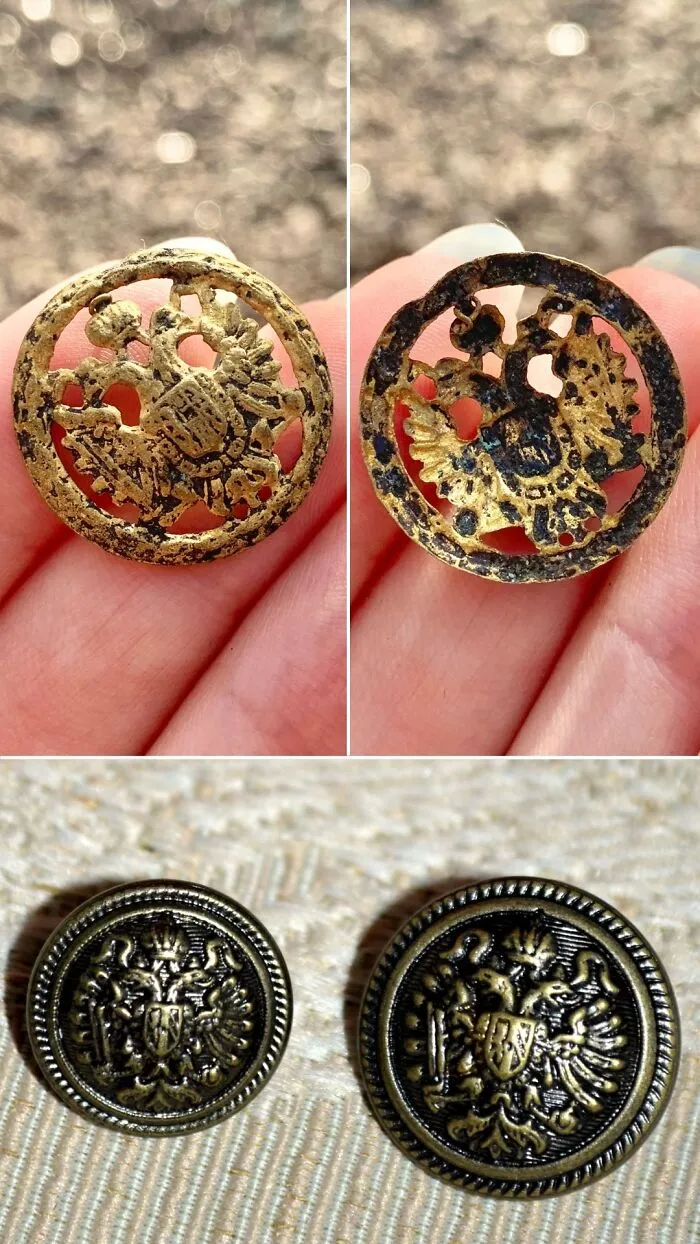
#33 100 Year Old (Part Of A) Button From The Austro-Hungarian Empire Times
0points
#34 Lead Bale/Cloth Seals
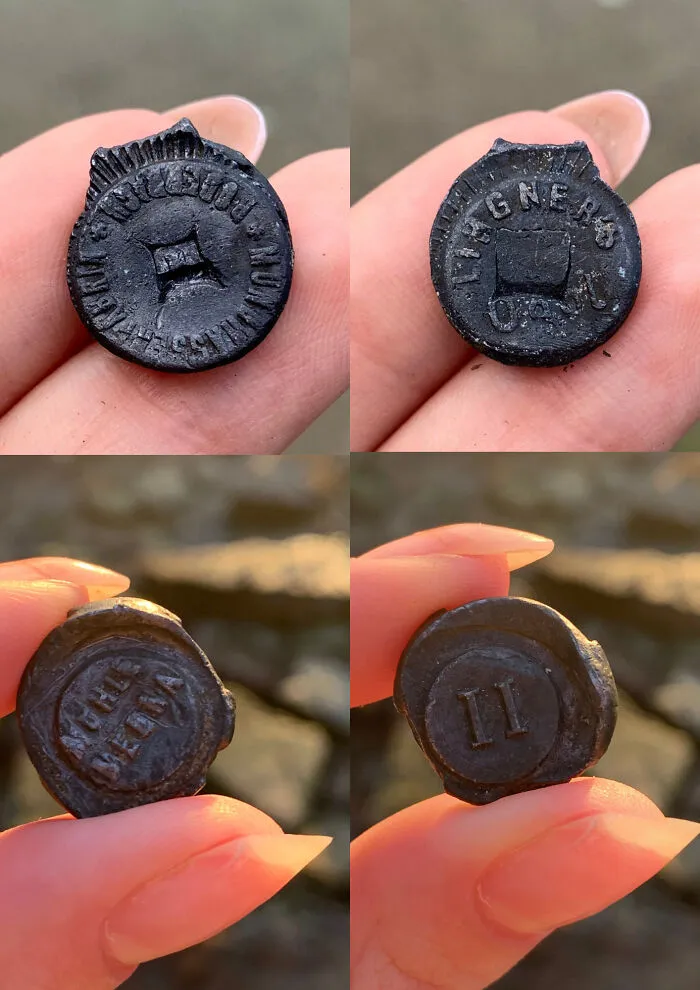
Lead seals were affixed to goods to communicate information such as place of origin, manufacture, quality, size, circulation, and taxation. Lead seals are the colonial equivalent to today’s merchandise tag. Most commonly associated with textiles, lead seals marked everything from tobacco and salt to bundles of various trade goods. Easily molded, a lead seal was affixed to a bale of goods at its place of origin (typically somewhere in Europe) and remained unmolested until the goods reached their final destination. They were used from the 17th to the 19th century.
0points
#35 Vintage Spoon
0points
#36 Natural Mineral Water Selters
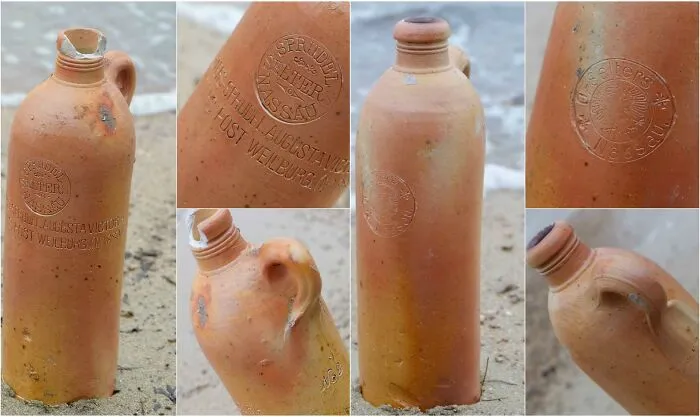
This stoneware bottle contained natural mineral water sourced from a naturally carbonated spring Selters located in Niederselters, Germany.
This spring was the best-known in Germany, and waters were exported worldwide during the 18th and 19th centuries. The bottles were manufactured in the Westerwald Mountains, known as the “jug baking land/district.”
This bottle is from a German company named OberSelters that even today sells mineral water (produced in Nassau, Germany).
Mineral water has been known as a natural soda water because of its high concentration of sodium bicarbonate, “soda”. Selters water also contains raised levels of calcium, chloride, magnesium, sulfate and potassium ions.
The stamp on this bottle (a German eagle surrounded with the words »Ober-Selters Nassau«) was used only on bottles made from 1836 to 1866.
Under the handle of each bottle is stamped the first initial of the jug maker’s location (I have always found the letter M) and their individual number.
0points
#37 Giacomini Pills
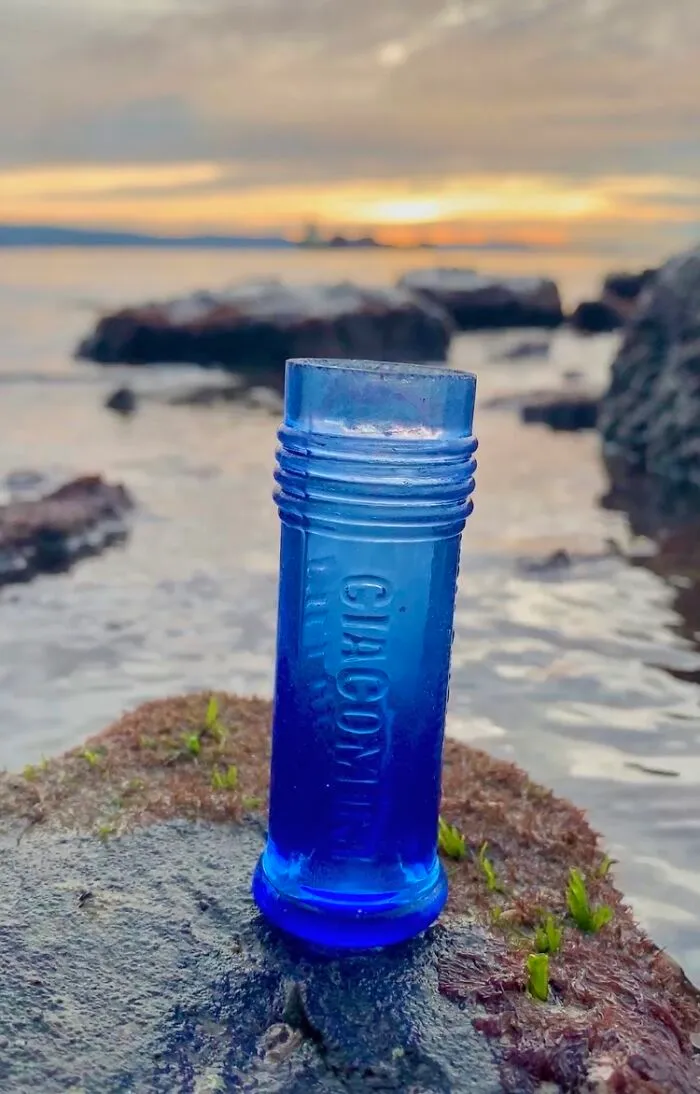
Cobalt blue glass bottle with the words »GIACOMINI«, »PILLOLE« AND »ANTI-EMORROIDALI«. The bottle contained treatment pills for hemorrhoid problems, as highlighted in relief on the outer wall of the package (ANTI-EMORROIDALI).
GIACOMINI is the name of one of the most important scientists in the first half of the 19th century in Italy and a university professor in Padua - Giacomo Andrea Giacomini.
Giacomini pills are also mentioned in the list of medicinal, medical, chemical, cosmetic, and various other approved products from 1890 in Italy and major European capitals.
At that time, for 50 years since prof. Giacomini registered the prescription pills, the right of distribution had the pharmacy Pianeri e Mauro located in the heart of Padua.
The bottle was made dark blue so the contents were protected from daylight.
0points
#38 Different Bottle Finds
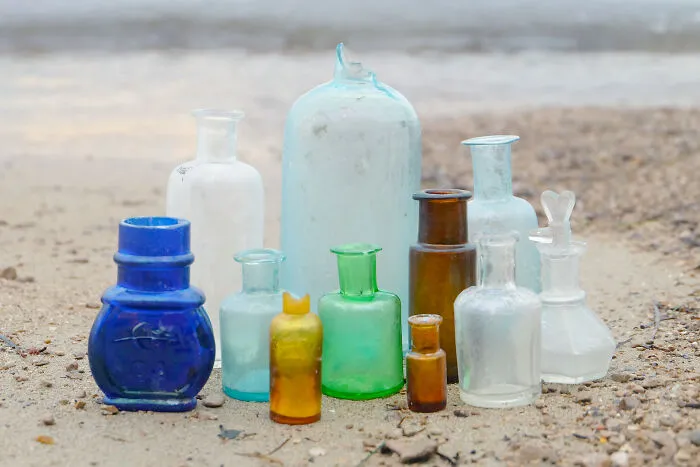
Most of them are pharmaceutical bottles once filled with medicine. Some don't have any markings while some have a number on the bottom (meaning how many millilitres were inside).
0points
#39 Rifle Bullet
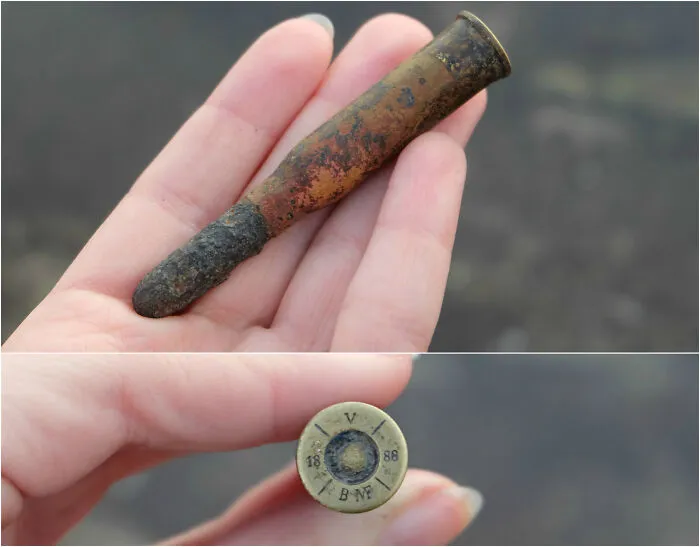
The 8×52mmR Mannlicher cartridge was first introduced in 1888 for the Mannlicher M1888 rifle. It was made in and also used by the Austro-Hungarian Empire from 1888 to 1890.
0points
#40 Sea Glass Locket
0points

