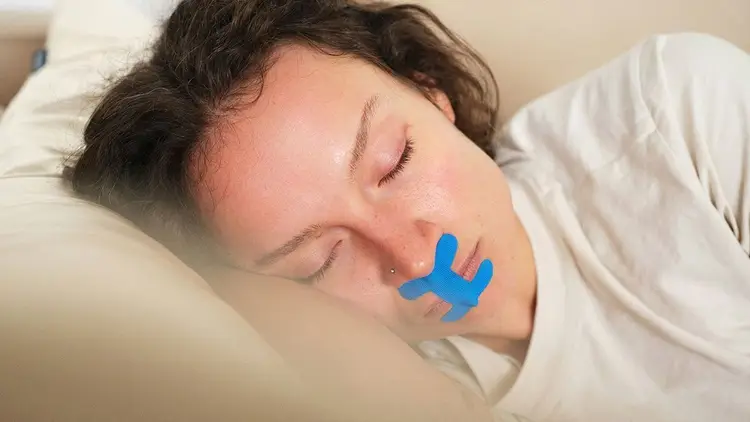
Walking into a new dentist’s office, the last thing I expected, before even opening wide, was to be called a mouth breather. I flinched, initially taking it as an insult. After all, “mouth breather” isn’t exactly a compliment. As it turns out, though, mouth breathing is more than an unflattering label. It can be a sign of underlying issues, from nasal congestion and allergies to structural problems that make breathing through the nose difficult. I hadn’t given it much thought before that appointment, but afterward I started wondering whether it was something I should pay attention to. I was reminded of it again when mouth taping started to take off online, appearing in video after video on my feed, with influencers claiming that sealing your lips before bed could work all sorts of miracles: reduce snoring, improve sleep, prevent dry mouth, and even give you a more defined jawline. Naturally, I had to wonder: does it actually work? And if you already breathe through your mouth, is taping it shut a sensible fix or a risky one? So I dug into the research and spoke to an ENT surgeon, an orthodontist, a dentist and a medical writer with a background in pulmonology to find out what’s worth knowing before you try this viral sleep trend. Roberta Sant'Anna / Unsplash (not the actual photo) Leaving the dentist’s office that day, I remember being amazed that he could tell so much about how I breathed at a glance. Was it written all over my face? Well, yes, it turns out it might very well have been. Studies have linked mouth breathing in childhood to changes in how the jaw develops. Dr. Shaun Dadjoo, an orthodontist in Porter Ranch, California, who treats children and adults with mouth breathing, told Bored Panda that the habit can affect the shape of the face, too. “The pressure of the lips and the jaw opening causes upper jaw crowding, and it causes the lower jaw to be recessed,” he said. “It can make the face look longer and narrower and make the nose look more pronounced over time as the child is growing.” There’s even a name for it, and it’s somehow less flattering than “mouth breather”: mouth breather face. WikiHow (not the actual photo) It’s also very much a dentist’s business. Dadjoo says mouth breathing “dries out your teeth,” making cavities and gum disease more likely. In a small study of 10 healthy volunteers, the inside of the mouth became more acidic when participants were forced to breathe through their mouths while sleeping. The researchers said this could contribute to tooth erosion and decay. And it doesn’t stop there. Breathing through your mouth at night has also been linked to snoring and sleep apnea, a common but serious condition where your breathing repeatedly stops and starts while you sleep. So if mouth breathing is a problem, why not just tape your mouth shut? It certainly sounds tempting, especially when TikTok promises that a simple strip of tape can fix just about everything. But as it turns out, those miracle claims have very little research behind them. Marcos Philip / TikTok / Jordan Walker / TikTok “The evidence is much weaker than social media suggests,” Dr. Muhammad Qasim, a medical writer with a background in pulmonology, told Bored Panda. “While it may reduce mouth breathing or snoring in some individuals, we don’t have convincing evidence that it consistently improves sleep quality or overall breathing.” A scoping review published in the American Journal of Otolaryngology by Sarah K. Fangmeyer and her colleagues identified 177 studies on the topic, but only nine met their criteria for examining mouth taping during sleep. They also looked at the first 50 TikTok videos about mouth taping to see what people were being told. The most common claim, made in 36% of the videos, was that it leads to better sleep. Next came oral health benefits, such as preventing cavities (24%), morning bad breath (22%), and dry mouth (18%). Some videos said it prevents snoring (16%), and a few (6%) even claimed it could improve or cure sleep apnea. Strikingly, however, just two referred to specific scientific studies, even though nearly a quarter featured medical professionals. In other words, there was no shortage of confident claims, but very little evidence offered to back them up. And only one in five mentioned any potential risks at all. That’s a problem, because those risks may be real. “There is very little evidence to support mouth taping’s purported health benefits, and some clear evidence of risk and potential harm,” Dr. Brian Rotenberg, a professor of ear, nose, and throat surgery at Western University’s Schulich School of Medicine and Dentistry, told PolitiFact. Rotenberg co-authored a 2025 systematic review in PLOS ONE that examined 10 small studies of mouth taping and other ways of keeping the mouth closed during sleep. Four highlighted potential dangers, including asphyxiation in people with nasal obstruction or regurgitation, while only two found statistically significant improvements in established sleep apnea measurements. jm_video / Envato (not the actual photo) The most encouraging results came from studies involving people with mild sleep apnea. One of these, a 2022 study, followed 20 people who usually breathed through their mouths at night. After a week of mouth taping, the number of times their breathing paused or became shallow fell from a median of 8.3 to 4.7 times an hour, and their snoring was roughly halved too. The researchers even suggested mouth taping could be an alternative to surgery or CPAP, a machine that pumps air through a mask to keep the airway open during sleep, for some people with milder cases. Sounds promising, right? But here’s the catch: The participants were carefully selected. Anyone with a blocked nose was excluded, and they had to be able to tolerate having their mouths sealed. A 2025 trial of 62 people, most with more severe sleep apnea, found another possible use. In people who breathe through their mouths, air can escape while using CPAP, making the machine harder to use. When participants added mouth tape, they used their CPAP machines for around 52 minutes longer per day on average. They also reported less snoring, less daytime sleepiness, less dry mouth, and fewer night awakenings, but some side effects were reported, too. Still, in both cases, tape was helping under specific conditions, not acting as a treatment on its own. In other words, as Qasim puts it, mouth taping “might have a limited role in carefully selected patients under specialist supervision, but the evidence remains preliminary.” Getty Images / Unsplash (not the actual photo) There’s a reason the 2022 study excluded anyone with a blocked nose. Sealing your mouth shut doesn’t automatically mean your nose will take over, and for some people, that can be a problem. For a start, tape doesn’t guarantee you’ll switch to breathing through your nose. When researchers in a small 2023 study taped the mouths of 71 people, some kept trying to breathe through their mouths anyway, puffing out their cheeks against the tape. This phenomenon, known as mouth puffing, was more common in people with severe sleep apnea. And for about half of the participants, oxygen levels dipped more often with the tape on than without it. On average, this group also did more mouth puffing. A separate 2024 study in JAMA Otolaryngology–Head & Neck Surgery looked at a related question. The researchers suspected that for some people, mouth breathing might be “an essential route to bypassing obstruction.” To test this, they measured airflow in 54 sedated patients with obstructive sleep apnea, first with their mouths relaxed and then held closed. No tape was used, but the principle is similar. The results varied depending on how much each person relied on mouth breathing. For those who barely breathed through their mouths, closing it made little difference. For people who breathed through their mouths moderately, airflow actually improved. But for the 12 patients who breathed mainly through their mouths, it got worse. The researchers linked this to velopharyngeal obstruction, a narrowing behind the soft palate where the nasal passage meets the throat, and concluded that “personalized approaches to treating mouth breathing should be considered.” Dr. Jessica Camacho, an assistant professor of internal medicine at the University of Colorado Anschutz, has also highlighted the findings. In an article published by the university in August 2025, she noted that some patients had “a distinct worsening with mouth occlusion, which could be dangerous.” That’s why simply sealing your mouth shut deserves a second thought, especially if breathing is already a struggle. “Taping doesn’t fix a structural blockage. It only takes away your backup airway,” Dr. Sami Moubayed, an ENT surgeon in Montreal, told Bored Panda. Dr. Shannon Sullivan, a sleep specialist at Stanford Medicine, agrees. “Taping closed a viable airway, even if it’s not the preferred airway, has a series of risks associated with it,” she told Women’s Health. Zinkevych_D / Envato (not the actual photo) With that in mind, experts say some people should steer clear altogether. In an article published by Cleveland Clinic, pediatric sleep medicine specialist Dr. Brian Chen says you should never use mouth tape if you have nasal obstruction, nasal congestion, chronic allergies, sinus infections, enlarged tonsils, a deviated septum, or heart issues. “For individuals already struggling with conditions like nasal obstruction or chronic allergies, mouth taping introduces an unacceptable level of risk,” he warns. Relying on your nose alone, he explains, could lead to severe breathing difficulties, significant drops in oxygen levels, and a worsening of underlying health problems during sleep. The Sleep Foundation also advises against it for people with untreated sleep apnea, chronic nasal congestion, or difficulty breathing through their nose, as well as those with asthma, COPD, or anxiety and panic disorders. Sullivan and Dr. Raj Dasgupta, who specializes in pulmonary, sleep and critical care medicine, also told Women’s Health it isn’t a good idea for people with a previous nose injury, a chronic cough, or postnasal drip. Moubayed and Sullivan caution against it after drinking alcohol or taking sedatives, and Sullivan advises against it for people who don’t wake easily. Dr. Andrey Ilyabayev, a dentist in Queens, New York, warns that a taped mouth can “create a huge choking and aspiration hazard if you throw up or have acid reflux.” Yes, the contraindications are quite a mouthful. And there are some less serious side effects to be aware of, too. According to Cleveland Clinic, mouth taping can cause redness, irritation or allergic reactions on the lips and skin, anxiety, and trouble falling or staying asleep. Ilyabayev adds that “removing that tape each morning can tear that delicate lip skin, and if you cough while your mouth is taped, it can cause more tugging that adds to the irritation.” Curated Lifestyle / Unsplash (not the actual photo) There’s a good reason nasal breathing is generally preferred. As Dr. Aatif Husain, a professor of neurology at Duke University Medical Center, told PolitiFact: “The nose warms, humidifies and filters inspired air.” But if you’re breathing through your mouth, there’s usually a reason. “Common causes are allergies, chronic rhinitis, a deviated septum, enlarged turbinates, polyps or, in kids, big adenoids,” Moubayed says. He suggests a simple test: “If you can’t breathe comfortably through your nose with your mouth closed for a few minutes during the day, it isn’t just a habit.” Dasgupta made a similar point to Women’s Health: “If you have to tape your mouth to breathe through your nose, that tells me there’s gotta be something anatomically wrong or medically wrong and that should be evaluated.” In that case, it’s worth finding out why before you reach for a roll of tape. As Husain puts it: “It is better to find and treat that cause than to ‘tape over it.’” The right treatment depends on what’s behind it. “Saline rinses and a steroid spray help many people with allergies or rhinitis. Some need septoplasty or turbinate reduction,” Moubayed says. “Loud snoring with daytime fatigue deserves a sleep study.” And if a sleep study shows sleep apnea, Qasim says, “CPAP has the strongest evidence for treating obstructive sleep apnea, while custom oral appliances, positional therapy and weight management can help selected patients.” There are also simpler steps for specific symptoms. For snoring, Cleveland Clinic suggests sleeping on your side, and the Sleep Foundation notes that decades of research show people snore less in that position. Nasal strips are another option, though studies on them have had mixed results. If dry mouth is your main complaint, Ilyabayev suggests drinking water, chewing sugarless gum, and cutting out alcohol and tobacco, “along with getting a dental check.” And if you simply want a better night’s sleep, there are less questionable places to start. Camacho recommends keeping a consistent sleep and wake schedule, making your bedroom cool and comfortable, avoiding screens for an hour before bed, limiting excess alcohol and caffeine, and getting enough exercise. magnific / Magnific (not the actual photo) Not tonight, at least. But something Dadjoo said stayed with me. Rather than taping up at bedtime, he suggests using a strip during the day, while watching TV or sitting in the car, simply to help you notice when you’re breathing through your mouth. “You’re certainly not going to see physical changes, but if it’s done with awareness, you will see a habit being recognized and fixed,” he says. (So much for that sharper jawline.) Taping during the day, when you’re awake and can easily take it off, seems reasonable enough. Still, I think I’ll play it safe. I can breathe comfortably through my nose with my mouth closed, so I’ll try working on the habit without tape first, reminding myself to switch back whenever I catch my mouth agape. If that doesn’t work, I think I’d rather see a doctor before I start keeping a roll on my bedside table. After all, it’s breathing we’re talking about here.