

Turning to family for help in tough times is often a reminder of why we need family in the first place. That doesn’t mean actually asking is simple or without any complications and that’s before we consider the question of if your relatives like each other in the first place.
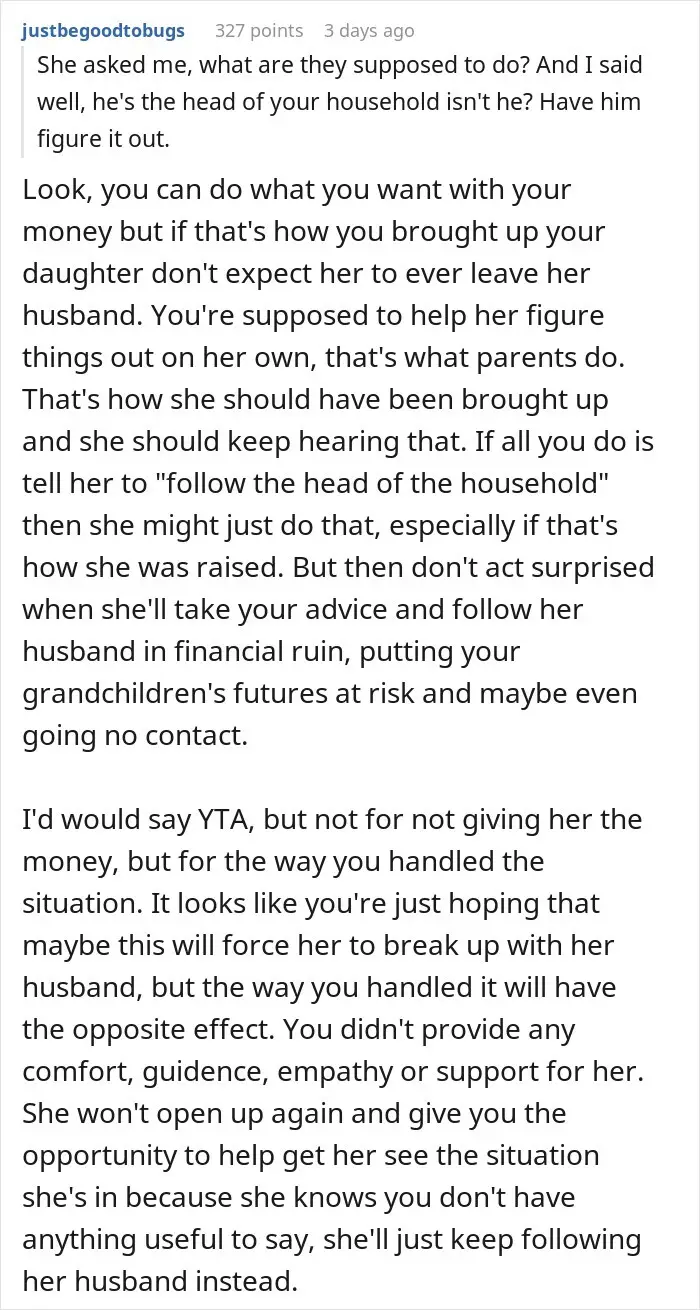
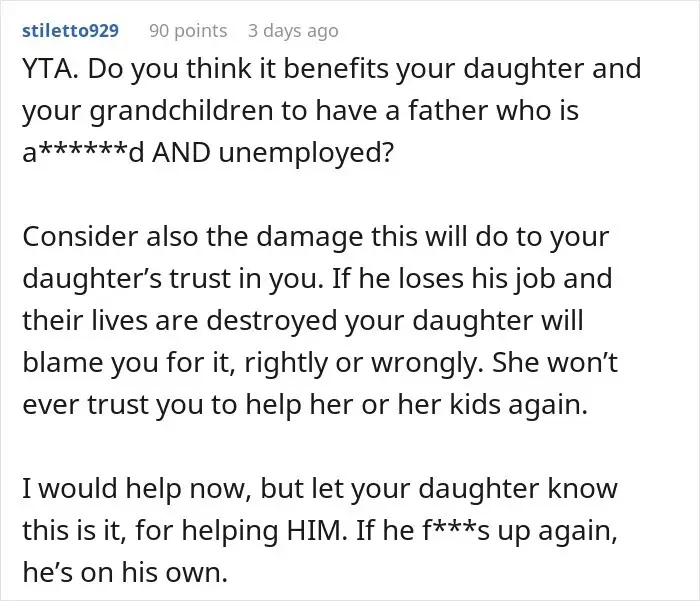
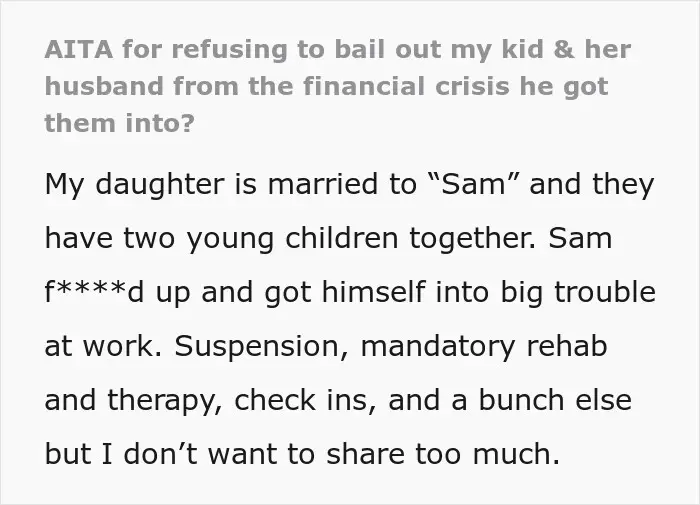
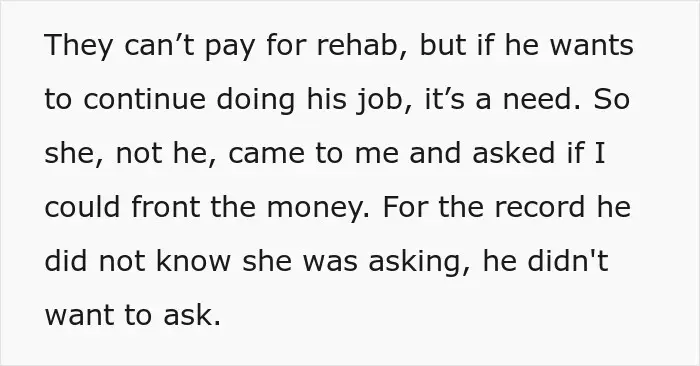
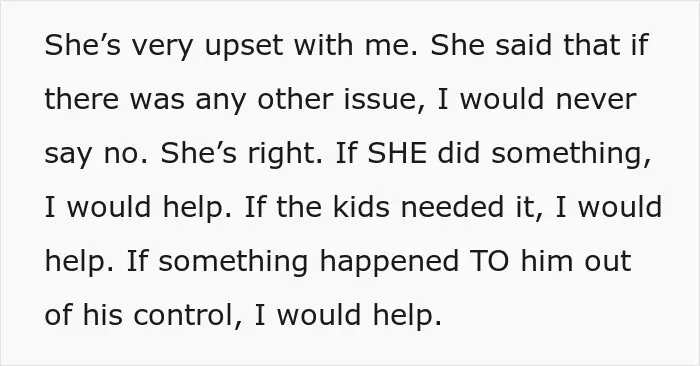
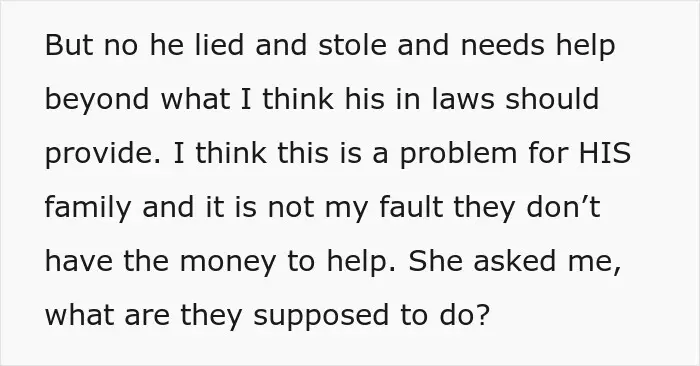
A netizen asked the internet if they were wrong for refusing to help their daughter’s husband with money. He’d lost his job and was required to go to rehab, which he could not afford. The daughter was angered when she was told no and, to make matters worse, it turns out that she hadn’t even told her husband she’d ask for help.
When and how one helps family is a complicated question








Helping your kids doesn’t end when they turn eighteen
Parents of grown children walk a tricky line, because the job description changes the day a kid turns eighteen and keeps changing from there. Nothing in any rulebook says a parent must pay for a daughter's husband to attend a treatment program, and plenty of money experts say a firm no can be healthy. AARP points out that many parents who help their adult children end up straining their own finances, and that stepping back from cash does not mean stepping away from helping altogether. So the refusal itself sits well within a parent's rights. The more interesting question is everything wrapped around it.
Money talks between generations are rarely only about money. Psychology Today notes that dollars carry symbolic weight and that anyone attaching conditions to help should say so plainly instead of expecting everyone to guess. In this case the conditions seem to live between the lines. The daughter heard a no, but she also heard that her marriage is a mistake, that her judgment is suspect, and that her husband's troubles belong to someone else's family. Urging a grown woman to think with her head instead of her heart sounds caring on paper, yet it quietly tells her that her own reasoning does not count. That is often where a boundary starts drifting into steering.
Manipulation does not require a villain. It can look like holding back support at a vulnerable moment in the hope that someone reaches the conclusion you prefer. The parent says they would never force a separation, and that seems sincere, but a closed wallet during a crisis can work as a nudge all the same. To be fair, nothing here suggests the daughter was playing games. She asked a parent for help during a stressful stretch, which is what families are for.
This isn’t just about a loan
Then there is the question of what counts as support and what counts as enabling. Here the consequences are already landing in full, with a suspension, mandatory check ins, and a career hanging in the balance. A treatment program looks less like an escape from those consequences and more like the path through them. Paying a provider directly, offering a loan with a written repayment plan, or making a gift that depends on finishing the program would all keep accountability intact. Declining every option is a choice, not a requirement of tough love.
Cost is also rarely the brick wall it appears to be. Suggesting a financial advisor or case worker was practical advice, and arguably the most useful part of the conversation. Offering to sit beside the daughter and make those calls together would have turned a brush off into real help.
The stated worry is the grandchildren, which makes the logic a little tricky. If treatment lapses and the career ends, household income takes the hit and the little ones feel it first. A grandparent who stays steady and reachable may be the best safety net those kids have. Simply Psychology frames boundaries with grown children as a tool for mutual respect, ideally paired with a message that the person can handle hard things. A line like "should have thought about that before" leans the other way, even if it contains some truth.
So is the parent overreaching a bit? Declining to write the check, not really. Where it tips toward overreach is in the extras, such as commenting on who should run the household, shrugging off the career stakes, and tying the answer to a verdict on the marriage. A calm reply saying the full amount is not possible, followed by what the parent can offer, would have held the boundary and protected the relationship. Anyone who has sat through a family money conversation knows how quickly a practical question turns into a ruling on someone's life choices.
They also answered some reader questions


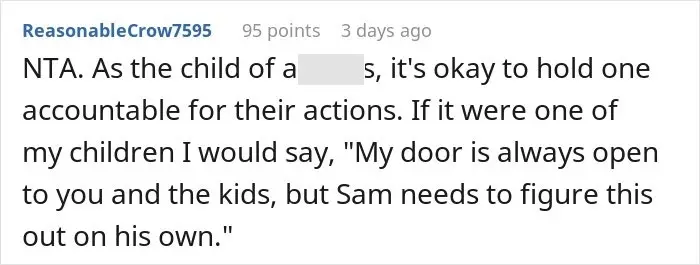
Some folks supported their decision


Others thought the question was more nuanced






A handful thought they should help their daughter