



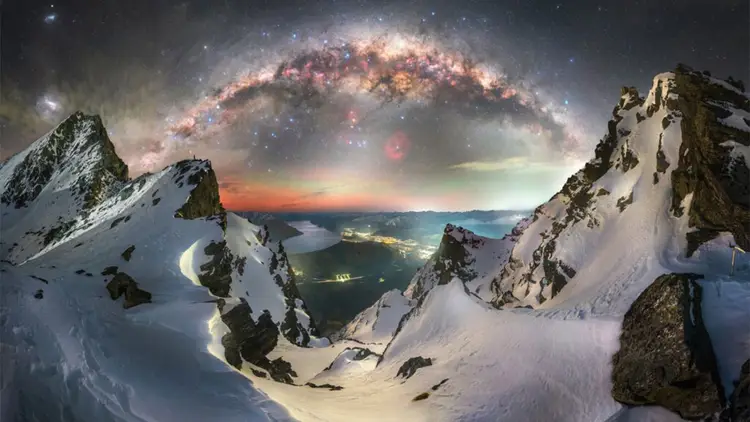


Every year, the Capture the Atlas Milky Way Photographer of the Year contest brings together some of the most striking night sky images from photographers all over the world. Curated by photographer Dan Zafra, the project highlights a carefully selected collection of around 25 photos taken in some of the darkest and most remote places on Earth – locations where the Milky Way is still visible in incredible detail, free from the glow of light pollution.
What makes this contest special isn’t just the final images, but everything behind them. Each photo usually involves planning, travel, and a lot of patience, waiting for clear skies, perfect timing, and the right conditions to align. These aren’t just snapshots of the night sky, but moments earned through dedication and a real passion for astrophotography. The result is a collection that feels both artistic and deeply human, showing how different places on Earth (and beyond) connect through a shared view of the cosmos.
Scroll down and explore the winning images for yourself. Each one is a window into a different corner of the night sky, captured in a way most of us rarely get to see.
#21 “Galactic Gandalf” By Evan Mckay
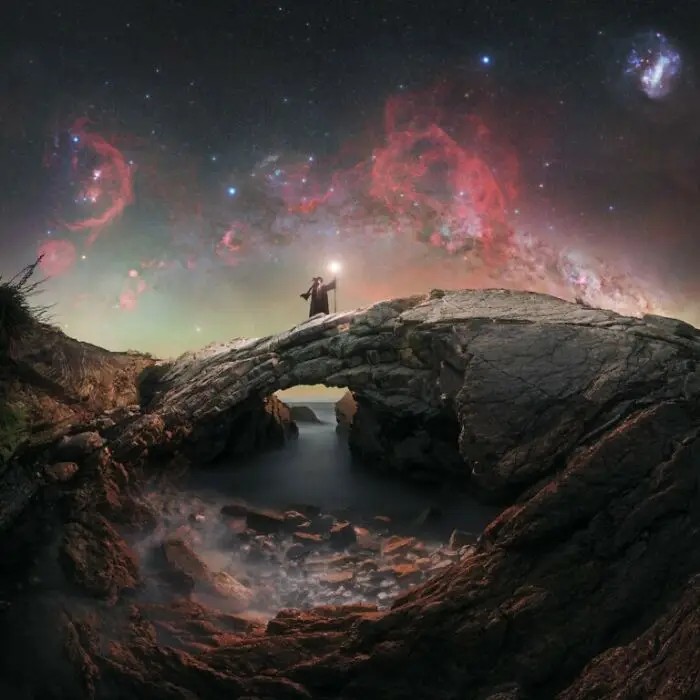
Location: Wairarapa Coast, New Zealand
When I first discovered this location, I immediately envisioned creating something special beneath the night sky. However, upon arriving after dark, I found that a seal had settled exactly where I had planned to set up my tripod. It showed little interest in moving, and judging by how worn and polished the rock was, it was clearly one of its preferred resting spots.
Eventually, the seal shifted slightly to the side, remaining within the scene for the duration of the shoot. It can still be seen in the final image for those who look closely, adding an unexpected and memorable element to the composition.
Given the complexity of the scene, I knew the final image would require a significant amount of work. Over the following weeks, starting in November, I returned whenever possible to collect the necessary data for this panorama, carefully building the image piece by piece under the night sky.
Report
4points
#22 “Sodium Milky Way” By Julien Looten
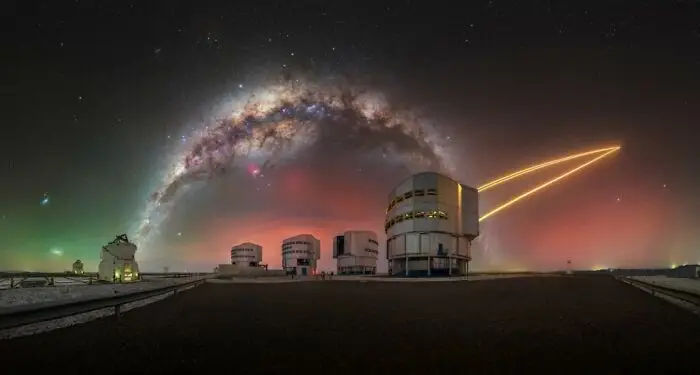
Location:Very Large Telescope, Paranal, Chile
This scene was captured at the Very Large Telescope (VLT) on Cerro Paranal, in Chile’s Atacama Desert, under exceptionally pure observing conditions where the boundary between Earth and sky feels almost seamless.
The Milky Way stretches across the sky, with its dense central bulge rising prominently overhead. To the left, the Magellanic Clouds, two neighboring satellite galaxies, are visible to the naked eye from the Southern Hemisphere. Subtle airglow adds another layer to the scene, a natural emission produced by chemical reactions in the upper atmosphere at altitudes of 80 to 100 kilometers. In this image, it reveals a range of colors, with green tones on the left and warmer reddish hues toward the right.
In the foreground stands the VLT, operated by the European Southern Observatory. Situated at 2,635 meters above sea level, the site benefits from extremely dry conditions, stable atmospheric layers, and minimal light pollution, resulting in more than 300 clear nights each year.
The observatory consists of four primary telescopes, each equipped with 8.2-meter mirrors. One of them, UT4 (Yepun), projects four sodium laser beams into the sky, creating artificial guide stars at an altitude of approximately 90 kilometers. These reference points enable adaptive optics systems to correct for atmospheric distortion in real time, significantly enhancing the clarity and precision of astronomical observations.
Report
4points
#23 “Lost In The Ripples Of Space And Time” By Leonel Padrón
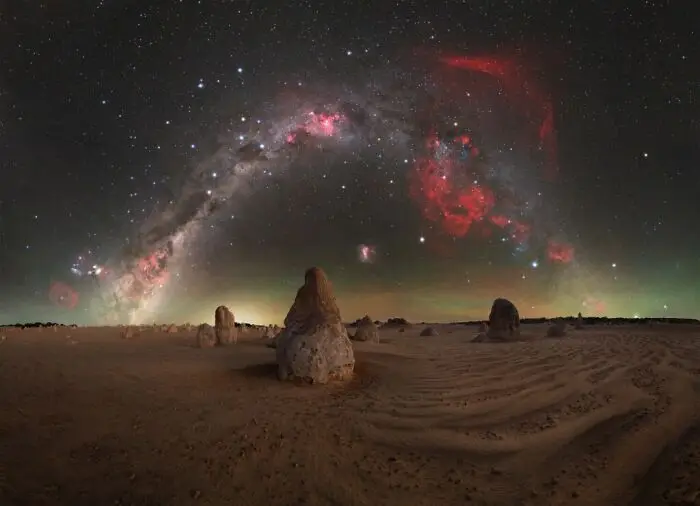
Location:Pinnacles Desert, Nambung, Western Australia
There’s something uniquely powerful about a calm, windless night in the Pinnacles Desert, a place that never fails to remind me how fortunate we are to have such pristine dark skies so close to home, just a short drive away. As the sun sets beyond the Indian Ocean, a profound stillness settles over Nambung, transforming the landscape into an almost otherworldly scene and drawing me back here time and time again.
In this composition, the main limestone pillar aligns almost perfectly with the South Celestial Pole, anchoring the image beneath the rotating sky. To the right, the faint but unmistakable red glow of the Gum Nebula, a vast supernova remnant, adds depth and scale to the scene.
Western Australia offers some of the finest night skies in the world, yet it’s easy to take them for granted. Nights like this serve as a reminder of just how special these quiet, remote corners of the Wheatbelt truly are.
Report
4points
#24 “Galactic Spine” By Andrew Imhoff
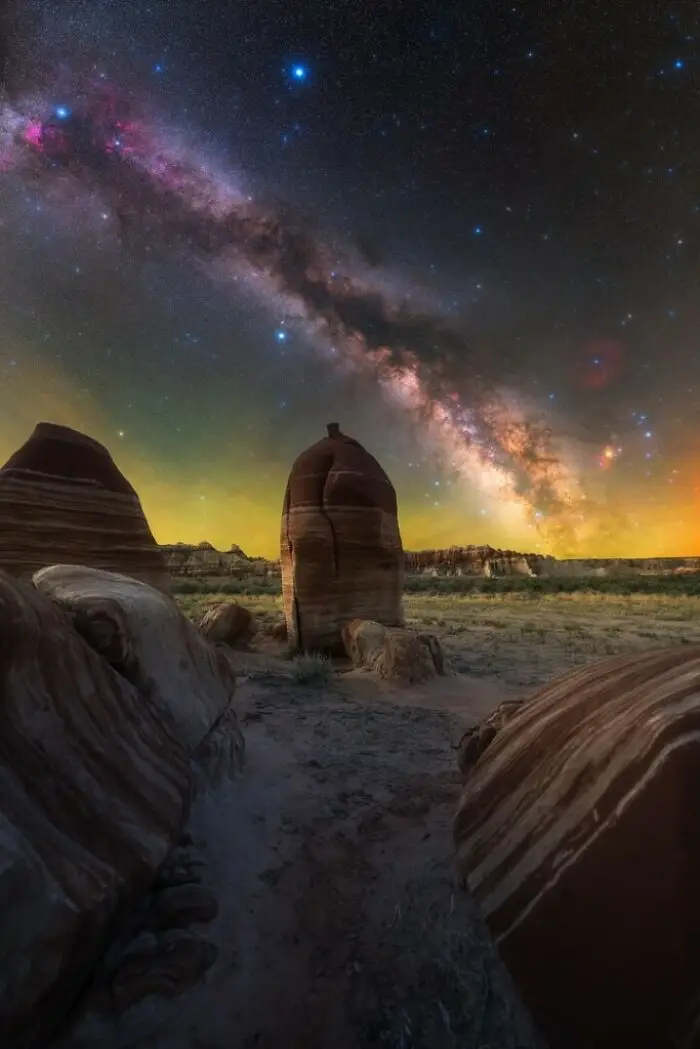
Location: Hopi Reservation, Northern Arizona, USA
I am drawn to Milky Way photography because of its ability to spark curiosity. It offers a perspective that feels entirely different from other forms of photography, often revealing a world that many people have never experienced.
With my images, my goal is to inspire that same sense of curiosity, encouraging others to imagine what it feels like to stand beneath a sky like this and witness it with their own eyes. That sense of wonder is what first drew me to the Milky Way, and it continues to shape the way I approach each image.
Report
4points
#25 “Double Milky Way Over Monfragüe National Park” By Luis Cajete
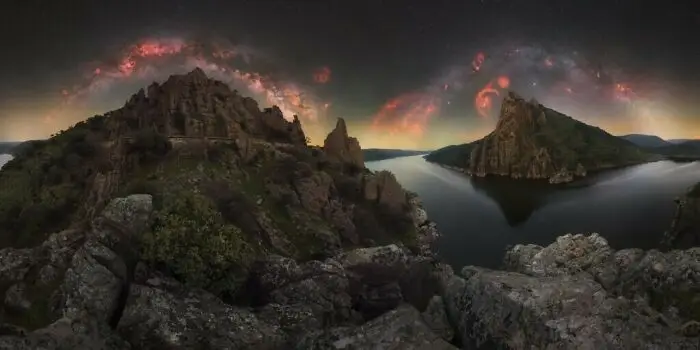
Location: Monfragüe National Park, Spain
I am always drawn to traveling to remarkable natural landscapes to capture their essence through night photography. This image, which represented a significant challenge for me, was taken in Monfragüe National Park during one of the few nights of the year when both the winter and summer Milky Way can be seen in the same sky.
The scene does not appear this way to the naked eye. It is a composite that captures the transition of the Milky Way over several hours, combining the winter Milky Way visible after dusk with the summer Milky Way rising before dawn.
The following morning, I was able to return to this location with my family, who had accompanied me in the search for this long-envisioned image. Those shared moments, along with the effort behind the capture, make this photograph especially meaningful to me.
Report
2points


