






There’s always something new to learn! Staying curious throughout your life is a great way to keep your mind sharp and avoid cognitive decline. Meanwhile, social media isn’t just meant to be entertaining. It can be very educational, too.
‘Explained Fact’ is a massively popular Instagram account with millions of followers that aims to share some of the most interesting and unusual facts about the world, science, history, and psychology. We’ve collected the most intriguing ones to give your brain a workout during your next coffee break.
#21

In 1991, a man quietly purchased a plot of land and left it untouched for decades. When he finally returned to the property years later, he was shocked to discover a newly built house valued at $1.5 million standing on the land, constructed entirely without his permission. The discovery has triggered a complex legal dispute, raising serious questions about how such a large development could proceed on land the builders did not legally own.
At the center of the case are failures in property oversight, including title searches, permitting processes, and enforcement systems that appear to have broken down at multiple stages. For the rightful owner, the situation is both surreal and burdensome, forcing him into a complicated legal battle not only over the land itself but also over the costly structure now occupying it. The outcome could set an important precedent for how property rights are protected and how developers are held accountable for expensive errors.
Report
77points
#22

Researchers have long observed an unexpected pattern in human generosity. Studies reveal that people with limited financial means often give a larger portion of what they have to help others, while those with greater wealth tend to contribute a smaller share of their income.
This trend appears consistently across many experiments and surveys. Psychologists suggest that individuals who have faced financial strain may feel deeper empathy because they understand hardship on a personal level. In contrast, those with substantial resources can be more insulated from struggle, which may lessen their awareness of the needs around them. Although wealthy individuals may donate larger amounts overall, people with less often give in ways that feel more immediate and more sacrificial.
It is a quiet paradox that those who possess the least may understand the true value of sharing.
Report
76points
#23

Malik Al Sultan turned a dream into a journey, driving his truck thousands of kilometers from Saudi Arabia to Norway to witness one of nature’s rarest spectacles, the Northern Lights.
As he crossed borders, climates, and continents, the road became part of the story. The trip carried him from desert heat to icy northern highways, a reminder that some experiences are worth every mile. When the sky finally came alive in Norway, it was not just about seeing the aurora, but about discovering how far passion and curiosity can carry you.
Report
75points
#24

A cleaner went viral after sharing what a client left for her when she arrived at their home 🦆
The client had hidden 100 tiny rubber ducks throughout the apartment, along with a note telling her to find them all “to ensure a job well done.”
The cleaner found 76 of the ducks and later emailed the client, saying she did not have time for games. She quit after the client dismissed it as a joke.
Report
73points
#25

A quick snapshot from 2016 captures an unforgettable moment when a teenager who could not find a prom date chose to bring his cat instead.
Seventeen year old Sam Steingard from Maryland brought his family cat Ruby, dressed her in a pink prom outfit, and proudly took her as his date, sparking an outpouring of affection from everyone who saw the pictures.
It was never about appearances or trying to fit in. It was simply a gesture from the heart. Some stories do not need roses or glamour. They only need a loyal companion
Report
67points
#26

In controlled laboratory experiments conducted by researchers at Harvard, some dogs demonstrated spontaneous empathetic behavior when humans appeared to be in distress. In these studies, people pretended to cry or express pain, and many dogs responded by approaching them, showing signs of concern, and attempting physical contact. The dogs were not trained to react this way, suggesting that their responses were not simply obedience cues but potentially rooted in social sensitivity.
Scientists believe this behavior may be linked to dogs’ long history of domestication and close cooperation with humans. Over thousands of years, dogs that were more attentive to human emotions may have been more likely to bond successfully with people. While researchers are careful not to assume dogs experience empathy exactly as humans do, these experiments provide evidence that dogs can recognize emotional cues and may be motivated to respond in supportive ways.
Report
64points
#27

The ozone layer protects life on Earth by absorbing harmful ultraviolet radiation, and its recovery stands as a rare environmental success. Since nations agreed in 1987 to phase out ozone depleting chemicals, damage once thought permanent has been slowly reversing.
Scientists now estimate that if current protections remain in place, ozone levels in most regions could return to pre 1980 conditions by around 2040, with the Arctic recovering a few years later. The Antarctic remains the most challenging case because of long lasting pollutants. Since chemicals like CFCs persist for decades, full recovery there may not occur until about 2066. The progress so far shows that coordinated global action can work, even when nature takes time to heal.
Report
61points
#28

Sleeping in a cooler room does more than improve comfort. Research suggests it may help the body burn fat and slow some aging related processes. Lower temperatures can activate brown fat, which burns calories to produce heat, and they can also promote deeper and more efficient sleep cycles. These effects are linked to improved metabolic and hormonal balance during the night.
Scientists also note that cooler sleeping conditions may affect melatonin production, a hormone closely tied to sleep quality and cellular repair. Healthier melatonin regulation has been associated with reduced inflammation and a slower pace of age related decline. The benefits appear most consistent when cool environments are combined with regular and stable sleep schedules.
Overall, these findings add to a growing body of research showing how small environmental adjustments can influence long term health. While sleeping in a cold room is not a cure all, it is a low effort change with measurable benefits. In a world focused on complex wellness solutions, simply lowering the thermostat may be one of the easiest steps to take.
Report
56points
#29

In Japan, vanishing from one’s life is not only an act of desperation but also a recognized phenomenon called johatsu, meaning “evaporation.”
Each year, with the aid of discreet “night movers,” thousands slip away in silence—leaving behind homes, debts, abuse, shame, or overwhelming pressures—to begin again in places where no one seeks answers.
Report
56points
#30

A new study suggests that dogs experience jealousy—even when they can’t directly witness the cause. Researchers at the University of Auckland found that dogs tried to interrupt their owners when it seemed they were petting a lifelike fake dog, even if the supposed interaction took place out of sight.
The research, published in Psychological Science, indicates that dogs can imagine social scenarios and respond emotionally, much like young children do when feeling jealous. Notably, they ignored random objects and reacted only when they believed another “dog” might threaten their relationship with their owner.
This marks the first clear evidence that dogs can picture jealousy-inducing events in their minds, highlighting their remarkable emotional depth and similarities to humans.
Report
56points
#31
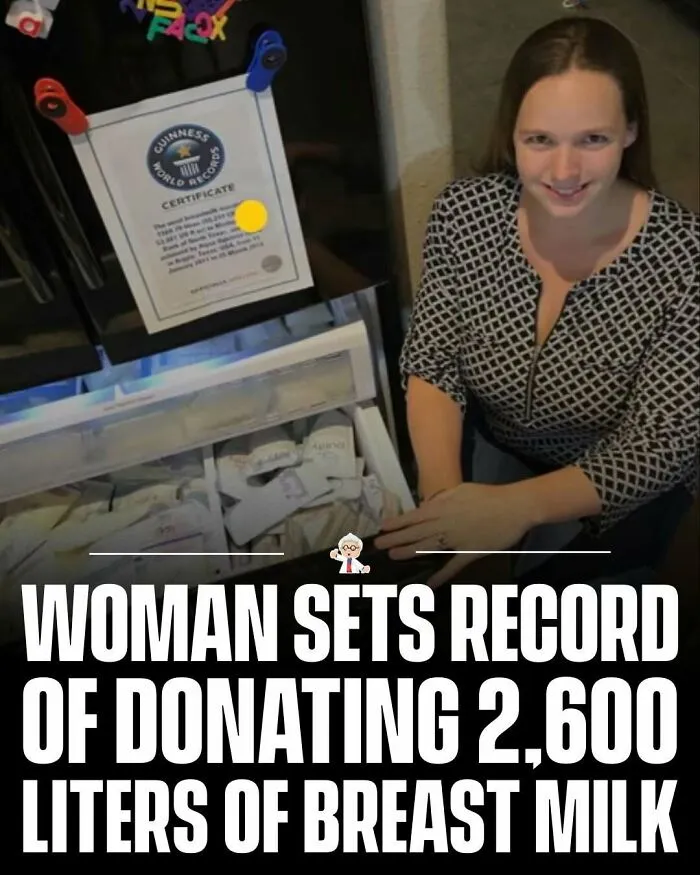
Alyse Ogletree of Texas broke her own Guinness World Record by donating 2,645 liters of breast milk, surpassing the record she set in 2014. 🥛
Since 2010, she has donated milk every three hours, helping feed more than 350,000 premature and sick babies. Relentless commitment. Extraordinary impact.
Report
55points
#32

In Japan, a man named Shoji Morimoto became widely known for offering a unique service where people can “rent” him to simply spend time with them. Clients hire him to accompany them to events, listen to them talk, eat meals together, or just provide quiet company. Morimoto charges a modest hourly fee, and because of the high demand for companionship services, he reportedly earns around $80,000 a year. 🇯🇵
His work highlights a growing social issue in modern cities where many people experience loneliness or social isolation. In Japan, busy lifestyles, urban living, and cultural pressures can make it difficult for some individuals to form close connections. Services like this provide temporary companionship without expectations, showing how emotional support and simple human presence can have real value in today’s society.
Report
53points
#33

Curly mice — often called rex mice — are a unique type of fancy mouse known for their naturally wavy fur and whiskers. Their plush, velvety coats come from a genetic mutation that alters the structure of the hair shaft, giving them a teddy bear–like appearance. The same mutation can affect their whiskers too, leaving them adorably kinked or curled.
Beyond their distinctive look, rex mice are also loved as pets for their calm, sociable temperament, making them as charming in personality as they are in appearance.
Report
52points
#34

This is the cutest thing you’re gonna see all day🥲
Most crow species: 7-8 years on average.
American Crow: 7-8 years, with some reaching 15-30 years.
Carrion Crow: 4-7 years, occasionally up to 12-14 years.
Hooded Crow: 7-9 years, with a record of 14 years.
Report
49points
#35

In 2019, 74 year old Katalin Metro was injured while hiking Piestewa Peak and suffered a broken nose after her fall. Although she reportedly refused helicopter evacuation, she was still airlifted in a rescue basket that spun more than 170 times during the hoist, turning an emergency response into a second traumatic event and leading to a spinal injury.
The case drew attention to how critical safety protocols and patient consent are during mountain rescues. Metro later reached a $450,000 settlement with the City of Phoenix in 2021, making the incident a widely discussed example of the risks involved in aerial extraction and the importance of proper emergency handling
Report
49points
#36

When Charles Brockman III graduated from high school, he crossed the stage holding his infant daughter in his arms, a powerful image of young fatherhood and determination. Nearly two decades later, that same daughter, now grown, walked across her own graduation stage. This time, her proud father walked beside her, recreating the moment with their roles reversed.
The side by side photos quickly went viral, capturing a touching full circle milestone. It was more than a throwback. It was a reminder of how fast time flies and how deeply a father’s love carries across generations.
Report
49points
#37

Baby elephants often suck on their trunks for comfort, much like human babies suck their thumbs.
This self-soothing habit is especially common when they’re tired, anxious, or adapting to new surroundings.
It also allows them to explore and get used to their trunks—remarkably complex, sensitive tools they’ll rely on for eating, drinking, and communicating.
As they grow and master trunk use, the need for sucking typically disappears.
Report
49points
#38

Owls usually avoid heavy rain because their feathers do not repel water. Unlike ducks and other birds that live on or near water, owls have soft feathers designed for silent movement through the air, which makes them much more likely to become soaked.
Once an owl is wet, it loses a great deal of its ability to fly smoothly, especially its quiet approach, which makes both hunting and escaping danger much harder.
During strong rainfall, owls often hide in thick leaves or small protected spaces to stay dry. A fully soaked owl can look completely different, appearing thin, ragged, and almost impossible to recognize.
Report
47points
#39

The Alchemist’s Jar explores the remarkable truth that honey can last forever. When sealed jars are opened in ancient Egyptian tombs, archaeologists sometimes find thick amber honey that is still perfectly edible after 3,000 years. This natural wonder makes raw honey one of nature’s most powerful preservatives. But this only applies to raw, unfiltered honey. Many commercial brands are pasteurized, which destroys beneficial enzymes. Raw honey keeps its full chemical strength and the healing properties ancient healers valued for faster wound care.
Its long life comes from a powerful biological trio. First, raw honey contains very little moisture. Bees fan nectar until water levels fall below 18 percent, which dries out invading microbes. Second, honey is naturally acidic with a pH between 3.2 and 4.5, stopping spoilage bacteria from surviving. Third, bees add an enzyme called glucose oxidase that produces small amounts of hydrogen peroxide, creating a natural antibacterial shield. Together, these qualities help raw honey resist decay for millennia
Report
47points
#40

A customer asked a local pizza place to absolutely cover his birthday pie in black olives. The restaurant said say less and delivered.
Report
45points
