







Scientific facts are far too often explained in an unnecessarily difficult or dreary way. Either that or they are presented as "fun facts," but then they are completely lacking sources or any guidance to further learning. I seek to rectify this by presenting and explaining various facts in an easy and enjoyable manner. In addition, all the facts on my page have reliable sources, so people will know where to learn more and know that the facts being presented are not misunderstood, made up, or plain "lies for likes."
You seemed to enjoy my last post, and that made me very happy, so here are more! There are even more to be found, both exclusive and public, on my website or Patreon page. You will find more information and my sources there.
More info: fancyfacts.info | patreon.com
#21 Photosynthesis
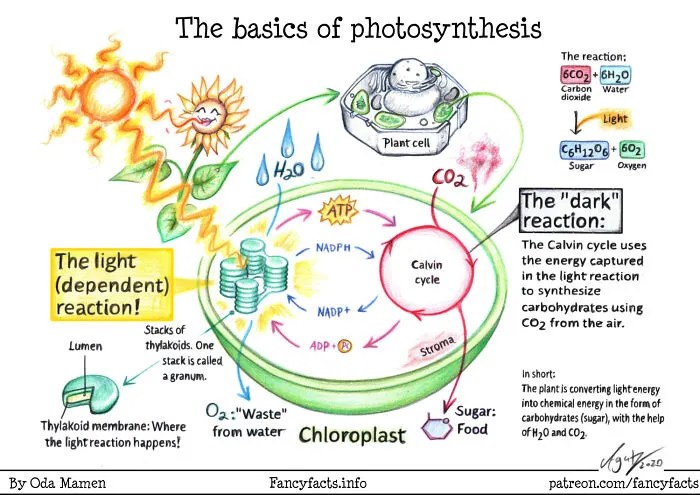
Photosynthesis is a topic in most introductory science classes, but it can be hard to grasp the whole process. Hopefully, this makes it a bit easier.
72points
#22 Horizontal Gene Transfer
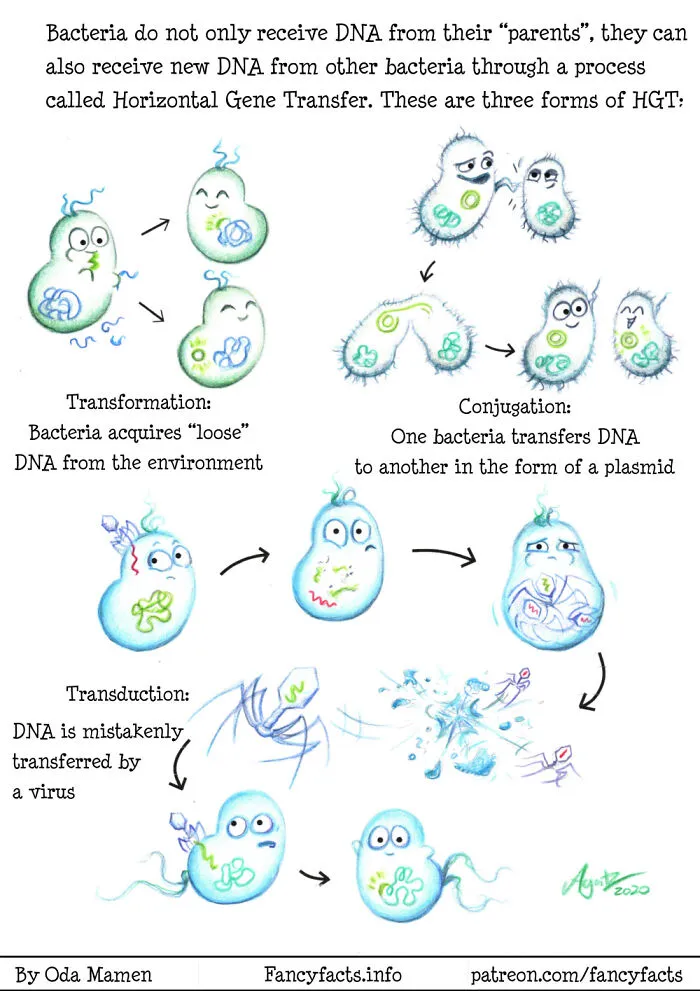
Transformation is the process whereby bacteria can “ingest” DNA from the environment and incorporate it into its own genome. It is incorporated either into the “main” DNA or as a plasmid, which is a separate form of “bonus-DNA” that bacteria have. Either way, the DNA they pick up can contain new genes with new functions that the bacteria can make use of, for instance, antibiotic resistance.
The loose DNA comes from dead, broken down bacteria, sort of like how you may find an old cookbook in a dead relative's house and learn a new recipe. That’s dark, let’s move on.
Conjugation happens when a bacteria hooks on to another bacteria with something called a “sex pilus”. Yeah, really! This forms a bridge between the two, over which a copy of the first bacterias plasmid is transferred to the second bacteria.
Transduction is actually just an accident. One way a bacteriophage (a virus that attacks bacteria) replicates is to insert its DNA into a bacteria, break apart the bacterias DNA and “trick” the bacterias systems to make more copies of the virus. It then explodes the bacteria from the inside, spilling new viruses everywhere! But sometimes one of these new viruses gets a piece of the original bacterias DNA, instead of the virus-DNA it was supposed to get. It will still act like a virus and infect new bacteria, as bacteriophages do, but when it does it will inject bacterial DNA instead of virus-DNA. The infected bacteria will get some random DNA from the first host bacteria (the one that exploded), but there is no guarantee that the DNA provides any new, cool genes.
It’s like someone forces a random, torn-out page of a cookbook on you: you might get the best recipe for chocolate cake in the world, or you might get the last half of the useless copyright-page. At least you won’t explode.
65points
#23 Basic Mitosis
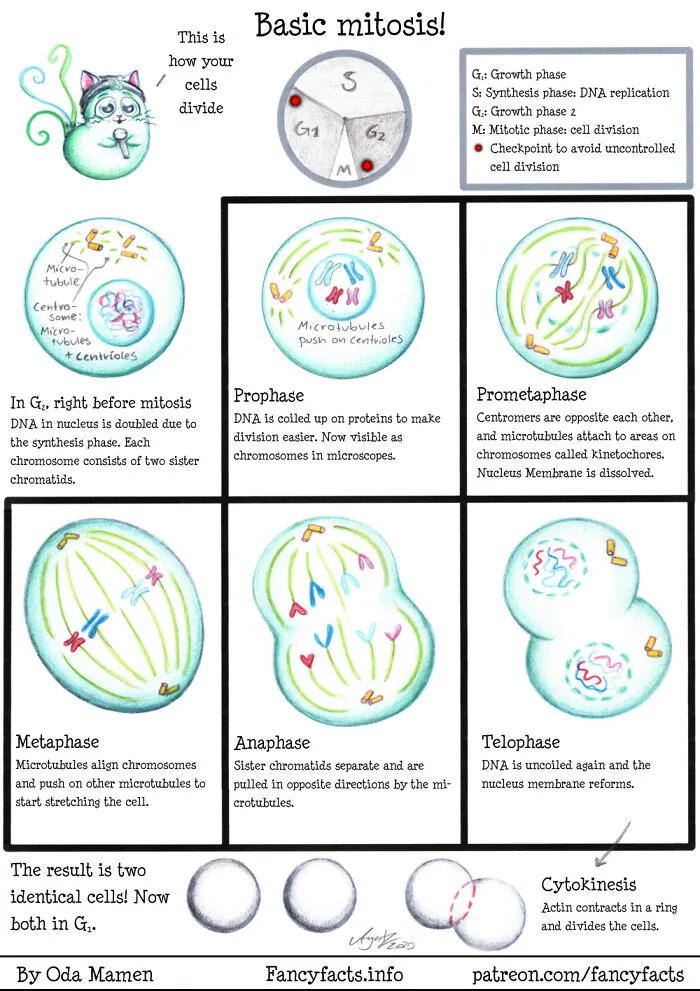
56points
#24 Binary Fission
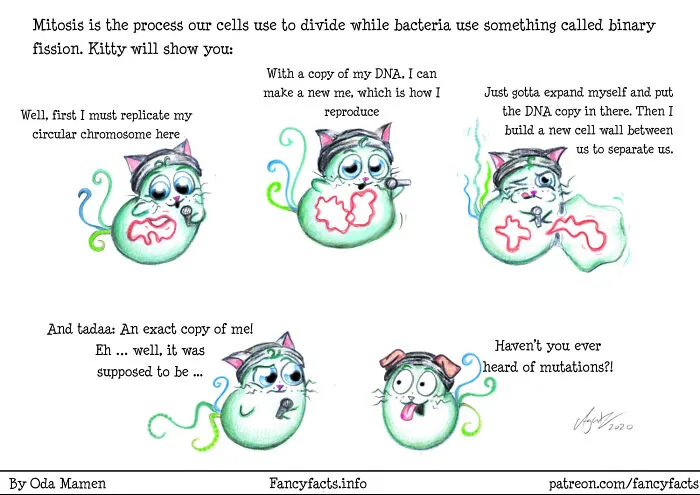
“Our cells” are eukaryotic cells, the same type found in other animals, plants, and mushrooms. The other type of cells is prokaryotic cells, which bacteria and archaea have. Procaryotic cells reproduce in the manner shown here.
54points
#25 PCR
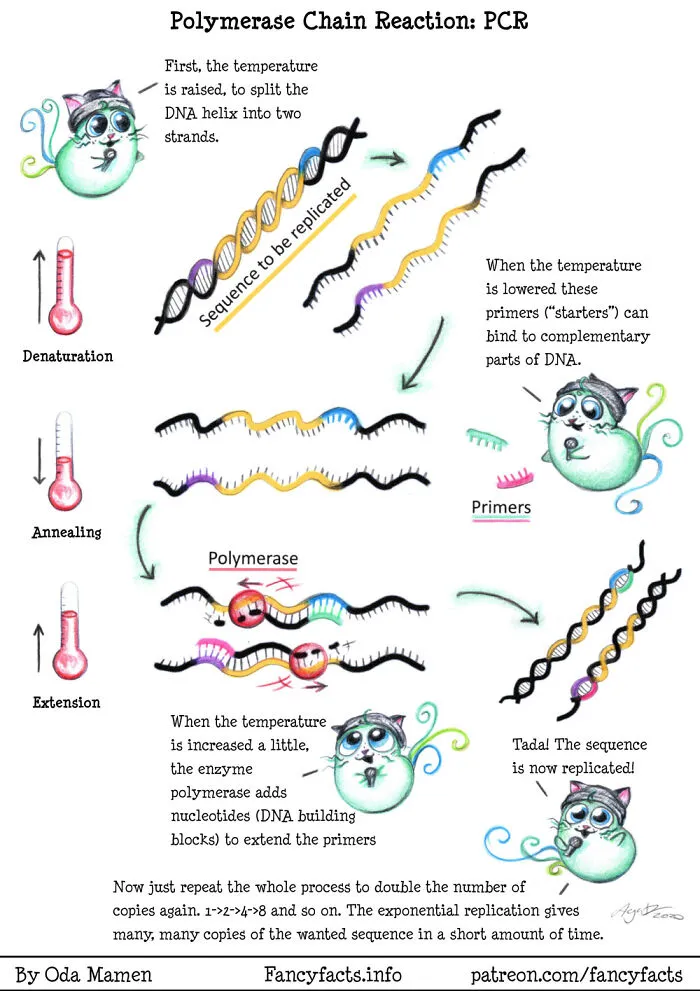
Polymerase Chain Reaction (PCR) is a topic in most introductory science classes, but it can be hard to grasp the whole process. Hopefully, this makes it a bit easier.
The initial description of the PCR process was discovered by the Norwegian scientist Kjell Kleppe and his colleagues and described in a paper published in 1971. Not many articles bother to mention this, but I feel it’s my duty as a good Norwegian.
The heat resistant enzymes that became a key component in industrializing PCR were discovered in 1960 in Yellowstone and are also widely used in corona-virus tests.
49points
#26 Basic Protein Synthesis
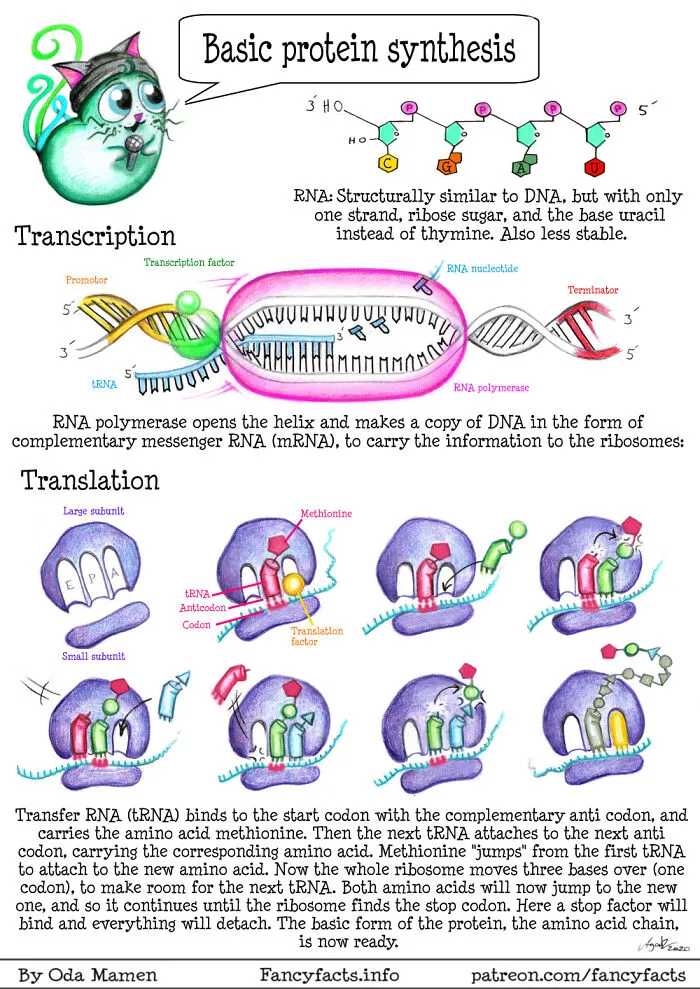
38points