




The popular Facebook page ‘World Beauties and Wonders’ is all about showcasing breathtaking sights from across the globe. Today, we’re bringing you some of the page’s most stunning recent photos, hoping to ignite a little wanderlust and inspire you to discover the amazing experiences that await beyond your comfort zone.
Scroll through, upvote your favorite shots, and tell us which ones impressed you the most and why. Have you recently encountered a view or adventure that took your breath away? Share your stories with us in the comments!

#22 Barcelona, Spain

Barcelona is more than a city — it’s a living museum beneath the open sky. Just look at the Casa Pere Brias building
Report
24points
#23 The Starry Ceiling Of The Church Of San Gioacchino, Rome, Italy

Report
24points
#24 Chicago, USA
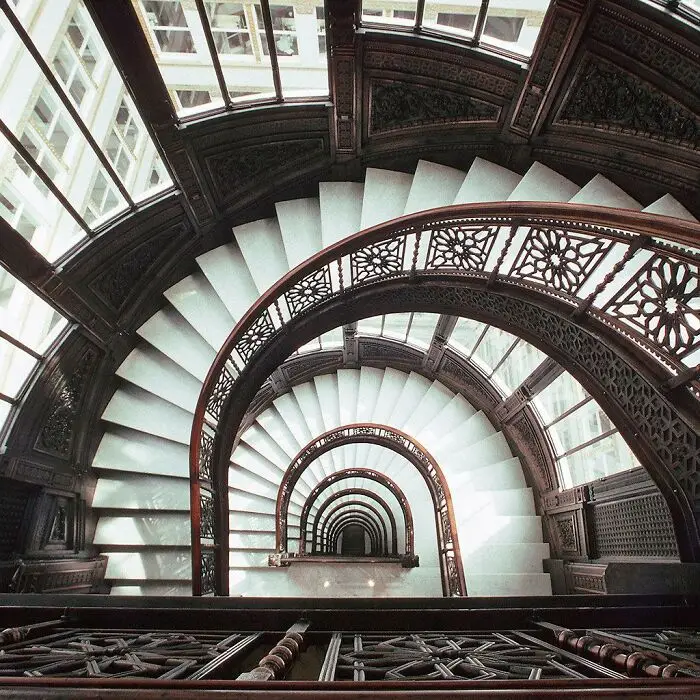
Looking down the spiral staircase of the Sullivan Center in Chicago
Report
24points
#25 Hadrian’s Cistern, Athens, Greece (C. 125 Ce)

Built around 125 CE, Hadrian’s Cistern in Athens is an engineering marvel of Roman water storage, still standing as a testament to ancient ingenuity.
Report
23points
#26 Athens, Greece

They utter no words, yet have watched empires rise and crumble. The original Caryatids of the Erechtheion stand as silent guardians of history, carrying its weight upon their shoulders.
Report
23points
#27 Santa Croce, Italy

Facade Details of Santa Croce
Architectural details from the façade of the Basilica of Santa Croce in Italy.
Report
22points
#28 Frescoes In The Villa Dei Misteri, Italy

2,000-year-old wall paintings from the “Room of the Frescoes” in Pompeii’s Villa dei Misteri.
Report
22points

#30 Aerial Perspective Of Hamadan In Western Iran

Formerly known as Ecbatana and once the capital of the Median Empire, this city with more than 3,000 years of history is widely regarded as one of the oldest continuously inhabited settlements in Iran.
Report
21points
#31 Mount Roraima, Venezuela

Mount Roraima, one of the most fascinating landscapes on the planet, rises from the isolated Gran Sabana region of Venezuela. This immense tabletop mountain—classified as a tepui—is widely regarded as one of the most striking natural formations on Earth. Towering nearly 3,000 meters above sea level, its flat summit and towering vertical cliffs have intrigued scientists, explorers, and travelers for centuries.
For more than five centuries, researchers from many countries have studied the mountain’s unusual geological characteristics. Its shape differs dramatically from typical mountain systems. Most mountains originate through tectonic processes, when shifting plates push portions of the Earth’s crust upward. Mount Roraima, however, traces its origins to the Precambrian era and is estimated to be about two billion years old, making it among the oldest exposed geological structures on Earth.
The mountain forms part of the Guiana Shield, an ancient craton composed of some of the planet’s oldest rock formations. The summit plateau and the dramatic vertical walls consist mainly of quartzite and sandstone—materials highly resistant to erosion. Over immense stretches of geological time, wind, rainfall, and temperature fluctuations sculpted the mountain into its distinctive form, producing an isolated natural stronghold that rises above the surrounding terrain.
The summit of Mount Roraima presents an almost surreal landscape and is frequently described as a “lost world” because of its isolation and its distinctive ecological environment. The plateau covers roughly 31 square kilometers and is often enveloped in dense mist, which enhances its mysterious atmosphere. Weather conditions on the summit shift rapidly, with regular rainfall and temperatures that may be warm during daylight hours but drop to near freezing overnight. These isolated conditions have produced a rare ecosystem containing numerous endemic plant and animal species that exist nowhere else on Earth. Carnivorous plants such as pitcher plants and sundews flourish here, adapting to nutrient-poor soils by trapping and digesting insects. The plateau also supports a remarkable variety of orchids and bromeliads, further enriching the region’s botanical diversity.
Mount Roraima also holds profound cultural meaning for the indigenous Pemon and Kapon peoples of the Gran Sabana. They call the mountain “Roraima,” often translated as “Mother of All Waters,” a reference to the many waterfalls cascading from its cliffs. In local belief systems, the mountain is sacred and inhabited by spiritual forces and deities. One widely known legend tells of a gigantic tree that once grew atop the summit. According to the story, this tree produced every fruit and vegetable found in the world. When it was cut down, a catastrophic flood followed, and the mountain emerged from the stump left behind. Interestingly, this narrative echoes flood myths that appear in numerous cultures across the globe.
The mystery and dramatic beauty of Mount Roraima have made it an appealing destination for explorers and travelers. The first documented ascent to the summit occurred in 1884, led by British explorer Everard im Thurn. Since that expedition, the mountain has drawn many climbers and trekkers eager to witness its extraordinary terrain and expansive vistas. The most frequently used route to the summit begins in the Gran Sabana region of Venezuela and typically requires several days of trekking. The journey involves navigating dense rainforest, crossing rivers, and climbing steep slopes. Despite the difficulty, those who reach the top encounter an otherworldly landscape filled with unusual rock formations, pristine pools, and sweeping views extending across three countries—Venezuela, Brazil, and Guyana.
Because of its ecological importance and cultural value, conservation efforts have been implemented to protect Mount Roraima and its environment. The mountain lies within Canaima National Park, a protected area recognized as a UNESCO World Heritage Site. This status offers some defense against threats such as deforestation, mining, and environmental damage. Nevertheless, the rise in tourism and the potential for ecological disruption remain ongoing concerns for those working to preserve this extraordinary landscape.
Report
21points
#32 Shazdeh Garden, Iran

Shazdeh Garden, near Mahan in Iran’s Kerman Province, was created in the late 19th century during the Qajar dynasty as an oasis in a harsh desert landscape.
Construction began around 1870 under governor Mohammad Hasan Khan Qajar Sardari Iravani, who envisioned an impressive Persian garden embodying authority, grace, and harmony. His successor, Abdolhamid Mirza Naserodolleh, expanded it with terraces, pavilions, and elegant water features.
Designed in the classic Persian chahar-bagh style, the garden relies on geometric order and channels flowing water at its core. Its irrigation system uses the Tigran qanat, allowing it to flourish in arid surroundings. Cascading pools descend along the slope, guiding the eye from the entrance to the upper residential pavilion.
The garden symbolized the Qajar rulers’ power over land and water and the prosperity they provided. After the dynasty’s fall, it fell into neglect until restoration efforts in the late 20th century revived its layout and structures.
Today, Shazdeh Garden is considered one of the finest surviving Persian desert gardens and is recognized as a UNESCO World Heritage Site for its blend of engineering, architecture, and landscape design.
Report
21points
#33 Royal Palace Of Caserta, Italy (1752)

Sometimes it feels almost unreal that such places were ever built.
Report
21points
#34 Piazza Dell’anfiteatro, Lucca, Italy

Piazza dell’Anfiteatro in Lucca is among the most distinctive public squares in Tuscany 🇮🇹, instantly recognizable for its oval form and the vibrant buildings that frame its perimeter.
This remarkable square occupies the footprint of an ancient Roman amphitheater constructed during the 1st or 2nd Century AD. At the time, it stood just outside Lucca’s city walls near the northern gate, making it easily accessible for spectators arriving from the surrounding countryside. The amphitheater featured an elliptical structure composed of two superimposed rings of 55 arches and could accommodate up to ten thousand spectators.
After the amphitheater fell into ruin, its stone columns and materials were stripped and reused for centuries as building resources. Gradually, residential structures were erected on its remains, yet the distinctive oval outline endured.
The square as it exists today was shaped by architect Lorenzo Nottolini, who in 1830 cleared the central arena space of later buildings and opened Via dell’Anfiteatro. Through his careful intervention, Piazza dell’Anfiteatro became one of Lucca’s most iconic and unforgettable landmarks.
Report
20points
#35 Castle De Haar (Reconstructed Just 113 Years Ago), Netherlands

Report
20points
#36 Geghard Monastery, Armenia

Geghard Monastery, in Armenia’s Kotayk Province, is a medieval marvel partly carved into the surrounding cliffs. The complex’s breathtaking setting and unique construction earned it UNESCO World Heritage status for its cultural and historical value.
Founded in the 4th century by Gregory the Illuminator at a site with a sacred spring, the monastery’s main chapel was completed in 1215 AD. For centuries, Geghard served as a spiritual and pilgrimage center, blending architecture and landscape into one of Armenia’s most sacred places. Its harmony with nature and its centuries-old sanctity make it a profound symbol of Armenian Christian heritage.
Report
20points
#37 Church Of The Savior On Spilled Blood, Saint Petersburg, Russia

Report
19points
#38 The Catacombs Of Kom El Shoqafa

The Catacombs of Kom El Shoqafa, whose name translates roughly as “Mound of Shards,” are one of the most important archaeological sites in Alexandria, Egypt. This underground complex is often referred to as the “Hill of Treasure” and represents a vast necropolis dating back to the 2nd century AD. The catacombs are particularly notable for their unique combination of artistic traditions. Elements of Roman, Hellenistic, and ancient Egyptian styles appear together in the wall decorations, statues, funerary objects, and architectural design. Because of this remarkable cultural blending, the site has sometimes been considered one of the Seven Wonders of the Middle Ages. The catacombs were rediscovered in September 1900 under unusual circumstances. According to local accounts, a donkey wandering near Alexandria’s outskirts stepped onto unstable ground and suddenly fell into the hidden shaft leading down into the tomb complex. The underground burial chambers create an eerie yet fascinating atmosphere. Rows of carved stone tombs stretch through the dimly lit spaces, giving visitors a mixture of historical curiosity and quiet unease. The Ptolemaic dynasty, which ruled Egypt after the conquests of Alexander the Great, had adopted many Egyptian religious beliefs. Although the dynasty was originally Greek, its rulers embraced Egyptian traditions regarding death, the afterlife, and divine worship. This cultural fusion is clearly visible in the catacombs, where Roman artistic features appear alongside traditional pharaonic symbolism. The complex consists of multiple Alexandrian tombs carved deep into the bedrock and descending approximately 35 meters underground across three levels. A circular entrance leads down through a spiral staircase toward the main burial chambers. The lowest level is now flooded due to groundwater seepage and cannot currently be accessed. Visitors enter through a central shaft that leads to the principal tomb chamber and a large antechamber supported by columns. This central area connects to an inner sanctuary. The walls of the antechamber are decorated with carvings of the Egyptian god Anubis, depicted wearing Roman-style armor. Statues representing Roman emperors who ruled Egypt during this period also appear within the chamber. This richly decorated antechamber is considered the most important area of the catacombs because it contains many of the site’s sculptures and decorative features. From here, two passages lead to another chamber known as the Hall of Caracalla, which contains its own staircases. Among the catacombs’ notable features are the tombs of Emperor Tigrane and Wardian, located only a short distance from the entrance.
Report
18points
#39 The “Crinkle-Crankle” Walls Of England

In certain parts of England, you may occasionally encounter unusual brick walls that follow a wavy or serpentine pattern. Surprisingly, this curved design actually uses fewer bricks than a traditional straight wall.
These structures are known as crinkle-crankle walls. At first glance they may appear decorative or whimsical, but their origin lies in practical engineering rather than aesthetics.
A straight brick wall built only one brick thick is structurally weak and can easily collapse under sideways pressure. To make a straight wall stable, builders normally construct two parallel layers of bricks, effectively doubling the amount of material required.
However, by introducing a repeating series of curves, the wall becomes significantly stronger. Each bend acts like a natural buttress, distributing forces across the structure and allowing the wall to stand securely while remaining only a single brick thick.
This clever design became particularly popular in parts of England where landowners needed long boundary walls but wanted to minimize construction costs. Over long distances, a serpentine single-layer wall could save thousands of bricks compared to a straight wall built with double thickness.
During the 18th and 19th centuries, the design became especially common in garden estates across East Anglia. The curved shape also offered horticultural benefits. The concave sections created small sheltered microclimates that were ideal for growing fruit trees such as apples and pears. Sunlight collected along the south-facing curves, helping to warm the plants and protect them from wind.
Although modern observers often view these walls primarily as decorative features, their elegant appearance was originally a by-product of practical engineering and cost efficiency.
Thomas Jefferson even adopted the idea after seeing similar walls in England and incorporated crinkle-crankle walls into the design of his estate at Monticello in the United States
Report
18points
#40 The Abbey Library Of Saint Gall In St. Gallen, Switzerland

The Abbey Library of Saint Gall in St. Gallen is not only one of Europe’s oldest libraries, but also one of its most visually striking.
According to official records from the Abbey of Saint Gall, the earliest evidence of a library on the site dates back to around 820 AD, with architectural plans showing a collection attached directly to the main church. Many of the library’s approximately 160,000 invaluable manuscripts are nearly that old.
Among its treasures are an 8th-century bill of sale for abbey lands, a Gospel of John dating to around 800 AD, and rotating exhibitions of handwritten and illuminated manuscripts. These include Bibles, liturgical texts, prayer books, and saints’ biographies from as early as the 8th and 9th centuries. Other works depict everyday monastic life, offering rare insight into abbey routines throughout the Middle Ages. Some of the earliest texts are written in Irish, reflecting the monastery’s Irish roots — hence the name “St. Gall.”
The elaborate Rococo library hall itself was constructed between 1758 and 1767. Its burnished woodwork, flowing balconies, and ceiling frescoes are artworks in their own right. Following the Rule of St. Benedict, which encouraged literary study when possible, the abbey naturally became a center of learning. By the 10th century, it was recognized as a major hub of Western science and culture.
In the mid-18th century, the collection was moved into its current baroque setting, lavishly decorated with sweeping moldings and ceiling art that give the space a dreamlike quality. Flower-shaped wooden balconies curve around the room. And yes — the historic books are still there, if you can pull your attention away from the surroundings long enough to notice them.
Today, the Abbey Library of Saint Gall remains nearly unmatched in beauty and significance, housing over twelve centuries of uninterrupted collecting, including the earliest known architectural plan on parchment
Report
18points

