


Bored Panda
30 Intriguing True Stories From The Past Few Know About
HistoryFEB 21, 2025

30 Intriguing True Stories From The Past Few Know About

81
15
Early on, people recorded history even if they didn’t yet understand the importance of doing so. Cave art, which was primarily used for communication, symbolic, and religious purposes, now gives us an insight into the lifestyle of our ancestors. The writings of the king's names on the Palermo Stone in Egypt are already one of the earliest examples of intentional historical recordings. Even though these aren’t typical ways we document the past nowadays, they still provide us with ample information about it. 
Sadly, the amount of recorded history we produced over thousands of years makes it easy to remember the pivotal moments and forget the others. That’s why today we’re featuring historical events and stories from the Instagram account “Past Preserved”—to bring light to happenings from the past people might have forgotten. Scroll down to find them below, and don’t forget to upvote the ones that definitely shouldn’t fade from our memory.
While you're at it, make sure to check out a conversation with historian Sean Stewart, who kindly agreed to chat with us about the preservation of history.

#21

"I Hate Elvis" badge from the 1950s, showcasing interesting historical facts of Elvis merchandise marketing.
47points

Lastly, he says that the cost of forgetting has to be understood properly. "If you don't know something happened, how does your complete ignorance of it affect you? Knowing it might enhance your life, but being ignorant of which Shogun was in charge in Japan 300 years ago will probably not stop you from living a full life."

#22
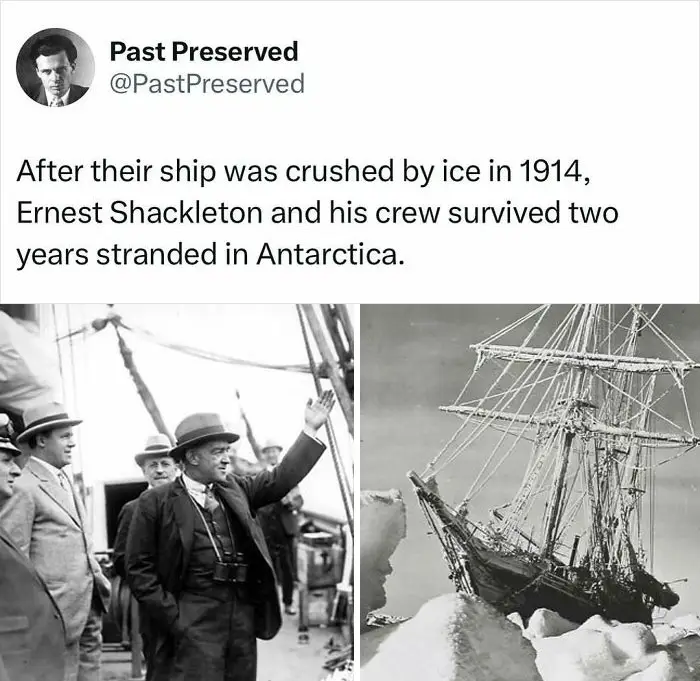
"Past Preserved post on Ernest Shackleton and crew's 1914 survival in Antarctica after ship crushed by ice."
In 1914, Sir Ernest Shackleton set out on the Imperial Trans-Antarctic Expedition, aiming to become the first to cross the Antarctic continent. However, his ship, *Endurance*, became trapped in thick pack ice in the Weddell Sea before even reaching the continent. For nearly two years, Shackleton and his 27-man crew endured brutal conditions after the ship was crushed by the ice and sank in 1915. The crew set up camp on the drifting ice floes, hoping for rescue, but as conditions worsened, they embarked on an extraordinary journey. They used lifeboats to reach Elephant Island, where they were still isolated from help. Shackleton and five others then made a daring 800-mile journey in a small open boat, the *James Caird*, to South Georgia Island. Despite treacherous seas and near-impossible navigation, they reached the island and hiked across its mountainous terrain to find help. After several failed attempts, Shackleton finally managed to rescue the entire crew from Elephant Island in August 1916—without a single loss of life. The expedition, though a failure in its original goal, became one of the greatest stories of leadership and survival in polar exploration history.
46points

#23

Ancient Methuselah tree with twisted branches against a clear blue sky, highlighting interesting historical facts.
Methuselah, a Great Basin bristlecone pine (Pinus longaeva), is the oldest known living tree in the world, located in California’s White Mountains. At over 4,800 years old, its age has been confirmed through tree-ring dating. To protect it from vandalism, the U.S. Forest Service keeps its exact location secret, ensuring the tree’s survival. Methuselah’s longevity highlights the resilience of bristlecone pines, which thrive in harsh, high-altitude environments. Despite extreme weather, it continues to grow slowly. While Methuselah holds the record, other bristlecone pines in the area are also ancient, some living for over 4,000 years, emphasizing the need to safeguard such natural wonders.
46points

#24

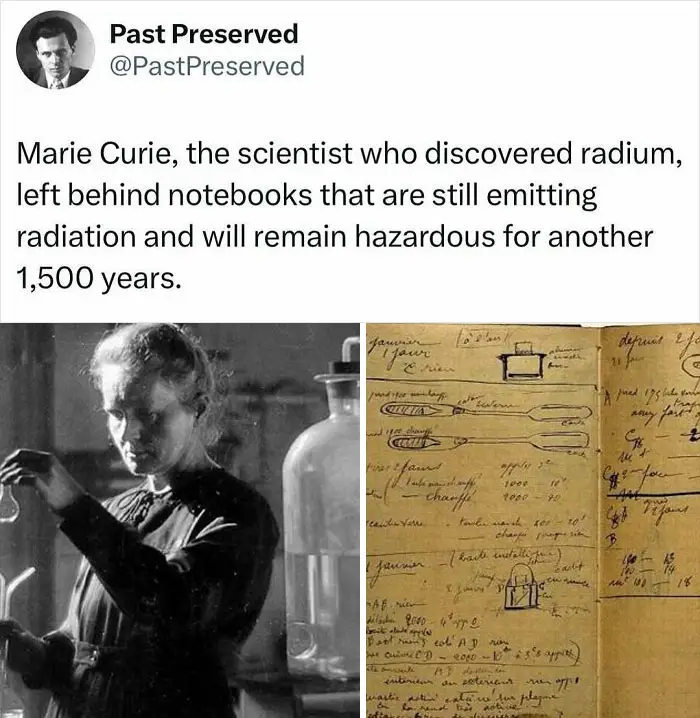
Marie Curie with hazardous notebooks emitting radiation, representing interesting historical facts.
Marie Curie was a pioneering physicist and chemist who made groundbreaking discoveries in radioactivity. She was the first woman to win a Nobel Prize and remains the only person to have won in two different scientific fields—Physics in 1903 (shared with her husband, Pierre Curie, and Henri Becquerel) and Chemistry in 1911 for her discovery of radium and polonium. Her research on radioactive elements revolutionized medicine and physics, laying the foundation for advancements in cancer treatment and nuclear energy. However, her extensive work with radioactive materials, often without proper protection, ultimately led to her death from aplastic anemia in 1934, a condition linked to prolonged radiation exposure. Curie’s research materials, including her notebooks, are still highly radioactive due to prolonged exposure to radium. These documents, housed at the Bibliothèque Nationale de France, are stored in lead-lined boxes to protect against radiation, and anyone wishing to handle them must wear protective gear and sign a waiver. The radiation levels are expected to remain dangerous for another 1,500 years, as radium-226, one of the primary contaminants, has a half-life of 1,600 years. Despite this, Curie’s legacy endures in modern science, and her discoveries continue to influence medicine, physics, and nuclear research today
45points

#25

Ancient graffiti depicting Jesus with a donkey head, illustrating historical mockery.
One of the earliest depictions of Jesus, found in a 200 AD engraving, wasn’t a tribute but a mockery. It shows a man worshiping a crucified figure with a donkey’s head, likely a satirical jab at early Christians.
43points

#26

Sony Walkman with dual headphone jacks, a historical feature now removed for lack of use.
When Sony released the first Walkman in 1979, it came with an interesting feature: two headphone jacks. The designers believed that listening to music in public could be seen as antisocial or rude, so they included the second jack to encourage sharing the experience with a friend. Along with this, the Walkman came with a “hotline” button, which temporarily lowered the volume so users could talk without removing their headphones. However, the feature of two headphone jacks wasn’t widely used as Sony expected. People preferred the personal, solitary experience the Walkman provided, which was its main appeal. As a result, later models removed the second headphone jack, focusing instead on enhancing the user’s individual listening experience. This change marked a shift in how people interacted with portable music, embracing the Walkman as a personal device.
40points

#27

Ancient Roman concrete sample with volcanic ash and lime, alongside a Roman building, showcasing preserved historical techniques.
Ancient Roman concrete has proven to be far more durable than most modern-day concrete. Unlike modern mixtures that degrade over time, Roman concrete is known for its ability to actually strengthen when exposed to seawater, a quality found in structures like the Pantheon and coastal piers that have stood for nearly two millennia. The secret lies in a unique blend of volcanic ash (often collected from Mount Vesuvius), lime, and seawater. These minerals react chemically over time to form new crystalline structures, fortifying the strength and durability of the concrete itself. This “self-healing” property allowed Roman marine structures to endure and even thrive despite millennia of weathering, leaving modern scientists studying its composition as they seek to replicate its strength for future construction.
39points

#28

Historical facts about Bologna's 12th-century towers, including the 97-meter-tall one still standing.
Bologna, Italy, is famous for its medieval towers, which once numbered over 100 in the 12th and 13th centuries. Built by wealthy families as symbols of power, these towers also served defensive purposes. Today, fewer than 20 remain, with the most iconic being the Asinelli and Garisenda towers. The Asinelli Tower, at 97.2 meters (318 feet), is the tallest leaning medieval tower in the world, while the shorter Garisenda leans dramatically due to foundational issues. These towers rose alongside Bologna’s prominence as a center of trade and education. While many were demolished or repurposed, the Asinelli Tower was preserved and used as a prison and lookout in the 14th century. Visitors today can climb its 498 steps for stunning views of the city and the Emilia-Romagna region. These remaining towers stand as reminders of Bologna’s competitive city-state era, where towering structures displayed wealth and influence
38points

#29

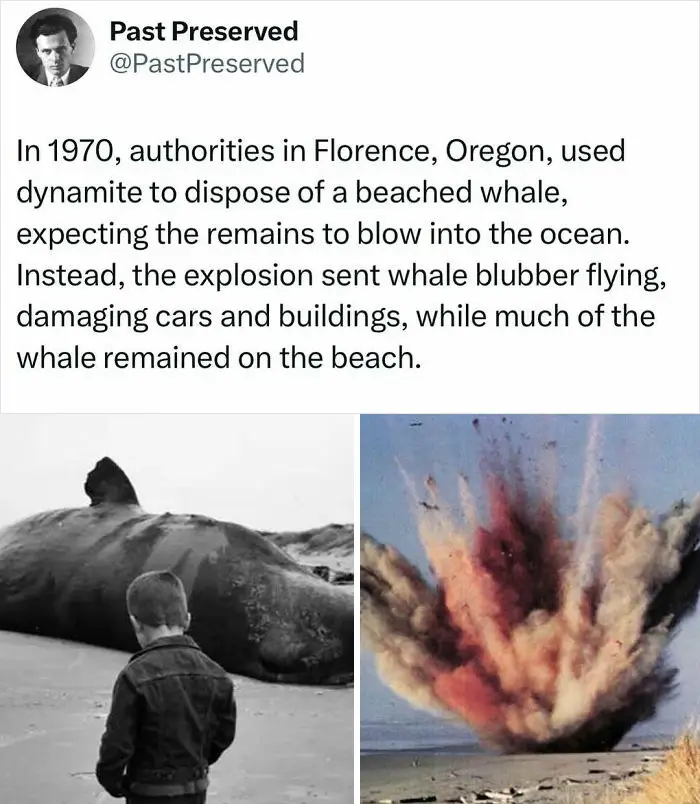
"Boy observing a beached whale, followed by an explosion, illustrating a unique historical event."
The 1970 whale explosion, also known as the Exploding Whale Incident, took place in Florence, Oregon, when local authorities decided to use dynamite to dispose of a 45-foot, 8-ton beached s***m whale. Officials believed the explosion would send the remains into the ocean, leaving scavengers to clean up the rest. However, the plan went disastrously wrong when the blast sent massive chunks of whale blubber flying over 800 feet, damaging cars, smashing windows, and nearly injuring bystanders. Despite the effort, much of the whale remained on the beach, and the incident became infamous for its bizarre and unintended consequences
34points

#30

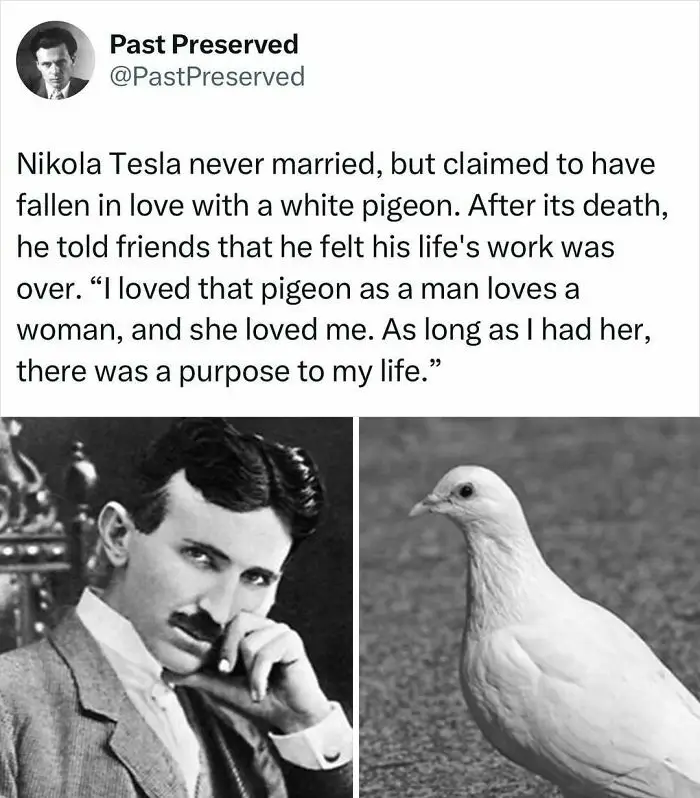
"Historical facts: black-and-white image of Tesla and a white pigeon side by side."
Nikola Tesla was a pioneering inventor best known for developing the alternating current (AC) electrical system, which transformed how we use and distribute power today. He also made significant contributions to radio, wireless technology, and early robotics, earning him a reputation as one of history’s most innovative minds. Although he never married and largely avoided personal relationships, Tesla had a deep affection for pigeons, frequently feeding them in New York parks. He formed a unique bond with a particular white pigeon, claiming he loved her in a profound way. Tesla devotedly cared for this pigeon, even nursing her through illness, finding comfort and companionship in their connection amid his isolated and work-focused life
23points

The discovery of intense radio bursts might remind us of how our past can hold mysteries yet to be solved. Just as radio bursts from a nearby star challenge our understanding of stellar phenomena, so too history presents us with puzzles. These radio signals may provide insights similar to how historical records inform us about past civilizations.

If you're intrigued by celestial mysteries, you may want to explore why researchers are captivated by these radio bursts.

81
15