






The world is full of interesting details and surprises that can change how we see things. Finding something you never knew existed always feels special, like an old photo, a strange invention, or a forgotten moment from history. These discoveries show us there is still so much to explore and learn.
Thanks to the internet, it’s easier than ever to come across amazing stories and photos from everywhere. From overlooked moments in history to incredible human achievements, there are so many things that don’t get much attention but can really stick with you once you find them.
From rare moments caught on camera to details that change how we see history, we bring you a collection of remarkable photos, surprising facts, and stories that seem unbelievable at first. Keep scrolling to check out some of the most fascinating discoveries.
#61
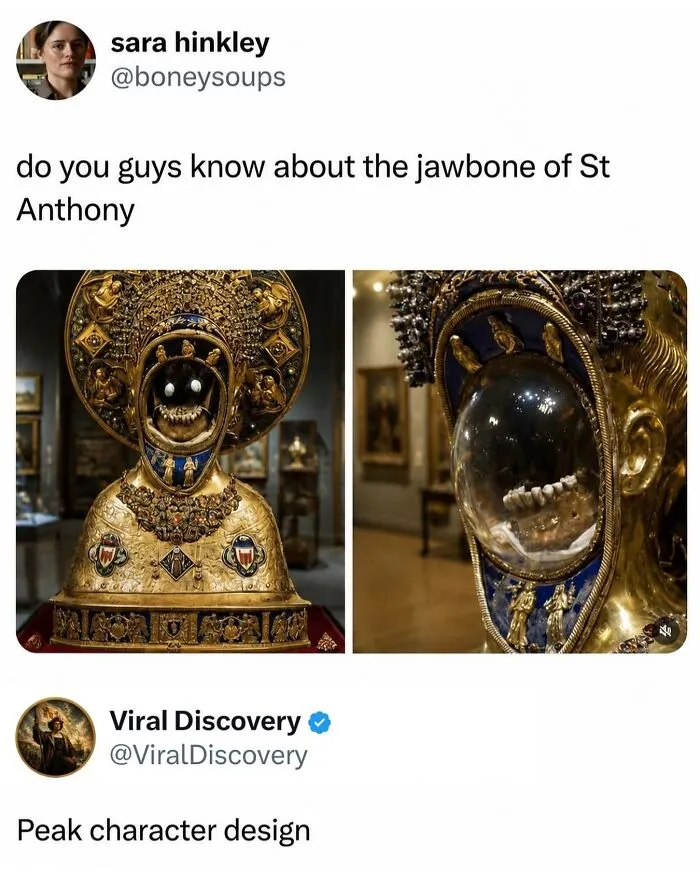
Crazy
Medieval Christian relic culture produced some of the most elaborate devotional objects in Europe, and the reliquary of St. Anthony of Padua’s jawbone is one of the most striking examples. Housed in the Basilica of Saint Anthony in Padua, Italy, the relic contains what is believed to be the saint’s mandible, displayed behind a crystal window and set within an ornate gilded bust crafted in the 14th century. Relics like this were created to honor saints whose teachings or miracles had shaped entire communities, and the craftsmanship surrounding them was often intended to reflect the saint’s spiritual importance.
St. Anthony died in 1231, and when his remains were exhumed in 1263, witnesses reported that his tongue and jawbone were unusually well-preserved—an event interpreted as a sign of his preaching and teaching. Over the centuries, these relics became central to pilgrimage traditions, drawing visitors from across Europe. While the reliquary may look dramatic or otherworldly to moder.
Report
2points
#62
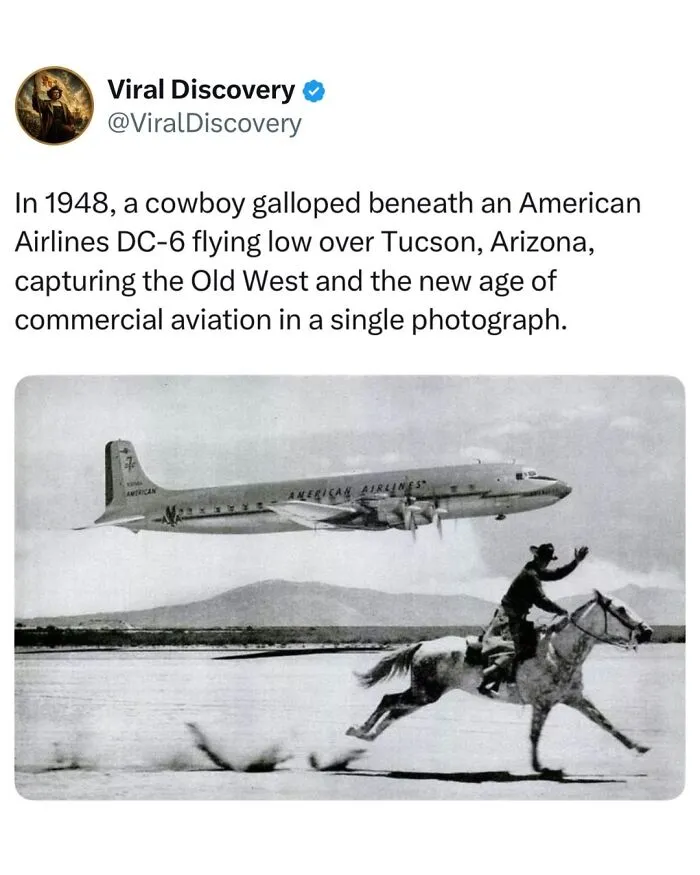
In 1948, a cowboy galloped on horseback beneath an American Airlines Douglas DC-6 over Tucson, Arizona. The photograph captured two eras of transportation side by side at a time when commercial aviation was rapidly transforming how Americans traveled. The DC-6 was one of the newest passenger aircraft of the period, having entered airline service in 1947, and offered greater range and capacity for long-distance routes across the country.
American Airlines was expanding its service across the Southwest during the postwar aviation boom, connecting cities like Tucson with its growing national network. Western imagery was commonly used to promote travel through the region, pairing Arizona’s cowboy identity with the speed and modernity of air travel. Photographs from the Tucson series combined horses, Western clothing and American Airlines aircraft to create some of the era’s most striking images of the changing American West.
American Airlines was expanding its service across the Southwest during the postwar aviation boom, connecting cities like Tucson with its growing national network. Western imagery was commonly used to promote travel through the region, pairing Arizona’s cowboy identity with the speed and modernity of air travel. Photographs from the Tucson series combined horses, Western clothing and American Airlines aircraft to create some of the era’s most striking images of the changing American West.
Report
2points
