






Just like there are cat people and dog people, so there are math people and... all the rest of the population.
You see, while we, the mortal ones, still dread the memory of a cursed math exam which ruined our final semester back in high school and shattered our dreams, self-esteem, and carefree summer vacation ahead, some find great comfort in numbers.
If you’re one of them, looking for a space to flex your math muscle, you came to the right place. Welcome to the They Did The Math subreddit where 944k took ‘do the math’ literally and came up with very interesting results. “Useless yet interesting calculations,” states the community’s description and who doesn’t like arguments proven by the power of determination and careful mathematical calculation?
Scroll down, upvote your favorite posts, and be sure to check out our previous post with more examples of people and numbers being best friends.
#21 Could Jeff Bezos Really Give All Amazon Employees $105k And Still Be As Rich As He Was Before The Pandemic?

"It’s complicated. Maybe calculated as his net-worth that’s probably true, but you need to understand that he hasn’t that money just lying around.. most of his wealth is bound as amazon stock. He can’t just take money and give it someone else. And if he‘d give away amazon stock, it would probably crash the stock market and would be guilty for market manipulation, regulations are pretty strict on that.
Yes, he should definitely do much more for amazon employees, but assuming he can just hand out sh*tloads if money doesn’t reflect reality."
Report
49points

#23 Can Someone Check The Conversion Rate And Inflation On This One? Merry Christmas!

"According to the Wikipedia arcticle for bob cratchit 15 shilling per week back then amounts to £36 or $54 US per week in 2015. With 52 weeks in a year (actual 1843 week count), that amoungs to $54*52=$2,808. The statement in the Post is incorrect."
Report
46points
#24 Making Water At Home Is Something You Might Not Want To Be Home For. Or Have A Home After
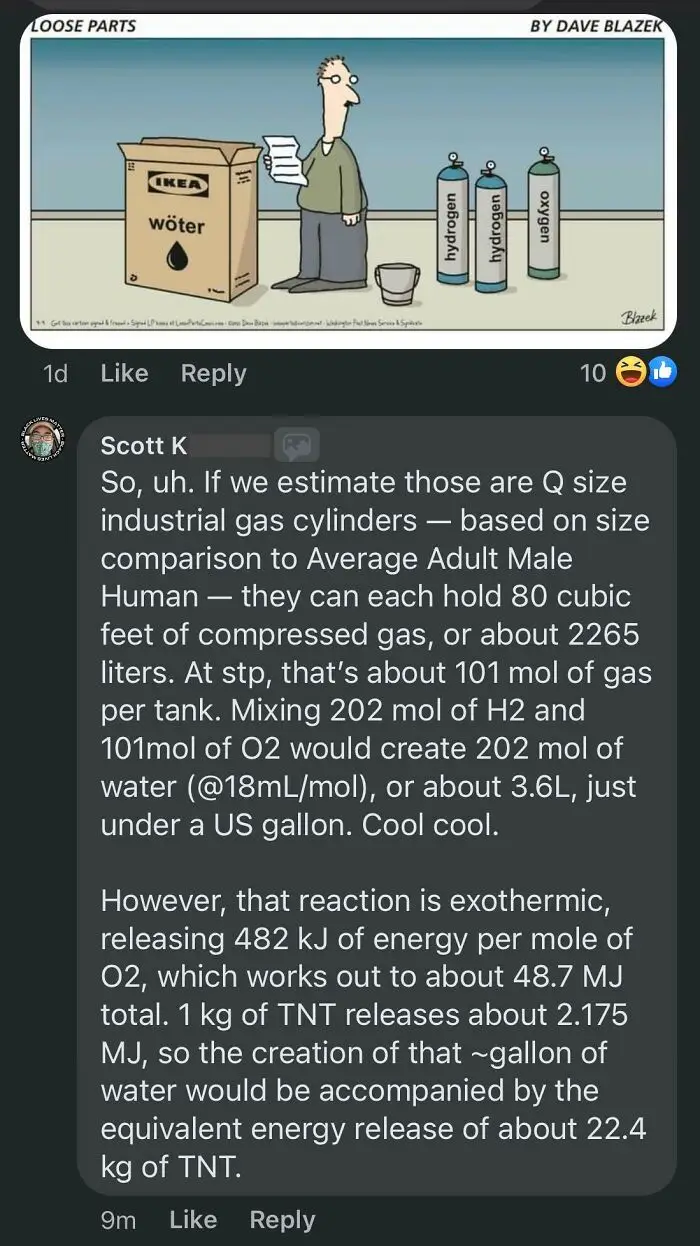
"a. Isn’t this basically rocket fuel and b. I’m pretty sure they do this in the Martian if you’ve seen the movie. otherwise cool calculations"
Report
40points

#26 Is This Accurate With How Much Their Tax Is? Or Is This Hooey?

"That just looks like a 3% tax. If that's what you're talking about, then it's accurate.
To do the math, take the "leave them with" amount, add back in the "would owe" amount, and you have the amount they're starting with. Multiply that by .03 and you get the "would owe" amount again."
Report
37points
#27 Aside From The Meme, Is This True?

"The conversion formulas are:
SPL = 20 * log10( p / p_0 )
p = p_0 * 10 ^ ( SPL / 20 )
With p_0 = 2e-5 Pa and 194 dB you get 100 kPa or 1 atm. After that point a sound isn’t really a sound but more of a shock wave, and it’s not clear how meaningful dB measurements are.
At 1100 dB you get a pressure of 2e50 Pa. Pressure isn’t really the right way to measure a black hole because size is also very important. But for reference, a Neutron Star, where atomic structure has collapsed, can have a pressure on the order of 1034 Pa. So 1050 Pa sounds like enough to me."
Report
33points
#28 Is This Why It's So Hard To Buy A House These Days?

"Now, there are issues with this, because we aren't weighing population growth and decline in these cities (rust belt population, demographic collapse of certain cities such as Detroit, etc.,). I think they just took "average price in X city." Back then there wasn't the insane income inequality from city-to-city either, so that factors. (e.g., median wage in a city that would go on to form the Rust Belt back then was closer to that of the coastal cities. Now you can famously buy houses in ghettos where there are no jobs for very little money- but you have no municipal services, among other issues.)
I genuinely think they just "averaged" these cities out by 'large municipal area.' I can't factor for wage growth in areas like Silicon Valley. We've seen extreme bifurcation in value and wages in these localities since 1971.
So, I instead took just my nearest city I lived in, Philadelphia. It's a sort of "normal" city that isn't an outlier (it's not exactly Detroit, nor San Francisco, but 'somewhere in-between.') So I'll use it as a yardstick, because I'm not spending more than like, 5 minutes on this thing, and hell, someone's gotta actually take a swing at this.
In 1971 a home in Philadelphia was 14,800, or in today's dollars, just a hair under $100,000.. For today, however, in that same municipality, it is $280,000., with the data ending in June and showing zero signs of slowing if you look at the chart's rising tail.
For everyone saying "but it doesn't have modern amenities-" I don't think anyone buying a "starter home" cares if it was built in the 1800s, 1900s, 1950s, 1970s, or today. Most want a place to build equity where they can stop burning their cash on rent and start putting it toward saving, maybe move up to a better home later once they have the equity.
Most places are at least wired for some kind of broadband. Most places have electrical outlets that meet code.
Past that, you can run either a window unit or space heater if you really have to, with the other differences being so small as to not matter, (at least when it comes to starter homes. It's not like it's a smart home that's hyper-modern.)
Starter homes of a modest size aren't really built anymore- and there's a reason for that. But for people 'starting out' in homeowning, it looks like the last few years and some change just made that a lot harder."
Report
32points
#29 I Saw This On R/Memes And Was Wondering How Far This Will Take Us From The Sun By The Time It Swallows Earth

"There's a paper published that calculates what fate the Earth suffers due to the sun swelling into a red giant. I'll see if I can find it.
Here it is:. https://scholar.google.com/scholar?hl=en&as_sdt=0,5&qsp=1&q=fate+of+earth+sun&qst=ib#d=gs_qabs&u=%23p%3Dqw-giyuR1AMJ
Anything inside 1.15au currently is doomed.
To elaborate: the sun will likely puff up to red giant with a diameter encompassing Mars. Which suggests that Earth will definitely be engulfed. That simple model however neglects that the sun will have lost a significant amount of mass by then which would tend to cause the orbits of the planets to expand. The paper calculates that even given the mass loss the Earth is still doomed."
Report
30points
#30 Scott Manley Did The Math

"Couple issues with this post.... 1) it’s not downloadable on Steam 2) Ark: Survival Evolved is much larger with dlc involved."
Report
27points
#31 Is This Correct? And How Much Power Could That Generate?
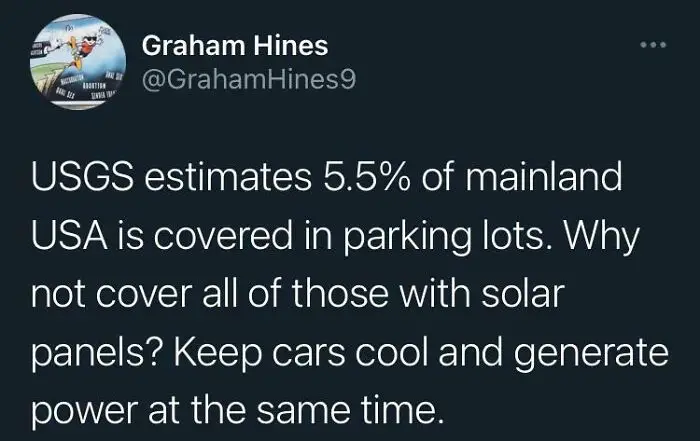
"That 5.5% figure is very clearly bullshit.
The mainland US covers 3,119,885 mi2. 5.5% of that are
3,119,885 mi2 * 0.055 =~ 171,593 mi2.
There are a bit less than 300 million motor vehicles in the US, but let's use that number to highball (note: that would include Alaska and Hawaii while our area claculation does not).
That makes for
171,593 mi2 / 300,000,000 =~ 0.000572 mi2 =~ 15,946 ft2
of parking lot per vehicle in the US.
A large pickup truck might be 20ft long and 7ft for a total of 140 ft2.
Let's say we need parking space just over 4 times that size per vehicle, so 500 ft2.
That would mean there were enough parking lots to park every US vehicle
15,946 ft2 / 500 ft2 =~ 32 times.
And that is, without a doubt, bullshit.
Especially considering that we're ignoring parking space on the side of roads and individual parking spots on people's private property.
So where the heck does this number come from?
I'm guessing it's this article which states:
In all, the model estimates that about 5.5% of all U.S. land was covered by parking lots in 2012
Huh. But then, under a picture it has the following:
About 5.5% of developed land in the lower 48 U.S. states is covered by impervious parking lots [...]
They conflate "all U.S. land" with "developed land in the lower 48 U.S. states". That's two very different things.
So what does the actual study say? At least they link to it (might take a while to load) which is more than most such articles do.
But looking at the brief summary, there is no mention of 5.5%. Some other, more specific figures, but no overall value for all developed land or even all land. It does clarify that they're only going for the conterminous 48 states, though.
So let's dig deeper. The first linked file has their metadata which also summarizes all their findings. Still no 5.5% though.
What is in there, is this snippet:
This was 5.46%, compared to the true parking areas in the validation areas, which was 5.49%.
That's the only source of a 5.5%-ish figure in there.
So what's the context? Well, this is under the section "Process Description". Notice the term "validation areas"? Those are the areas they ran their automated measuring tool (classifying parking lots from satellite data) on for which they had actual data, so that they could compare and ensure that their tool provides good results.
What was that validation data? It's listed as the following:
Bloomington, Indiana; Chattanooga, Tennessee; Denver, Colorado; Hartford, Connecticut; Wake County, North Carolina (city of Raleigh), and Ramsey County, Minnesota (St Paul)
So, 6 cities. That's where the 5.5% comes from. These 6 cities are 5.5% parking lots.
Nothing else. The study does not give a total for the entire US (or 48 states). It doesn't give a total for all "developed land" either. It has sub-categories of this with data but without knowledge of their proportion to each other, we can't derive an overall value here.
Whoever wrote that article, do better.
But sure, let's cover 5.5% of the mainland US in solar panels.
That's 171,593 mi2 as we calculated earlier.
Solar panels might average around 6 kwh per square metre per day.
171,593 mi2 =~ 4.4443 * 1011 m2.
4.4443 * 1011 m2 * 6 kwh/(m2*day) = 2.66658 * 1012 kwh/day.
The US uses about 3.8 * 1012 kwh/day. So we could cover a solid 70% of that with our solar panels."
Report
26points
#32 So About How Many Extra Nuggets Would That Be?

"Let's assume that this is part time worker. We can't say for certain how many hours they would get in a given week, so we will assume that they work 20 hours per week.
It was stated that they worked at McDonald's for 2.5 years. With 52 weeks per year, this would give us a total of 130 weeks (52 x 2.5 = 130).
At 20 hours per week, for 130 weeks, we have a total of 2,600 hours worked (20 x 130 = 2,600).
The remaining variable is how many orders of 10 piece nuggets occur each hour. Each order represents 1 free nugget. There are many factors which determine how many orders there are per hour:
-The number of 10 piece nuggets ordered would be higher during peak dining hours, and lower during off peak hours.
-Nuggets aren't served during breakfast hours.
-Location would have a major impact on this number. We would expect a location in a densely populated area to have lots of customers (and therefore more orders of 10 pice nuggets each hour). We could assume that a store in a more remote location would experience a smaller number of customers.
For simplicity, let's assume that there are 10 orders of 10 piece nuggets per hour.
With the assumptions above, we have the employee working for 2,600 hours, giving away 10 free nuggets in each of those hours.
2,600 hours x 10 free nuggets per hour = 26,000 free nuggets"
Report
23points
#33 Just Saw This Meme And It Seems Wildly Out Of Proportion. Can Someone Confirm Or Give Me A More Accurate Number To Share With My Buddies?

"Golf courses are between 5000-7000+m long on average on the card plus extra walking and the fact that unless you are pro you arent going in a straight line the whole time you can do nearly the same again.
Assuming 6 mile (9.6km) walked per round, 1 round per week minus 2 for holidays that would give 50*6 or 300 miles.
Assuming one has a pint at the end of each round, that would give 50 pints or 6.25 gallons
My math says that that equals 48mpg
So the numbers look like they are assuming 3 rounds a week but the ratio is there or there abouts"
Report
23points
#34 How Long Till The Average Person Farts 500k Times

"The average person farts between 5-15 times a day, using the median (10) it would take 50000 days to fart 500k times. This is 136.9863 years."
Report
22points
#35 How Long Could An Average Car Stay On Before Running Out Of Gas?

"The average car is a Toyota Corolla which has a gas tank big enough to hold 13.2 gallons of gas. An average car uses about 1/5 of a gallon of gas an hour if you let it idle. 13.2÷.2 is 66. So about 66 hours in a full tank. I did a whole 5 minutes of research on this and I don't know if I used the right equation so I may be wrong"
Report
20points
