



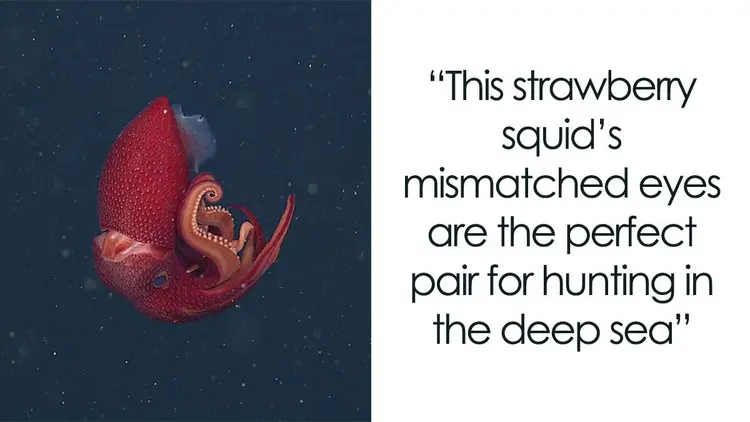


The ocean is still one of the biggest mysteries on Earth, and the deeper you go, the stranger it gets. Far below the surface, where sunlight can’t reach, lives a world full of creatures that look more like aliens than animals we know.
Researchers at MBARI, the Monterey Bay Aquarium Research Institute, have been exploring this hidden world for years. Using advanced technology and deep-sea robots, they’ve captured some of the most unusual and fascinating animals ever seen.
From see-through creatures that almost disappear in the dark to glowing animals that light up the abyss, these discoveries show just how little we know about life in the deep sea. Many of these animals are rarely seen, and some are still being studied to understand how they survive in such extreme conditions.
We’ve put together 30 amazing images shared by MBARI that show just how strange and beautiful the deep ocean can be. Get ready to meet creatures you won’t believe exist!
#21 Balloon Worm
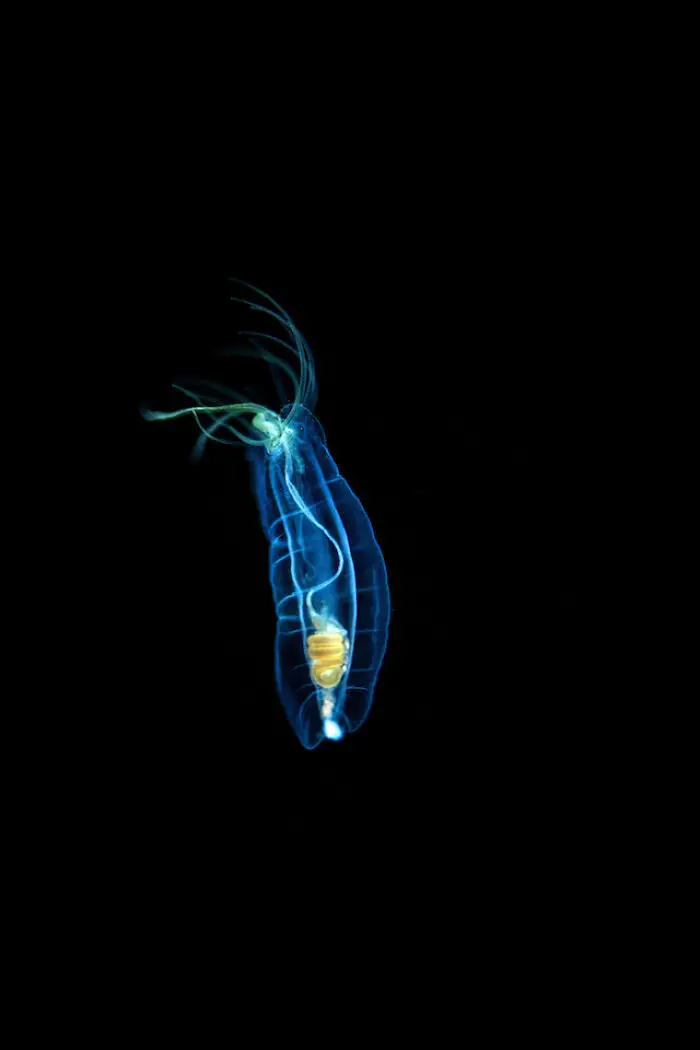
It’s a jelly. It’s an egg case. It’s a . . . worm?
The balloon worm (Poeobius meseres) hardly looks like a worm at all. It lives in the midwater—the vast expanse of open water deep below the surface and far above the seafloor. This worm has evolved unique ways of living suspended in the water column instead of crawling along the seafloor.
Most marine polychaete worms—the much more elaborate relatives of earthworms and leeches—have a body that is clearly segmented. Their bodies are divided into many nearly identical, repeated parts. Typically, each of those repeated parts is studded with several stiff bristles. Poeobius, however, has a bag-like body filled with fluid that, together with its thick gelatinous coat, provides buoyancy to help it float in the water column effortlessly. Its smooth body lacks the obvious segmentation and the bristles of its bottom-dwelling kin. But if you look carefully, there is evidence of segmentation: several repeated clusters of nerves spaced along the worm’s belly.
Poeobius is a common and very abundant resident of the midwater in Monterey Bay. It drifts through the water, collecting and eating bits of sinking organic matter in a mucous net. This little worm is actually an important part of cycling nutrients like carbon from the ocean’s surface to its depths.
Report
18points
#22 Crystal Amphipod
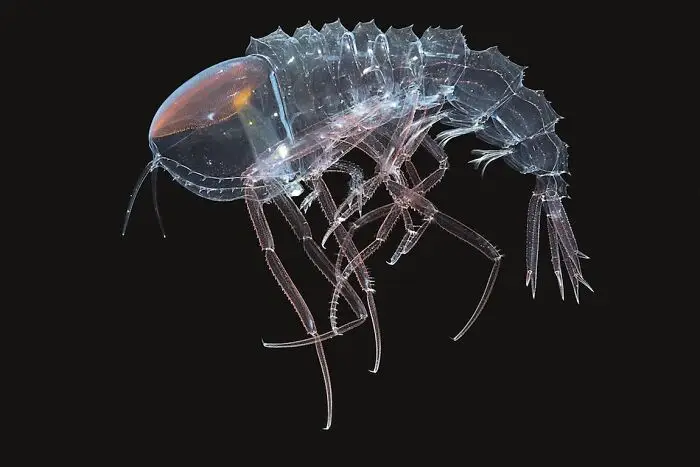
This living jewel hides in plain sight.
Life in the twilight zone is a constant game of hide and seek. The crystal amphipod (Cystisoma spp.) combines invisible armor and giant eyes for a winning strategy.
Amphipods are shrimp-like crustaceans. Cystisoma is a deep-sea hyperiid amphipod. Most of their cousins grow no bigger than your fingernail, but the crystal amphipod can fill your entire hand.
Cystisoma are also unusual because they swim freely in the open water. Many other hyperiids are hitchhikers, taking advantage of nearby jellies for food and shelter. Living out in the open requires the crystal amphipod to become almost completely transparent.
With the help of MBARI’s ships and deep-sea robots, our researchers and their collaborators revealed the secret to the crystal amphipod’s invisibility. Their exoskeleton is covered in microscopic shaggy structures or a fine coating of biofilm. Tiny spherical bacteria, only nanometers in diameter, work like the anti-reflective coating on eyeglasses to help Cystisoma camouflage in an environment that is sorely lacking in places to hide from hungry predators.
The crystal amphipod’s eyes are massive and cover up to a third of their body, helping them find transparent prey in the dim downwelling light. Their retinas are spread out into a thin sheet of tiny dots to reduce their shadow below.
Jellies are on the menu for the crystal amphipod. We have observed Cystisoma using those sharp pincers to tear bits of gelatinous tissue off a comb jelly.
Cystisoma mothers, like all amphipods, typically carry their babies within a special sac on their chest—even at the risk of blowing their invisible cover. Because her babies are reflective and visible to predators, mom does not brood her young for very long. She likely drops them off on a gelatinous host when they are quite small and leaves them to grow up on their own.
The crystal amphipod faces a fragile future. As industries look to the deep seafloor for mining precious metals, even animals living far above the bottom are at risk. Mining these metals will release plumes of dirty wastewater into the ocean’s twilight zone, clouding the crystal amphipod’s vision and interfering with their invisible superpower.
We urgently need to identify the impacts deep-sea mining will have on all ocean habitats, from the midwater to the seafloor. What we learn can help resource managers and policymakers guide decision-making about the ocean, its inhabitants, and its resources. Share what you have learned about the remarkable animals of the deep—together, we can be a powerful voice for the ocean.
Report
17points
#23 Dragonfish
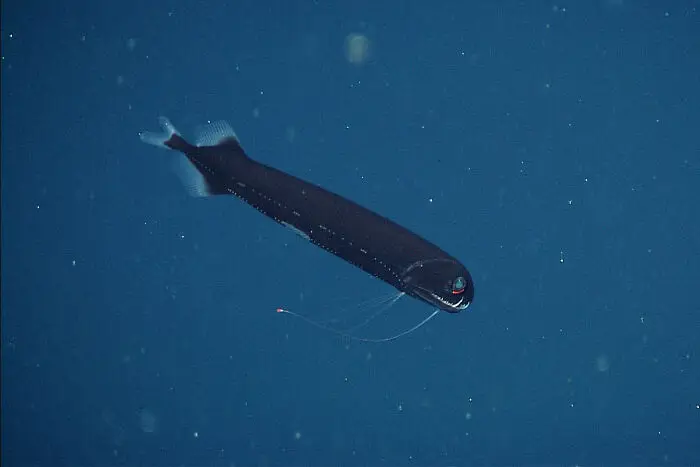
Dragons lurk in dark depths.
Dragonfishes (family Stomiidae) are cunning predators. Although they are strong swimmers, they prefer to lie in wait and ambush unsuspecting fishes and crustaceans. Most have dark skin—pigmented with some of the blackest blacks known in nature—to stay camouflaged from their prey. Some dragonfishes dangle a luminescent lure from their chins to entice prey. When a tasty morsel comes close, their big jaws open wide, and sharp teeth snap shut.
MBARI researchers have observed several different dragonfishes in the depths of Monterey Bay. The Pacific blackdragon (Idiacanthus antrostomus) and the longfin dragonfish (Tactostoma macropus) are the most commonly sighted species. Encounters with others are rare treats.
Report
17points
#24 Fangtooth
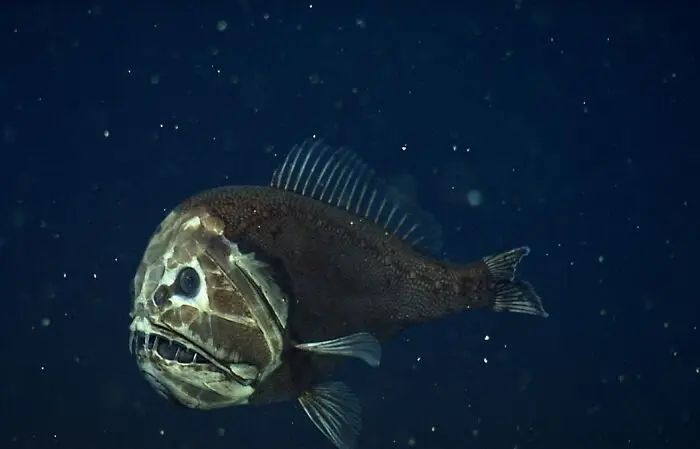
This rarely-sighted creature thrives in the deep sea worldwide.
Despite this fish’s fierce name and ferocious looks, fangtooth (Anoplogaster cornuta) is a rather small (and possibly lazy) predator. The gaping mouth, stubby fins, and mottled patterning suggest a fish that lurks and waits—until prey swims too close, that is.
Scientists believe fangtooth fish have bad eyesight, but an excellent sense of touch. The pronounced dark line down their sides is a lateral line that senses even small movements around them.
It’s easy to imagine why fangtooth’s face earned the species its other nickname—”ogrefish”—but that’s not the only similarity. MBARI research teams have spotted a fangtooth less than once every two years on average since we opened our doors, making this fish almost as elusive as it is astonishing.
Report
17points
#25 Midwater Octopus
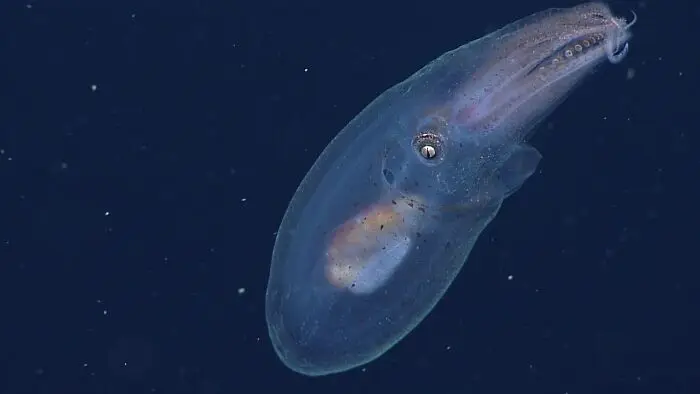
This little octopus is a master of survival in the deep sea.
The midwater octopus (Japetella diaphana) is one of just a handful of octopuses that live in open water. This species calls the expansive waters of the ocean’s twilight zone home. Here, there are no rocks or reefs for hiding or nesting. Instead, Japetella has evolved creative solutions to survive life’s everyday challenges.
Japetella cannot rest on the seafloor. A buoyant gelatinous body means this octopus can drift with the currents, and a low metabolism helps conserve energy while swimming.
A nearly transparent appearance helps Japetella blend into the dim, twilight waters. When the octopus sees the glow from a bioluminescent predator or senses movement nearby, a built-in defense mechanism gets to work. A network of tiny pigment-filled cells called chromatophores covers the octopus’s entire body. By rapidly expanding these cells, Japetella can shift from crystal clear to opaque orange. Since red and orange light do not reach the deep sea, this color change helps Japetella remain hidden from predators, an impressively nimble camouflage response to threats.
Life out in the open presents other challenges for Japetella too.
A mother midwater octopus does not attach her eggs to the seafloor. Instead, she carries them in her arms. To protect herself and her offspring, she descends to the deeper waters of the midnight zone, where there are fewer predators. Like other octopus moms, she makes the ultimate sacrifice to ensure the next generation’s survival. A mother Japetella lives just long enough for her babies to hatch and begin their journey back up to twilight waters.
Threats like climate change and pollution present new challenges for deep-sea animals.
The depth range of the midwater octopus overlaps with the oxygen minimum zone, a naturally occurring layer of low-oxygen water. Climate change is warming our ocean. Warmer surface waters do not easily mix with cooler waters, reducing replenishment of oxygen-rich waters. Scientists predict the oxygen minimum zone will expand with climate change. Japetella already live at the edge of their oxygen tolerance—will climate change push them over the edge?
MBARI’s advanced technology has provided vital insight into the secret lives of deep-sea animals. Our work will help us understand how Japetella and other denizens of the deep will navigate a changing ocean.
Report
17points
#26 Armhook Squid
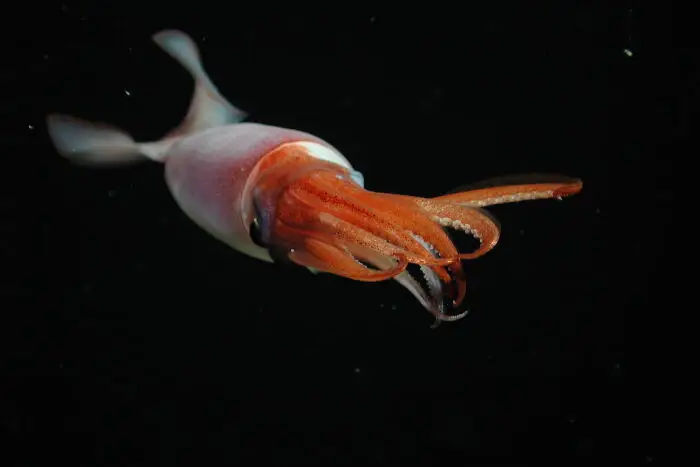
These squids are fierce predators, but caring mothers.
In the ocean’s twilight zone, squids are dominant predators. Two long tentacles with thick clubs at the tip grab a meal, then eight arms lined with suckers hold on tight. The armhook squids (family Gonatidae) have a secret weapon to keep especially slippery prey from escaping their grip: tiny claws line their arms to prevent prey from wiggling loose. The sharp hooks can pierce the scales of a fish or the squishy tissue of a squid. They also help immobilize prey bigger than the squid themselves.
We frequently encounter armhook squids during our explorations of the midwater in Monterey Canyon. The black-eyed squid (Gonatus onyx) is the most common. We have encountered other stunning armhook squids—the deep-red Gonatus berryi, the fiery-white Gonatus pyro, the eight-armed Gonatopsis, and the small-finned Berryteuthis.
Until recently, the diet of the armhook squids in the genus Gonatus remained unknown. Our archive of thousands of hours of underwater video contains valuable observations of feeding interactions of deep-sea animals, including squids. Taking a closer look revealed that fishes were a favorite food. But we also saw a surprising pattern: both Gonatus onyx and Gonatus berryi frequently feed on their own kind.
These squid have an active metabolism, which demands food for fuel. Food is scarce in the deep sea, so a hungry Gonatus cannot afford to be picky. Dining on their own kind also reduces competition for food and mates.
In the endless expanse of the ocean’s midwater, finding food is not the only challenge facing armhook squids. Most shallow-water squids leave clumps of eggs attached to the seafloor or release neutrally buoyant egg masses containing thousands of eggs that drift in the water column. Deep-dwelling armhook squids have a different strategy. With the seafloor far below and predators plentiful, female armhook squids cradle their eggs in their arms.
While brooding, a mother squid will not eat. Instead, she survives on fatty lipids stored in her digestive gland, an organ analogous to the liver in humans. She retreats to deeper waters of the midnight zone, beyond the reach of air-breathing predators like beaked whales and elephant seals and too far above the seafloor for bottom-dwelling fishes and sharks. In about nine months, her eggs will hatch, and then she will die. Her sacrifice gives her offspring a better chance of survival.
Deep-sea squids play a vital role in ocean food webs, eaten by large fishes, sharks, whales, dolphins, seals, and seabirds. They make up a large part of the diets of commercially important fishes like tunas, swordfish, and billfishes. Despite their ecological and economic importance, we still know very little about the lives of deep-sea squids. MBARI’s work is answering fundamental questions about the biology of deep-sea cephalopods and providing vital information that resource managers can use to inform decision-making about the ocean.
Report
16points
#27 Big Red Jelly
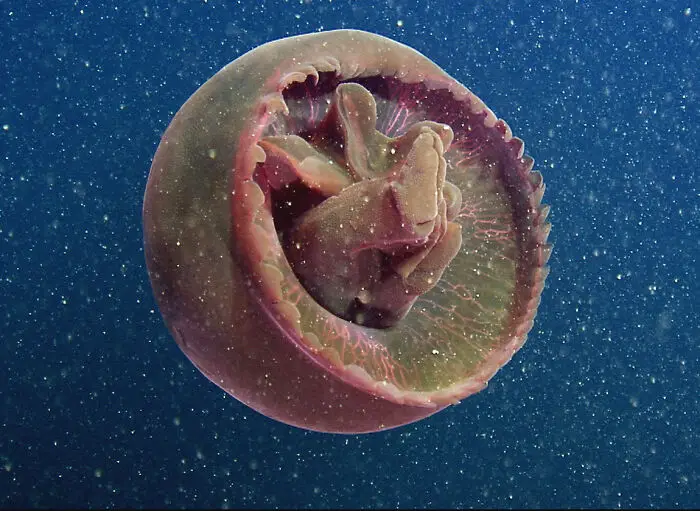
Giants lurk in the ocean’s mysterious midwaters.
While surveying the Gumdrop Seamount off the central California coast in 1998, MBARI staff spotted an unusual—and exceptionally large—jelly. This crimson creature was a full meter across. Unlike jellies that dwell near the ocean’s surface, this one didn’t have tentacles. Instead, a cluster of finger-like oral arms dangled beneath its bulky bell.
A closer look confirmed this was a new species—and one that had actually eluded our scientists five years earlier. Detailed video observations captured by our robotic submersibles helped MBARI researcher George Matsumoto and his colleagues in California and Japan formally describe this unusual jelly. They named it Tiburonia granrojo in honor of MBARI’s now-retired remotely operated vehicle (ROV) Tiburon, which was instrumental in documenting this delicate drifter in its natural environment.
Scientists have since spotted this jelly across the Pacific Ocean, from Baja California to Hawaii to Japan. That something so big remained undiscovered for so long shows how little we’ve explored the deep sea—and what more must be out there waiting to be found.
Report
16points
#28 Giant Tubeworm
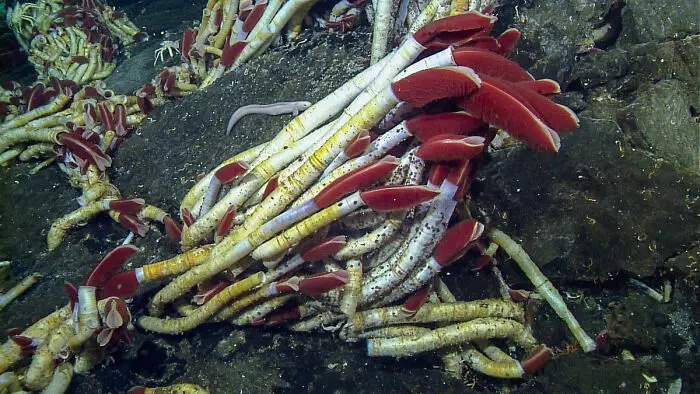
The world’s heaviest worms thrive in an extreme environment.
Towering colonies of giant tubeworms (Riftia pachyptila) grow where hot, mineral-laden water flows out of the deep seafloor. Unlike most animals, they don’t eat; instead, bacteria living in their guts transform sulfur into energy for them.
As harsh as their environment is, giant tubeworms live surrounded by a community of other animals—and their size doesn’t necessarily protect them. Their gills, which resemble foot-long red feathers, can be a vulnerable target for predators. The worms can quickly retract their gills into the tube if a hungry predator, like a vent crab, ventures too close.
When volcanic activity deep below the seafloor changes, the hot water sometimes stops flowing. In this case, the entire worm colony may die off. But when new hot springs pop up in other areas—often dozens or even hundreds of miles away—the tubeworm larvae quickly colonize them. Researchers are not sure how the larvae find the new vents, but deep-sea biologists are revealing new findings with every research expedition to these iconic deep-sea communities.
Report
16points
#29 Rattail Fish
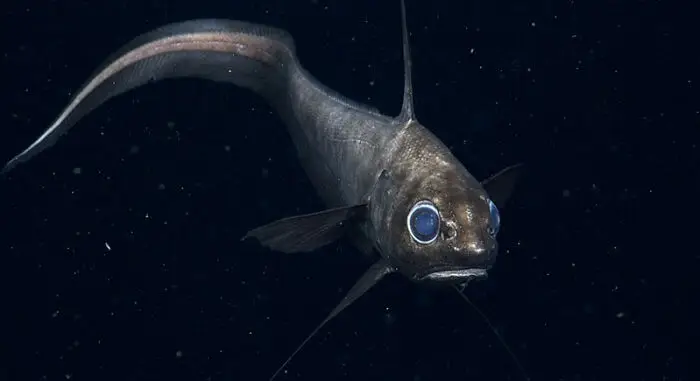
Super senses help a rattail thrive in darkness.
Food is scarce in the deep sea and, without sunlight, can be hard to find. But those big blue eyes give the rattail an edge. It can glimpse even the faintest flickers of bioluminescence—the “living light” produced by deep-sea animals. Keen eyesight reveals prey, like fishes and squid, darting in the waters above the seafloor.
A rattail relies on other senses, like smell and touch, to find a meal too. It has a nose for rotting carrion, and sensitive barbels on its chin detect small crustaceans or worms wiggling in the mud below.
Humans play a pivotal role in deep-sea food webs too. As fish stocks in the ocean’s sunlit shallows dwindle, fisheries cast their nets to deeper waters. You might see “grenadier” as the catch of the day in restaurants and seafood markets—that’s a deep-sea rattail fish sold under a more palatable market name. Rattails and other deep-sea fishes grow slowly and mature late in life, making them vulnerable to overfishing. The gear used to catch these fishes may harm seafloor habitats or unintentionally catch other species too. Thankfully, effective management for rattail fisheries on the West Coast has reduced the risk of overfishing and habitat damage. The Monterey Bay Aquarium’s Seafood Watch guide can help you make seafood selections that keep ocean health in mind.
Report
16points
#30 Abyssal Comb Jelly
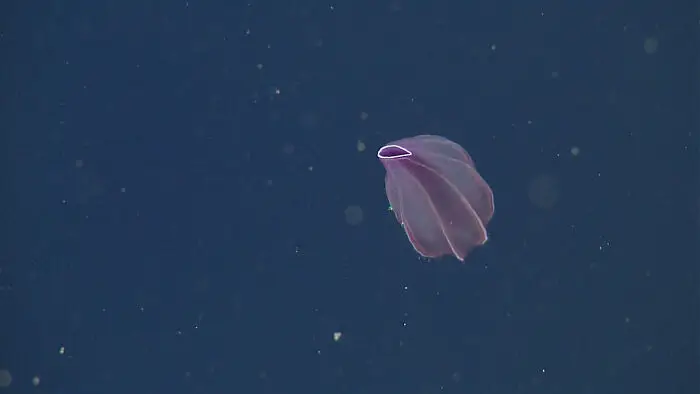
This predator’s pretty pink color is clever camouflage.
The abyssal comb jelly (Beroe abyssicola) patrols the midnight zone searching for its favorite food—other comb jellies. When Beroe finds another comb jelly, it opens its mouth wide. Rows of tiny hair-like cilia in its mouth act like teeth to help it take a bite of its prey, though sometimes a hungry Beroe will simply swallow its meal whole!
This predator prowls in dark depths where most animals can produce bioluminescence. A glowing gut would invite the attention of other predators. The crimson color of the abyssal comb jelly’s stomach absorbs the light produced by bioluminescent prey, keeping Beroe camouflaged.
MBARI researchers have learned that gelatinous animals like Beroe have a large impact on deep-sea food webs. Our archive of nearly 28,000 hours of deep-sea video contains hundreds of observations of deep-sea animals feeding. Examining these observations in detail revealed that jellies, comb jellies, and siphonophores are important as both predators and prey in the ocean’s midnight zone.
Report
15points


