




Funnily enough, researchers have actually studied people who act smug on social media and seem to think they're better than everyone else.
This brings us to the Dunning-Kruger effect, a cognitive bias identified by psychologists David Dunning and Justin Kruger. It suggests that people with limited knowledge or skills in a particular area will actually overestimate their competence. This happens because they lack the expertise to recognize their own mistakes, leading them to share their opinions with complete confidence.





Another factor comes into play with this cognitive bias: the online disinhibition effect, identified by psychologist John Suler over two decades ago.
This explains why people drop their usual social filters when they're behind a screen rather than in person. Because of the invisibility factor, meaning no eye contact or immediate facial feedback, people who love to say "well, actually" will often talk down to strangers in ways they would never dare to in a face-to-face conversation.


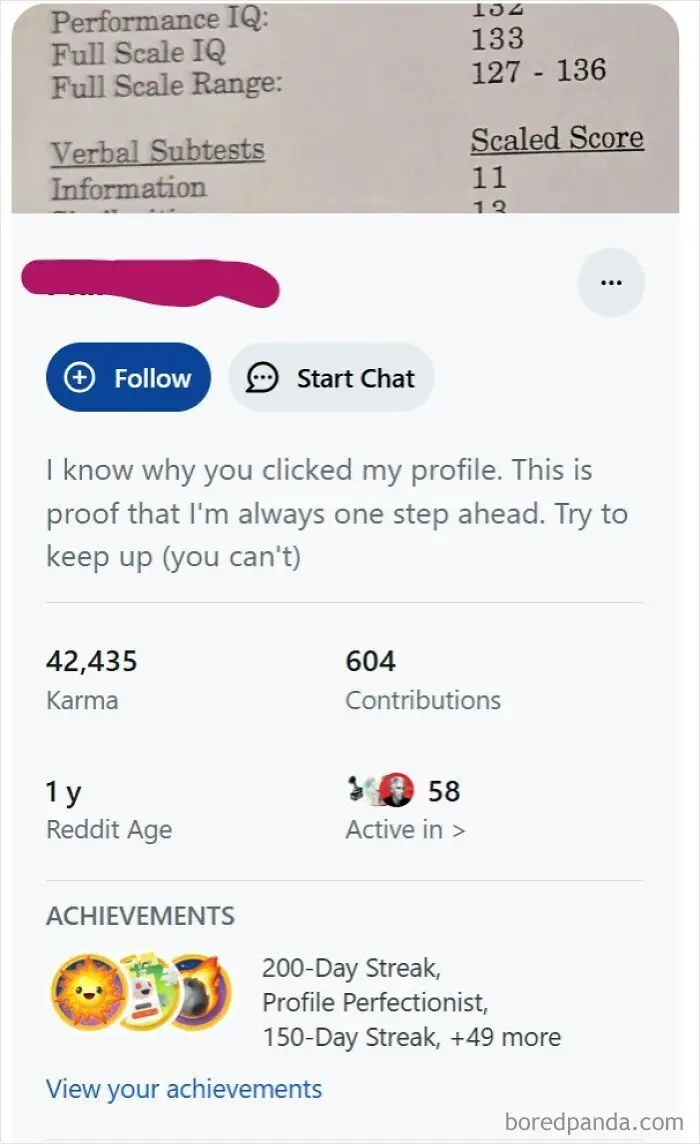

And of course, it's just so satisfying to see these people getting owned by others online. And well, there's actually an explanation for how our brains work in these situations.
A 2019 study found that schadenfreude, or taking pleasure in someone else's misfortune, tends to spike when the person falling from grace displays "hubristic pride." In other words, when they're arrogant, dominant, and constantly bragging. Seeing someone arrogant get put in their place isn't just funny; it can also feel like a little restoration of fairness in society.

#13 “Everyone Remembers The Word That Knocked Them Out Of The Third Grade Spelling Bee”



#16 Iq:146- Doesn't Know The Difference Between Adrenochrome And Plasma


And it's not just in the modern world that we see this happening. Historically, there have also been examples of this exact phenomenon.
Apparently, in Ancient Greece and Ancient Rome, rulers used the metaphor of "cutting down the tall poppy" to describe bringing overly prominent or arrogant figures down to size. Nowadays, this idea is even known in countries like New Zealand, Australia, and the UK as "tall poppy syndrome."