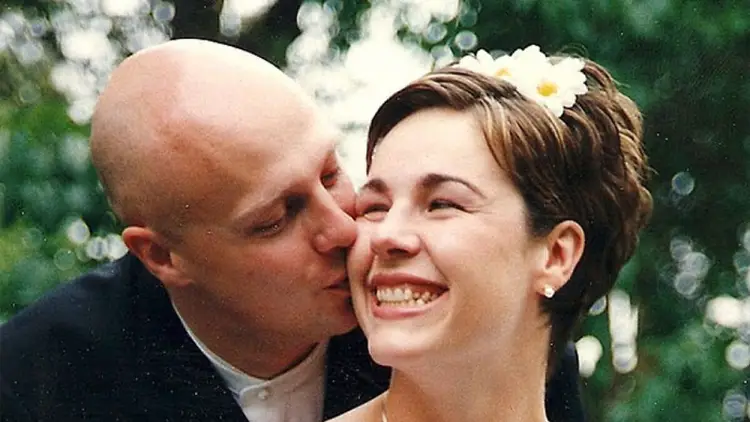
Jessica Waite thought she knew the man she had spent years building a life with. The Canadian teacher and her husband, Sean, had met young, raised a family, and navigated the everyday challenges of marriage, work, and more. Their relationship was far from perfect, but she believed it was real. Then, in 2015, Sean suddenly passed away at a Houston airport. While preparing for his funeral, Jessica turned to his iPad in search of a hospital phone number. What she found instead was a trail of secrets that threatened to unravel everything she thought she believed about her husband:Infidelity, intimate compulsions, cannabis, and significant financial troubles. As the full truth emerged, mourning gave way to a profound psychological crisis. In time, Jessica found herself in the garden of her Calgary home, doing something few could imagine: Eating her husband’s ashes. Phil Crozier Sean and Jessica’s marriage had begun showing cracks before his demise. The couple had met in Osaka, Japan, in 1995 while both were teaching English. Sean was 26, and Jessica was 22. They eventually returned to Canada, married in 1998, and started a family. Like most marriages, theirs had its share of difficulties, particularly as Sean began experiencing increasingly unpredictable mood swings. Jessica later recalled that he could go from being cheerful and sociable to becoming extremely angry over seemingly insignificant things. She had grown concerned about his mental health, given a history of bipolar disorder in both their families. Sean had also been struggling with sleep deprivation and exhaustion in the months leading up to his passing. However, Jessica only realized just how serious things had become during a 17-hour drive from Calgary to Denver in July 2015. Jessica Waite / Instagram Recounting the incident on the 2 Lives podcast in May 2022, Jessica explained that Sean became extremely agitated after taking a wrong turn. In a fit of anger, he suddenly cranked the steering wheel and drove over the curb. Their dogs were thrown around in the back of the vehicle. Jessica yelled that he was going to cause an accident. “I’m gonna k*ll you,” Sean replied. Months later, on November 4, 2015, Sean had a heart attack while waiting to board a flight home from a business trip at a Houston airport. He was 47. For Jessica, Sean’s demise would become the beginning of another kind of loss. The loss of certainty about the man she married. Jessica Waite / Instagram Jessica opened Sean’s iPad, intending to find the telephone number for the hospital that was holding his body. However, as she began typing “Houston” into the browser, the search field auto-filled with “Houston esco*ts.” Sean’s search history revealed he had looked for specific paid companions, their prices, and their locations. On the day of Sean’s funeral, a box containing his personal effects arrived at their Calgary home. Jessica set it aside because she was preparing to deliver his eulogy. Only the next day did she begin opening it. Mohit Sharma / Unsplash (not an actual photo) Inside were the clothes Sean had worn, his computer bag, and his wallet. Among the ordinary remnants of a business trip was also a card that stopped her: a “frequent bud buyer” pass from a cannabis store in Denver, Colorado. Cannabis was legal in Colorado but not yet in Canada. “He wasn’t, to my knowledge, a habitual pot smoker,” she said. Then came the discovery of explicit media and debt. As Jessica continued through Sean’s belongings, she managed to figure out the password for his other electronic devices. Jessica Waite One of his computers, she said, had a vast collection of p**nography. The material, moreover, had been organized and categorized with a methodical precision that Jessica later compared to the way Sean organized home-improvement supplies—everything sorted and labeled. Most of the material had been downloaded between 2 a.m. and 5 a.m. This detail made Jessica recall how Sean would spend late nights at his laptop, sometimes for hours at a time. He had claimed to be working, but now Jessica knew better. Getty Images / Unsplash (not an actual photo) Carmen, a friend who worked as a financial planner, came to help Jessica sort through Sean’s receipts and spending records. Among them were hotel bills that seemed unusually expensive for the number of nights Sean had stayed away on work trips. Jessica requested an itemized receipt. When it arrived, she saw charges for “breakfast for two.” Sean was found to have been involved in a five-year affair with a woman Jessica identified by the pseudonym Rebekah. She was a colleague of Sean’s, not a stranger he had met through paid companion advertisements. Ihnatsi Yfull / Unsplash (not an actual photo) Jessica had noticed years before Sean’s passing that he and Rebekah were texting outside work hours. She had also noticed that Rebekah appeared to be confiding in Sean about her personal life. The affair, notably, did not come to light only through Sean’s receipts. It was also confirmed by Carmen herself, who was married to Sean’s friend Scott. Jessica Waite / Instagram During her appearance on the 2 Lives podcast, Jessica expressed anger over Sean passing away, believing his secrets would remain hidden forever while she was left to doubt years of shared life in light of the evidence she had found. She began to see earlier events differently, she explained, including his mood swings, the exhaustion, the unexplained absences, and the moments when her intuition had told her something was wrong. “You have to be pretty crafty to hide something like that,” she said. “And you have to lie a lot.” Jessica Waite / Substack Even then, she still saw Sean as her own and wanted him to explain things to her. “Are you just a liar?” she remembered yelling into the air, removing her wedding ring and declaring herself divorced. “Is everything you ever told me a lie?” Travis Saylor / Pexels (not an actual photo), ai-assisted image Jessica took Sean’s ashes outside in a moment of “despair, detachment, and fury.” She cut open the bag containing his remains and mixed some of them into her dog’s feces. It was an act of “desecration” directed at the husband she felt had betrayed her. This, however, was still not enough to make Jessica feel at ease. She then decided to consume the residue. “The remains feel dry against my fingertips, coarser than baking powder, grainier than salt,” she shared. “They mix with the teary water, a mineral mud on the back of my tongue. I swallow.” Rene Terp / Pexels (not an actual photo) Jessica knew how deeply her son adored his father, whom he remembered as “a wonderful, fun, loving dad.” Determined not to shatter that image, she began making efforts to protect Sean’s reputation in the boy’s eyes, even as her own understanding of their marriage continued to unravel. Jessica’s struggle to reconcile her husband’s two identities, however, soon began taking a toll One day, while changing her son’s bedsheets, Jessica discovered a small metal identification tag from Sean’s cremated remains beneath his platform bed. The tag had been screwed inside the urn, which she had hidden in a roll-top desk in the garage. Initially fearing that her son had taken it, she was even more unsettled when he appeared not to recognize it. Jessica Waite / Substack / Hallowe’en 2015, four days before Sean died. Unable to explain how it had reached his bedroom, Jessica began wondering whether her late husband was somehow trying to communicate with them. She even directed her fury at the small piece of metal, asking Sean, “Are you trying to haunt us?” before demanding that he leave them alone. Books seemed to appear at meaningful moments. A strange episode in a library added to the sense that something beyond ordinary explanation was happening. This led Jessica to seek help. The help, too, was not the regular kind. It came in the form of Sarah Kerr, a demise doula and ritual healing practitioner. Jessica Waite / Instagram Jessica’s attempts to move forward began with clearing out the basement, where Sean’s extensive collection of explicit material had remained untouched for months. She handed the material to a friend, describing the experience as an act of letting go. “I was handing over my own shame. Sean’s shame,” she said, adding that her friend could simply “receive it.” The friend reportedly told her, “Clutter is frozen fear.” Jessica subsequently attended Camp Widow, where she began exploring life beyond her current state and eventually met a guy named William through a dating website. Courtney Lovgren The two started seeing each other shortly after the first anniversary of Sean’s passing and have now been together for roughly a decade. In 2024, Jessica published her bestselling memoir, The Widow’s Guide to Dead Bastards, documenting the revelations that had destroyed her perception of her marriage and the extreme ways she had reacted to them. What made the decision particularly problematic, though, was that Jessica gave her son the book to read. The boy, who had once regarded Sean as a devoted father, was now being confronted with the fact that, in her fury following Sean’s passing, his mother had mixed his cremated remains with dog waste and consumed the mixture. Still, Jessica’s account, and most importantly her admission, raises another troubling question. Tracking Yes Under Section 182(b) of Canada's Criminal Code, it is an offense to improperly or indecently interfere with a deceased human body or human remains, or treat them in a way that shows disrespect. A person convicted of the offense through an indictment can face up to five years in prison. Applying this law to Jessica's case, however, is not straightforward. Erin Randle / Unsplash (not an actual photo) She did not describe eating flesh from a body. Instead, she recounted mixing cremated ashes with animal waste and swallowing it. Whether this would fall under the same provision is less clear. Cremated ashes are treated differently from an uncremated body under some Canadian provincial laws. Alberta's Funeral Services Act, for instance, excludes cremated remains from its definition of human remains. That does not automatically mean they fall outside the protection of the federal Criminal Code. A 1994 Supreme Court of Canada ruling, R. v. Moyer, also established that a person does not necessarily have to physically touch human remains to commit an offense under Section 182. Even conduct directed at a grave can amount to an indignity towards the remains buried there. However, the ruling did not specifically address the consumption or contamination of cremated ashes. Sora Shimazaki / Pexels (not an actual photo) Ultimately, whether Jessica's actions could have resulted in criminal charges would depend on how the provision was interpreted and applied to the circumstances. There is, however, another striking absence in the public record. Neither her memoir nor the media accounts of her admission identify any police investigation or prosecution over the incident. It is also unclear whether authorities were ever notified of what she described.