


No country in the world has achieved true gender equality when it comes to unpaid domestic and care labor. While some men are finally waking up, others remain completely oblivious to their own incompetence.
One shocking example is a grown man whose wife spends hours each month doing meal prep on her own — cooking and freezing dinner for the next 30 days. But even she reached her breaking point one day when her husband gave away half the food. When she demanded he fix the mistake, her in-laws called her “petty.” Now, she’s turned to the internet to ask if she really is.
Read on to see how netizens reacted to this story of a man who’s probably never even used a stove.
A woman spent most of her Sunday doing meal prep for her family

She made 30 meals for the month, but her husband had other plans











Even today, a lot of men weaponize their incompetence
Given our need for and obsession with food, you would think every adult would naturally learn to feed themselves. Yet plenty of men still can’t even cook a simple meal.
While cooking itself isn’t sexist, the burden of doing it has long been unequally distributed.
A 2023 survey found that the gender gap in “home cooking” has widened — women cooked under nine meals per week, on average, in 2022. Men cooked about four per week.
The culinary gender gap varies by location, though. In the US, women prepare roughly two more meals each week than men. But in countries with the highest disparity, such as Ethiopia, Tajikistan, Egypt, Nepal, and Yemen, women cook about eight more meals per week than their male counterparts.
Women and girls also remain the default caretakers worldwide — spending more than 2.5 times as many hours per day on unpaid care work as men.
Even though more women have entered the workforce, men haven’t stepped up at home to match. Domestic labor isn’t just physical work— it also includes the mental toll of planning, coordinating, and managing a household.
“Men still seem to get around doing more of the routine housework tasks, and that may be because there’s no incentive for them. Housework isn’t valued as highly, and it does not provide the same rewards as paid work or spending time with your children. And if the house is a bit messy or the kids have stains on their clothes, people tend to blame the woman,” says Dr Inga Lass, a senior research fellow at the University of Melbourne.
It’s not that men can’t cook or do household chores. If a man can fix a leaking tap, manage a project, or master a complex career, learning basic home cooking isn’t rocket science.
The ultimate proof that cooking roles are a social construct lies in the professional culinary world. When cooking is unpaid domestic routine, it’s labeled “women’s work.” But the moment it becomes paid, prestigious, and high-status, the industry becomes overwhelmingly male-dominated.
While women make up over 52% of the overall restaurant workforce, their presence plummets at the top. Women hold just 30% of executive roles, and only 6% of Michelin-starred restaurants globally are female-led.

Entitlement doesn’t happen in a vacuum — it is enabled
It usually stems from a mix of childhood privilege, cultural norms, and ongoing enablement. For example, when someone grows up watching one parent handle every chore without complaint, they internalize the belief that domestic care is an automatic service owed to them.
“Overly permissive parenting (where kids are rarely told no) or neglectful parenting (where children overcompensate by demanding attention as adults) are the two biggest culprits I see in my practice. There are also lots of societal messages… Too many kids are overly catered to and constantly told, ‘You’re special.’ While empowering, these messages can also backfire, creating unrealistic expectations,” says Dr. Abby Medcalf, a relationship and happiness expert.
This behavior also persists because society quietly rewards it. A study on household labor division shows that men who do less around the house often aren’t called out. Instead, their lack of contribution is normalized. When a husband never faces real consequences for slacking off, his sense of entitlement only grows.
Experts often emphasize that one of the best ways to deal with such behavior is to set firm boundaries. However, women have been socially conditioned for generations to keep the peace and take on most of the emotional and physical caretaking. This makes it difficult for many women to set firm boundaries without feeling guilty or being labeled “petty.”
So, what can women actually do in these situations?
Our female ancestors fought hard to give us the right to vote, drive, and earn our own money. Today, women also have access to therapy, online resources, and other supportive tools. Yet, many still struggle to use that power at home.
In this story, the wife let four years pass without her husband cooking a single meal. By taking on all the labor without complaint, she subtly enabled his behavior from the start. His entitlement is wrong, but it’s a clear lesson: if you don’t set firm boundaries early on, you end up parenting a grown adult.
Ultimately, the fundamental shift has to come from men themselves. After all, if you can learn how to operate a smartphone, you can definitely follow a simple recipe.
Netizens couldn't believe that the husband complained to his mom

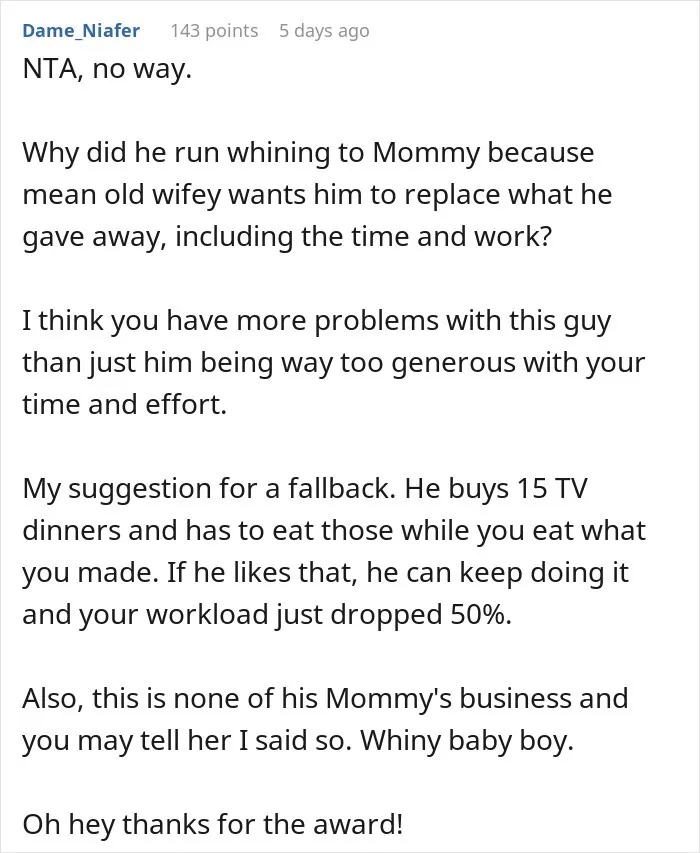





Many people in the comments understood the woman's frustration









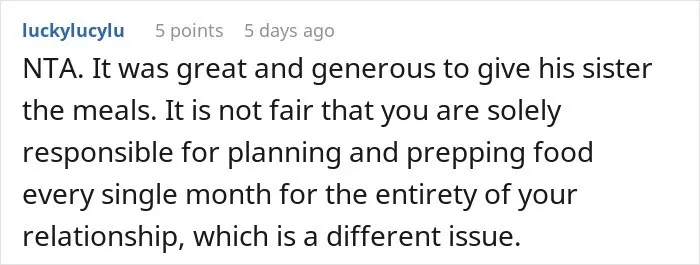

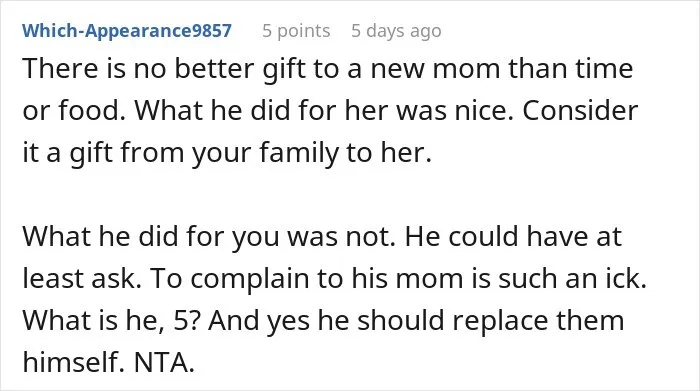




A few in the comments sided with the husband for some reason