

For nearly 30 years, nobody in the small Georgia town of Ringgold had seen Virginia Ridley. Many believed she had disappeared, while others suspected her husband was hiding a terrible secret.
Then, on October 4, 1997, Virginia was found lifeless inside the home she shared with her husband, Alvin Ridley, a once-respected television repairman affectionately known as the “Zenith Man.”
Highlights
- TV repairman Alvin Ridley was accused of keeping his wife Virginia captive for nearly 30 years before taking her life, following her mysterious passing in 1997.
- Approximately 10,000 pages of Virginia's writings revealed her affection for Alvin, leading to his acquittal in 1999.
- More than two decades later, a key discovery about Alvin changed how his community understood him.
Alvin was accused of keeping his wife prisoner for three decades before taking her life.
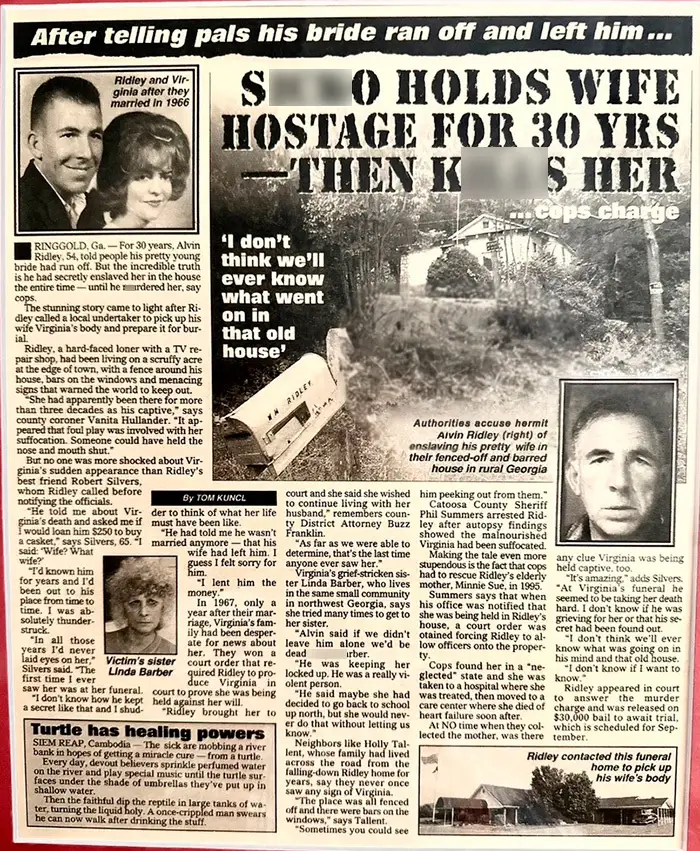
His reputation collapsed as the accusations spread nationwide, with one tabloid branding him a monster who had held Virginia hostage.
But when a defense attorney finally gained access to the couple's house, he discovered thousands of handwritten pages by Virginia, documenting the truth behind the marriage.
A beloved television repairman lost the love of his life and was immediately branded a criminal
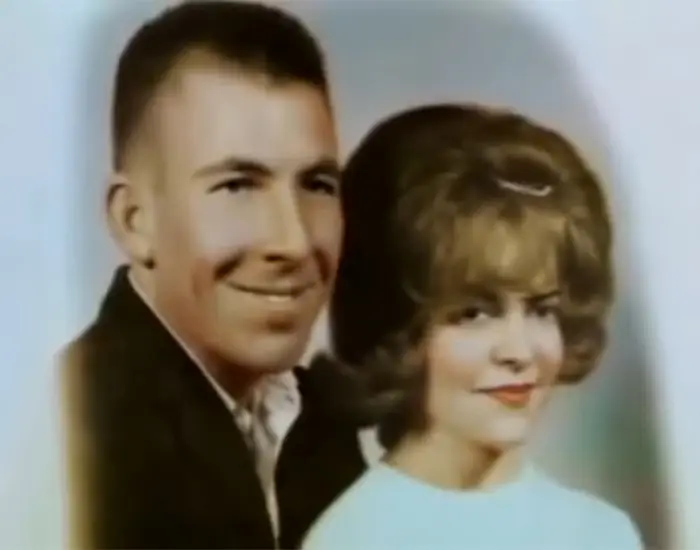
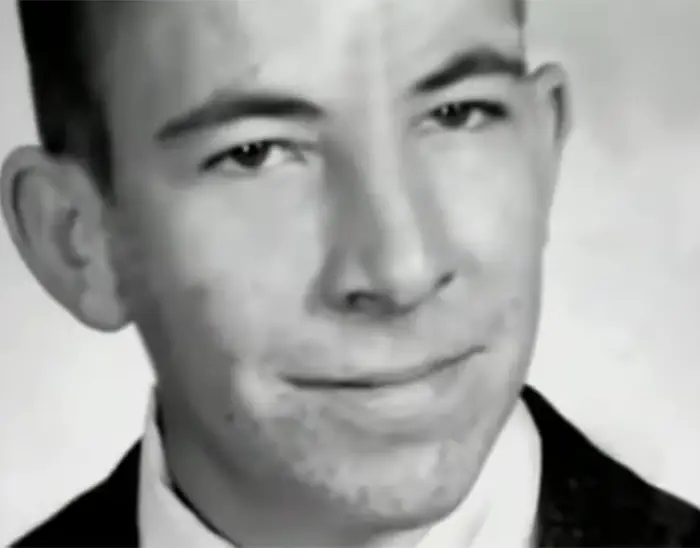
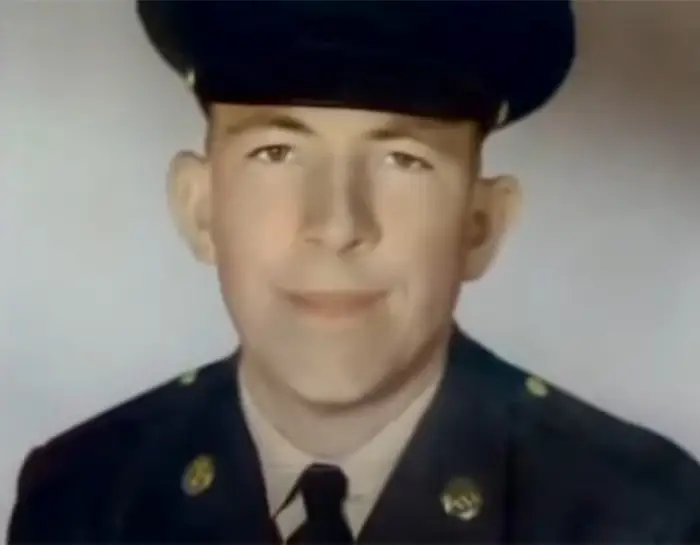
Before becoming the subject of a nationally publicized homicide trial, Alvin was a young man from Ringgold, Georgia, a small community in the Appalachian foothills.
An only child, he graduated from high school and served in the US Army.
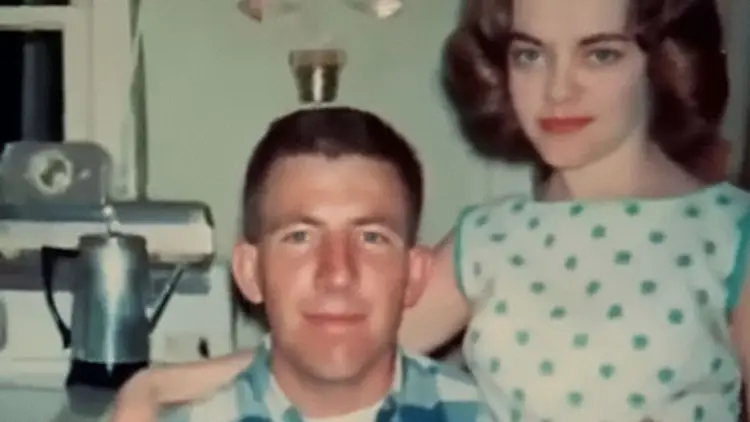
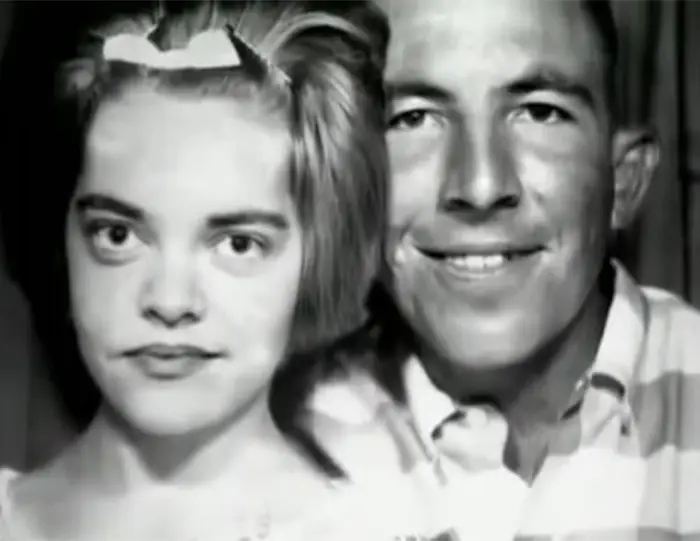
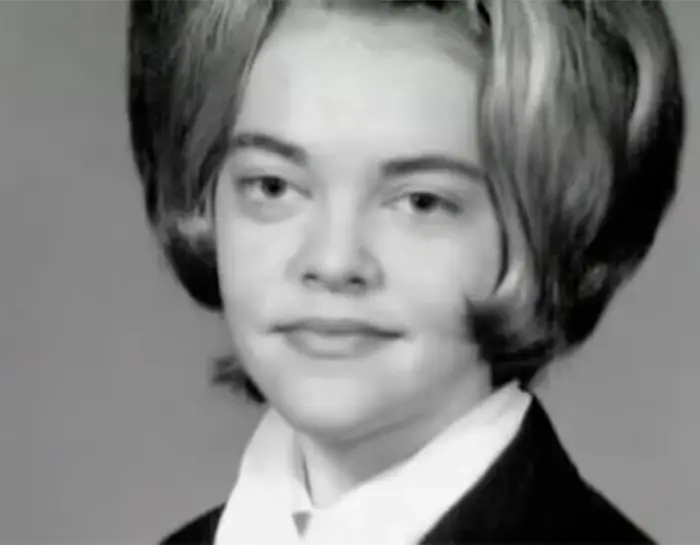
During the 1960s, he began courting Virginia Hickey, a quiet young woman from a nearby town.
Virginia had lived with epilepsy since childhood, having reportedly been diagnosed at just nine years old. Her condition made growing up difficult and contributed to her increasingly withdrawn personality.
Alvin was also described as shy, never the most popular guy around. They bonded over the fact that they were so different from the people around them. Around each other, they could be at peace.
The couple married in 1966 at Pleasant Valley Baptist Church, beginning what would become a 31-year marriage.
Incidentally, that same year, another couple exchanged vows in Ringgold: the late country music legend Dolly Parton and her future husband, Carl Dean.
At the time, there was little to suggest Alvin and Virginia's relationship would eventually become one of the town's most notorious mysteries.
But tensions with Virginia's family soon began developing as her relatives disapproved of the marriage. Within a few years, communication between them had largely collapsed.
As a result, Virginia gradually withdrew from public life, spending most of her time at home with Alvin and planting the seeds of mistrust that ended with him being accused of her passing years down the line.


Her family became increasingly concerned.
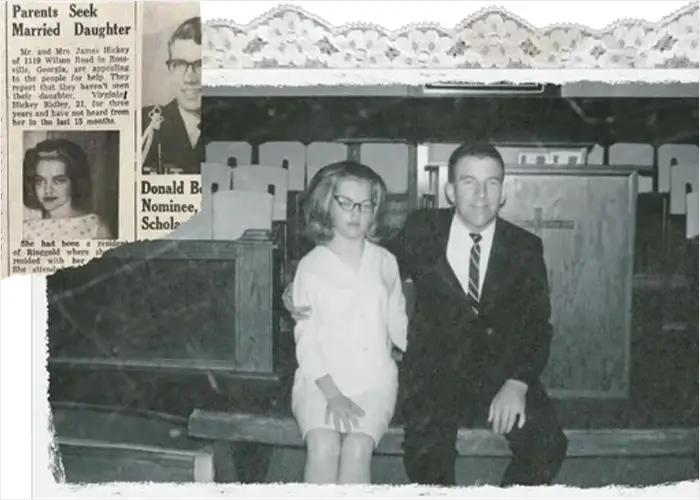
Before long, her parents began placing notices in local newspapers with an alarming headline:
“Parents Seek Married Daughter.”
The advertisements included Virginia's photograph and identified Alvin as the last person known to have been with her.
Sheriff's deputies subsequently visited the couple on two occasions. Both times, they found that Virginia was alive, secure and most certainly not disappeared.
Virginia's family tried to separate the couple, but she made her wishes clear in court

The dispute eventually reached the courts when Virginia's parents attempted to have the couple evicted from their residence.
Alvin refused to accept the situation without a legal fight and demanded a jury trial.
During the proceedings, Virginia was brought before a judge to establish whether she was being held against her will.
According to defense attorney McCracken Poston's later account, the decisive hearing took place on September 15, 1970.
The judge ordered Alvin to produce his wife. Alvin's father went to collect Virginia, who then met privately with the judge and her parents.
When the meeting ended, she returned home with her husband.
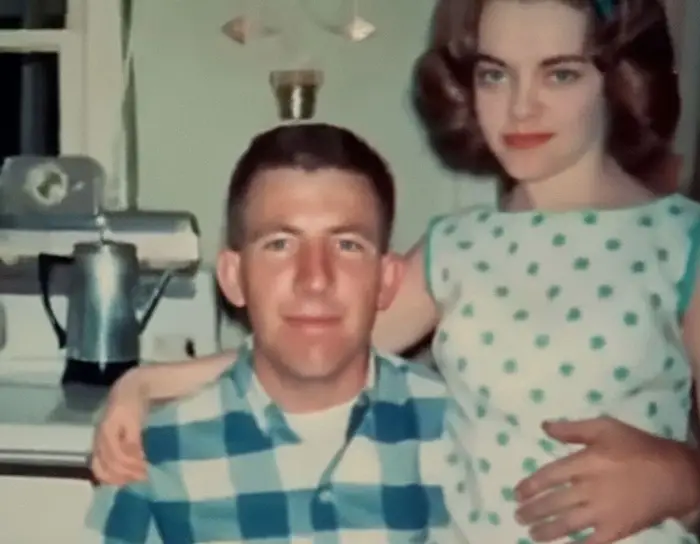
Poston has maintained that her appearance should have settled the question of whether she was being held captive. Instead, it became one of the last occasions on which most people outside the household saw her.
The couple subsequently moved into Alvin's parents' home on Inman Street. Needless to say, the relationship between the couple and Virginia’s family was ruined beyond repair.
In 2026, Poston would explain the lasting damage the trial caused. Alvin and Virginia became paranoid, with the former misleading people about his wife's whereabouts.
“He always thought, and she always thought, that her family was trying to trap her,” the lawyer explained.
At times, Alvin reportedly told people that Virginia had left him years earlier.
To say that the couple's attempts to protect their privacy had backfired would be an understatement. They fed rumors that almost ended with Alvin behind bars.
Alvin's television repair business earned him the nickname “Zenith Man,” but his reputation gradually deteriorated

For years, Alvin made his living selling and repairing television sets.
His shop, Ridley TV Sales & Service, operated in downtown Ringgold, where he became particularly associated with Zenith televisions.
Older residents became fond of Alvin, as he was able to bring back to life televisions that were thought to be beyond repair.
His familiarity with the brand eventually earned him the nickname “Zenith Man.”
But as televisions became more technologically advanced and increasingly difficult to repair using traditional methods, his business began struggling.
The introduction of solid-state circuitry particularly affected his livelihood. His old tricks no longer worked. Instead of updating his knowledge, however, Alvin became resentful.

“His business fell apart and Alvin blamed everyone for it,” Poston later recalled.
By the 1980s, the once-active shop had deteriorated.
Its windows were shuttered, and Alvin began covering the building with typed notices accusing neighbors and government officials of wrongdoing. He became involved in numerous lawsuits, often representing himself, and developed an intense distrust of local authorities.
His relationship with the outside world deteriorated further after a dispute involving an exterminator who, according to Virginia's writings, had entered their apartment without warning and made an unwanted advance toward her.
Alvin and Virginia started to resent the “outside world” that, in their minds, had done nothing but hurt them
Another family tragedy followed in 1981, when Alvin's father was involved in a car accident.
After his father's passing in 1984, Alvin developed an elaborate belief that the accident had contributed to his passing.
His mother subsequently passed away in 1994.
With both his parents gone and his business effectively finished, Alvin's world grew increasingly small.


Inside the house, Virginia continued living quietly, watching television and caring for their cats, Kitty and Meowy.
More importantly, she also devoted extraordinary amounts of time to writing. Almost nobody outside the home knew how extensively she was documenting their daily lives.
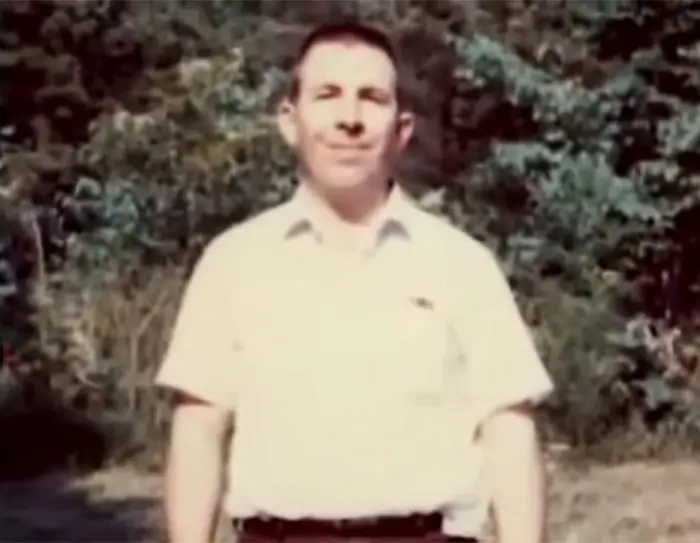
Meanwhile, Alvin's reputation changed from that of a familiar repairman to someone children were afraid to approach. Years of rumors and animosity started to catch up with him.
Poston later described him as Ringgold's “town bogeyman.”
Virginia's isolation concealed a medical condition that would later become crucial to the case
While residents imagined Virginia trapped somewhere inside the house, her own writings eventually revealed a more complicated reality. In particular, her desire for writing came from a dark place, not inspiration.
She had a condition called hypergraphia, which can involve a compulsive urge to write.
Over the decades, Virginia produced thousands of pages documenting ordinary events, personal thoughts and her religious beliefs.
She wrote on loose-leaf paper, scraps of cardboard and anything else available.
Her entries recorded meals she prepared, television shows she enjoyed and the couple's activities together. She grew fond of family-oriented programs, including The Waltons and Happy Days.
But she also wrote about her fears, her strained relationship with her relatives and her reasons for avoiding the outside world. For instance, one entry explained why she had not attended her own father's funeral.
For Virginia, religious study had become more important than participating in the ceremony.
The writings also suggested that she shared Alvin's distrust of local institutions. Their marriage was unconventional, yes, and their mutual withdrawal made their lives increasingly difficult for outsiders to understand.
Nevertheless, the surviving records contradicted the image of a woman secretly begging for rescue.
But none of that was known to investigators when Alvin made an alarming phone call on October 4, 1997.
Alvin reported finding his wife unresponsive, but his behavior immediately raised suspicions
On the morning of October 4, Alvin left the couple's home and drove through Ringgold searching for a telephone.
He passed a fire station with an ambulance before stopping at a payphone outside a convenience store.
The Catoosa County emergency communications office was directly across the street. Alvin initially attempted to contact a hospital in Chattanooga before being directed to call 911.
When he finally reached emergency services, his voice was unusually flat.
“I think my wife's passed out,” he told the dispatcher.

He explained that Virginia had stopped breathing, but did so with what was described as an uncharacteristic lack of emotion. Investigators began treating Alvin's demeanor as suspicious.
Emergency responders arrived at the couple's home and discovered Virginia deceased in her bed.
She was 49 years old.
The house was, to put it bluntly, disgusting. The rooms were severely cluttered, dirty, and the place was infested with cockroaches. All of that gave investigators the feeling that something was deeply wrong inside the residence.
Investigators subsequently examined Virginia's body and identified small hemorrhages around her eyes, known as petechiae.
The medical examiner concluded that she had passed away from asphyxiation, with epilepsy listed as a secondary factor.
Everything pointed towards Alvin in the authorities’ eyes.
And then, Virginia’s relatives became involved.
Police accused the “Zenith Man” of keeping his wife prisoner before taking her life
The news that Virginia had passed away inside Alvin's home caused a sensation as many Ringgold residents had not even known he was married.
Suddenly, the years of rumors, legal conflict, fights with neighbors, scared children, the rundown tv repairment store, the missing person posters, everything coalesced into a singular theory:
Alvin was a criminal, a kidnapper, and had kept Virginia locked in the basement for nearly 30 years.
One tabloid published a particularly damaging headline accusing him of keeping his wife hostage before taking her life.
The allegation soon spread far beyond Georgia. Television crews arrived in Ringgold, and Alvin's unusual behavior became part of the story.
In 1998, authorities formally charged him with homicide.
Prosecutors argued that the hemorrhaging found around Virginia's eyes was consistent with suffocation.
But the defense faced an immediate problem: Alvin was almost impossible to work with.
McCracken Poston Jr., a former Georgia state legislator who had recently lost a congressional election, agreed to represent him. The lawyer knew Alvin as a difficult local character, but his own father had maintained a friendly relationship with the repairman.
Poston believed the prosecution's evidence deserved closer examination.
Yet his client repeatedly refused appointments, argued about unrelated lawsuits and initially would not allow him inside the house.
Alvin was his own worst enemy.
As the trial approached, Poston was still struggling to find reliable information about Virginia's life.
Then, in late 1998, two key discoveries changed the direction of the case.
The autopsy of Olympic athlete Florence Griffith Joyner offered a startling medical comparison

Poston's first major breakthrough involved the passing of American Olympic sprinter Florence Griffith Joyner.
The celebrated athlete had lost her life in September 1998 after suffering a seizure, and her autopsy revealed petechial hemorrhaging similar to that found in Virginia.
According to Poston, Griffith Joyner had actually exhibited more extensive hemorrhaging, yet her passing had been attributed to natural causes. The comparison allowed him to challenge the prosecution's position that Virginia's eye injuries were proof of suffocation.

Poston also consulted medical specialists who explained that people with epilepsy could pass away suddenly during seizures.
Virginia had suffered from the condition since childhood, and the defense argued that her medical history provided a plausible explanation.
But the medical evidence alone would not resolve the allegations that Alvin had kept her captive.
For that, Poston needed to learn what life had actually been like inside the house.
And on Thanksgiving 1998, Alvin finally opened his door.
Thousands of pages hidden inside the house revealed the marriage nobody had understood

The breakthrough came after Poston brought his client a Thanksgiving gift.
His parents had suggested taking something to Alvin, remembering that the repairman was now living alone. Touched by the gesture, Alvin finally allowed the attorney inside.
Poston was astonished by what he found.


The deteriorating house was filled with old televisions and possessions accumulated over decades.
But the most important discovery was the writing.
Drawers contained scraps of paper covered in Virginia's handwriting. More pages were attached to walls, while others were stored among the couple's belongings.
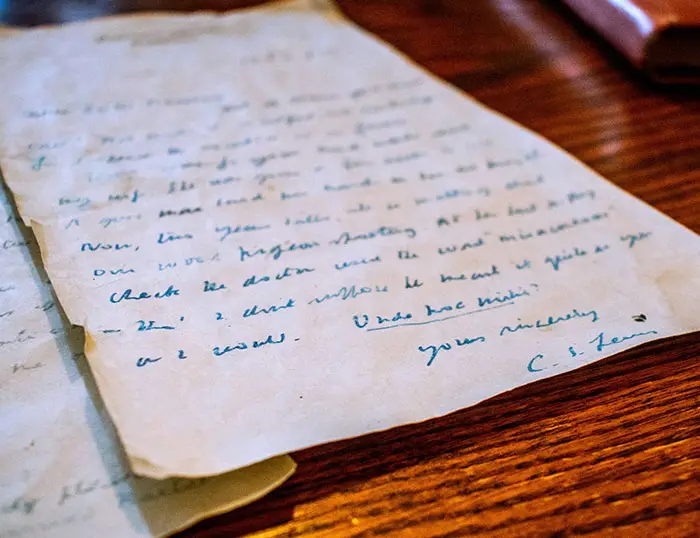
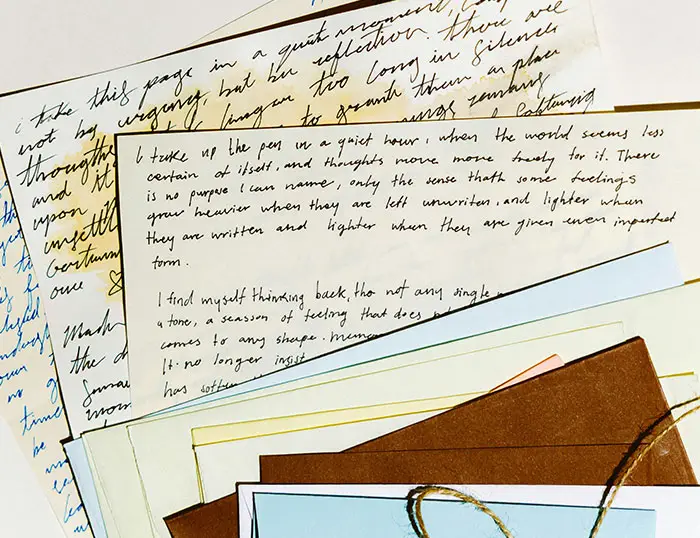
Together, the writings amounted to an estimated 10,000-page record of their marriage, describing Virginia’s affection for Alvin and their daily routines, alongside her anxieties and conflicts with relatives.

They documented experiences across nearly three decades, providing dates and personal details that could be checked against outside events.
A handwriting expert subsequently helped establish that Virginia had written the material.
Alvin, however, initially refused to surrender them. The writings were a treasure to him. “That's all I still have of her,” he told the attorney.
The lawyer, however, explained to him how little of a choice he had in the matter. He either surrendered the writings, or he would go to jail.
In January 1999, Virginia's writings would finally be examined by a jury.
Alvin's trial took a bizarre turn when cockroaches emerged from his evidence
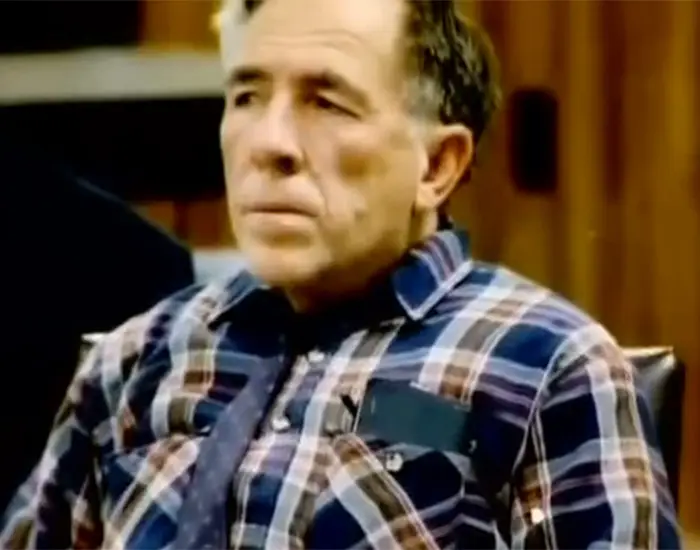
The proceedings began in Ringgold in January 1999, attracting national attention.
Alvin arrived with two battered suitcases filled with Virginia's writings, photographs and old medical records.
The luggage was infested with cockroaches. When the documents were opened, insects escaped onto the courtroom furniture.
According to Poston, the disruption became so severe that proceedings had to be transferred to another courtroom.
By an extraordinary coincidence, the new location was the same courthouse where Virginia had appeared decades earlier during the dispute involving her parents.
Poston used everything he had, both the letters and medical records, to revert the situation and free Alvin.
Then, Alvin insisted on taking the witness stand.


The decision alarmed his attorney, who feared that the defendant's unpredictable manner would turn jurors against him.
Alvin had already created difficulties by appearing in court wearing a neck brace and insisting that the Constitution excused him from attending proceedings when he was sick or injured.
He later claimed that Jesus had appeared to him and instructed him to testify.
Poston reluctantly allowed it.
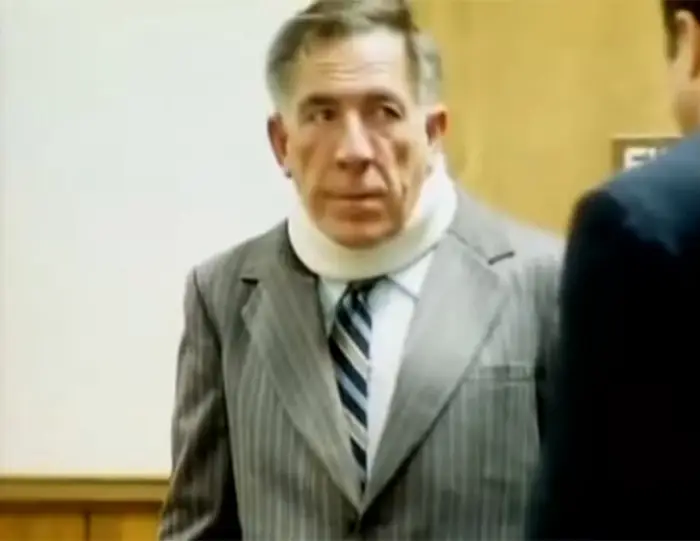
When questioned about his marriage, Alvin spoke about how Virginia was the love of his life, that the life they had decided to create was theirs alone, and that he would have never harmed her.
In that house, away from the world, between walls, notebooks, letters, and cockroaches, they had lived. They were happy.
His testimony, unconventional as it was, coupled with Poston’s evidence, destroyed the prosecution.
“Why would Alvin k*ll Virginia? She was his only friend in the world,” Poston argued.
After just two hours, the jury acquitted Alvin of all charges
On January 15, 1999, the jury returned its verdict.
Alvin Ridley was not guilty.
The jurors had deliberated for approximately two hours before rejecting the homicide charge.
The defense had presented evidence supporting a fatal epileptic seizure, while prosecutors had failed to establish that Alvin had deliberately suffocated his wife.
Juror Kimberly Clark-Barnes later explained that the prosecution could not demonstrate a convincing motive.
The verdict also forced some residents to reconsider the assumptions they had made about Alvin long before he entered the courtroom.
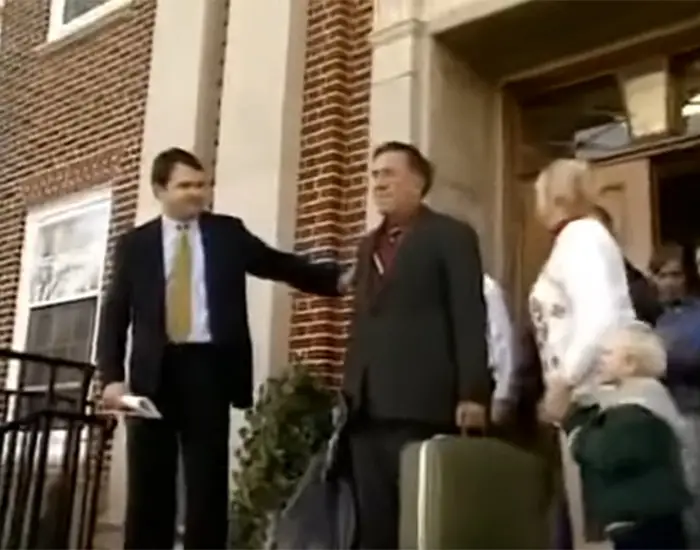
But his freedom became a bitter victory. Virginia was still gone, and he had no time to grieve her loss.
Outside the courthouse, Alvin received congratulations from people who had previously feared him.
He returned to his isolated home, where much of Ringgold continued treating him with suspicion. For years, the acquittal could not erase the image of the frightening man who had supposedly hidden his wife away.
It would take another two decades for the town to understand something fundamental about Alvin.
At 78, Alvin was finally diagnosed with autism, changing how his community understood him
Years after the trial, one of the jurors, who had become a nurse in Alaska, contacted Poston with an unexpected suggestion.
“Has anyone ever considered that Alvin might be autistic?”
The question led to a new medical evaluation and, at approximately 78 years old, more than two decades after his acquittal, Alvin was diagnosed with autism spectrum disorder.
The revelation transformed Poston's understanding of their difficult relationship.
Alvin's rigid routines, literal interpretations and unusual communication style could now be understood in a different context.
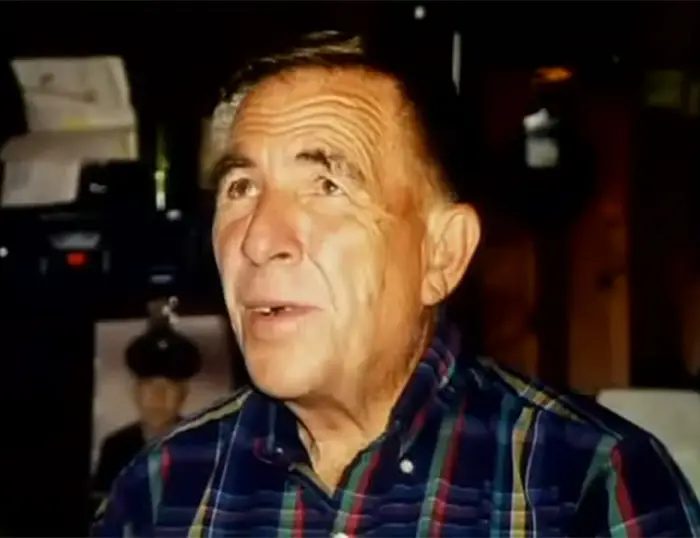
His flat tone during the emergency call, his resistance to unfamiliar situations and his inability to respond in socially expected ways had all contributed to the suspicions surrounding him.
Poston later acknowledged that he, too, had struggled to understand his client.
“At the same time, I wasn't processing him,” the lawyer said.
Gradually, residents began approaching the former repairman rather than avoiding him. Poston, who had remained close to Alvin after the trial, began taking him to lunch regularly.
The two developed a friendship that would last for the rest of Alvin's life.
The “Zenith Man” finally found acceptance before his passing in 2024
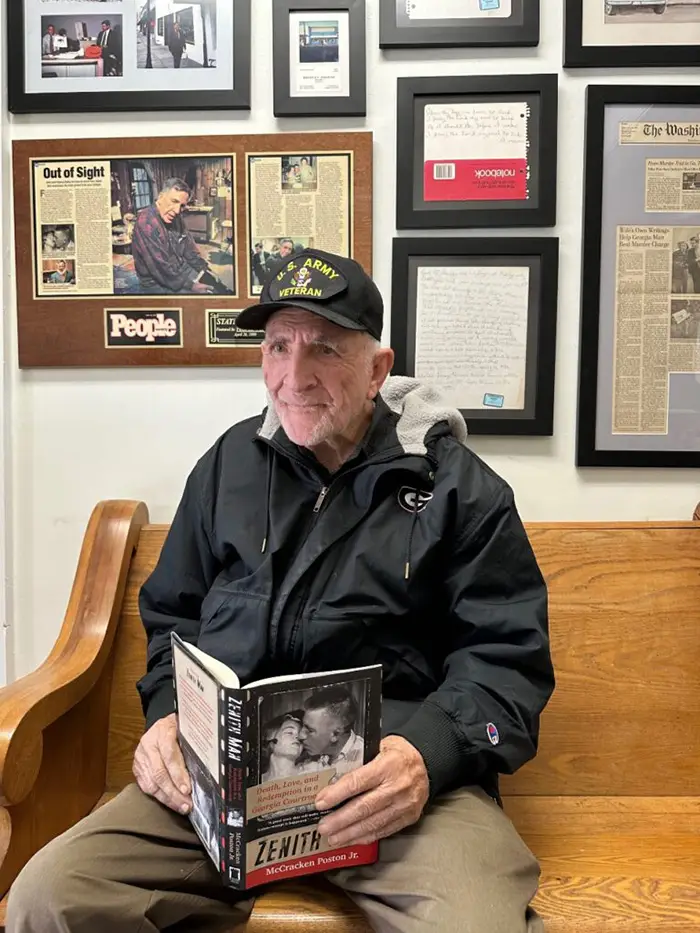
In February 2024, Poston published Zenith Man: Death, Love, and Redemption in a Georgia Courtroom, recounting the trial and the decades-long friendship that followed.
Before publication, he had read the chapters aloud to Alvin during their lunches.
The former defendant attended book events and signed copies for readers, including former jurors and some of Virginia's relatives. People who had once been frightened of him began sharing memories of his television repair work.

The attention finally offered Alvin acceptance from the community where he had spent his life.
His former television shop at 7819 Nashville Street was eventually transformed into the Ridley Building, now home to Caffeine Addicts, a coffee shop and folk-art gallery.
Inside, visitors can find vintage Zenith televisions alongside photographs and artifacts connected to Alvin's extraordinary trial.
On July 2, 2024, Alvin passed away at the age of 82, just four months after his lawyer's book was published.
“Much of the redemption belongs to the town, too,” Poston wrote.
"From boogeyman, to beloved," a reader wrote