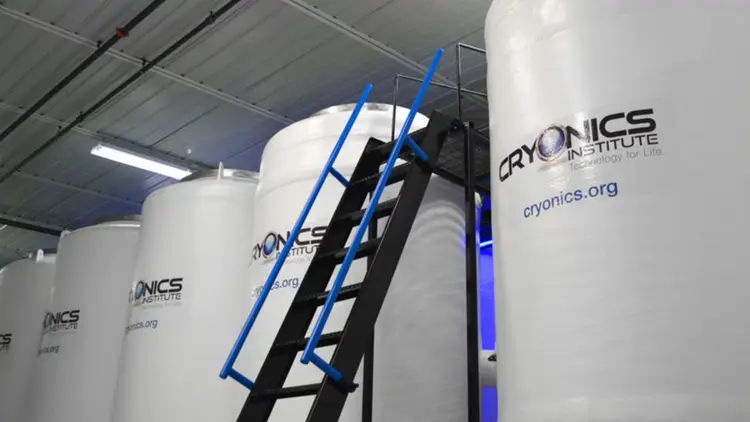
Folks, today we're talking about cryonics, something that definitely sounds like science fiction. But as robotics, artificial intelligence, and other once-imagined technologies become real, the idea of pushing human limits doesn't seem so impossible anymore. So, what is exactly cryonics? Cryonics is based on a remarkable idea: people who can't be saved by today's medicine might have another chance at life in the future. After they are legally declared dead, their bodies or brains are preserved at very low temperatures, with the hope that future scientists will figure out how to revive them. For some, it's a final hope in technology. For others, it's a way to keep the door open to living again. However, freezing a human body doesn't mean it can be brought back to life. The process can harm cells and delicate brain structures, and scientists still haven't found a proven way to revive someone who has been cryonically preserved. To learn more about what happens during preservation and whether this risky idea has any scientific support, I talked to Dr. Ramon Velazquez, a neuroscientist, and Dr. Muhammad Qasim, a specialist in pulmonology and sleep medicine. But cryonics brings up questions that go beyond science. Wanting to overcome our biological limits shows a bigger wish to change what it means to be human. Even as technology keeps moving forward, it's worth thinking about whether life is meaningful because it doesn't last forever. The Cryonics Institute Cryonics may seem like something only for billionaires or those afraid of aging. For those of us who have been around for a while, it sure does remind us of the myth around Disney being frozen. However, there’s more to cryogenics than just stories. People who choose this option often don’t wait until old age to decide. Many begin planning years ahead, seeing preservation as a way to keep the door open to a future that today’s medicine can’t provide. A 2022 Cryosphere Press survey of 244 people in the cryonics community found the average age was 43. About 85% were men, and many had technical or scientific backgrounds. The survey also showed that most cryonicists aren’t just afraid of dying. Many said they are happy with their lives and simply want more time to enjoy them. For many supporters, cryonics isn’t about running from an unhappy life. They think life is valuable and want to experience it as long as they can. Some hope for future medical advances, while others like the idea of keeping their identity and living on in a world that might be very different from today. The growing number of people choosing cryonics shows it’s more than just a theory. Alcor and the Cryonics Institute, two leading organizations, have already preserved hundreds of patients. Their membership is even larger, which means many more are planning for a future that science hasn’t yet proven possible. Anna Tolipova / magnific (not the actual photo) The most important detail here is that signing up for cryonics doesn’t let someone choose to be frozen at any time. The process only starts after an independent authority has legally declared the person dead. At Alcor, a team can be on standby when a member is nearing the end of life, ready to begin preservation as soon as it’s legally allowed. After legal death is declared, the team starts cooling the body and uses machines to keep blood flowing while giving protective medications. These steps help slow tissue damage, especially in the brain, where a lack of oxygen can quickly cause harm. Dr. Muhammad Qasim explained to us that both oxygen loss and the preservation process can still cause serious cell injury. In the next step, the blood is replaced with a cryoprotectant solution to help prevent harmful ice crystals from forming during cooling. At Alcor, this is called vitrification. The body or brain is slowly cooled to cryogenic temperatures, then stored long-term in liquid nitrogen at about -196°C. Alcor offers two choices: whole-body preservation or neuropreservation, which keeps the brain intact and assumes future technology might provide a new body. These options also differ in price. According to Alcor’s current prices, neuropreservation costs $80,000 and whole-body preservation costs $220,000. Members can use life insurance to help pay for these services. For long-term storage, Alcor sets aside some of the funds in an independent Patient Care Trust, which is legally separate and protects the money used to care for patients even if Alcor has financial problems. The Cryonics Institute Cryonics is based on a tough idea: if scientists can preserve the brain’s structure well enough, future technology might be able to fix the damage and bring its functions back. The brain stores memories, personality, and identity, so keeping its complex network of connections safe is key. It’s quite a gamble, since preserving that structure and actually reviving it are two separate challenges. Even so, research has made some interesting progress. In 2026, scientists were able to restore electrical activity and other important functions in the hippocampus of an adult mouse after cryopreservation using vitrification. The hippocampus is important for learning and memory, and the researchers found that some of its key mechanisms still worked after the procedure. This was a significant step for brain preservation, but the experiment did not show that a whole brain or a living animal could be brought back. Dr. Ramon Velazquez says the challenge is much more than just cooling a brain and keeping it whole. Scientists would also have to fix damage from lack of oxygen, exposure to cryoprotectants, and the preservation process itself, then bring back the complex activity that lets the brain work. So far, no human preserved by cryonics has ever been revived, and researchers still don’t know if current methods can keep all the information needed to recover someone’s memories and personality. Even if future medicine could solve the technical problems, there’s still another question: would the person who wakes up really be the same? Saving neural structures might help keep information linked to identity, but scientists haven’t shown that this would be enough to bring back someone’s memories, consciousness, or sense of self. For now, cryonics is more of a wild guess on what science might do in the future, not a treatment that can promise a second life. Anna Shvets / Pexels (not the actual photo) Cryonics is just one part of a larger goal: using technology not only to treat illness, but also to overcome the limits that have always defined human life. For decades, the idea of going beyond the human body has captured our imagination. We see it in movies, TV shows, and video games, where characters use technology to improve themselves in the most dystopic cyberpunk settings, or even leave their bodies behind. While this often seems like science fiction, it actually shows a real desire at the core of transhumanism: using science and technology to move past our biological limits. I remember exploring this idea while I was in college, when I read The Postorganic Man: Body, Subjectivity, and Digital Technologies by sociologist Paula Sibilia. I even used some of her ideas to analyze the video game BioShock, where society collapsed after searching to transcend humanity. In her book, Sibilia looks at how modern technology is changing how we see the human body. She points out that more and more, we treat the body as something that always needs to be improved, almost like its natural form is no longer good enough. Genetic engineering, digital tools, biotechnology, all these changes show what she calls a Faustian drive: the urge to go beyond the limits set by nature. I can’t help but to geek out a little, but the connection with BioShock now seems particularly fitting. The game shows what can happen when the quest for human perfection and scientific progress goes too far. Its world shows the same Faustian ambition Sibilia talks about: the refusal to accept natural limits and the belief that people can change themselves with technology. Cryonics fits into this idea because it sees the body's limits not as the end, but as a challenge that science might solve in the future. Still, the idea of always improving ourselves brings up some tough questions. If we start to think of aging as a technical problem and the body as something that always needs an upgrade, how does that change what it means to be human? And who will actually get to use these new technologies, especially when they are so expensive? The dream of beating our limits sounds exciting, but it also makes us ask if every natural boundary is really something we should try to remove. Getty Images / Unsplash (not the actual photo) Although it's not natural to want to live forever, it’s understandable. Many people fear losing loved ones, letting go of what brings them joy, or seeing their bodies change as they age. Cryonics gives us hope for more time, but it also makes us wonder about something technology can't solve: would living forever really make life better? In a 2026 article for The Guardian, astrophysicist and folklorist Dr. Moiya McTier shares another point of view. She says that being mortal links us to nature and to all the people who came before us. Realizing our time is limited can push us to take risks, learn, and enjoy our experiences as much as possible. This way of thinking moves our attention from how long we live to how we spend our time. Getting older, looking after loved ones, facing loss, and making connections aren't just challenges. They help shape who we are and bring us closer to others. Even grief, as McTier notes, can unite communities and show us the importance of our relationships. This doesn't mean we should stop trying to prevent illness, reduce suffering, or help people live longer, healthier lives. Still, there's a difference between wanting more time and thinking life only matters if it never ends. Cryonics may one day teach us something extraordinary about preserving the human brain, or it may never deliver on its promise. Either way, perhaps the most important question is not whether we can outsmart our biological limits, but whether we are making the most of the time we already have. gstockstudio / magnific (not the actual photo)